
Euler's Eyes
2026-09-26
FUVEST 2025 – 1st phase: Mathematics solved
Source: FUVEST – General Knowledge test, version V1 and official answer key from the 1st phase (17/11/2024), available in the FUVEST collection 2025.
The 1st phase of FUVEST 2025 was a General Knowledge test with 90 questions from all disciplines. This post only covers mathematics questions. The numbering used here is that of Proof V1; in versions V2, V3 and V4 the same issues appear with other numbers.
Template
| Question | Subject | Template |
|---|---|---|
| 16 | Percentage: slope of ramps | C |
| 17 | Distance between points on the plane | C |
| 45 | Arithmetic mean | E |
| 48 | Graph reading and percentage | D |
| 52 | Cosine function: graph transformation | D |
| 69 | Modular function and parabolas | B |
| 70 | Arithmetic progression | A |
| 75 | Cone Trunk Volume | A |
| 76 | Volume and lateral area of cylinders | D |
| 77 | Relative position of circles | E |
Question 16: Slope of an accessible ramp (percentage)
Statement
The construction of a ramp that is accessible to wheelchair users must follow the ABNT NBR 9050 standard. This document regulates the inclination that the ramp must depend on the maximum difference in level of each ramp segment, according to the following table:
Maximum slope and unevenness of each ramp segment
| Level difference $h$ (in m) | Allowable slope $i$ (in %) |
|---|---|
| $1 < h \le 1{,}5$ | $5$ |
| $0{,}8 < h \le 1$ | $5 < i \le 6{,}25$ |
| $0 < h \le 0{,}8$ | $6{,}25 < i \le 8{,}33$ |
Accessibility to buildings, furniture, spaces and urban equipment. Available in https://www.prefeitura.sp.gov.br/cidade/ (Adapted).
The slope $i$ of the ramp in percentage (%) is calculated by dividing the height $h$ of the difference in level of the ramp segment, in meters, by the length of the horizontal projection $c$, in meters, and multiplying the result by 100. The following figure shows a two-segment ramp.
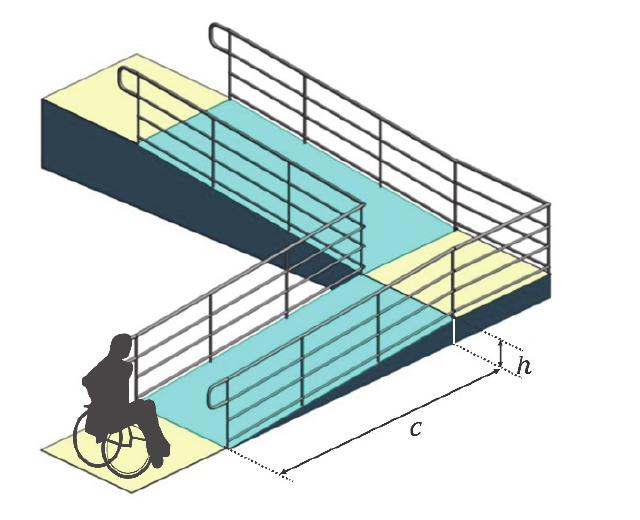
A two-segment ramp was constructed as follows:
- the first segment has a horizontal projection of 10 m and an inclination of 6%;
- the second segment has a horizontal projection of 7 m and a difference in level of 0,5 m.
Based on what was presented about the regulations, what is correct to say about the adequacy of this ramp to accessibility standards?
- A) The ramp is not suitable, as the two segments do not comply with the standard.
- B) The ramp is adequate, as both segments comply with the standard.
- C) The ramp is not suitable, as the first segment does not comply with the standard.
- D) The ramp is not suitable, as the second segment does not comply with the standard.
- E) The ramp is adequate because, although the second segment does not comply with the standard, the first does.
Resolution
The given formula is
$$i = \frac{h}{c} \cdot 100$$and the board associates each slope strip $h$ with a slope strip $i$. For each segment, we need to find out the unevenness, see which line of the board it is on. falls and check if the slope is within the range of that line.
1. First segment. We know $c = 10$ m and $i = 6$. The unevenness comes out of the formula:
$$6 = \frac{h}{10} \cdot 100 \quad\Rightarrow\quad h = \frac{6 \cdot 10}{100} = 0{,}6 \text{ m}$$As $0 < 0{,}6 \le 0{,}8$, the last line of the table applies: the slope should satisfy $6{,}25 < i \le 8{,}33$. But $i = 6$ is not in that range ($6 < 6{,}25$). The first segment does not conform to the table.
2. Second segment. We know $c = 7$ m and $h = 0{,}5$ m:
$$i = \frac{0{,}5}{7} \cdot 100 = \frac{50}{7} \approx 7{,}14$$Since $h = 0{,}5$ is also in the range $0 < h \le 0{,}8$, the slope must satisfy $6{,}25 < i \le 8{,}33$. And $7{,}14$ is in that range: the second segment is agreement.
3. Conclusion. The ramp is not suitable because of the first segment.
Answer: alternative C.
Beware of the catch: the temptation is to think “6% is less steep than 8,33%, then it’s great” and mark B. The question asks to use the table as given, and in it each unevenness band has its own slope band; 6% is out of range corresponding to 0,6 m. The official answer key is C.
To review, see Percentage Basics.
Question 17: Crossing Rua da Consolação (distance between points)
Statement
The following image shows an intersection on Rua da Consolação, in the central region of city of São Paulo, where there are pedestrian crossings in different directions. These lanes speed up street crossing. A person starts from point O and wants to get to point C. To do so, travel along the track that connects O to B and then uses the strip that connects B to C. Consider that the coordinates of the points indicated in figure, in meters, are: O(0,0), B(13,-15) and C(29,-8).
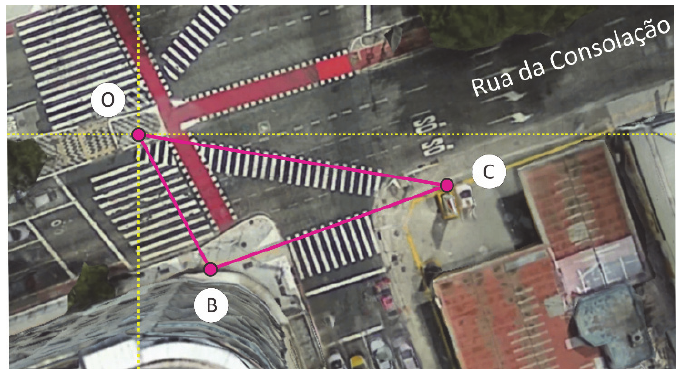
Let $d$ be the distance, in meters, that this person would stop traveling if he had opted to cross the pedestrian crossing that connects O to C. In this context, it is correct to say:
- A) $d < 2$
- B) $2 \le d < 5$
- C) $5 \le d \le 8$
- D) $8 < d \le 11$
- E) $11 < d$
Resolution
The distance between two points $(x_1, y_1)$ and $(x_2, y_2)$ is given by the Pythagorean theorem:
$$\sqrt{(x_2 - x_1)^2 + (y_2 - y_1)^2}$$1. Path O → B:
$$OB = \sqrt{13^2 + (-15)^2} = \sqrt{169 + 225} = \sqrt{394} \approx 19{,}85$$2. Path B → C:
$$BC = \sqrt{(29 - 13)^2 + (-8 + 15)^2} = \sqrt{16^2 + 7^2} = \sqrt{256 + 49} = \sqrt{305} \approx 17{,}46$$3. Direct path O → C:
$$OC = \sqrt{29^2 + (-8)^2} = \sqrt{841 + 64} = \sqrt{905} \approx 30{,}08$$4. Difference. The distance that the person would stop traveling is
$$d = OB + BC - OC \approx 19{,}85 + 17{,}46 - 30{,}08 \approx 7{,}23$$Without a calculator, just estimate the roots: $19^2 = 361 < 394 < 400 = 20^2$, $17^2 = 289 < 305 < 324 = 18^2$ and $30^2 = 900 < 905$. The values are close to $19{,}8$, $17{,}5$ and $30{,}1$, and $d$ is around 7.
Answer: alternative C ($5 \le d \le 8$).
For review, see Pythagorean Theorem.
Question 45: Life expectancy of men and women (arithmetic mean)
Statement
Consider that life expectancy in Brazil at the age of 19 years can be calculated, approximately, as the simple arithmetic average between life expectancy estimated to be the same age for men and women. The same can be done at the age of 20 years.
According to IBGE data, in 2022, the estimated life expectancy in Brazil at the age of 19 years was 58, and the estimated life expectancy of men at the same age was 54,7.
It is known that the difference between the estimated life expectancy of men and that of women women remained at the age of 20 years and that the estimated life expectancy of men at this age (EVH20) was 53,8.
Based on the data presented, select the alternative that presents the expectation estimated life expectancy of women at the age of 19 years (EVM19) and the expectation of estimated life at the age of 20 years in Brazil (EVB20) in 2022.
| EVM19 | EVB20 | |
|---|---|---|
| A) | 54,7 | 54,7 |
| B) | 54,7 | 58 |
| C) | 60 | 54 |
| D) | 61,3 | 56 |
| E) | 61,3 | 57,1 |
Resolution
1. Women’s expectations at 19 years. Brazil’s expectations are average between men and women:
$$58 = \frac{54{,}7 + M_{19}}{2} \quad\Rightarrow\quad M_{19} = 116 - 54{,}7 = 61{,}3$$2. Difference between women and men. At 19 years:
$$61{,}3 - 54{,}7 = 6{,}6$$The statement says that this difference remains after 20 years.
3. Expectations of women at 20 years.
$$M_{20} = 53{,}8 + 6{,}6 = 60{,}4$$4. Brazil’s expectations at 20 years. Again the average:
$$\text{EVB}_{20} = \frac{53{,}8 + 60{,}4}{2} = \frac{114{,}2}{2} = 57{,}1$$(Another way: as the difference is the same, the average is always $6{,}6 / 2 = 3{,}3$ above the expectations of men: $53{,}8 + 3{,}3 = 57{,}1$.)
Answer: alternative E (61,3 and 57,1).
Beware of the catch: alternative D has the right EVM value19 (61,3), but an EVB20 wrong. It’s not enough to get the first part right.
To review, see Position Measurements.
Question 48: Cattle slaughter (reading graphs and percentage)
Statement
The following graphs show the evolution of cattle slaughter and the participation of males and females, by quarter (indicated by Roman numerals), according to information obtained by IBGE.
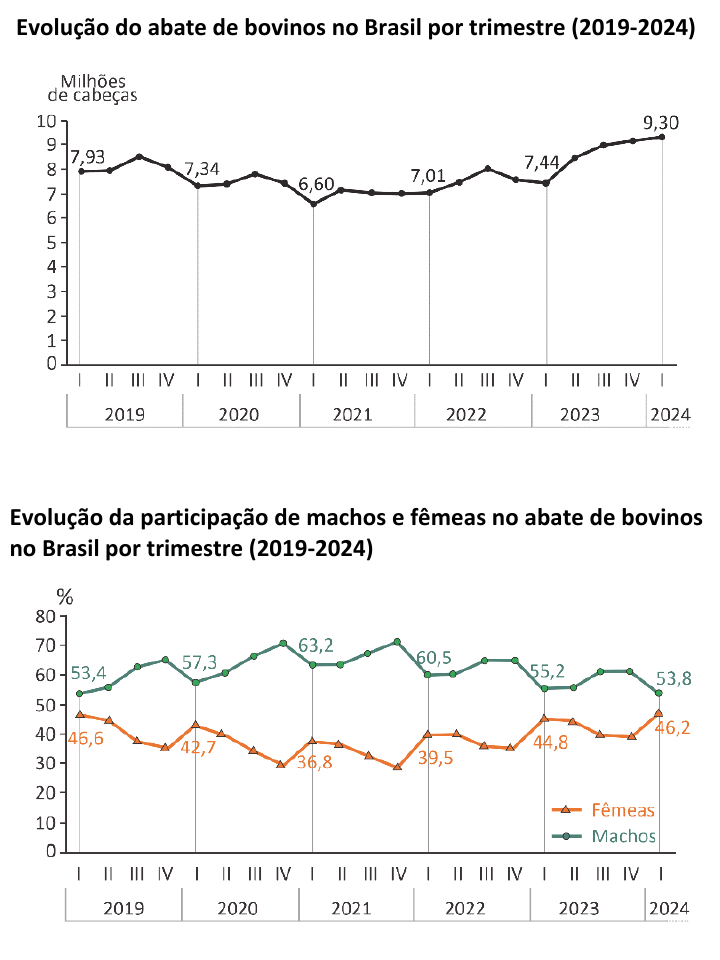
IBGE: Research Directorate. Coordination of Agricultural Statistics. Quarterly Animal Slaughter Survey 2019-2024 (Adapted).
Based on the data observed in the graphs, it is correct to state:
- A) In the first quarter of 2023, the difference between the numbers of males and females slaughtered was smaller than that in the first quarter of 2019.
- B) In the first quarter of 2023, the number of females slaughtered was approximately 2 million.
- C) In the first quarter of 2021 and 2022, the difference between the numbers of males and females slaughtered was equal.
- D) In the first quarter of 2024, the number of females slaughtered was approximately 4,3 million.
- E) In the first quarter of 2024, the number of females slaughtered was the same as in the first quarter of 2019.
Resolution
The first graph gives the total of animals slaughtered (in millions) and the second gives the percentage of males and females. The number of females, for example, is percentage of females × total. All alternatives talk about the 1st quarter, and the values for these quarters are written in the graphs:
| 1st quarter | Total (millions) | Males | Females |
|---|---|---|---|
| 2019 | 7,93 | 53,4% | 46,6% |
| 2021 | 6,60 | 63,2% | 36,8% |
| 2022 | 7,01 | 60,5% | 39,5% |
| 2023 | 7,44 | 55,2% | 44,8% |
| 2024 | 9,30 | 53,8% | 46,2% |
1. Alternative A. Difference between males and females:
- 2019: $7{,}93 \cdot (0{,}534 - 0{,}466) = 7{,}93 \cdot 0{,}068 \approx 0{,}54$ million;
- 2023: $7{,}44 \cdot (0{,}552 - 0{,}448) = 7{,}44 \cdot 0{,}104 \approx 0{,}77$ million.
In 2023 the difference was bigger. A is false.
2. Alternative B. Females in 2023: $7{,}44 \cdot 0{,}448 \approx 3{,}33$ million, not 2 million. B is false.
3. Alternative C. Difference between males and females:
- 2021: $6{,}60 \cdot (0{,}632 - 0{,}368) = 6{,}60 \cdot 0{,}264 \approx 1{,}74$ million;
- 2022: $7{,}01 \cdot (0{,}605 - 0{,}395) = 7{,}01 \cdot 0{,}210 \approx 1{,}47$ million.
They are not the same. C is false.
4. Alternative D. Females in 2024:
$$9{,}30 \cdot 0{,}462 \approx 4{,}30 \text{ milhões}$$D is true.
5. Alternative E. Females in 2019: $7{,}93 \cdot 0{,}466 \approx 3{,}70$ million, much less than the 4,30 million of 2024. And it’s false.
Answer: alternative D (about 4,3 million females).
Beware of the catch: the percentages of females in 2019 (46,6%) and in 2024 (46,2%) are almost equal, which leads to alternative E. But the total of animals slaughtered changed a lot (from 7,93 to 9,30 million), so the quantities of females are very different.
To review, see Percentage Basics.
Question 52: AM wave and the cosine function
Statement
The floods that occurred in Rio Grande do Sul, in May 2024, damaged the communication infrastructure. The affected population was informed about the news related to flooding by tuning, via battery-powered radio, to AM wave frequencies, whose reach is greater.
An AM wave is mathematically modeled by equations involving the cosine function, whose independent variable is time $t$, which appears multiplied by the frequency $f$ of the wave.
As an example, we can consider the equation referring to the modulation process of a AM wave:
$$s(t) = A\left[1 + k \thinspace m(t)\right]\cos(2\pi f t),$$where $A$ is the amplitude, $f$ the frequency, $k$ the sensitivity constant amplitude and $m(t)$ the signal that contains the information.
When the frequency $f$ is multiplied by 3, the wave length changes. Because of this multiplication, what transformation occurs on the graph of the function original cosine?
- A) Vertical expansion.
- B) Horizontal translation.
- C) Horizontal expansion.
- D) Horizontal contraction.
- E) Vertical contraction.
Resolution
1. What changes. Multiplying $f$ by 3 exchanges $\cos(2\pi f t)$ by
$$\cos(2\pi \cdot 3f \cdot t) = \cos\big(3 \cdot (2\pi f t)\big)$$In other words, the cosine argument is multiplied by 3. The amplitude $A$ does not change, so there is no vertical expansion or contraction.
**2. The effect on period.**The period of the cosine $\cos(2\pi f t)$ is $T = \dfrac{1}{f}$. Often $3f$, the new period is
$$T' = \frac{1}{3f} = \frac{T}{3}$$Each complete cycle now occupies one third of the space on the horizontal axis (the axis of the time). The graph is “squeezed” horizontally.
3. General rule. Replacing $g(t)$ with $g(3t)$ compresses the graph horizontally by a factor 3: the value that previously appeared in $t$ now appears in $t/3$.
Answer: alternative D (horizontal contraction).
Be careful with the catch: the factor 3 multiplies the variable, and this shrinks the graph horizontally, although the intuition of “multiply by 3” suggests expansion (alternative C). There is no translation (B): nothing is added to $t$.
Question 69: Graph of a function with module
Statement
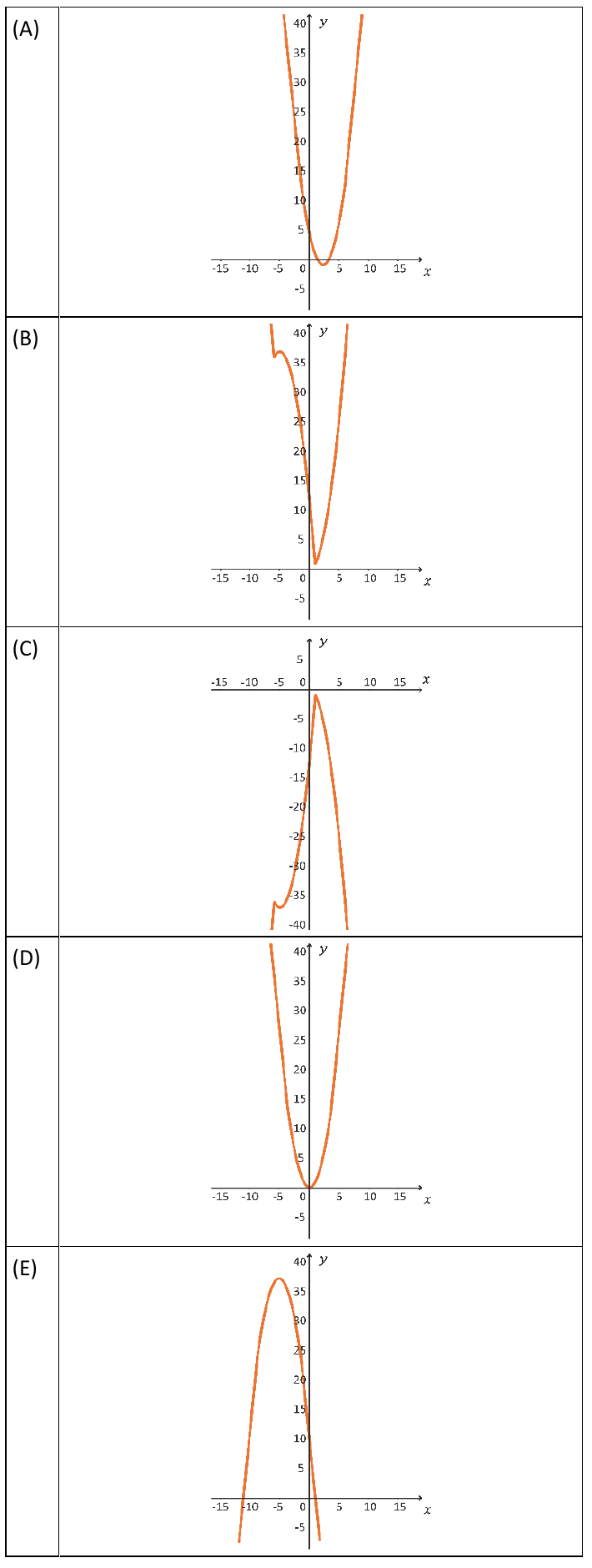
In the Cartesian plane $Oxy$, the graph that best represents the function $f(x) = |x^2 + 5x - 6| - 5x + 6$ is given by
Resolution
To take the module, we need to know where $x^2 + 5x - 6$ is positive and where it is negative.
1. Roots from within the module.
$$x^2 + 5x - 6 = 0 \quad\Rightarrow\quad (x + 6)(x - 1) = 0 \quad\Rightarrow\quad x = -6 \text{ ou } x = 1$$The parabola $x^2 + 5x - 6$ is concave upwards, so it is non-negative for $x \le -6$ or $x \ge 1$, and negative for $-6 < x < 1$.
2. For $x \le -6$ or $x \ge 1$ the module does not change anything:
$$f(x) = x^2 + 5x - 6 - 5x + 6 = x^2$$3. For $-6 < x < 1$ the module changes the sign:
$$f(x) = -(x^2 + 5x - 6) - 5x + 6 = -x^2 - 10x + 12$$It is a parabola with concavity downwards and apex at $x_v = -\dfrac{-10}{2 \cdot (-1)} = -5$, with $f(-5) = -25 + 50 + 12 = 37$.
4. Splicing points. $f(-6) = 36$ and $f(1) = 1$ (both formulas give the same value, so the graph is continuous).
5. Assembling the graph.
- to the left of $-6$: part of the parabola $y = x^2$, rising a lot ($f(-7) = 49$);
- between $-6$ and $-5$: rises from 36 to the local maximum 37;
- between $-5$ and $1$: descends from 37 to 1, passing through $f(0) = 12$;
- to the right of $1$: parabola $y = x^2$, rising again.
The graph is always above the $x$ axis, there is a small “peak” near $x = -6$ (with local maximum at $(-5, 37)$), cuts the $y$ axis at 12 and has a minimum at $(1, 1)$. It’s exactly graph B.
Answer: alternative B.
Be careful with the catch: graph D is the entire parabola $y = x^2$, which is the which is obtained by forgetting the module (without it, $x^2 + 5x - 6 - 5x + 6 = x^2$ for all $x$). Graph C is that of B reflected on the $x$ axis, with negative values, which is impossible here, because $f(x) \ge 0$ in both parts.
To review, see 2th degree equation.
Question 70: Sequence formed by adding the terms of a PA
Statement
Let $(a_n)$ be an arithmetic progression whose first term is $a_1$ and the ratio $r$, both real numbers. It is possible to construct another sequence $(b_n)$, in which the first term is a real number $b_1$ and with the following formation law
$$b_{n+1} = b_n + a_n,$$where $n > 0$ is a natural number.
For example, if $b_1 = 0$ and
$$(a_n) = (1, 3, 5, 7, 9, 11, \ldots),$$there is
$$(b_n) = (0, 1, 4, 9, 16, 25, \ldots).$$Based on such information, the values of $a_1$ and $r$ were chosen so that $(b_n)$ is also an arithmetic progression of ratio $r'$. Under these conditions, it is correct to say:
- A) $r' = a_1$
- B) $r' = 2a_1$
- C) $r' = r$
- D) $r' = 2r$
- E) $r' = b_1 - a_1$
Resolution
1. The difference between consecutive terms of $(b_n)$. From the formation law:
$$b_{n+1} - b_n = a_n$$2. Condition for $(b_n)$ to be PA. A sequence is PA of ratio $r'$ when the difference between consecutive terms is always the same, $r'$. So we need
$$a_n = r' \quad \text{para todo } n$$In other words, $(a_n)$ must be constant: $a_1 = a_2 = a_3 = \ldots$, which requires $r = 0$.
3. The reason. With $r = 0$, all terms of $(a_n)$ are worth $a_1$, and
$$r' = b_{n+1} - b_n = a_1$$Checking with an example: $a_1 = 2$, $r = 0$ and $b_1 = 5$ give $(a_n) = (2, 2, 2, \ldots)$ and $(b_n) = (5, 7, 9, 11, \ldots)$, a PA of ratio $2 = a_1$.
Answer: alternative A ($r' = a_1$).
Beware of the catch: alternative C ($r' = r$) seems natural, but how $r$ needs to be 0, it would say that $(b_n)$ is constant, which only happens if $a_1 = 0$. The example in the statement shows that, in general, $(b_n)$ is not PA (0, 1, 4, 9, … are the perfect squares).
To review, see Arithmetic Progression.
Question 75: Capacity of a vessel (cone trunk)
Statement
A product designer wants to manufacture a flower vase as shown in the following figure.
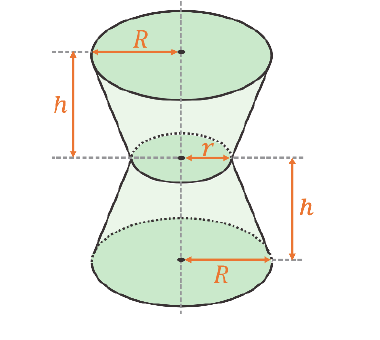
It is known that the base and top of the vase are a circle of radius $R$ that measures 10 cm, the central part is a circle with a radius $r$ of 5 cm and the measurement $h$ measures 12 cm. What is the volumetric capacity of this vessel in cm³?
- A) $1400\pi$
- B) $2100\pi$
- C) $2400\pi$
- D) $2600\pi$
- E) $2800\pi$
Resolution
The vase is formed by two equal cone trunks, joined by the smaller base: each has a larger base of radius $R = 10$, a smaller base of radius $r = 5$ and height $h = 12$.
1. Volume of a frustum of a cone.
$$V_{\text{tronco}} = \frac{\pi h}{3}\left(R^2 + Rr + r^2\right) = \frac{\pi \cdot 12}{3}\left(100 + 50 + 25\right) = 4\pi \cdot 175 = 700\pi$$2. Checking in another way. The trunk is a large cone minus a small cone. As the radius drops from 10 to 5 in 12 cm, the large cone has height 24 and the small one, 12:
$$\frac{1}{3}\pi \cdot 10^2 \cdot 24 - \frac{1}{3}\pi \cdot 5^2 \cdot 12 = 800\pi - 100\pi = 700\pi$$3. Volume of the vessel. There are two trunks:
$$V = 2 \cdot 700\pi = 1400\pi \text{ cm}^3$$Answer: alternative A ($1400\pi$ cm³).
Be careful with the catch: treating each half as a cylinder of radius 10 gives $2 \cdot \pi \cdot 100 \cdot 12 = 2400\pi$ (alternative C), which ignores the narrowing of the vase in the middle.
Question 76: Volume and lateral area of cylinders
Statement
Consider a cylinder $C$ of height $h > 0$ and whose circumference radius, top and from the base, it is $r > 0$; a cylinder $C_1$ whose radius is equal to that of $C$ and height equal to $\frac{h}{2}$; and a cylinder $C_2$ with height $h$ and radius equal to $\frac{r}{2}$.
With $V$, $V_1$ and $V_2$ being the volumes and $A$, $A_1$ and $A_2$ the lateral areas of the cylinders $C$, $C_1$ and $C_2$, respectively, it is correct to state:
- A) $V = V_1 + V_2$ e $A = A_1 + A_2$
- B) $V = V_1 + V_2$ e $A = A_1 + 2A_2$
- C) $V = V_1 + 2V_2$ e $A = A_1 + 2A_2$
- D) $V = V_1 + 2V_2$ e $A = A_1 + A_2$
- E) $V = 2V_1 + 2V_2$ e $A = 2A_1 + 2A_2$
Resolution
For a cylinder of radius $\rho$ and height $H$: volume $\pi \rho^2 H$ and lateral area $2\pi \rho H$.
1. Cylinder $C$ (ray $r$, height $h$):
$$V = \pi r^2 h, \qquad A = 2\pi r h$$2. Cylinder $C_1$ (ray $r$, height $h/2$):
$$V_1 = \pi r^2 \cdot \frac{h}{2} = \frac{V}{2}, \qquad A_1 = 2\pi r \cdot \frac{h}{2} = \pi r h = \frac{A}{2}$$3. Cylinder $C_2$ (ray $r/2$, height $h$):
$$V_2 = \pi \left(\frac{r}{2}\right)^2 h = \frac{\pi r^2 h}{4} = \frac{V}{4}, \qquad A_2 = 2\pi \cdot \frac{r}{2} \cdot h = \pi r h = \frac{A}{2}$$4. Testing relationships.
- Volumes: $V_1 + 2V_2 = \dfrac{V}{2} + \dfrac{2V}{4} = V$. ✔ (E $V_1 + V_2 = \frac{3V}{4} \ne V$.)
- Areas: $A_1 + A_2 = \dfrac{A}{2} + \dfrac{A}{2} = A$. ✔ (E $A_1 + 2A_2 = \frac{3A}{2} \ne A$.)
Answer: alternative D ($V = V_1 + 2V_2$ and $A = A_1 + A_2$).
Beware of the gotcha: reducing the radius by half divides the volume by 4 (the radius appears squared), but it divides the side area only by 2. Who treats the two of the same way falls into A or C.
Question 77: Two circles in the Cartesian plane
Statement
In relation to the Cartesian plane $Oxy$, it is correct to state that the equations $x^2 + y^2 - 4x = -3$ and $x^2 + y^2 - 4y = -3$ represent
- A) two circles with radii of the same size and which intersect at two points.
- B) two circles with radii of different measurements and which intersect at two points.
- C) two circles that intersect at a single point.
- D) two concentric circles that do not intersect.
- E) two circles with different centers that do not intersect.
Resolution
1. Completing squares in the first equation.
$$x^2 - 4x + 4 + y^2 = -3 + 4 \quad\Rightarrow\quad (x - 2)^2 + y^2 = 1$$Center circumference $(2, 0)$ and radius 1.
2. Completing squares in the second equation.
$$x^2 + y^2 - 4y + 4 = -3 + 4 \quad\Rightarrow\quad x^2 + (y - 2)^2 = 1$$Center circumference $(0, 2)$ and radius 1.
3. Distance between centers.
$$d = \sqrt{(2 - 0)^2 + (0 - 2)^2} = \sqrt{8} = 2\sqrt{2} \approx 2{,}83$$4. Relative position. The sum of the radii is $1 + 1 = 2$. Like $d \approx 2{,}83 > 2$, the circumferences are exterior: they do not touch. The centers are different (they are not concentric).
Checking through algebra: subtracting the equations, $-4x + 4y = 0$, that is, $y = x$. Replacing the first: $2x^2 - 4x + 3 = 0$, with $\Delta = 16 - 24 = -8 < 0$. There is no common ground.
Answer: alternative E.
Be careful with the catch: they both have the same radius, which attracts the alternative A. But equal radii do not guarantee intersection: the centers are far away too much.
To review, see Circumferences.