
Euler's Eyes
2026-10-18
Wallis's ∞: a sign that is not a number
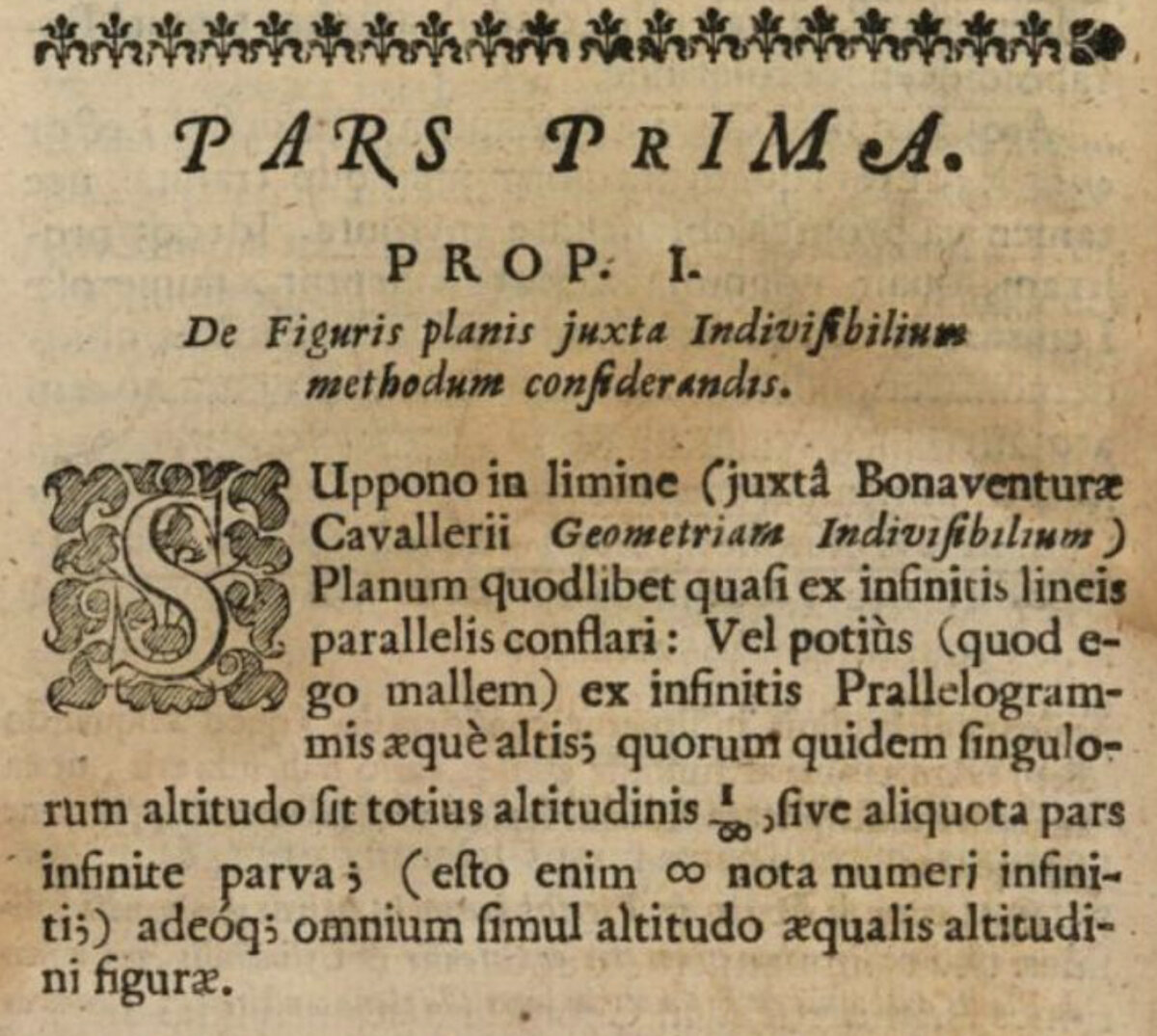
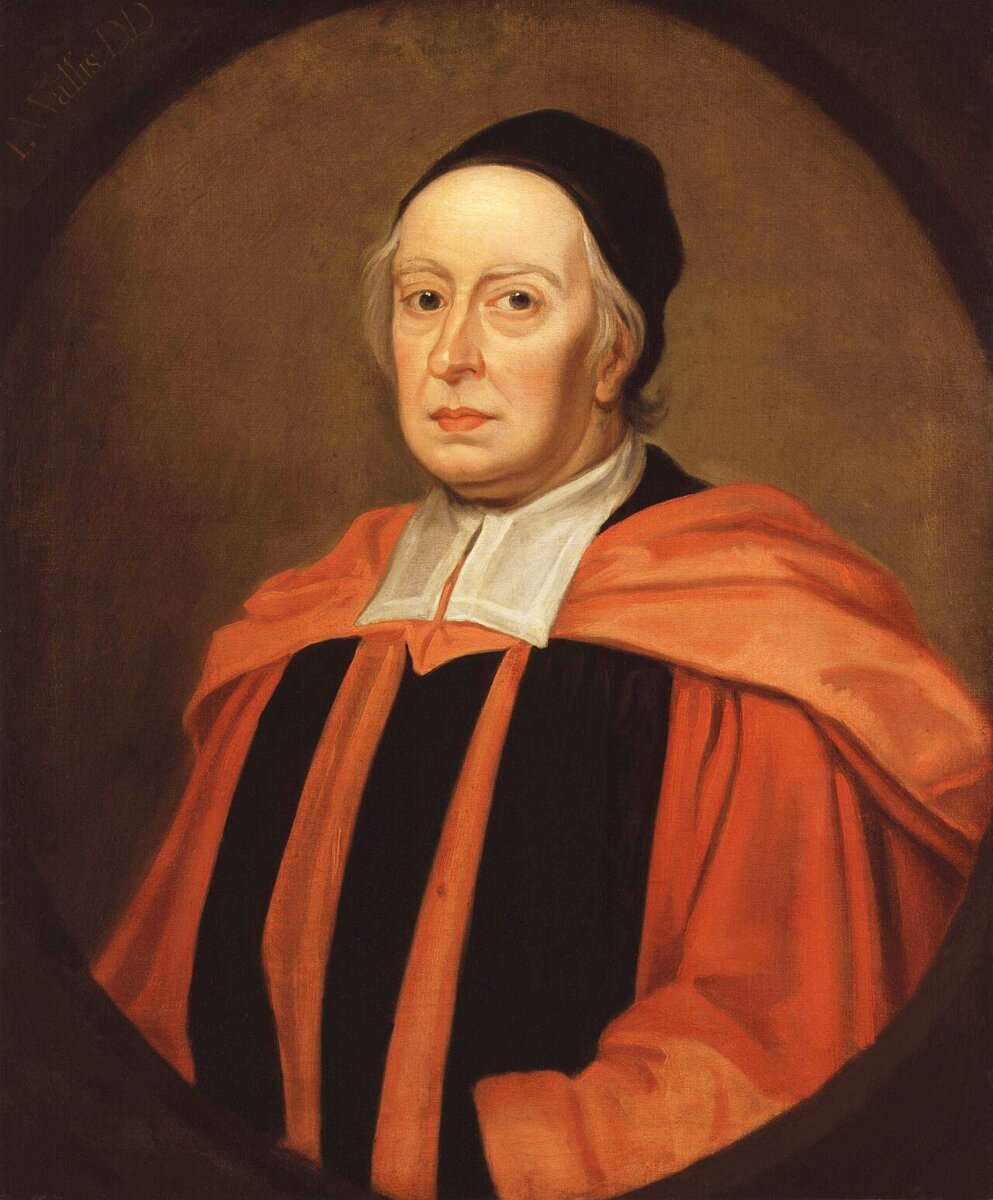
In 1655 the Englishman John Wallis, a professor at Oxford, divided a plane figure into infinitely many very thin parallelograms, each with a height equal to an infinitely small part of the total height. To write that part, he needed a sign for infinity, and invented one:
Let, then, ∞ be the sign of an infinite number.
— John Wallis, De sectionibus conicis (1655)
And he wrote the height of each parallelogram as $\frac1\infty$. Nobody knows for sure where he got the shape. The two most frequently cited hypotheses are a variant of the Roman numeral CIↃ, which was worth a thousand and was used for “many”, and the last letter of the Greek alphabet, lower-case omega, $\omega$, the end of everything.
A sign that looks like a number
The trouble with $\infty$ is that it looks like a number. It sits on the same line as the others, accepts operation signs beside it, goes into fractions. And that invites calculations that make no sense. If $\infty$ were a number, then $\infty-\infty=0$. But look:
$$\lim_{x\to\infty}\big((x+1)-x\big)=1,\qquad\lim_{x\to\infty}(2x-x)=\infty,\qquad\lim_{x\to\infty}(x-2x)=-\infty.$$In all three calculations, both terms go to infinity, and each gives a different result. That is why $\infty-\infty$ is called an indeterminate form: the notation does not decide the value; what decides it is how fast each part grows. The same holds for $\frac\infty\infty$, $0\cdot\infty$, $1^\infty$ and $\frac00$.
The ∞ of the limit is a direction
When one writes $x\to\infty$, the $\infty$ is not a place that $x$ reaches. It is a direction: “$x$ grows without stopping”. The sentence
$$\lim_{x\to\infty}\frac1x=0$$does not say that $\frac1\infty=0$. It says that $\frac1x$ gets as close to zero as you like, provided $x$ is large enough. Chapter 1 told how Cauchy and Weierstrass wrote this without using infinity as a number. Aristotle called this kind of infinity potential: a process that can always continue, but is never complete.
The infinity that has a size
At the end of the nineteenth century, Georg Cantor did something Aristotle forbade: he treated infinite sets as complete objects and compared their sizes. The set of natural numbers and the set of even numbers have the same size, because they pair up one to one ($n\leftrightarrow2n$). The set of real numbers is larger, as the diagonal shows that the Turing chapter, in the History book, uses for computable numbers.
For these complete infinities, Cantor did not use Wallis’s $\infty$. He chose a new letter, aleph, the first letter of the Hebrew alphabet: $\aleph_0$ is the size of the naturals. The choice is semiotic: $\infty$ was already committed to the idea of “without end”, and the new infinities were something else, genuine numbers with their own arithmetic. Today the two signs coexist, one for infinity as a direction, the other for infinity as a quantity.
Exercise: an ∞ − ∞ that gives a half
Calculate $\displaystyle\lim_{x\to\infty}\left(\sqrt{x^2+x}-x\right)$.
Both terms go to infinity. Multiply and divide by the conjugate:
$$\sqrt{x^2+x}-x=\frac{(x^2+x)-x^2}{\sqrt{x^2+x}+x}=\frac{x}{\sqrt{x^2+x}+x}=\frac{1}{\sqrt{1+\frac1x}+1}.$$As $x\to\infty$, this tends to $\frac1{1+1}=\frac12$. An $\infty-\infty$ worth $\frac12$.
Exercise: two different ∞/∞
Calculate $\displaystyle\lim_{x\to\infty}\frac{x}{x+1}$ and $\displaystyle\lim_{x\to\infty}\frac{x^2}{x+1}$.
In both, numerator and denominator go to infinity. In the first, $\frac{x}{x+1}=\frac1{1+1/x}\to1$. In the second, $\frac{x^2}{x+1}=\frac{x}{1+1/x}\to\infty$. The same form $\frac\infty\infty$ gave $1$ in one case and $\infty$ in the other.
Chapter index · ← The fundamental theorem: when d and ∫ cancel · Sums that never end: the = of series →