
Euler's Eyes
2026-10-15
Letters that generalise: from 3 + 5 = 5 + 3 to a + b = b + a
Add $3+5$ and $5+3$: you get $8$ both times. Try $12+7$ and $7+12$, $100+1$ and $1+100$. It always works. But how many examples do you need to be sure? A thousand? A million? No number of examples is enough, because there are infinitely many pairs of numbers.
The sentence
$$a+b=b+a$$solves the problem in another way. It speaks of no particular pair: it speaks of all of them at once. The letters $a$ and $b$ here do not hide a value, as the unknown does; they stand for any value. This is what Usiskin called generalised arithmetic.
Think of a number
An old party trick: think of a number, double it, add $6$, divide by $2$ and take away the number you thought of. The result is always $3$.
With examples you can gain confidence: with $5$ you get $10$, $16$, $8$, $3$; with $20$ you get $40$, $46$, $23$, $3$. With a letter you can be certain. Call the number $n$:
$$n\ \to\ 2n\ \to\ 2n+6\ \to\ \frac{2n+6}{2}=n+3\ \to\ (n+3)-n=3.$$The letter did what the examples could not: it ran through all the numbers at once. And it showed why the trick works: the number you thought of goes in and comes out again, and only the $6$ divided by $2$ survives.
The trick step by step (click to advance)
- Think of a number: $n$.
- Double it: $2n$.
- Add $6$: $2n+6$.
- Divide by $2$: $n+3$.
- Take away the number you thought of: $(n+3)-n=3$. The $n$ has disappeared; the result does not depend on it.
The sum of the odd numbers
Add the first odd numbers: $1=1$, $1+3=4$, $1+3+5=9$, $1+3+5+7=16$. Squares appear. To say this for every $n$, we need a letter:
$$1+3+5+\cdots+(2n-1)=n^2.$$The expression $2n-1$ is a portrait of the $n$-th odd number: for $n=1$ it gives $1$, for $n=4$ it gives $7$. The proof can be done with another letter and a sum written backwards, as the young Gauss did: adding the list to itself reversed, each pair gives $2n$, and there are $n$ pairs, so twice the sum is $2n\cdot n$ and the sum is $n^2$.
When examples deceive
Examples can be dangerous. In 1772 Euler noticed that the expression
$$n^2+n+41$$gives prime numbers for $n=0, 1, 2, 3, \dots$: $41$, $43$, $47$, $53$, $61$, $71$… Test up to $n=39$ and all of them are prime. Forty examples in a row! But for $n=40$:
$$40^2+40+41=1681=41^2,$$which is not prime. Written with letters, the failure can be seen without calculating: for $n=40$, $n^2+n+41=n^2+n+(n+1)=n(n+1)+(n+1)=(n+1)^2$. The letter does not only generalise: it also shows where the generalisation fails.
Viète’s species
It was François Viète, in 1591, who turned this idea into a method. He called calculation with letters logistica speciosa, calculation with species, and set it against logistica numerosa, calculation with numbers. A species, for Viète, was a general form, as the species “horse” covers all horses. His great innovation was to use letters also for the known quantities: in this way an equation could stand for a whole family of problems, and solving it was solving all of them at once.
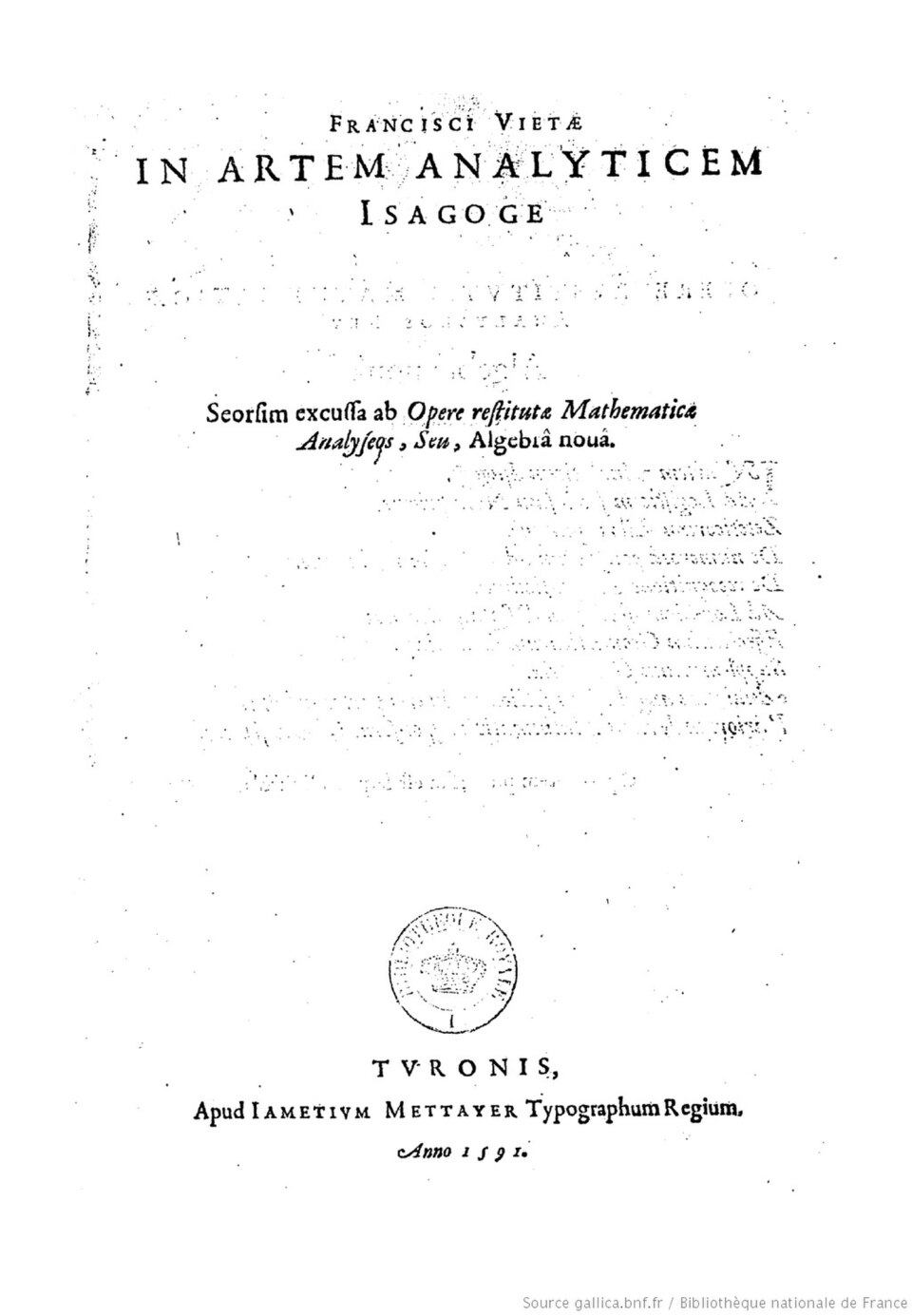
Semiotically, the letter that generalises is a symbol in Peirce’s sense, but of a special kind: it stands not for an object but for a class of objects, and any member of the class can take its place. The sentence with letters works like a promise: “choose whatever number you like; the equality will remain true”.
Exercise: prove with letters that the sum of two odd numbers is even
Any odd number can be written $2m+1$, and another one $2n+1$, with $m$ and $n$ any integers. The sum is $2m+2n+2=2(m+n+1)$, which is twice an integer: it is even. Note that we need two different letters. With just one, $2n+1$ and $2n+1$, we would only have proved that twice an odd number is even.
Exercise: invent a trick that always ends in 5
One solution: think of a number $n$, multiply by $4$, add $20$, divide by $4$ and take away the number you thought of: $\frac{4n+20}4-n=n+5-n=5$. The general recipe is to multiply by $k$, add $5k$, divide by $k$ and take away $n$; the letter shows that the trick works for any $n$ and for any $k\ne0$.
Chapter index · ← The unknown: a place for what is being sought · The variable: the letter that moves →