
Euler's Eyes
2026-10-14
The brachistochrone: the challenge of 1696
Given two points A and B in a vertical plane, to find the curve AMB along which a moving body M, descending under its own weight, passes from A to B in the shortest possible time.
— Johann Bernoulli, Acta Eruditorum (June 1696)
In June 1696, in the Acta Eruditorum, Johann Bernoulli challenged “the most acute mathematicians of the whole world”. The question sounds like something from a funfair: what is the shape of the fastest slide between two points? The name of the problem comes from Greek: brachistos, shortest, and chronos, time. Brachistochrone, the curve of least time.
Johann gave six months and announced that he already had the solution. It was a challenge to everyone, but it had two targets: his brother Jakob, with whom he was at open war, and Isaac Newton, whom Leibniz’s friends accused of having copied the calculus.
The straight line is not the answer
The straight line is the shortest path, but not the fastest. A ball sliding without friction gains speed as it falls. So it pays to start by dropping steeply, to gain speed early, even if the path gets longer. On the other hand, an exaggerated plunge lengthens the route too much. The best path is a compromise, and finding it means finding a whole curve among infinitely many possible ones.
Put $x$ horizontal and $y$ downwards, with the start at $A=(0,0)$. By conservation of energy, the speed after falling a height $y$ is
$$\frac12mv^2=mgy\quad\Longrightarrow\quad v=\sqrt{2gy}.$$It depends only on the height, not on the path.
Johann’s idea: the ball is a ray of light
Johann had a brilliant idea. Fermat had shown that light, passing from one medium to another, follows the path of least time, and that Snell’s law of refraction follows from this:
$$\frac{\sin\alpha_1}{v_1}=\frac{\sin\alpha_2}{v_2},$$where $\alpha$ is the angle of the ray with the vertical and $v$ is the speed of light in each medium. Light, too, wants to arrive as fast as possible!
So Johann imagined the space between $A$ and $B$ sliced into very thin horizontal layers, like sheets of glass, each with a speed, $v=\sqrt{2gy}$, that increases downwards. A ray of light crossing the layers bends at each one. With infinitely thin layers, the ray becomes a smooth curve, and Snell’s law holds at every point:
$$\frac{\sin\alpha}{v}=\text{constant}.$$That is an equation for the curve. Since $\alpha$ is the angle of the tangent with the vertical, $\sin\alpha=\dfrac{1}{\sqrt{1+y'^2}}$. Substituting $v=\sqrt{2gy}$ and squaring,
$$\boxed{\ y\left(1+y'^2\right)=2a\ }$$with a constant $a>0$.
The answer: the cycloid
Johann recognised the equation: it is that of the cycloid, the curve traced by a point on the rim of a wheel rolling along a straight line, here upside down. For a wheel of radius $a$ that has turned through an angle $\theta$,
$$x=a(\theta-\sin\theta),\qquad y=a(1-\cos\theta).$$Let us check. Dividing the derivatives, $y'=\dfrac{\sin\theta}{1-\cos\theta}=\cot\dfrac\theta2$, and since $1-\cos\theta=2\sin^2\dfrac\theta2$,
$$y(1+y'^2)=2a\sin^2\frac\theta2\cdot\frac1{\sin^2(\theta/2)}=2a.$$It checks. The fastest slide is an arc of a cycloid, which starts by falling vertically and ends more gently.
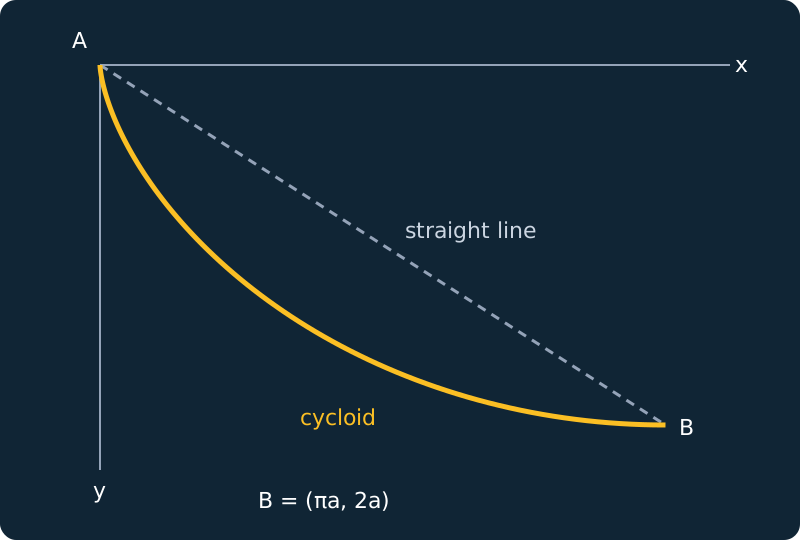
How much is gained
Choose $B=(\pi a,2a)$, the lowest point of the cycloid, which corresponds to $\theta=\pi$. On the cycloid, the element of length and the speed are
$$ds=2a\sin\frac\theta2\,d\theta,\qquad v=\sqrt{2g\cdot2a\sin^2\frac\theta2}=2\sqrt{ga}\sin\frac\theta2.$$The time for each piece is $dt=\dfrac{ds}v=\sqrt{\dfrac ag}\,d\theta$: the sine cancels! From $\theta=0$ to $\theta=\pi$,
$$T_{\text{cycloid}}=\pi\sqrt{\frac ag}.$$On the straight line from $A$ to $B$, the length is $\ell=a\sqrt{\pi^2+4}$ and the acceleration along the ramp is constant, $g\cdot\frac{2a}\ell$. From the formula $\ell=\frac12\cdot\text{acceleration}\cdot T^2$,
$$T_{\text{line}}=\sqrt{\pi^2+4}\,\sqrt{\frac ag}.$$Since $\pi\approx3.14$ and $\sqrt{\pi^2+4}\approx3.72$, the cycloid is about 16% faster. With $a=1$ m, a slide 3.14 m wide and 2 m high, the ball takes $1.00$ s along the cycloid and $1.19$ s along the line.
The lion’s claw
When the deadline expired, only Leibniz had sent a solution. At his request, Johann extended the deadline to Easter 1697 and sent the printed problem directly to several mathematicians, among them Newton, in London.
Newton was 54 and working at the Mint. According to his niece, Catherine Conduitt, he received the letter at four in the afternoon on 29 January 1697, on arriving home tired from work, and did not go to bed until he had solved the problem, at four in the morning. He sent the solution, unsigned and without proof, to the Royal Society, which published it anonymously.
In May 1697 the Acta Eruditorum published five solutions: by Johann, by Jakob, by Leibniz, by l’Hôpital and by Tschirnhaus, and reproduced the anonymous answer from England. Johann had no doubt about who its author was. He wrote that he recognised him tanquam ex ungue leonem: “as the lion is known by its claw”.
The most important solution, however, was Jakob’s. More laborious than his brother’s, it did not use the analogy with light: it compared the curve with neighbouring curves, an idea that, generalised, gave rise to the calculus of variations of Euler and Lagrange.
Exercise: if all the dimensions of the slide are multiplied by four, what happens to the times?
In both formulas the time is proportional to $\sqrt a$. Multiplying $a$ by 4 multiplies the times by $\sqrt4=2$. The cycloid’s advantage stays the same, about 16%: the ratio $\frac{\pi}{\sqrt{\pi^2+4}}\approx0.844$ does not depend on size.
Exercise: on the cycloid, where is the ball when half the time has passed?
Since $dt=\sqrt{a/g}\,d\theta$, the time is proportional to $\theta$. At half time, $\theta=\frac\pi2$, and the point is $x=a\left(\frac\pi2-1\right)\approx0.57a$, $y=a$. The ball has already dropped half the total height, $2a$, but has covered only 18% of the horizontal distance, $\pi a$. That is the cycloid’s strategy: fall first, advance later.
Sources: Johann Bernoulli, “Curvatura radii in diaphanis non uniformibus”, Acta Eruditorum (May 1697) · Herman H. Goldstine, A History of the Calculus of Variations (Springer, 1980), ch. 1 · Richard S. Westfall, Never at Rest: A Biography of Isaac Newton (Cambridge, 1980).
All topics on Johann Bernoulli · ← L’Hôpital’s rule: the lessons sold to a marquis · The exponential calculus: differentiating x to the power x →