
Euler's Eyes
2026-09-26
FUVEST 2024 – 1st phase: Mathematics solved
Source: FUVEST – test of the 1st phase, version V and official template (rectified in 24/11/2023), available in the FUVEST collection 2024.
The 1st phase of FUVEST 2024 (General Knowledge Test, 19/11/2023) had 90 questions from all disciplines. This post only contains 12 math questions. The numbering used here is that of Proof V; In versions K, Q, X and Z the same questions appear with other numbers.
Template
| Question | Subject | Template |
|---|---|---|
| 13 | Matrices: product and social network | B |
| 31 | Volume of cylinder and circular segment | B |
| 33 | Percentage: cost variation | A |
| 34 | Statistics: mode, median, mean and range | A |
| 35 | Count: digital clock reflected | B |
| 48 | Cobblestone Packaging | D or E (both accepted) |
| 49 | Parallelogram and trigonometry | C |
| 59 | Exponential and logarithmic function (inverse) | D |
| 60 | Linear system and line graph | E |
| 63 | Pythagorean Tree: geometric progression and logarithm | C |
| 84 | Graph Reading: Homicide Rates | E |
| 85 | Triangular and oblong numbers | D |
Question 13: Matrices and connections in a social network
Statement
Matrices can be used to obtain information about a social network. To understand how this can be done, let’s consider as an example a small social network made up of 4 people: $P_1, P_2, P_3, P_4$. The matrix associated with this social network is the matrix $4 \times 4$:
The value 1 (one) in position $a_{32}$ (row 3, column 2) of the matrix means that person $P_3$ follows the person $P_2$, while the value 0 (zero) in position $a_{24}$ (row 2, column 4) means that the person $P_2$ does not follow person $P_4$. The value 0 (zero) will be assigned to positions $a_{ii}$. The meaning of value from position $b_{mn}$ of the product matrix $M \times M = M^2$ is the number of connections from person $P_m$ to person $P_n$ passing through exactly one person, other than two of them, which we will call degree connection 2.
In this way, the values of the positions in the matrix $M^2$ can reflect the reach of the social network, its potentialities and weaknesses, the influence of certain members, among other aspects.
Regarding the social network presented, it is correct to state that:
- A) There are 5 pairs of different people ($P_i \neq P_j$) who do not have connections of degree 2.
- B) There are 6 pairs of different people ($P_i \neq P_j$) who have only one degree connection 2.
- C) There are 3 pairs of different people ($P_i \neq P_j$) who have 2 connections of different 2 degree.
- D) There are 3 people who have connections of degree 2 with everyone else in the social network.
- E) There is only 1 person $P_i$ ($i \neq 3$) such that $P_i$ and $P_3$ follow each other.
Note and adopt: The position $b_{mn}$ of the product matrix $M \times M = M^2$ is given by the expression $b_{mn} = a_{m1}a_{1n} + a_{m2}a_{2n} + a_{m3}a_{3n} + a_{m4}a_{4n}$
Resolution
1. Calculate $M^2$. Each term $a_{mk}a_{kn}$ is worth 1 only when $P_m$ follows $P_k$ and $P_k$ follows $P_n$, that is, counts a path $P_m \to P_k \to P_n$. Doing row by column:
For example, $b_{13} = a_{12}a_{23} + a_{14}a_{43} = 1 + 1 = 2$: from $P_1$ we reach $P_3$ passing through $P_2$ or $P_4$.
2. Only look at positions outside the diagonal(different people, $m \neq n$). These are 12 ordered pairs:
| Value of $b_{mn}$ | Pairs $(P_m, P_n)$ | Amount |
|---|---|---|
| 0 | $(1,2), (1,4), (2,3), (4,3)$ | 4 |
| 1 | $(2,1), (2,4), (3,1), (3,2), (3,4), (4,1)$ | 6 |
| 2 | $(1,3), (4,2)$ | 2 |
3. Test the alternatives.
- A) These are 4 unconnected pairs of degree 2, not 5. False.
- B) They are exactly 6 pairs with a single connection of degree 2. True.
- C) They are 2 pairs with two connections, not 3. False.
- D) Only $P_3$ has $b_{3n} \geq 1$ for all $n \neq 3$ (the line 3 off the diagonal is $1, 1, 1$). False.
- E) $P_2$ and $P_3$ follow each other ($a_{23} = a_{32} = 1$) and also $P_4$ and $P_3$ ($a_{43} = a_{34} = 1$): they are 2 people, not 1. False.
Answer: alternative B.
Question 31: Water taken from a cylindrical water truck
Statement
The reservoir of a water truck is in the form of a straight circular cylinder with a horizontal axis and internal dimensions of 6 meters in length and 2 meters in diameter. A school contracted the service of water truck to fill your water tank. After refueling, the driver noticed that the The truck’s reservoir was full to 3/4 its height, as shown in the figure.
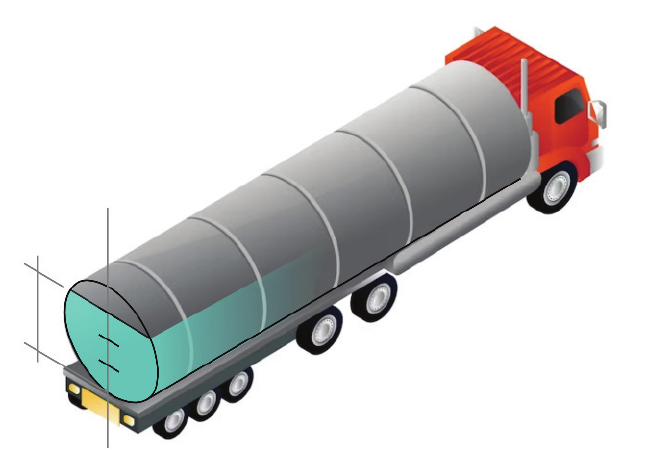
What was the volume, in cubic meters, of water used to supply the school’s water tank, knowing that the truck’s tank was full before refueling?
- A) $\left(2\pi - \frac{\sqrt{3}}{4}\right)$
- B) $\left(2\pi - \frac{3\sqrt{3}}{2}\right)$
- C) $\left(2\pi + \frac{3\sqrt{3}}{2}\right)$
- D) $\left(4\pi + \frac{\sqrt{3}}{4}\right)$
- E) $\left(4\pi + \frac{3\sqrt{3}}{2}\right)$
Resolution
The water used is the upper part of the cylinder that was empty. Since the cylinder is lying down, the volume is (empty section area) × (length).
1. The section. The circle has radius $r = 1$ m. Full to height $3/4$ (total height 2 m) means level of water at $1{,}5$ m from the bottom, that is, $0{,}5$ m above the center. The empty part is a circular segment whose chord is the distance $d = 0{,}5$ from the center.
2. Central angle. Let $\theta$ be the central angle that sees this string. In the triangle formed by center, the middle of the string and one end of the string:
$$\cos\frac{\theta}{2} = \frac{d}{r} = \frac{0{,}5}{1} \quad\Rightarrow\quad \frac{\theta}{2} = 60^\circ \quad\Rightarrow\quad \theta = 120^\circ = \frac{2\pi}{3}$$3. Area of the segment = area of the sector − area of the triangle:
$$A = \frac{\theta}{2}r^2 - \frac{1}{2}r^2\sin\theta = \frac{\pi}{3} - \frac{1}{2}\cdot\frac{\sqrt{3}}{2} = \frac{\pi}{3} - \frac{\sqrt{3}}{4}$$4. Volume used.
$$V = 6 \cdot \left(\frac{\pi}{3} - \frac{\sqrt{3}}{4}\right) = 2\pi - \frac{3\sqrt{3}}{2} \approx 3{,}68 \text{ m}^3$$Answer: alternative B ($2\pi - \frac{3\sqrt{3}}{2}$ m³).
Be careful with the catch: alternative E, $4\pi + \frac{3\sqrt{3}}{2}$, is the volume of water that stayed in the truck ($6\pi - V$). The question is how much was used.
To review, see Circle Area.
Question 33: Increase in the cost of a medicine
Statement
A pharmaceutical company produces a certain medicine, which is made up of four components, as indicated in table I. The cost per gram of each of the components of this medicine is also presented in this table.
Table I
| Composition of the medicine | Quantity (in mg) | Cost (in R$/g) |
|---|---|---|
| Component A | 200 | 700 |
| Component B | 70 | 500 |
| Component C | 130 | 300 |
| Component D | 100 | 120 |
For the production of the next batch of the medicine, the company will have different expenses to manufacture it, as the costs of some components have changed, as shown in table II.
Table II
| Composition of the medicine | Variation in cost (in %) |
|---|---|
| Component A | + 7 |
| Component B | − 5 |
| Component C | 0 |
| Component D | + 10 |
What is the increase, in reais, in the cost of the medicine?
- A) 9,25
- B) 12,00
- C) 12,75
- D) 36,00
- E) 86,00
Note and adopt: Consider that other production costs remained unchanged.
Resolution
1. Cost of each component in a unit of the medicine. Quantities are in mg and the cost in R$ per gram; $1 \text{ mg} = 0{,}001$ g.
| Component | Mass (g) | Cost (R$) |
|---|---|---|
| A | 0,200 | $0{,}2 \cdot 700 = 140$ |
| B | 0,070 | $0{,}07 \cdot 500 = 35$ |
| C | 0,130 | $0{,}13 \cdot 300 = 39$ |
| D | 0,100 | $0{,}1 \cdot 120 = 12$ |
2. Variation of each cost.
- A: $+7\%$ of 140 $= +9{,}80$
- B: $-5\%$ of 35 $= -1{,}75$
- C: $0$
- D: $+10\%$ from 12 $= +1{,}20$
3. Add.
$$9{,}80 - 1{,}75 + 0 + 1{,}20 = 9{,}25$$Answer: alternative A (R$ 9,25).
Be careful with the catch: alternative B (12,00) comes from adding the percentages ($7 - 5 + 0 + 10 = 12$) as if they were real. Each percentage applies to a different value.
To review, see Percentage Basics.
Question 34: Lists with mode = median = mean = range
Statement
The concepts of mode, median, mean and range define measurements used to study a set of numerical information. For example, in the list of 5 numbers (2, 2, 4, 8, 14), we have that the mode is equal to 2, the median is equal to 4, the mean is equal to 6 and the range is equal to 12.
Select the alternative that represents the number of lists of 5 positive integers that meet the condition: mode = median = mean = range = 23.
- A) 8
- B) 9
- C) 11
- D) 22
- E) 44
Resolution
Write the list in ascending order: $x_1 \leq x_2 \leq x_3 \leq x_4 \leq x_5$.
1. Translate the conditions.
- Median 23: $x_3 = 23$.
- Average 23: $x_1 + x_2 + x_3 + x_4 + x_5 = 5 \cdot 23 = 115$.
- Amplitude 23: $x_5 = x_1 + 23$.
- Mode 23: 23 appears more times than any other number. Like $x_3 = 23$, you need $x_2 = 23$ or $x_4 = 23$.
It cannot be $x_2 = x_3 = x_4 = 23$: $x_1 + x_5 = 46$ would be left with $x_5 - x_1 = 23$, which gives $x_1 = 11{,}5$, not integer. So 23 appears exactly twice, and the other three numbers have to be be distinct from each other (otherwise there would be a tie in fashion).
2. Case $x_2 = 23$ and $x_4 > 23$. From the sum: $x_1 + x_4 + (x_1 + 23) = 69$, then $x_4 = 46 - 2x_1$. We need $23 < x_4 \leq x_5$:
$$46 - 2x_1 > 23 \Rightarrow x_1 \leq 11 \qquad 46 - 2x_1 \leq x_1 + 23 \Rightarrow x_1 \geq 8$$These are 4 lists: $x_1 = 8, 9, 10, 11$, for example $(8, 23, 23, 30, 31)$.
3. Case $x_4 = 23$ and $x_2 < 23$. From the sum: $x_1 + x_2 + (x_1 + 23) = 69$, then $x_2 = 46 - 2x_1$. We need $x_1 \leq x_2 < 23$:
$$46 - 2x_1 < 23 \Rightarrow x_1 \geq 12 \qquad x_1 \leq 46 - 2x_1 \Rightarrow x_1 \leq 15$$These are 4 lists: $x_1 = 12, 13, 14, 15$, for example $(12, 22, 23, 23, 35)$.
In none of the cases do repeated values appear beyond 23, so the mode is really 23.
4. Total: $4 + 4 = 8$ lists.
Answer: alternative A (8).
To review, see Position Measurements and Dispersion Measures.
Question 35: Digital clock times reflected in the glass
Statement
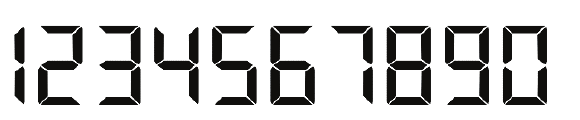
A digital clock uses the following numerals to represent a specific time:
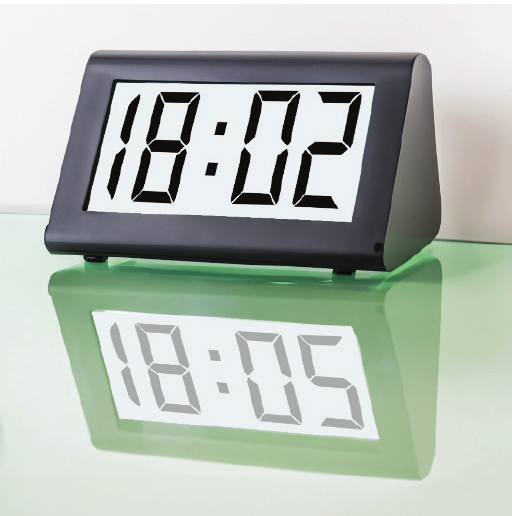
This clock is placed on a glass table, so that the glass reflects the time on its face. surface. The figure shows an example of this situation:
From 00:00 to 23:59, how many times will the glass reflect a valid time?
- A) 96
- B) 360
- C) 540
- D) 640
- E) 960
Resolution
1. What the reflection does. The glass is underneath the clock, so it flips the image from top to bottom. down, maintaining the order of the digits from left to right (18:02 becomes 18:05).
2. Which digits remain digits. Flipping each numeral from top to bottom:
- $0 \to 0$, $1 \to 1$, $3 \to 3$, $8 \to 8$ (are symmetrical);
- $2 \to 5$ and $5 \to 2$ (this is what the photo shows);
- $4$, $6$, $7$ and $9$ become figures that are not numerals (for example, the inverted 6 has the “belly” in top and left, which is not the 9 of this watch).
So only the digits $\{0, 1, 2, 3, 5, 8\}$ are useful.
3. Count the times HH:MM whose reflection is also a time.
- Ten of the hour: can be 0, 1 or 2, but the 2 reflected becomes 5, and there is no hour 5_. There are 2 options left (0 or 1).
- Time unit: with ten 0 or 1, any valid digit will do, before and after the reflection: 6 options.
- Tens of the minute: must be at most 5: $\{0, 1, 2, 3, 5\}$, and reflections $\{0, 1, 5, 3, 2\}$ are also at most 5: 5 options.
- Minute unit: 6 options.
Answer: alternative B (360).
Question 48: Packaging in a transport box
Statement
A food company uses packaging in the shape of a straight-rectangle parallelepiped, with dimensions 2 cm x 3 cm x 11 cm, for storing cookies. To transport this product, boxes are used to packaging these packages, also in the shape of a straight-rectangle parallelepiped, with dimensions 12 cm x 13 cm x 26 cm. The following image illustrates a straight-rectangle parallelepiped.
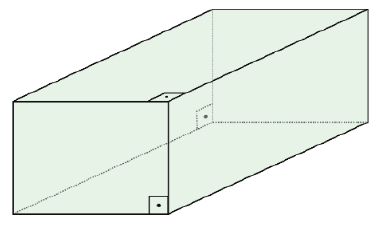
Determine the maximum number of packages that can be packed in each closed box to transport, without the product being damaged.
- A) 48
- B) 52
- C) 56
- D) 60
- E) 61
Note: in the official template (rectified in 24/11/2023), FUVEST considered the alternatives correct D e E.
Resolution
1. Limit by volume. Each package is $2 \cdot 3 \cdot 11 = 66$ cm³ and the box is $12 \cdot 13 \cdot 26 = 4\thinspace 056$ cm³. As $4\thinspace 056 / 66 \approx 61{,}5$, does not fit more than 61 packaging.
2. An arrangement with 60. Lay the packages with the 11 cm side along the 26 cm edge: two layers occupy $22$ cm. Each layer is a rectangle $12 \times 13$, which can be covered completely with 26 $2 \times 3$ rectangles (one stripe $12 \times 9$ with 18 of them and one stripe $12 \times 4$ with 8). These are $2 \cdot 26 = 52$ packaging. There is a slice left $12 \times 13 \times 4$, where more can fit 8 (11 cm along 12 cm, and the face $13 \times 4$ with $4 \cdot 2$ rectangles $3 \times 2$). Total: 60.
3. An arrangement with 61. Now place the side of 11 cm along the edge of 13 cm.
- In block $12 \times 11 \times 26$: 3 cm along 12 cm (4 rows) and 2 cm along 26 cm (13 rows), 11 cm along the 11 cm: $4 \cdot 13 = 52$ packages, without excess.
- There is a $12 \times 2 \times 26$ slice left (2 cm thick). In it, the packaging is placed on the 2 cm in thickness, and the face $12 \times 26$ receives rectangles $3 \times 11$: $4 \cdot 2 = 8$ (3 along 12, 11 along 26, using 22 cm), and in the remaining range $12 \times 4$ there is room for one more (11 along 12, 3 along 4). They are 9.
Total: $52 + 9 = 61$, exactly the limit of item 1. Therefore, the maximum is 61.
Answer: the maximum is 61, alternative E. The official FUVEST template accepted D and E.
Question 49: Space left in the garage (parallelogram)
Statement
In the Works and Buildings Code of the City of São Paulo, there are regulations for job vacancies. parking in one building for different types of vehicles. According to the code, the dimensions of A parking space is established according to the type of vehicle, according to the following table:
Table: Dimensions of parking spaces depending on the type of vehicle (measured in meters).
| Types of vehicles | Width | Length |
|---|---|---|
| Automobile | 2,20 | 4,50 |
| Car for people with disabilities | 3,70 | 5,00 |
| Motorcycle | 1,00 | 2,00 |
| Utility | 2,50 | 5,50 |
| Light Truck | 3,10 | 8,00 |
São Paulo City Hall Works and Buildings Code. Adapted.
The following figure shows part of a garage project for a building. Vacancies were projected for cars and a parking space for a motorcycle, in the shape of a parallelogram, with angle α measuring 60°.
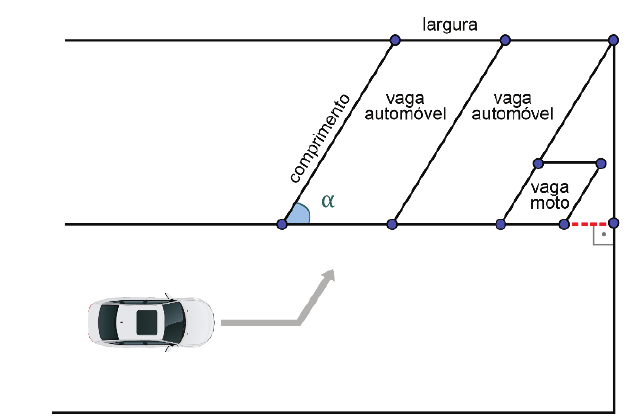
Note: The image is not to scale.
After the motorcycle was parked, there was space left in the garage. Those responsible for the work are evaluating the possibility of placing an object that can be used by the building’s residents. What is the measure of the highlighted (dashed) segment in this space?
- A) 0,75 m
- B) 1,15 m
- C) 1,25 m
- D) 2,20 m
- E) 2,25 m
Note and adopt: $\cos(60^\circ) = 0{,}5$ ; $\sin(60^\circ) = \frac{\sqrt{3}}{2}$
Resolution
From the figure, the width of each space is measured horizontally (along parallel lines) and the length is the inclined side, which makes $60^\circ$ the horizontal.
1. The sloping side of the last car space. It comes out of the upper right corner (leaning against the wall) and descends to the bottom line, with length $4{,}50$ m. Its horizontal displacement is
$$4{,}50 \cdot \cos 60^\circ = 4{,}50 \cdot 0{,}5 = 2{,}25 \text{ m}$$So the foot on that side is $2{,}25$ m to the left of the wall.
2. The bike’s spot. It starts exactly at that foot (its left side is on the sloping side of the bike). car space) and occupies, on the bottom line, its width: $1{,}00$ m.
3. What’s left up to the wall:
$$2{,}25 - 1{,}00 = 1{,}25 \text{ m}$$Answer: alternative C (1,25 m).
Be careful with the catch: alternative E (2,25 m) is just the horizontal projection of the length of the vacancy by car; She forgets to take into account the width of the motorcycle space.
To review, see Parallelogram.
Question 59: Exponential and its inverse
Statement
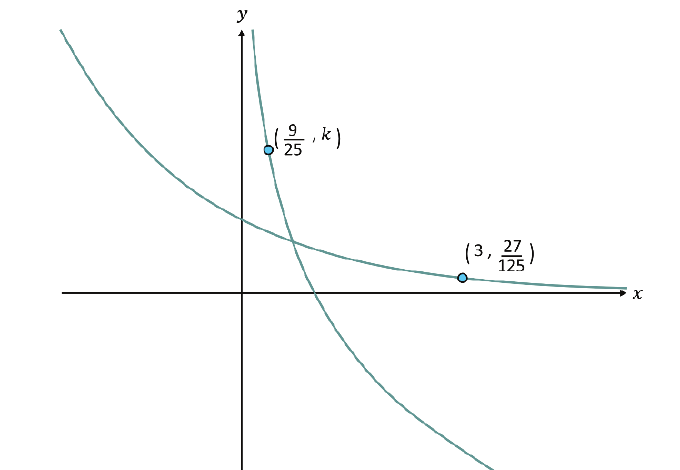
Consider the function $f$, given by $f(x) = b^x$, with $b > 0$, $b \neq 1$ and $x \in \mathbb{R}$, and its inverse $f^{-1}$. The figure highlights two points, one belonging to the $f$ graph and the other to the $f^{-1}$ graph. Determine $b + k$.
- A) $\frac{5}{6}$
- B) $1$
- C) $\frac{6}{5}$
- D) $\frac{13}{5}$
- E) $\frac{18}{5}$
Resolution
**1. Which point is from which graph.**The graph of $f(x) = b^x$ cuts the $y$ axis (at $y = 1$) and exists for all $x$; is the curve that approaches the $x$ axis to the right, where the point $\left(3, \frac{27}{125}\right)$. The graph for $f^{-1}(x) = \log_b x$ only exists for $x > 0$ and is the curve which “goes up” glued to the axis $y$, where the point $\left(\frac{9}{25}, k\right)$ is.
2. Find $b$.
$$f(3) = b^3 = \frac{27}{125} = \left(\frac{3}{5}\right)^3 \quad\Rightarrow\quad b = \frac{3}{5}$$3. Find $k$. The point $\left(\frac{9}{25}, k\right)$ is on the inverse graph, so $f^{-1}\left(\frac{9}{25}\right) = k$, that is, $f(k) = \frac{9}{25}$:
$$\left(\frac{3}{5}\right)^k = \frac{9}{25} = \left(\frac{3}{5}\right)^2 \quad\Rightarrow\quad k = 2$$4. Add. $b + k = \frac{3}{5} + 2 = \frac{13}{5}$.
Answer: alternative D ($\frac{13}{5}$).
To review, see Properties of Logarithms.
Question 60: Graph of a linear system
Statement
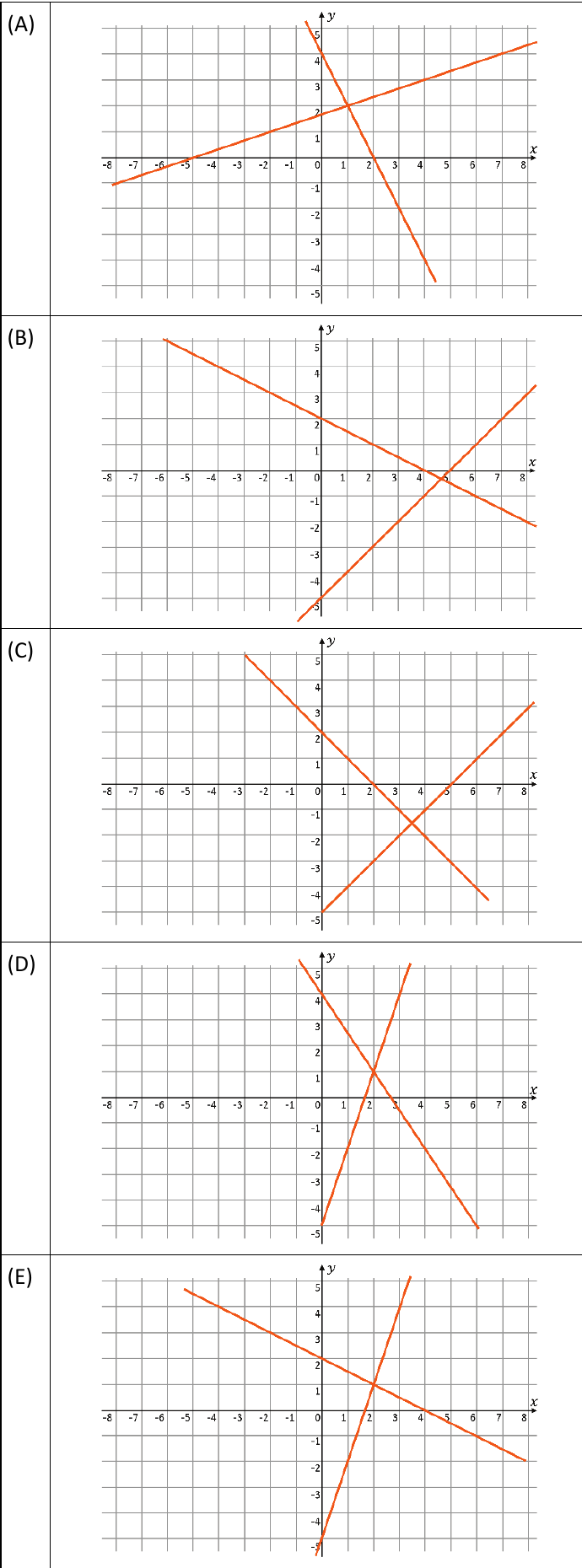
Consider the linear system $\begin{cases} x + 2y = 4 \\\\ 3x - y = 5 \end{cases}$. Select the alternative that graphically represents this system.
Resolution
Each equation is a straight line; the right graph has the two right lines, and not just the meeting point right.
1. System solution. From the 2nd equation, $y = 3x - 5$. Replacing in the 1st:
$$x + 2(3x - 5) = 4 \Rightarrow 7x = 14 \Rightarrow x = 2, \quad y = 3 \cdot 2 - 5 = 1$$The lines intersect at $(2, 1)$.
2. Every straight line.
- $x + 2y = 4$: passes through $(0, 2)$ and $(4, 0)$; slope $-\frac{1}{2}$ (descends slowly).
- $3x - y = 5$: passes through $(0, -5)$ and $(2, 1)$; slope $3$ (goes up quickly).
3. Compare. In A, B and C the lines do not intersect in $(2, 1)$. In D and E the meeting is in $(2, 1)$, but in D the decreasing line is very steep (cuts the axis $y$ close to 4,5), so it is not $x + 2y = 4$. In E, the decreasing line passes through $(0, 2)$ and $(4, 0)$ and the increasing line passes through $(0, -5)$: the two match.
Answer: alternative E.
Be careful with the catch: alternative D also shows straight lines intersecting at $(2, 1)$. Just check the point of intersection is not enough; It is necessary to check the points where each straight line intersects the axes.
To review, see First Degree Functions.
Question 63: Pythagorean Tree (PG and logarithm)
Statement
A Pythagorean Tree is a flat figure that is constructed in stages. In Step 1, it starts with a square of side 1 cm. In Step 2, two squares are constructed above the square in Step 1, in such a way that the measure of its sides is equal to the measure of the legs of the isosceles right triangle that has hypotenuse equal to the side of the square in Step 1. In Step 3, Step 2 is applied to each of the new obtained squares, and so on. In other words, in each new stage, the previous stage is applied in each of the new squares obtained. The following figure shows the first four stages of building the Tree Pythagorean.
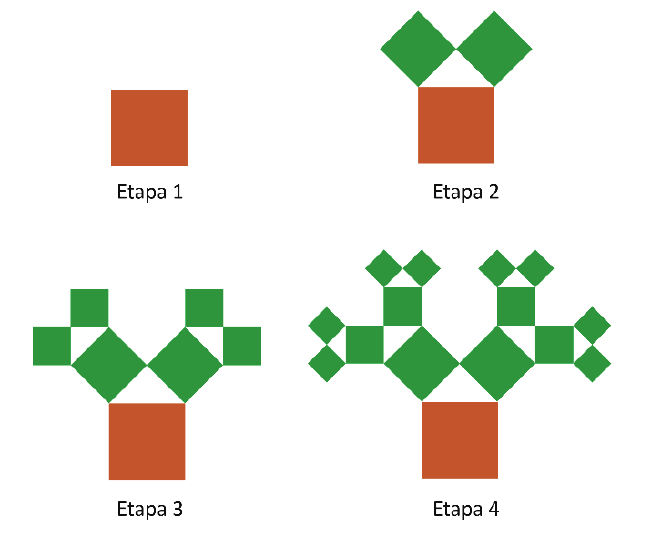
Public domain. Available at https://commons.wikimedia.org/.
From which stage of construction does the side of each of the new squares obtained become, for the first time, less than 1 ten-thousandth of the side of the square in Step 1?
- A) 26
- B) 27
- C) 28
- D) 29
- E) 30
Note and adopt: $\log_{10} 2 = 0{,}3$
Resolution
1. Ratio between steps. In an isosceles right triangle with hypotenuse $\ell$, each side measures $\frac{\ell}{\sqrt{2}}$. Then, at each step, the side is multiplied by $\frac{1}{\sqrt{2}} = 2^{-1/2}$.
2. Side in step $n$ (PG with first term 1):
$$\ell_n = \left(2^{-1/2}\right)^{n-1} = 2^{-\frac{n-1}{2}}$$3. Condition. One ten thousandth is $10^{-4}$:
$$2^{-\frac{n-1}{2}} < 10^{-4}$$Applying $\log_{10}$ (which is increasing):
$$-\frac{n-1}{2}\cdot 0{,}3 < -4 \quad\Rightarrow\quad (n-1)\cdot 0{,}15 > 4 \quad\Rightarrow\quad n - 1 > 26{,}\overline{6}$$The smallest integer is $n - 1 = 27$, that is, $n = 28$.
Checking: in step 27, $\ell = 2^{-13} = \frac{1}{8192} \approx 1{,}2 \times 10^{-4}$ (even higher); in step 28, $\ell = 2^{-13{,}5} \approx 0{,}86 \times 10^{-4}$ (minor).
Answer: alternative C (28).
Be careful with the catch: alternative B (27) appears when using $\ell_n = 2^{-n/2}$, forgetting that Step 1 already has side $1 = 2^0$.
To review, see Properties of Logarithms.
Question 84: Women’s homicide rates (graph reading)
Statement
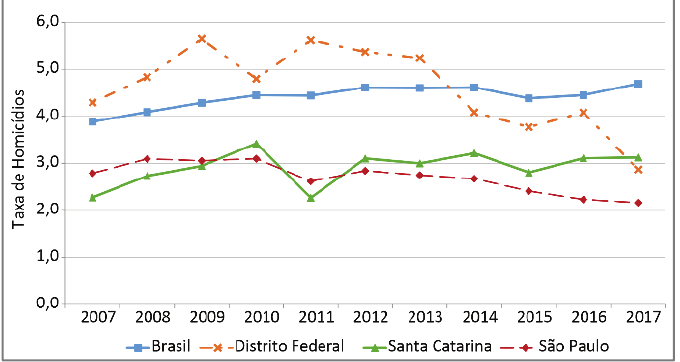
The Atlas of Violence, published in 2019 and organized by the Institute for Applied Economic Research and Forum Brazilian Public Security, presents a study to better understand violence in the country. The data that appear there refer to the period from 2007 to 2017. One of the chapters of this document deals with, specifically, violence against women. The following graph shows the evolution of the homicide rate of women (equivalent to the number of homicides per 100 thousand women), from 2007 to 2017, in Brazil and in three federative units with the lowest rates in 2017.
Ipea/FBSP. Atlas of Violence, 2019.
According to the data presented, it is correct to state:
- A) Among the federative units mentioned, the one with the greatest decrease in the rate of female homicides in the period between 2014 and 2017 was São Paulo.
- B) The three indicated federative units had a decrease in the female homicide rate in 2017 when compared to the rate in 2007.
- C) The female homicide rate in Brazil in 2017 is higher than the sum of the rates in the three federative units presented in the same year.
- D) Among the federative units mentioned, the one with the highest rate of female homicides in 2017 is Santa Catarina, surpassing the rate recorded in the other states in the South region.
- E) Among the federative units mentioned, the greatest reduction in the female homicide rate, between 2016 and 2017, recorded in the research occurred in the Federal District.
Resolution
Approximate chart readings (rate per 100 thousand women):
| 2007 | 2014 | 2016 | 2017 | |
|---|---|---|---|---|
| Brazil | 3,9 | 4,6 | 4,5 | 4,7 |
| Federal District | 4,3 | 4,1 | 4,1 | 2,9 |
| Santa Catarina | 2,3 | 3,2 | 3,1 | 3,1 |
| São Paulo | 2,8 | 2,7 | 2,2 | 2,2 |
A) False. From 2014 to 2017, the DF fell by about $4{,}1 - 2{,}9 = 1{,}2$ point; São Paulo only fell by about $2{,}7 - 2{,}2 = 0{,}5$.
B) False. Santa Catarina rose from around 2,3 (2007) to 3,1 (2017).
C) False. The sum of the three rates in 2017 is about $2{,}9 + 3{,}1 + 2{,}2 = 8{,}2$, much larger than that in Brazil (about 4,7).
D) False. Santa Catarina actually has the highest of the three rates in 2017, but the graph does not show the others states in the South region (Paraná and Rio Grande do Sul); It is not possible to conclude that she surpasses them. Furthermore, the statement itself says that these three units have the lowest rates in the country in 2017.
E) True. From 2016 to 2017, the DF dropped from about 4,1 to 2,9 (drop of about 1,2). Santa Catarina was practically stable and São Paulo changed very little.
Answer: alternative E.
Question 85: Triangular and oblong numbers
Statement
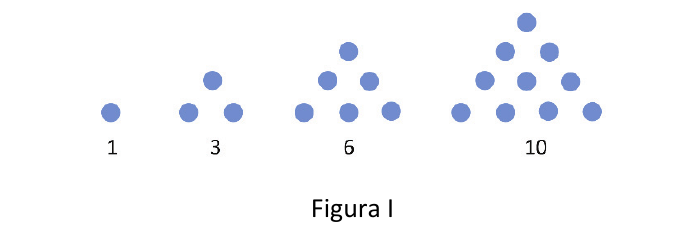
Figurative numbers are numbers that express the total number of points in certain geometric configurations. One An example of figurative numbers are triangular numbers, which are natural numbers that can be represented geometrically in the shape of a triangle. The first four triangular numbers are illustrated in figure I. Although the number 1 does not represent a triangle, it is considered a triangular number.
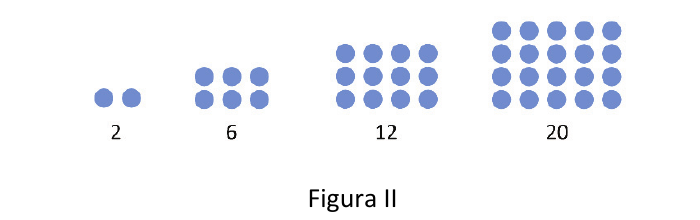
Another example of a figurative number is the oblong number, which represents the total number of points in a frame. rectangular in which the number of columns is one more unit than the number of rows. The first four oblong numbers are illustrated in figure II. Although the number 2 does not represent a rectangular table, it is considered an oblong number.
Regarding triangular numbers and oblong numbers, select the correct alternative.
- A) 162 is the 15th triangular number.
- B) The 13th triangular number is prime and the 30th oblong number is odd.
- C) 156 is neither an oblong nor a triangular number.
- D) 210 is a triangular and oblong number.
- E) The difference between two consecutive triangular numbers are terms of a geometric progression.
Resolution
1. Formulas. The $n$-th triangular number is $1 + 2 + \cdots + n$:
$$T_n = \frac{n(n+1)}{2} \qquad (1, 3, 6, 10, \ldots)$$The $n$-th oblong number is a table with $n$ rows and $n + 1$ columns:
$$O_n = n(n+1) \qquad (2, 6, 12, 20, \ldots)$$2. Test the alternatives.
- A) $T_{15} = \frac{15 \cdot 16}{2} = 120 \neq 162$. False.
- B) $T_{13} = \frac{13 \cdot 14}{2} = 91 = 7 \cdot 13$, which is not prime (and $O_{30} = 30 \cdot 31 = 930$ is even). False.
- C) $156 = 12 \cdot 13 = O_{12}$ is oblong. False.
- D) $210 = \frac{20 \cdot 21}{2} = T_{20}$ and $210 = 14 \cdot 15 = O_{14}$. True.
- E) $T_{n+1} - T_n = n + 1$: the differences $2, 3, 4, \ldots$ form an arithmetic progression, not a geometric one. False.
Answer: alternative D (210).
To review, see Geometry with number sequences.