
Euler's Eyes
2026-10-14
The marvellous spiral and the lemniscate
With Leibniz’s calculus in hand, the Bernoulli brothers went hunting for curves. For each one they asked: what is the tangent, what is the length, what is the area, what is the curvature? Many of these curves had been known since the Greeks, but only now could these questions be answered by a general rule. Two of them kept Jakob’s name forever.
The spiral that does not change shape
The logarithmic spiral had already been studied by Descartes and by Torricelli. In polar coordinates, where each point is given by its distance $r$ from the centre and by the angle $\theta$, it is
$$r=a\,e^{b\theta}.$$At each complete turn the angle increases by $2\pi$ and the radius is always multiplied by the same factor, $e^{2\pi b}$. That is why the turns are not evenly spaced: each one is larger than the one before in the same proportion.
From this comes the property that enchanted Jakob. Rotating the spiral by an angle $\alpha$ has the same effect as enlarging it by the factor $e^{b\alpha}$. If you enlarge a photograph of this spiral, the result is the same spiral, only rotated. It is the same as itself at every scale.
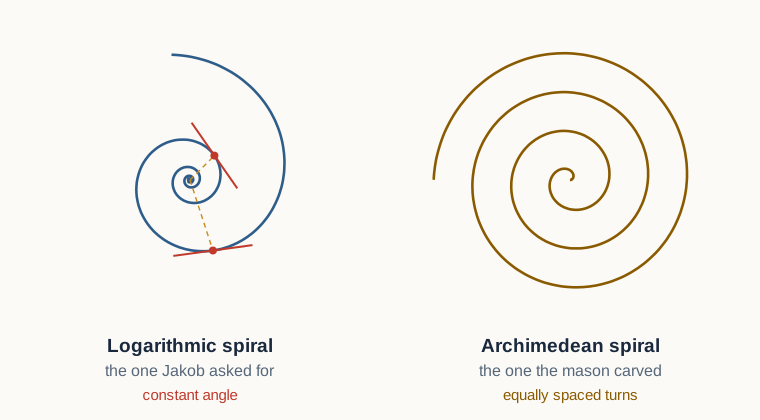
The constant angle
At a point on the spiral, the radius coming from the centre and the tangent to the curve make an angle $\psi$. When the angle $\theta$ increases by a tiny amount $d\theta$, the point moves $r\,d\theta$ perpendicular to the radius and $dr$ along the radius. So
$$\tan\psi=\frac{r\,d\theta}{dr}=\frac{r}{dr/d\theta}=\frac{r}{b\,r}=\frac1b.$$The $r$ cancels: the angle is the same at every point. That is why the curve is also called the equiangular spiral. An insect that flies keeping a fixed angle to a lamp, as moths are said to do with the Moon, describes such a spiral and ends up falling into the lamp.
Jakob discovered more. The curve formed by the centres of curvature of the spiral is another logarithmic spiral equal to the first. The rays of light leaving the centre and reflected by the spiral form, again, an equal spiral. Wherever he looked, the curve was reborn the same. He called it spira mirabilis, the marvellous spiral.
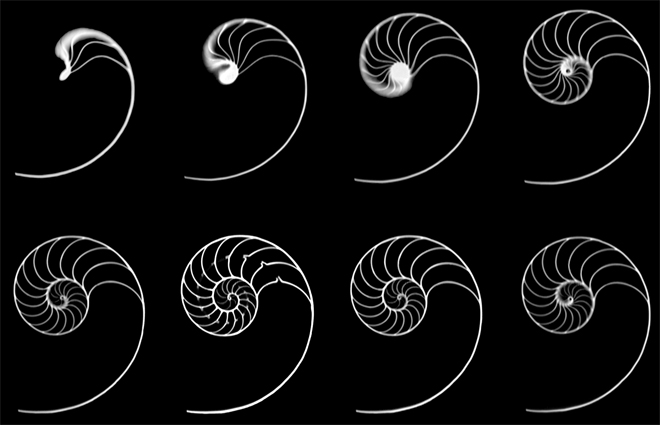
Nature likes this curve for the same reason. An animal that grows by adding layers without changing shape, like the nautilus, produces a shell in a logarithmic spiral. The arms of many galaxies and the clouds of a hurricane follow similar shapes.
The lemniscate: a figure eight lying down
In 1694, in a paper in the Acta Eruditorum, Jakob presented a new curve. Choose two fixed points, the foci $F_1=(-c,0)$ and $F_2=(c,0)$. In the ellipse, the sum of the distances from a point to the foci is constant. Jakob replaced the sum by the product:
$$PF_1\cdot PF_2=c^2.$$With $P=(x,y)$, the squared distances are $(x+c)^2+y^2$ and $(x-c)^2+y^2$. Writing each as $(x^2+y^2+c^2)\pm2cx$, the product is a difference of squares:
$$\begin{aligned}&\left(x^2+y^2+c^2\right)^2-4c^2x^2=c^4\\ &\Longrightarrow\ (x^2+y^2)^2+2c^2(x^2+y^2)-4c^2x^2=0\\ &\Longrightarrow\ \boxed{(x^2+y^2)^2=2c^2\left(x^2-y^2\right)}\end{aligned}$$The curve has two loops crossing at the origin, like a figure eight lying down, or like the infinity symbol, $\infty$. Jakob called it lemniscus, the Latin word for a ribbon tied in a bow, which hung from the wreaths of victors.
An integral nobody knew how to do
The length of a quarter of the lemniscate, with $2c^2=1$, is the integral
$$\int_0^1\frac{dx}{\sqrt{1-x^4}}\approx1.311.$$It looks like $\int_0^1\frac{dx}{\sqrt{1-x^2}}$, which gives a quarter of the length of the circle, $\frac\pi2$. But replacing $x^2$ by $x^4$ makes all the difference: this integral cannot be written with the known functions. The lemniscate became the laboratory of a new theory, that of elliptic integrals, studied by Fagnano, by Euler and, a century later, by Gauss, who filled notebooks with it.
Exercise: which logarithmic spiral doubles in size at each turn, and what is its constant angle?
Doubling at each turn means $e^{2\pi b}=2$, that is, $b=\frac{\ln2}{2\pi}\approx0.110$. The constant angle satisfies $\tan\psi=\frac1b\approx9.06$, so $\psi\approx83.7°$. The tangent is almost perpendicular to the radius: the spiral opens slowly.
Exercise: where does the lemniscate cross the x-axis?
With $y=0$, the equation becomes $x^4=2c^2x^2$. One solution is $x=0$, the origin, where the loops cross. The others come from $x^2=2c^2$: $x=\pm c\sqrt2$. Check: the point $(c\sqrt2,0)$ is $c\sqrt2+c$ from $F_1$ and $c\sqrt2-c$ from $F_2$, and the product is $2c^2-c^2=c^2$.
Sources: Jakob Bernoulli, “Specimen alterum calculi differentialis”, Acta Eruditorum (1691), and “Constructio curvae accessus et recessus aequabilis”, Acta Eruditorum (1694) · Eli Maor, e: The Story of a Number, ch. 11 · biography of Jacob Bernoulli, MacTutor.
All topics on James Bernoulli · ← The harmonic series and the call for help · The art of conjecturing: counting the chances →