
Euler's Eyes
2026-11-04
EJU 2016 (1st session) – Mathematics Course 1 solved
Source: JASSO – Mathematics paper in English, in Japanese and official answer key. Files on the page for the 1st session of 2016.
Course 1 is the basic mathematics paper of the EJU. Each letter $\boxed{\text{A}}$, $\boxed{\text{B}}$, … is a digit from 0 to 9 or the minus sign; in some blanks the answer is the number of a choice. The statements below are summarized from the official English version.
Answer key
| Question | Topic | Answers |
|---|---|---|
| I Q1 | Vertex on a line | A=4, B=2, CD=−2, E=4, F=1, G=1, H=3, I=1, J=8 |
| I Q2 | Triangles in a grid | KLM=220, N=3, O=8, PQ=12, R=8, STU=200, VW=48 |
| II Q1 | Factoring in $x$ and $y$ | A=5, B=4, C=3, D=2, E=3, F=5, G=2, H=4, I=3, J=4, KL=12 |
| II Q2 | A double congruence | M=7, NO=13, P=1, Q=2, R=1, S=7, T=1, UV=91, W=5, XY=96 |
| III | $f(x) \ge g(x)$ for all $x$ | A=2, B=1, C=4, D=4, E=3, F=5, G=2, H=5 |
| IV | Tetrahedron from its net | AB=30, C=6, D=7, E=9, F=4, G=2, H=9, IJ=80, K=2, L=3 |
Question I
Q1: the vertex of a parabola on a line
Statement. Consider $y = -\frac18x^2 + ax + b$ ①, with vertex $(p, q)$: $p = \boxed{\text{A}}\,a$ and $q = \boxed{\text{B}}\,a^2 + b$.
- If the vertex lies on the line $x + y = 1$, then $b = \boxed{\text{CD}}\,a^2 - \boxed{\text{E}}\,a + \boxed{\text{F}}$, and $8a + b$ is largest at $a = \boxed{\text{G}}$, with value $\boxed{\text{H}}$.
- If the graph of ① is tangent to the $x$-axis, then $a + b \le \dfrac{\boxed{\text{I}}}{\boxed{\text{J}}}$.
Solution.
1. The vertex. $y = -\frac18(x - 4a)^2 + 2a^2 + b$: $p = 4a$ and $q = 2a^2 + b$.
2. On the line. $4a + 2a^2 + b = 1$ gives $b = -2a^2 - 4a + 1$. Then $8a + b = -2a^2 + 4a + 1 = -2(a - 1)^2 + 3$, maximum $3$ at $a = 1$.
3. Tangent to the $x$-axis. $q = 0$, or $b = -2a^2$. Then $a + b = -2a^2 + a = -2\left(a - \frac14\right)^2 + \frac18 \le \frac18$.
Answers: A=4, B=2, CD=−2, E=4, F=1, G=1, H=3, I=1, J=8.
Q2: triangles in a grid of 12 points
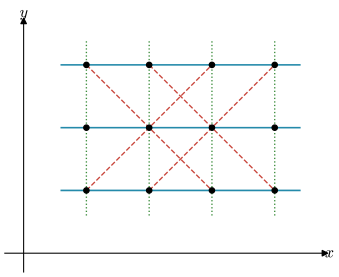
Statement. In the plane, the 12 points $(x, y)$ with $x \in \{1, 2, 3, 4\}$ and $y \in \{1, 2, 3\}$ form a grid. How many triangles have their vertices among these points?
There are $\boxed{\text{KLM}}$ ways to choose three of the 12 points. We count the collinear triples: (i) there are $\boxed{\text{N}}$ lines through four points; (ii) there are $\boxed{\text{O}}$ lines through exactly three points. So $\boxed{\text{PQ}}$ collinear triples come from case (i) and $\boxed{\text{R}}$ from case (ii), and the number of triangles is $\boxed{\text{STU}}$. In particular, with $A(1, 1)$ and $B(4, 1)$, $\boxed{\text{VW}}$ triangles have two vertices on segment $AB$.
Solution.
1. $\binom{12}{3} = 220$.
2. Lines through four points: the three horizontal rows ($y = 1, 2, 3$).
3. Lines through exactly three points: the four vertical columns and four diagonals: $(1,1),(2,2),(3,3)$; $(2,1),(3,2),(4,3)$; $(1,3),(2,2),(3,1)$; $(2,3),(3,2),(4,1)$. Other slopes (such as 2 or $\frac12$) do not collect three points in a $4\times3$ grid. That makes $8$.
4. Collinear triples. Each line with four points gives $\binom43 = 4$ triples: $12$; each line with three points gives $1$: $8$. Triangles: $220 - 12 - 8 = 200$.
5. Two vertices on $AB$. Segment $AB$ is the row $y = 1$, with 4 points. Choose two of them ($\binom42 = 6$) and the third vertex off the row ($8$ points): $6\cdot8 = 48$.
Answers: KLM=220, N=3, O=8, PQ=12, R=8, STU=200, VW=48.
Question II
Q1: factoring a degree-2 polynomial in x and y
Statement. We want $a$ for which $15x^2 - 2xy - 8y^2 - 11x + 22y + a$ factors as a product of linear expressions in $x$ and $y$. The first three terms factor: $15x^2 - 2xy - 8y^2 = \left(\boxed{\text{A}}\,x - \boxed{\text{B}}\,y\right)\left(\boxed{\text{C}}\,x + \boxed{\text{D}}\,y\right)$. Setting
$$15x^2 - 2xy - 8y^2 - 11x + 22y + a = \left(\boxed{\text{A}}\,x - \boxed{\text{B}}\,y + b\right)\left(\boxed{\text{C}}\,x + \boxed{\text{D}}\,y + c\right) \quad \text{①},$$the right-hand side is $15x^2 - 2xy - 8y^2 + \left(\boxed{\text{E}}\,b + \boxed{\text{F}}\,c\right)x + \left(\boxed{\text{G}}\,b - \boxed{\text{H}}\,c\right)y + bc$. Comparing, $b = \boxed{\text{I}}$, $c = -\boxed{\text{J}}$, and $a = -\boxed{\text{KL}}$.
Solution.
1. $15x^2 - 2xy - 8y^2 = (5x - 4y)(3x + 2y)$ (check: $10xy - 12xy = -2xy$).
2. Expanding $(5x - 4y + b)(3x + 2y + c)$, the linear terms are $(3b + 5c)x + (2b - 4c)y$, and the constant is $bc$.
3. $3b + 5c = -11$ and $2b - 4c = 22$, or $b = 11 + 2c$. Then $33 + 11c = -11$, $c = -4$ and $b = 3$. Hence $a = bc = -12$.
Answers: A=5, B=4, C=3, D=2, E=3, F=5, G=2, H=4, I=3, J=4, KL=12.
Q2: a double congruence
Statement. We want the two-digit natural number $a$ such that $a + 9$ is a multiple of 7 and $a + 8$ is a multiple of 13. Writing $a + 9 = \boxed{\text{M}}\,m$ and $a + 8 = \boxed{\text{NO}}\,n$, we have $\boxed{\text{M}}\,m - \boxed{\text{NO}}\,n = \boxed{\text{P}}$ ①. Since $m = \boxed{\text{Q}}$, $n = \boxed{\text{R}}$ is a solution, $\boxed{\text{M}}\left(m - \boxed{\text{Q}}\right) = \boxed{\text{NO}}\left(n - \boxed{\text{R}}\right)$ ②. So $n = \boxed{\text{S}}\,k + \boxed{\text{T}}$, $a = \boxed{\text{UV}}\,k + \boxed{\text{W}}$ and, since $a$ has two digits, $a = \boxed{\text{XY}}$.
Solution.
1. Subtracting, $7m - 13n = 1$. One solution is $m = 2$, $n = 1$ ($14 - 13 = 1$).
2. $7(m - 2) = 13(n - 1)$, and since $\gcd(7, 13) = 1$, $7 \mid n - 1$: $n = 7k + 1$.
3. $a = 13n - 8 = 91k + 5$. With two digits, $k = 1$: $a = 96$. (Check: $105 = 7\cdot15$ and $104 = 13\cdot8$.)
Answers: M=7, NO=13, P=1, Q=2, R=1, S=7, T=1, UV=91, W=5, XY=96.
Question III: a quadratic inequality for all x
Statement. Let $f(x) = x^2 + 2ax + 4a - 3$ and $g(x) = 2x + 1$. We want the condition on $a$ for $f(x) \ge g(x)$ for all $x$, and the possible values of the minimum of $f$ under that condition. We need $x^2 + \boxed{\text{A}}\left(a - \boxed{\text{B}}\right)x + \boxed{\text{C}}\,a - \boxed{\text{D}} \ge 0$ for all $x$.
- The condition is the inequality $\boxed{\text{E}}$, so $a$ lies in $\boxed{\text{F}}$ (choose from ⓪ $a^2 - 5a + 4 \ge 0$, ① $a^2 - 6a + 5 \ge 0$, ② $a^2 - 5a + 4 \le 0$, ③ $a^2 - 6a + 5 \le 0$, ④ $a \le 1$ or $5 \le a$, ⑤ $1 \le a \le 5$, ⑥ $1 \le a \le 4$, ⑦ $a \le 1$ or $4 \le a$).
- Let $m$ be the minimum of $f$. Since $m = \boxed{\text{G}}$, the values of $m$ under the condition of (1) are $\boxed{\text{H}}$ (choose from ⓪ $a^2 + 4a - 3$, ① $4a^2 + 4a - 3$, ② $-a^2 + 4a - 3$, ③ $2a^2 - 4a + 3$, ④ $-5 \le m \le 1$, ⑤ $-8 \le m \le 1$, ⑥ $-8 \le m \le -1$, ⑦ $-5 \le m \le -1$).
Solution.
1. $f(x) - g(x) = x^2 + 2(a - 1)x + 4a - 4$. It is $\ge 0$ for all $x$ when the discriminant is not positive: $(a - 1)^2 - (4a - 4) = a^2 - 6a + 5 \le 0$ (③), that is, $(a - 1)(a - 5) \le 0$, or $1 \le a \le 5$ (⑤).
2. The vertex of $f$ is at $x = -a$, and $m = f(-a) = -a^2 + 4a - 3 = -(a - 2)^2 + 1$ (②). On $[1, 5]$, $m$ ranges from $1$ (at $a = 2$) to $-8$ (at $a = 5$): $-8 \le m \le 1$ (⑤).
Answers: A=2, B=1, C=4, D=4, E=3, F=5, G=2, H=5.
Question IV: a tetrahedron from its net
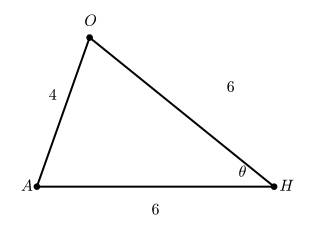
Statement. The tetrahedron $OABC$ (given by its net) satisfies $BC = 10$, $AC = 8$, $\sin\angle ACB = \frac34$, $OA = 4$ and $\triangle ABC \equiv \triangle OBC$ (with $O$ corresponding to $A$).
- The area of triangle $ABC$ is $\boxed{\text{AB}}$.
- Let $AH$ be the perpendicular from $A$ to side $BC$. Then $AH = \boxed{\text{C}}$.
- Let $\theta$ be the angle between planes $ABC$ and $OBC$. Then $\cos\theta = \dfrac{\boxed{\text{D}}}{\boxed{\text{E}}}$ and $\sin\theta = \dfrac{\boxed{\text{F}}\sqrt{\boxed{\text{G}}}}{\boxed{\text{H}}}$.
- The volume of the tetrahedron is $\dfrac{\boxed{\text{IJ}}\sqrt{\boxed{\text{K}}}}{\boxed{\text{L}}}$.
Solution.
1. $\triangle ABC = \frac12\cdot BC\cdot AC\cdot\sin C = \frac12\cdot10\cdot8\cdot\frac34 = 30$.
2. $AH = \frac{2\cdot30}{BC} = 6$.
3. The dihedral angle. Since $\triangle OBC \equiv \triangle ABC$ with $O \leftrightarrow A$, the perpendicular from $O$ to $BC$ has the same foot $H$ and the same length: $OH = 6$. The two perpendiculars to $BC$ at $H$ form the angle between the planes, $\theta = \angle AHO$. In triangle $AHO$, with $AH = OH = 6$ and $OA = 4$:
$$\cos\theta = \frac{36 + 36 - 16}{2\cdot36} = \frac79, \qquad \sin\theta = \sqrt{1 - \frac{49}{81}} = \frac{4\sqrt2}{9}.$$4. The volume. Taking $OBC$ as the base (area 30), the height is the distance from $A$ to plane $OBC$: $AH\sin\theta = \frac{24\sqrt2}{9} = \frac{8\sqrt2}{3}$. Hence
$$V = \frac13\cdot30\cdot\frac{8\sqrt2}{3} = \frac{80\sqrt2}{3}.$$Answers: AB=30, C=6, D=7, E=9, F=4, G=2, H=9, IJ=80, K=2, L=3.