
Euler's Eyes
2026-10-25
The life of Augustin-Louis Cauchy
Timeline
- 1789Born on 21 August in Paris, five weeks after the fall of the Bastille.
- 1794During the Terror, the family takes refuge in Arcueil, next door to Laplace.
- 1805Enters the École Polytechnique, second in the entrance examination.
- 1810Goes to Cherbourg as an engineer on Napoleon’s military harbour.
- 1813Returns to Paris in poor health and proves Fermat’s polygonal number theorem.
- 1816Appointed to the Academy of Sciences by royal decree, in place of Monge.
- 1821Publishes the Cours d’analyse of the École Polytechnique.
- 1825Presents the memoir on integrals between imaginary limits.
- 1830Refuses to swear allegiance to Louis-Philippe and goes into exile.
- 1833In Prague, becomes tutor to the Duke of Bordeaux, grandson of Charles X.
- 1838Returns to Paris.
- 1848The new republic abolishes the oath; the following year he takes up the chair at the Sorbonne.
- 1857Dies on 23 May at Sceaux, aged 67.
A child of the Revolution
Augustin-Louis Cauchy was born in Paris on 21 August 1789. The Bastille had fallen on 14 July, and his father, Louis-François Cauchy, was a senior official of the Paris police, an Ancien Régime post that became dangerous overnight. In 1794, during the Terror, the family fled to their country house in Arcueil, south of the city. There they knew hunger and poverty; Augustin was a frail child, and poor health stayed with him all his life.
His father, a cultivated man, taught the children at home, with plenty of Latin and Greek and a fervent Catholic faith that Augustin would keep to the end. In Arcueil, the neighbours were the mathematician Pierre-Simon Laplace and the chemist Claude Louis Berthollet, who gathered a circle of scientists in their homes.
After Napoleon’s coup in 1799, the father was appointed secretary-general of the Senate, with an office in the Luxembourg Palace. Among the senators was Joseph-Louis Lagrange, the greatest living mathematician, who met the boy and was struck by him.
You see this little young man? Well, he will replace all of us, mere geometers that we are.
— Joseph-Louis Lagrange, as reported by Claude-Alphonse Valson (1868)
The story goes that Lagrange advised the father not to let the boy open a mathematics book before the age of 17, and to give him a solid literary education first: otherwise his talent would carry him away too early. The father followed the advice. At the École Centrale du Panthéon, Augustin won prizes in Latin and in Greek verse.
The engineer of Cherbourg
In 1805, at 16, Cauchy entered the École Polytechnique, second in the entrance examination. Two years later he moved on to the École des Ponts et Chaussées, the school of civil engineering. In 1810 he was sent to Cherbourg, on the Normandy coast, where Napoleon was building a large military harbour for the war against England. According to his biographer Valson, he took in his luggage Laplace’s Celestial Mechanics, Lagrange’s Theory of Analytic Functions, a Virgil and The Imitation of Christ.
He worked on the site all day and did mathematics at night. In 1811 he solved a problem on convex polyhedra put to him by Legendre and Malus, and in 1812 he wrote a long memoir on determinants. In 1813, exhausted and ill, he returned to Paris. That same year he proved the polygonal number theorem, which Fermat had stated without proof in 1638. At 24, he was already known throughout Europe.
Monge’s seat
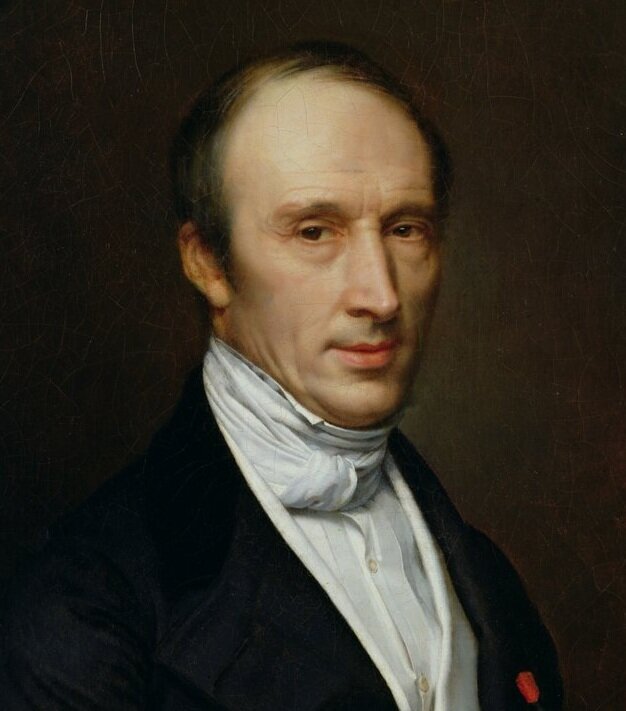
With the fall of Napoleon and the return of the Bourbons, scientists associated with the Revolution were pushed aside. In 1816 a royal decree expelled Lazare Carnot and Gaspard Monge from the Academy of Sciences and appointed Cauchy to Monge’s seat. Cauchy, a convinced royalist, accepted without hesitation, and many colleagues never forgave him for it. That same year he won the Academy’s Grand Prize with a work on the propagation of waves on the surface of a liquid, and became professor of analysis at the École Polytechnique.
In 1818 he married Aloïse de Bure, from a family of booksellers and publishers; they had two daughters. The following years were the most creative: the Cours d’analyse of 1821, the Résumé of lessons on the infinitesimal calculus of 1823, the theory of stress in solids in 1822 and the integral in the complex plane in 1825.
His lectures, however, were a problem. Cauchy demanded a rigour that his students, future engineers, neither understood nor wanted, and the school’s administration complained that he spent too much time on proofs. In 1826 he started a journal just for himself, the Exercices de mathématiques, which he wrote alone, issue after issue.
Exile
In July 1830 a revolution overthrew Charles X and put Louis-Philippe on the throne. Every public servant had to swear allegiance to the new king. Cauchy refused: for him, the oath he had sworn to the Bourbons could not be broken. He lost all his posts and in September left France, first for Switzerland, then for Turin, where the King of Piedmont created a chair of theoretical physics for him. In Turin, in 1831, he wrote down the integral formula that now bears his name.
In 1833 Charles X, in exile in Prague, called him to be tutor to his grandson Henri, Duke of Bordeaux, the legitimist heir to the throne. Cauchy spent five years teaching mathematics and science to a teenager who, by all accounts, had little interest in them and even less patience for his teacher’s long explanations. In return, Charles X made him a baron.
Back in Paris
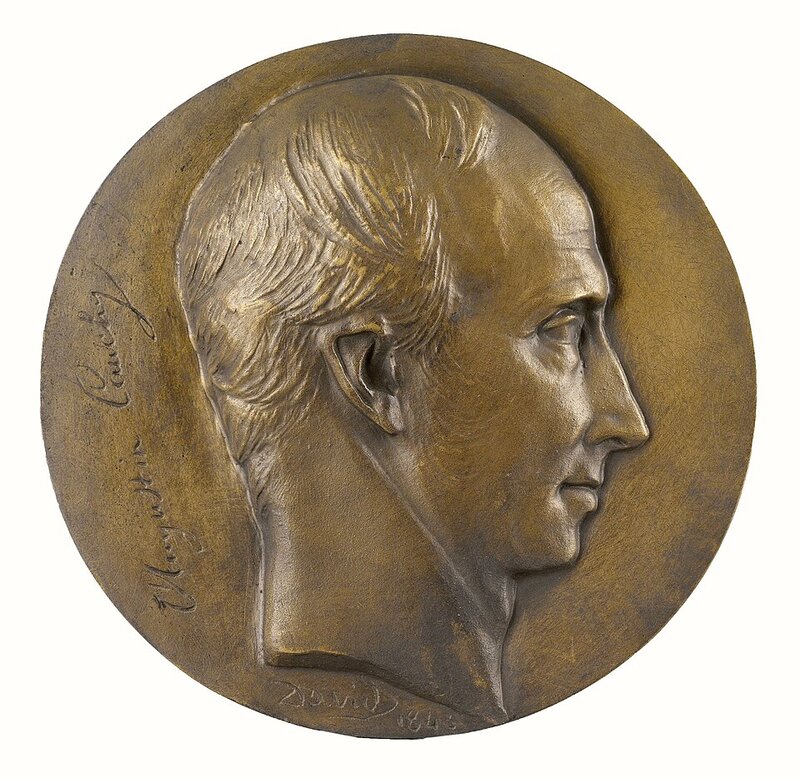
Cauchy returned to Paris in 1838. He was still a member of the Academy, where no oath was required, but he could not teach. In 1839 the Bureau des Longitudes elected him, and the government refused to confirm the election without the oath; Cauchy worked there anyway, unpaid, for years. In 1843 he lost the chair at the Collège de France to Guglielmo Libri, a mathematician who, it later emerged, was stealing rare books from French libraries.
In those years he wrote without pause. In 1835 the Academy had begun publishing a weekly bulletin, the Comptes rendus, and Cauchy sent notes almost every week, sometimes more than one. It is said that the page limit per article that the journal adopted was a response to his output. In 1844 he went back to the study of permutations and wrote, in a few months, a series of papers that founded the theory of finite groups.
The revolution of 1848 abolished the oath, and in 1849 Cauchy at last took up the chair of mathematical astronomy at the Sorbonne. When Napoleon III restored the oath in 1852, Cauchy and the physicist François Arago, a republican, were exempted from it.
The last years
Cauchy also devoted his old age to charitable work: he was active in the Society of Saint Vincent de Paul, in the founding of the Institut Catholique and in relief campaigns for Ireland during the Great Famine. He was generous to the poor of Sceaux, where the family had a house, and, according to Valson, handed his Sorbonne salary to the town’s mayor to be distributed among them.
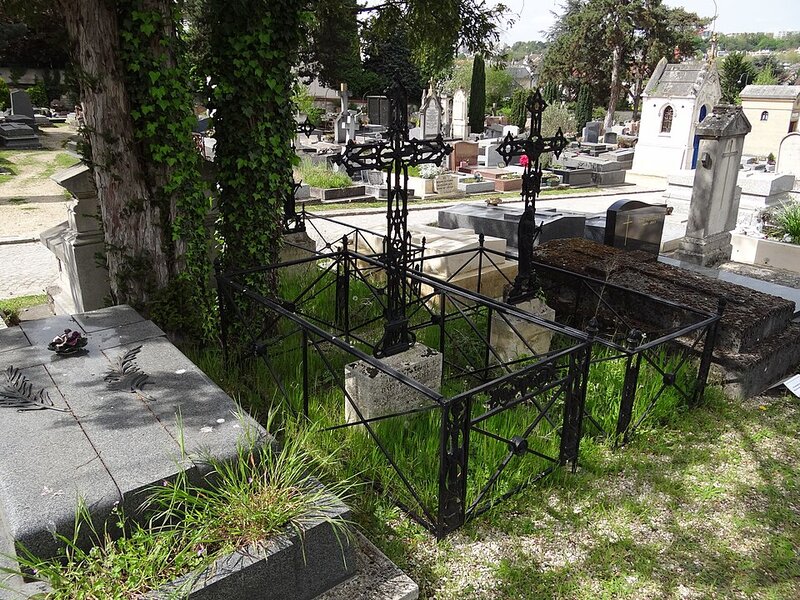
In May 1857, at Sceaux, a bout of bronchitis grew worse. He died on 23 May, aged 67. According to Valson, his last words, addressed to the Archbishop of Paris, were: “Men pass away, but their deeds abide.” He is buried in the cemetery of Sceaux.
Exercise: Cauchy's age
Cauchy was born on 21 August 1789 and died on 23 May 1857. How old was he when he died? And how old was he when he entered the École Polytechnique, in November 1805, and when he came back from exile in 1838?
In May 1857 he had not yet had his birthday that year: $1857 - 1789 - 1 = 67$ years. In November 1805, after his August birthday: $1805 - 1789 = 16$ years. In 1838 he turned 49 in August, so he came back aged 48 or 49, depending on the month; he was away from France for eight years, from 1830 to 1838.
Exercise: Lagrange's advice
Lagrange met Cauchy around 1800 and advised that he should not open a mathematics book before the age of 17. In what year could the boy begin? How many years after that did he prove the polygonal number theorem?
Cauchy turned 17 in August 1806, so by Lagrange’s rule he could begin in 1806. In practice he entered the École Polytechnique a year earlier, in 1805, having already studied a good deal of mathematics. The polygonal number theorem dates from 1813: $1813 - 1806 = 7$ years after the date Lagrange had set.
Sources: Claude-Alphonse Valson, La vie et les travaux du baron Cauchy (1868) · Bruno Belhoste, Augustin-Louis Cauchy: A Biography (1991) · Cauchy biography, MacTutor · Judith V. Grabiner, The Origins of Cauchy’s Rigorous Calculus (1981).
All topics on Augustin-Louis Cauchy · The polygonal number theorem →