
Euler's Eyes
2022-10-14
Simple Interest
The Sumerians were the first to use concepts of contracts, invoices, receipts, and rudimentary credits. They started the concept of finance after the Babylonians around 2000 BC (Hammurabi’s code), with the concept of interest that was paid with seeds or other goods.

The emergence of coins was around the 7th century BC. C. in Lydia, present-day Türkiye. Over time, the accumulation of these coins began to be a problem, as they could lose control of how much they had saved. The concept of a bank began to emerge with this problem.

The “merchants” of the time who kept the coins issued written receipts that showed the value of the saved coins, which today we call money.

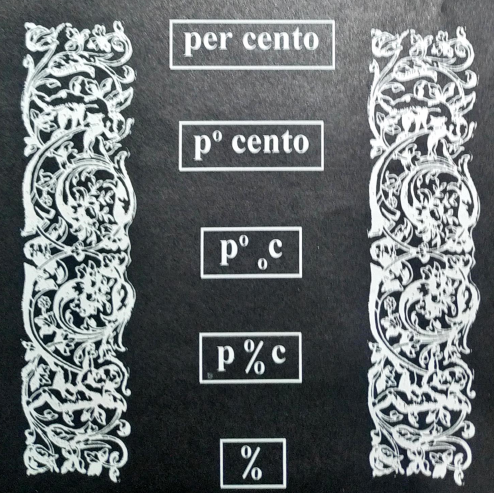
The genesis of the percentage symbol
In Italian manuscripts from the 14th and 15th centuries, we notice the evolution of this symbol, which happened in a natural and curious way.

To understand this evolution, we just need to notice the contraction of an Italian word:

With this, they allowed other authors to write:
Interest
Interest charging has always been widely used by civilizations. Interest rates were not expressed in percentages, as they are today. In this post, we will express it with percentages.
Before presenting the concepts of interest, we have to keep in mind that scholars began to introduce the concepts of Depositum x Interest x Creditum. To do this, look at the Latin names.
From the Latin ponere (by), jurare (to swear) and credere (to believe).
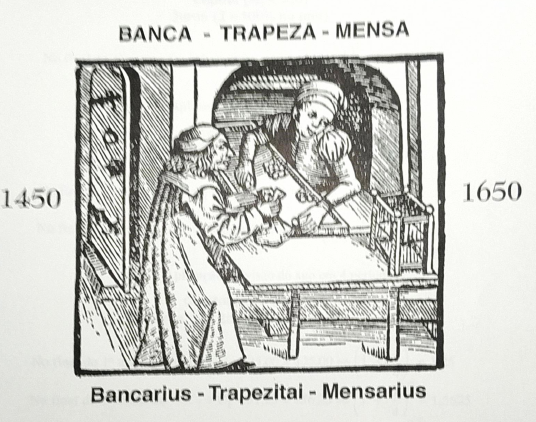
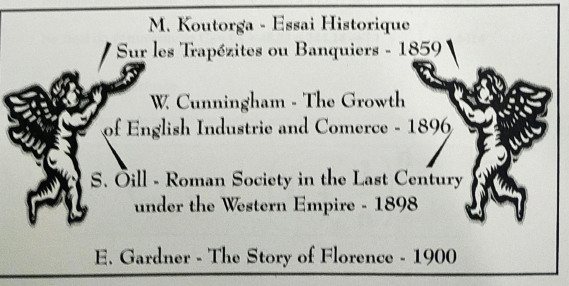
Some accounts of the history of banks.
Interest is used in current times and is defined as an additional amount that we pay when we carry out a financial transaction, such as a loan, financing or investments.
Simple Interest
In the previous post, we saw concepts of discount increases and they basically depend on the correction factor.

Let $c$ be the initial capital we have so far and $p$ be the percentage applied to this capital. To increase capital we have:
- $c_f$: final capital;
- $c$: initial capital;
- $p$: percentage applied to the initial capital;
- $1+p$: correction factor for increase.
In the case of simple interest, the interest rate is applied to the initial value in a linear manner in all periods. For this concept, the time variable is fundamental. In this way, we have:
- $c_f$: final capital or amount;
- $c$: initial capital;
- $p$: percentage applied to the initial capital;
- $t$: period in time units.

Times applied to interest
The concept of time is fundamental to financial mathematics. Below we present the tenses used in finance.
| Temporal term | Example |
|---|---|
| By day | Suppose 1 month, we have a period of 30 days |
| Per month | Suppose 1 year, we have a period of 12 months |
| Every two months | Suppose 1 year, we have a period of 6 two months |
| To the quarter | Suppose 1 year, we have a period of 4 quarters |
| per year | Suppose 1 decade, we have a period of 10 years |
Example
In this example, we assume that a worker invested R$500 in an investment fund at a simple interest of 2% per month over 6 months. How much did he receive at the end of the contract period?

| Period | Amount (capital + interest) | Interest |
|---|---|---|
| 0 | $500$ | $0$ |
| 1 | $500 + 10= 510$ | $500~.~\frac{2}{100}=10$ |
| 2 | $510 +10 = 520$ | $5~.~\cancel{100}~.~\frac{2}{\cancel{100}}=10$ |
| 3 | $520+10=530$ | $10$ |
| 4 | $530+10=540$ | $10$ |
| 5 | $540+10=550$ | $10$ |
| 6 | $550+10=560$ | $10$ |

or simply
- $c_f$: final capital or amount;
- $c$: initial capital R$500;
- $p$: percentage applied to the initial capital 2%;
- $t$: period in time units (6 months).
These are the concepts for simple interest. Wait for the next posts.