
Euler's Eyes
2026-11-02
MEXT 2019 – Mathematics (B) solved
Source: MEXT / Study in Japan – Mathematics (B) paper and official answers. Files on the past exams page.
Mathematics (B) is the paper for undergraduate applicants in science and engineering. It has three fill-in questions and is worth 100 points. The statements below follow the original English.
Answer key
| Item | Topic | Answer |
|---|---|---|
| 1 (1) | Divisors of 2019 | $4$; $2696$ |
| 1 (2) | Angle bisector | $\frac12$ |
| 1 (3) | Tangent parallel to a chord | $2$, $-1$; $(1, 1)$ |
| 1 (4) | Line and circle | $\frac{15}{8}$; $3$ |
| 1 (5) | $\sin x + \cos x$ | $\sqrt2$; $-1$ |
| 1 (6) | $6^{100}$ | $78$ digits; starts with $6$ |
| 2 (1) | $I(2, n)$ and $I(3, n)$ | $n$; $\frac{n(n + 1)}{2}$ |
| 2 (2) | $I(5, 3)$ | $15$ |
| 3 (1) | Derivatives | $h' < f' < g'$ |
| 3 (2) | Functions | $g < f < h$ |
| 3 (3) | Integrals | $\frac12 - \frac1e$; $\frac1e - \frac13$ |
Question 1: six short items
Item (1)
Statement. The number of positive divisors of 2019 is ①, and their sum is ②.
Solution. $2019 = 3\cdot 673$, and $673$ is prime (it is not divisible by any prime up to $25$, and $26^2 > 673$). The divisors are $1, 3, 673, 2019$: there are $4$, with sum $(1 + 3)(1 + 673) = 2696$.
Answer: ① $4$; ② $2696$.
Item (2)
Statement. For the points $O(0, 0)$, $A(3, 0)$ and $B(3, 4)$, the bisector of $\angle AOB$ is $y = \boxed{\phantom{0}}\,x$.
Solution. The unit vectors from $O$ towards $A$ and $B$ are $(1, 0)$ and $\left(\frac35, \frac45\right)$. Their sum points along the bisector: $\left(\frac85, \frac45\right)$, with slope $\frac12$. (By the angle bisector theorem, it cuts $AB$ at $(3, \frac32)$, since $OA : OB = 3 : 5$.)
Answer: $\frac12$.
Item (3)
Statement. For the parabola $y = x^2$ and its points $(-1, 1)$ and $(3, 9)$, the tangent line parallel to the line through the two points is $y =$ ① $x +$ ②, with point of tangency (③, ④).
Solution. The chord has slope $\frac{9 - 1}{3 + 1} = 2$. The tangent at $x = t$ has slope $2t$, so $t = 1$ (the midpoint of the abscissas, as always for a parabola). The tangent at $(1, 1)$ is $y = 2x - 1$.
Answer: ① $2$, ② $-1$; ③ $1$, ④ $1$.
Item (4)
Statement. The line $y = m(x - 5) + 3$ meets the circle $x^2 + y^2 = r^2$ ($r > 0$) if and only if $0 \le m \le$ ①, with $r =$ ②.
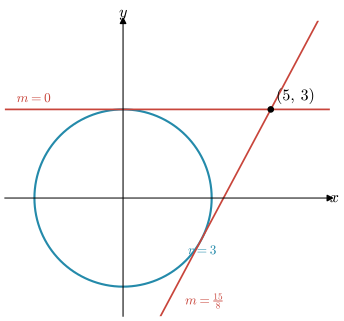
Solution. The lines pass through $(5, 3)$. The extreme values of $m$ are those of the two tangents through that point. Since $m = 0$ is one extreme, the line $y = 3$ is a tangent, and $r = 3$. The distance from the origin to the line $mx - y - 5m + 3 = 0$ equals $3$ when
$$\frac{|3 - 5m|}{\sqrt{m^2 + 1}} = 3 \iff 9 - 30m + 25m^2 = 9m^2 + 9 \iff 2m(8m - 15) = 0.$$The other tangent has $m = \frac{15}{8}$.
Answer: ① $\frac{15}{8}$; ② $3$.
Item (5)
Statement. For $|x| \le \frac\pi2$, the maximum of $\sin x + \cos x$ is ① and the minimum is ②.
Solution. $\sin x + \cos x = \sqrt2\sin\left(x + \frac\pi4\right)$, with $x + \frac\pi4 \in \left[-\frac\pi4, \frac{3\pi}{4}\right]$. The sine ranges from $-\frac{\sqrt2}{2}$ (at $-\frac\pi4$) to $1$ (at $\frac\pi2$). So the maximum is $\sqrt2$ and the minimum is $\sqrt2\cdot\left(-\frac{\sqrt2}{2}\right) = -1$, at $x = -\frac\pi2$.
Answer: ① $\sqrt2$; ② $-1$.
Item (6)
Statement. Using $\log_{10}2 \approx 0.3010$ and $\log_{10}3 \approx 0.4771$, the number of digits of $6^{100}$ is ①, and its leading digit is ②.
Solution.
1. $\log_{10}6^{100} = 100(0.3010 + 0.4771) = 77.81$. So $10^{77} < 6^{100} < 10^{78}$, and the number has $78$ digits.
2. $6^{100} = 10^{77}\cdot 10^{0.81}$, and the leading digit is the integer part of $10^{0.81}$. We have $\log_{10}6 = 0.7781 < 0.81$. And $\log_{10}7 > 0.81$, because $7^2 = 49 > 48 = 2^4\cdot 3$ gives $\log_{10}7 > \frac{4\cdot 0.3010 + 0.4771}{2} \approx 0.84$. Hence $6 < 10^{0.81} < 7$.
Answer: ① $78$; ② $6$.
Question 2: a recurrence that generates Pascal’s triangle
Statement
Let $I(m, n)$ be a function of pairs $(m, n)$ of natural numbers defined inductively:
- $I(m, 1) = I(1, n) = 1$ for all $m, n$;
- $I(m + 1, n) + I(m, n + 1) = I(m + 1, n + 1)$ for all $m, n$.
Write $I(2, n)$ and $I(3, n)$ as functions of $n$, and compute $I(5, 3)$.
Solution
1. $I(2, n)$. With $m = 1$, rule (ii) gives $I(2, n + 1) = I(2, n) + I(1, n + 1) = I(2, n) + 1$. Starting from $I(2, 1) = 1$, $I(2, n) = n$.
2. $I(3, n)$. With $m = 2$: $I(3, n + 1) = I(3, n) + I(2, n + 1) = I(3, n) + (n + 1)$. Starting from $I(3, 1) = 1$:
$$I(3, n) = 1 + 2 + \dots + n = \frac{n(n + 1)}{2}.$$3. The general formula. Rule (ii) is Pascal’s rule, and the borders equal 1. By induction, $I(m, n) = \binom{m + n - 2}{m - 1}$: it matches $I(2, n) = \binom{n}{1}$ and $I(3, n) = \binom{n + 1}{2}$. Hence
$$I(5, 3) = \binom{6}{4} = 15.$$The table can also be built by hand:
| $m \backslash n$ | 1 | 2 | 3 |
|---|---|---|---|
| 1 | 1 | 1 | 1 |
| 2 | 1 | 2 | 3 |
| 3 | 1 | 3 | 6 |
| 4 | 1 | 4 | 10 |
| 5 | 1 | 5 | 15 |
Answer
- ① $I(2, n) = n$; ② $I(3, n) = \frac{n(n + 1)}{2}$.
- $I(5, 3) = 15$.
Question 3: eˣ and its approximating polynomials
Statement
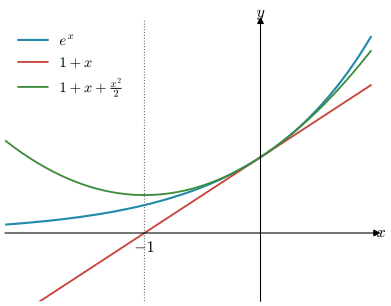
Let $f(x) = e^x$, $g(x) = 1 + x$ and $h(x) = 1 + x + \frac12x^2$.
- For $x < 0$, put $f'(x)$, $g'(x)$ and $h'(x)$ in increasing order.
- For $x < 0$, put $f(x)$, $g(x)$ and $h(x)$ in increasing order.
- Compute $I_1 = \int_{-1}^0 |f(x) - g(x)|\,dx$ and $I_2 = \int_{-1}^0 |f(x) - h(x)|\,dx$.
Solution
$g$ and $h$ are the Taylor polynomials of $e^x$ of degrees 1 and 2 about $0$.
1. Derivatives. $f' = e^x$, $g' = 1$, $h' = 1 + x$. For $x < 0$, $e^x < 1$. And $e^x > 1 + x$ for every $x \ne 0$ (the tangent line lies below the exponential, which is convex). So $h' < f' < g'$.
2. Functions. Let $\varphi = f - g$ and $\psi = f - h$, both zero at $x = 0$.
- $\varphi' = e^x - 1 < 0$ for $x < 0$: $\varphi$ decreases to $\varphi(0) = 0$, so $\varphi > 0$ and $g < f$.
- $\psi' = e^x - 1 - x > 0$ for $x \ne 0$: $\psi$ increases to $\psi(0) = 0$, so $\psi < 0$ and $f < h$.
Thus $g < f < h$ for $x < 0$: for negative $x$, the series of $e^x$ alternates, and the sum lies between two consecutive partial sums. (For $x > 0$ it would be $g < h < f$.)
3. Integrals. By the signs from the previous item,
$$I_1 = \int_{-1}^0 (e^x - 1 - x)\,dx = \left[e^x - x - \frac{x^2}{2}\right]_{-1}^0 = 1 - \left(\frac1e + 1 - \frac12\right) = \frac12 - \frac1e,$$$$I_2 = \int_{-1}^0 \left(1 + x + \frac{x^2}{2} - e^x\right)dx = \left[x + \frac{x^2}{2} + \frac{x^3}{6} - e^x\right]_{-1}^0 = -1 - \left(-1 + \frac12 - \frac16 - \frac1e\right) = \frac1e - \frac13.$$Numerically, $I_1 \approx 0.132$ and $I_2 \approx 0.035$: the degree‑2 polynomial is a much better approximation.
Answer
- $h'(x) < f'(x) < g'(x)$.
- $g(x) < f(x) < h(x)$.
- $I_1 = \frac12 - \frac1e$; $I_2 = \frac1e - \frac13$.