
Euler's Eyes
2026-11-04
EJU 2018 (1st session) – Mathematics Course 2 solved
Source: JASSO – Mathematics paper in English, in Japanese and official answer key. Files on the page for the 1st session of 2018.
Course 2 is the advanced mathematics paper of the EJU. Each letter $\boxed{\text{A}}$, $\boxed{\text{B}}$, … is a digit from 0 to 9 or the minus sign; in some blanks the answer is the number of a choice. The statements below are summarized from the official English version.
Answer key
| Question | Topic | Answers |
|---|---|---|
| I | Same as Question I of Course 1 | A=4, B=2, C=4, D=5, E=1, F=1, G=4, H=1, I=1, JK=15, LM=11; NOP=256, QR=24, ST=12, UVW=144, XY=84 |
| II Q1 | Parallelepiped | A=3, B=3, C=2, D=0, E=2, F=1, G=9, HI=21, JK=17, L=4 |
| II Q2 | The smallest of $\frac yx$, $x$, $\frac8y$ | M=1, N=4, O=6, P=0, Q=0, R=6, S=5, T=0, U=7, V=2, W=4, X=2 |
| III | Trigonometric function | A=2, B=1, C=4, D=1, E=2, F=1, G=2, H=6, I=8, J=1, K=2, L=3, M=1, N=3, O=1, P=3, QR=55, ST=27, U=2, V=2, W=2, XY=15 |
| IV | Integrals of $x^{2n}\sqrt{1 - x^2}$ | A=4, B=1, C=3, D=3, E=2, F=1, G=3, H=3, I=2, J=1, K=3, L=2, MN=16, O=6, P=3, Q=5, R=7, S=9, T=6, U=1 |
Question I
Question I of Course 2 is identical to that of Course 1 (the roots of a quadratic in an interval and the ways of coloring four cards). The full solution is in the Course 1 post.
Answers: A=4, B=2, C=4, D=5, E=1, F=1, G=4, H=1, I=1, JK=15, LM=11; NOP=256, QR=24, ST=12, UVW=144, XY=84.
Question II
Q1: vectors in a parallelepiped
Statement. The parallelepiped $ABCD$-$EFGH$ (with $E, F, G, H$ joined to $A, B, C, D$ by parallel edges) has $AB = 2$, $AD = 3$, $AE = 1$, $\angle BAD = 60^\circ$, $\angle BAE = 90^\circ$ and $\angle DAE = 120^\circ$; $M$ is the midpoint of edge $GH$. Take $P$ on edge $BF$ and $Q$ on edge $DH$ so that $A$, $P$, $M$ and $Q$ lie on one plane. We want the $P$ and $Q$ that maximize $PQ$.
- With $\vec a = \vec{AB}$, $\vec b = \vec{AD}$ and $\vec c = \vec{AE}$: $\vec a\cdot\vec b = \boxed{\text{A}}$, $\vec b\cdot\vec c = -\dfrac{\boxed{\text{B}}}{\boxed{\text{C}}}$, $\vec c\cdot\vec a = \boxed{\text{D}}$.
- Let $0 \le s, t \le 1$ with $BP : PF = s : (1 - s)$ and $DQ : QH = t : (1 - t)$. Since $A$, $P$, $M$, $Q$ are coplanar, there are $\alpha$ and $\beta$ with $\vec{AM} = \alpha\vec{AP} + \beta\vec{AQ}$. Then $s = \boxed{\text{E}}\left(\boxed{\text{F}} - t\right)$ and $|\vec{PQ}|^2 = \boxed{\text{G}}\,t^2 - \boxed{\text{HI}}\,t + \boxed{\text{JK}}$. $PQ$ is largest when $\boxed{\text{L}}$ (choose from ⓪ $s = 0, t = 1$; ① $s = 0, t = \frac12$; ② $s = \frac12, t = \frac34$; ③ $s = \frac23, t = \frac23$; ④ $s = 1, t = \frac12$; ⑤ $s = 1, t = \frac23$).
Solution.
1. $\vec a\cdot\vec b = 2\cdot3\cos60^\circ = 3$; $\vec b\cdot\vec c = 3\cdot1\cos120^\circ = -\frac32$; $\vec c\cdot\vec a = 0$.
2. The points. With origin at $A$: $\vec{AP} = \vec a + s\vec c$, $\vec{AQ} = \vec b + t\vec c$ and $\vec{AM} = \frac{\vec{AG} + \vec{AH}}{2} = \frac12\vec a + \vec b + \vec c$.
3. Coplanarity. $\frac12\vec a + \vec b + \vec c = \alpha\vec a + \beta\vec b + (\alpha s + \beta t)\vec c$. Since $\vec a, \vec b, \vec c$ are independent, $\alpha = \frac12$, $\beta = 1$ and $\frac s2 + t = 1$, that is, $s = 2(1 - t)$.
4. The length. $\vec{PQ} = \vec b - \vec a + (t - s)\vec c = \vec b - \vec a + (3t - 2)\vec c$. With $u = 3t - 2$:
$$|\vec{PQ}|^2 = 9 + 4 + u^2 - 2\cdot3 + 2u\left(-\frac32\right) - 0 = u^2 - 3u + 7 = 9t^2 - 21t + 17.$$5. The maximum. $0 \le s \le 1$ requires $\frac12 \le t \le 1$. The vertex of the parabola in $t$ is $\frac{21}{18} = \frac76 > 1$, so it is decreasing on the interval and the maximum is at $t = \frac12$, $s = 1$ (④): $P = F$.
Answers: A=3, B=3, C=2, D=0, E=2, F=1, G=9, HI=21, JK=17, L=4.
Q2: the smallest of three numbers
Statement. For $x > 0$ and $y > 0$, let $m$ be the smallest of $\frac yx$, $x$ and $\frac8y$. Let $A$ be the set of points $(x, y)$ with $m = \frac yx$ and $B$ the set of points with $m = \frac8y$.
- Choose $\boxed{\text{M}}$ to $\boxed{\text{S}}$ from ⓪ $x$, ① $y$, ② $x + y$, ③ $x - y$, ④ $x^2$, ⑤ $xy$, ⑥ $y^2$, ⑦ $x^2 + y^2$: $A = \{(x, y) \mid \boxed{\text{M}} \le \boxed{\text{N}},\ \boxed{\text{O}} \le 8\boxed{\text{P}}\}$ and $B = \{(x, y) \mid 8\boxed{\text{Q}} \le \boxed{\text{R}},\ 8 \le \boxed{\text{S}}\}$.
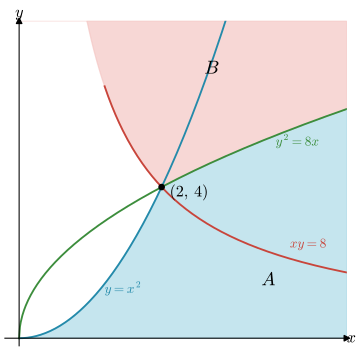
- In the plane, $A$ is the shaded part of graph $\boxed{\text{T}}$ and $B$ that of graph $\boxed{\text{U}}$ (the figures in the paper show the curves $y = x^2$, $y^2 = 8x$ and $xy = 8$ with shaded regions).
- We want the largest value of $m$ with $P(x, y)$ in $A \cup B$. In $A$, since $y = mx$, we look for the point that maximizes the slope of $OP$; in $B$, since $m = \frac8y$, we look for the point with the smallest $y$-coordinate. So at $(x, y) = (\boxed{\text{V}}, \boxed{\text{W}})$, $m$ takes its maximum value $\boxed{\text{X}}$.
Solution.
1. The inequalities. $m = \frac yx$ when $\frac yx \le x$ and $\frac yx \le \frac8y$, that is, $y \le x^2$ and $y^2 \le 8x$. And $m = \frac8y$ when $\frac8y \le \frac yx$ and $\frac8y \le x$, that is, $8x \le y^2$ and $8 \le xy$.
2. The regions. $A$ is the part below both curves $y = x^2$ and $y = \sqrt{8x}$ (graph ⓪); $B$ is the part above the curve $y = \sqrt{8x}$ and the hyperbola $xy = 8$ (graph ⑦).
3. The maximum. In $A$, the slope $\frac yx$ is largest at the “corner” where the two curves meet: $x^4 = 8x$, $x = 2$, $y = 4$, slope $2$. In $B$, the smallest $y$-coordinate is where $y^2 = 8x$ meets $xy = 8$: $y^3 = 64$, $y = 4$, $x = 2$, and $m = \frac84 = 2$. The maximum is $m = 2$, at the point $(2, 4)$, where all three numbers equal 2.
Answers: M=1, N=4, O=6, P=0, Q=0, R=6, S=5, T=0, U=7, V=2, W=4, X=2.
Question III: a trigonometric function that becomes a cubic
Statement. We want the maximum and minimum of
$$f(x) = 4\sin^3x + 4\cos^3x - 8\sin2x - 7, \qquad 0 \le x \le \pi.$$Let $t = \sin x + \cos x$. Since $\sin x + \cos x = \sqrt{\boxed{\text{A}}}\sin\left(x + \dfrac{\boxed{\text{B}}}{\boxed{\text{C}}}\pi\right)$, $t$ ranges over $-\boxed{\text{D}} \le t \le \sqrt{\boxed{\text{E}}}$. Since $\sin2x = t^2 - \boxed{\text{F}}$ and $4\sin^3x + 4\cos^3x = -\boxed{\text{G}}\,t^3 + \boxed{\text{H}}\,t$,
$$f(x) = -\boxed{\text{G}}\,t^3 - \boxed{\text{I}}\,t^2 + \boxed{\text{H}}\,t + \boxed{\text{J}} \quad \text{①}.$$Calling the right-hand side $g(t)$, $g'(t) = -\boxed{\text{K}}\left(\boxed{\text{L}}\,t - \boxed{\text{M}}\right)\left(t + \boxed{\text{N}}\right)$. At $t = \dfrac{\boxed{\text{O}}}{\boxed{\text{P}}}$, $g$ takes its maximum $\dfrac{\boxed{\text{QR}}}{\boxed{\text{ST}}}$, and at $t = \sqrt{\boxed{\text{U}}}$, its minimum $\boxed{\text{V}}\sqrt{\boxed{\text{W}}} - \boxed{\text{XY}}$.
Solution.
1. The range of $t$. $t = \sqrt2\sin\left(x + \frac\pi4\right)$, with $x + \frac\pi4 \in \left[\frac\pi4, \frac{5\pi}{4}\right]$. The sine ranges from $-\frac{\sqrt2}{2}$ to $1$, so $-1 \le t \le \sqrt2$.
2. The substitutions. $t^2 = 1 + 2\sin x\cos x$, so $\sin2x = t^2 - 1$ and $\sin x\cos x = \frac{t^2 - 1}{2}$. By the sum of cubes,
$$\sin^3x + \cos^3x = t\left(1 - \sin x\cos x\right) = t\cdot\frac{3 - t^2}{2},$$and $4(\sin^3x + \cos^3x) = -2t^3 + 6t$. So $f = -2t^3 + 6t - 8(t^2 - 1) - 7 = -2t^3 - 8t^2 + 6t + 1$.
3. The derivative. $g'(t) = -6t^2 - 16t + 6 = -2(3t^2 + 8t - 3) = -2(3t - 1)(t + 3)$. On $[-1, \sqrt2]$, $t + 3 > 0$: $g$ increases up to $t = \frac13$ and decreases afterwards.
4. The values. Maximum: $g\left(\frac13\right) = -\frac{2}{27} - \frac89 + 2 + 1 = \frac{55}{27}$. Minimum: the smaller endpoint value, $g(-1) = 2 - 8 - 6 + 1 = -11$ or $g(\sqrt2) = -4\sqrt2 - 16 + 6\sqrt2 + 1 = 2\sqrt2 - 15 \approx -12.17$. The minimum is $2\sqrt2 - 15$, at $t = \sqrt2$ (that is, $x = \frac\pi4$).
Answers: A=2, B=1, C=4, D=1, E=2, F=1, G=2, H=6, I=8, J=1, K=2, L=3, M=1, N=3, O=1, P=3, QR=55, ST=27, U=2, V=2, W=2, XY=15.
Question IV: the recurrence for the integrals of x²ⁿ√(1 − x²)
Statement. Let $a_n = \int_0^1 x^{2n}\sqrt{1 - x^2}\,dx$ ($n = 0, 1, 2, \dots$). We want $\lim_{n\to\infty}\frac{a_n}{a_{n-1}}$.
-
Since the area of the circle of radius 1 is $\pi$, $a_0 = \int_0^1\sqrt{1 - x^2}\,dx = \dfrac{\pi}{\boxed{\text{A}}}$. Integrating by parts,
$$a_1 = -\frac{\boxed{\text{B}}}{\boxed{\text{C}}}\left[x(1 - x^2)^{\frac{\boxed{\text{D}}}{\boxed{\text{E}}}}\right]_0^1 + \frac{\boxed{\text{F}}}{\boxed{\text{G}}}\int_0^1(1 - x^2)^{\frac{\boxed{\text{H}}}{\boxed{\text{I}}}}dx = \frac{\boxed{\text{J}}}{\boxed{\text{K}}}\left\{\int_0^1\sqrt{1 - x^2}\,dx - \int_0^1 x^{\boxed{\text{L}}}\sqrt{1 - x^2}\,dx\right\},$$so $a_1 = \dfrac{\pi}{\boxed{\text{MN}}}$.
-
Choose $\boxed{\text{O}}$ to $\boxed{\text{U}}$ from ⓪ $0$, ① $1$, ② $2$, ③ $3$, ④ $4$, ⑤ $2n - 2$, ⑥ $2n - 1$, ⑦ $2n$, ⑧ $2n + 1$, ⑨ $2n + 2$. In the same way,
$$a_n = \frac{\boxed{\text{O}}}{\boxed{\text{P}}}\left\{\int_0^1 x^{\boxed{\text{Q}}}\sqrt{1 - x^2}\,dx - \int_0^1 x^{\boxed{\text{R}}}\sqrt{1 - x^2}\,dx\right\},$$so $\left(\boxed{\text{S}}\right)a_n = \left(\boxed{\text{T}}\right)a_{n-1}$ and $\lim\frac{a_n}{a_{n-1}} = \boxed{\text{U}}$.
Solution.
1. $a_0$. It is the area of a quarter of the circle of radius 1: $\frac\pi4$.
2. $a_1$ by parts. Write $x^2\sqrt{1 - x^2} = x\cdot x\sqrt{1 - x^2}$, with $u = x$ and $dv = x\sqrt{1 - x^2}\,dx$, $v = -\frac13(1 - x^2)^{3/2}$:
$$a_1 = -\frac13\left[x(1 - x^2)^{3/2}\right]_0^1 + \frac13\int_0^1(1 - x^2)^{3/2}dx.$$The bracket is zero. And $(1 - x^2)^{3/2} = (1 - x^2)\sqrt{1 - x^2}$, so $a_1 = \frac13(a_0 - a_1)$, or $4a_1 = a_0$, $a_1 = \frac{\pi}{16}$.
3. The general case. With $u = x^{2n-1}$ and the same $dv$:
$$a_n = \frac{2n - 1}{3}\int_0^1 x^{2n-2}(1 - x^2)^{3/2}dx = \frac{2n - 1}{3}\left(a_{n-1} - a_n\right).$$So $3a_n + (2n - 1)a_n = (2n - 1)a_{n-1}$, or $(2n + 2)a_n = (2n - 1)a_{n-1}$.
4. The limit. $\frac{a_n}{a_{n-1}} = \frac{2n - 1}{2n + 2} \to 1$.
Answers: A=4, B=1, C=3, D=3, E=2, F=1, G=3, H=3, I=2, J=1, K=3, L=2, MN=16, O=6, P=3, Q=5, R=7, S=9, T=6, U=1.