
Euler's Eyes
2026-11-03
EJU 2018 (2nd session) – Mathematics Course 1 solved
Source: JASSO – Mathematics paper in English, in Japanese and official answer key. Files on the page for the 2nd session of 2018.
Course 1 is the basic mathematics paper of the EJU. Each letter $\boxed{\text{A}}$, $\boxed{\text{B}}$, … is a digit from 0 to 9 or the minus sign; in some blanks the answer is the number of a choice. The statements below are summarized from the official English version.
Answer key
| Question | Topic | Answers |
|---|---|---|
| I Q1 | Quadratic with a parameter | A=1, B=2, C=1, D=1, E=6, F=5, G=6, H=8, I=3, J=6, K=1, LM=−2 |
| I Q2 | Dice and a quadratic | N=5, OPQ=216, R=3, S=6, TU=36, VW=36, X=3, Y=8 |
| II Q1 | Conjugate radicals | A=2, B=3, C=2, D=3, E=4, F=1, GH=14, IJ=−5, KL=−1, M=3 |
| II Q2 | Three parabolas | N=2, O=1, P=0, Q=4, R=3, S=1, T=3, U=2, V=3, W=4 |
| III | Divisors of 1400 | A=2, B=3, C=5, D=2, E=7, FG=24, H=3, I=7, JKL=200, MN=28, O=4, P=1, Q=7, R=2, ST=57 |
| IV | Rhombus and four circles | A=4, B=2, C=3, D=4, E=2, F=3, G=3, H=1, I=3, J=1, K=2, L=3, M=1, N=3, O=2, P=3, Q=1, R=2, S=3, T=1, U=2, V=2, W=6, X=5, YZ=18 |
Question I
Q1: maximum and minimum of a quadratic with a parameter
Statement. Consider the maximum $M$ and the minimum $m$ of $f(x) = x^2 - 2(a + 1)x + 2a^2$ on $0 \le x \le 2$, where $a$ is a constant with $0 \le a \le 3$.
- The vertex of the graph is $\left(a + \boxed{\text{A}},\ a^2 - \boxed{\text{B}}\,a - \boxed{\text{C}}\right)$.
- Choose $\boxed{\text{D}}$ to $\boxed{\text{H}}$ from ⓪ $0$, ① $1$, ② $2$, ③ $3$, ④ $a^2 - 2a$, ⑤ $a^2 - 2a - 1$, ⑥ $2a^2$, ⑦ $2a^2 - 2a - 1$, ⑧ $2a^2 - 4a$, ⑨ $2a^2 - 6a + 3$. If $0 \le a < \boxed{\text{D}}$, $M = \boxed{\text{E}}$ and $m = \boxed{\text{F}}$; if $\boxed{\text{D}} \le a \le 3$, $M = \boxed{\text{G}}$ and $m = \boxed{\text{H}}$.
- $m$ is largest at $a = \boxed{\text{I}}$, with value $\boxed{\text{J}}$, and smallest at $a = \boxed{\text{K}}$, with value $\boxed{\text{LM}}$.
Solution.
1. $f(x) = (x - a - 1)^2 + 2a^2 - (a + 1)^2 = (x - a - 1)^2 + a^2 - 2a - 1$.
2. The axis $x = a + 1$ is in $[1, 4]$, never to the left of the middle of $[0, 2]$. So the endpoint farther from the axis is always $x = 0$: $M = f(0) = 2a^2$. For the minimum:
- if $a + 1 < 2$, that is, $a < 1$, the vertex is inside: $m = a^2 - 2a - 1$;
- if $a \ge 1$, the vertex is to the right of 2 (or at 2): $m = f(2) = 2a^2 - 4a$.
3. On $[0, 1)$, $m = (a - 1)^2 - 2$ decreases from $-1$ to nearly $-2$; on $[1, 3]$, $m = 2(a - 1)^2 - 2$ increases from $-2$ to $6$. Maximum $6$ at $a = 3$; minimum $-2$ at $a = 1$.
Answers: A=1, B=2, C=1, D=1, E=6, F=5, G=6, H=8, I=3, J=6, K=1, LM=−2.
Q2: dice and a quadratic
Statement. A die is rolled three times, giving $a$, $b$ and $c$. Let $f(x) = ax^2 + bx + c$.
- The probability that $b = 4$ and $f(x) = 0$ has two distinct real solutions is $\dfrac{\boxed{\text{N}}}{\boxed{\text{OPQ}}}$.
- The probability that $f(10) > 453$. The number of triples $(a, b, c)$ with $f(10) > 453$ is: with $a = 4$ and $b = 5$, $\boxed{\text{R}}$; with $a = 4$ and $b = 6$, $\boxed{\text{S}}$; with $a = 5$, $\boxed{\text{TU}}$; with $a = 6$, $\boxed{\text{VW}}$. The probability is $\dfrac{\boxed{\text{X}}}{\boxed{\text{Y}}}$.
Solution. There are $6^3 = 216$ equally likely triples.
1. With $b = 4$, the discriminant $16 - 4ac$ is positive when $ac < 4$: $(a, c) \in \{(1,1), (1,2), (1,3), (2,1), (3,1)\}$. That is $5$ triples: $\frac{5}{216}$.
2. $f(10) = 100a + 10b + c$ is the three-digit number “$abc$”. To exceed 453:
- $a \le 3$: at most $366$, never.
- $a = 4$, $b \le 4$: at most $446$, never.
- $a = 4$, $b = 5$: $450 + c > 453$ for $c = 4, 5, 6$: $3$ triples.
- $a = 4$, $b = 6$: always: $6$ triples.
- $a = 5$ or $a = 6$: always: $36$ triples each.
Total $3 + 6 + 36 + 36 = 81$, and $\frac{81}{216} = \frac38$.
Answers: N=5, OPQ=216, R=3, S=6, TU=36, VW=36, X=3, Y=8.
Question II
Q1: conjugate radicals
Statement. Let $x = \dfrac{\sqrt3 + 1}{\sqrt3 - 1}$ and $y = \dfrac{\sqrt6 - \sqrt2}{\sqrt6 + \sqrt2}$.
- $x = \boxed{\text{A}} + \sqrt{\boxed{\text{B}}}$ and $y = \boxed{\text{C}} - \sqrt{\boxed{\text{D}}}$. Then $x + y = \boxed{\text{E}}$, $xy = \boxed{\text{F}}$ and $\frac{1}{x^2} + \frac{1}{y^2} = \boxed{\text{GH}}$. Moreover, $5(x^2 - 4x) + 3(y^2 - 4y + 1) = \boxed{\text{IJ}}$.
- The integers $m$ and $n$ with $\frac mx + \frac ny = 4 + 4\sqrt3$ are $m = \boxed{\text{KL}}$ and $n = \boxed{\text{M}}$.
Solution.
1. Rationalizing: $x = \frac{(\sqrt3 + 1)^2}{2} = 2 + \sqrt3$ and $y = \frac{(\sqrt6 - \sqrt2)^2}{4} = \frac{8 - 4\sqrt3}{4} = 2 - \sqrt3$. They are conjugates: $x + y = 4$ and $xy = 1$. Since $xy = 1$, $\frac{1}{x^2} + \frac{1}{y^2} = y^2 + x^2 = 16 - 2 = 14$.
2. $x$ and $y$ are the roots of $t^2 - 4t + 1 = 0$. So $x^2 - 4x = -1$ and $y^2 - 4y + 1 = 0$, and the expression equals $5\cdot(-1) + 3\cdot0 = -5$.
3. $\frac mx + \frac ny = my + nx = m(2 - \sqrt3) + n(2 + \sqrt3) = 2(m + n) + (n - m)\sqrt3$. Comparing with $4 + 4\sqrt3$ (integers, and $\sqrt3$ irrational): $m + n = 2$ and $n - m = 4$, so $m = -1$ and $n = 3$.
Answers: A=2, B=3, C=2, D=3, E=4, F=1, GH=14, IJ=−5, KL=−1, M=3.
Q2: three parabolas
Statement. Consider $f(x) = -x^2 - 2x + 1$, $g(x) = -x^2 + 4x$ and $h(x) = 2x^2 + ax + b$.
- Let $D_1$ be the discriminant of $h(x) - f(x) = 0$ and $D_2$ that of $h(x) - g(x) = 0$. Then $D_1 = \boxed{\text{N}}$ and $D_2 = \boxed{\text{O}}$ (choose from ⓪ $a^2 + 4a - 3b + 7$, ① $a^2 - 8a - 12b + 16$, ② $a^2 + 4a - 12b + 16$, ③ $a^2 + 8a + 12b + 16$, ④ $a^2 - 4a + 12b + 16$, ⑤ $a^2 - 8a - 3b + 7$).
- The values of $a$ and $b$ for which $f(x) = h(x)$ and $g(x) = h(x)$ each have exactly one real solution are $a = \boxed{\text{P}}$ and $b = \dfrac{\boxed{\text{Q}}}{\boxed{\text{R}}}$. Then the solution of $f(x) = h(x)$ is $x = -\dfrac{\boxed{\text{S}}}{\boxed{\text{T}}}$ and that of $g(x) = h(x)$ is $x = \dfrac{\boxed{\text{U}}}{\boxed{\text{V}}}$.
- Let $b = 3$. The values of $a$ for which $f(x) < h(x)$ and $g(x) < h(x)$ for all $x$ are $\boxed{\text{W}}$ (choose from ⓪ $-2 - 2\sqrt6 < a < 10$, ① $a < -2 - 2\sqrt6$ or $10 < a$, ② $a < -1 - \sqrt6$ or $10 < a$, ③ $-2 < a < -1 + \sqrt6$, ④ $-2 < a < -2 + 2\sqrt6$, ⑤ $-1 - \sqrt6 < a < 10$).
Solution.
1. $h - f = 3x^2 + (a + 2)x + (b - 1)$, so $D_1 = (a + 2)^2 - 12(b - 1) = a^2 + 4a - 12b + 16$ (②). And $h - g = 3x^2 + (a - 4)x + b$, so $D_2 = (a - 4)^2 - 12b = a^2 - 8a - 12b + 16$ (①).
2. $D_1 = D_2 = 0$. Subtracting: $12a = 0$, $a = 0$, and then $16 - 12b = 0$, $b = \frac43$. The double roots are $x = -\frac{a + 2}{6} = -\frac13$ and $x = -\frac{a - 4}{6} = \frac23$.
3. $h - f > 0$ and $h - g > 0$ for all $x$ (upward parabolas) require $D_1 < 0$ and $D_2 < 0$. With $b = 3$:
- $D_1 = a^2 + 4a - 20 < 0$: $-2 - 2\sqrt6 < a < -2 + 2\sqrt6$;
- $D_2 = a^2 - 8a - 20 = (a - 10)(a + 2) < 0$: $-2 < a < 10$.
The intersection is $-2 < a < -2 + 2\sqrt6$ (④).
Answers: N=2, O=1, P=0, Q=4, R=3, S=1, T=3, U=2, V=3, W=4.
Question III: the divisors of 1400
Statement.
- The prime factorization of 1400 is $\boxed{\text{A}}^{\boxed{\text{B}}}\times\boxed{\text{C}}^{\boxed{\text{D}}}\times\boxed{\text{E}}$, with $\boxed{\text{A}} < \boxed{\text{C}}$.
- 1400 has $\boxed{\text{FG}}$ divisors.
- Let $a$ and $b$ be divisors of 1400 with $1 < a < b$. There are $\boxed{\text{H}}$ pairs $(a, b)$ with $a$ and $b$ coprime and $ab = 1400$. Among them, the pair with the largest $b - a$ is $a = \boxed{\text{I}}$, $b = \boxed{\text{JKL}}$.
- With these $a$ and $b$, consider $bx - ay = 1$ ①, which can be written $y = \boxed{\text{MN}}\,x + \dfrac{\boxed{\text{O}}\,x - \boxed{\text{P}}}{\boxed{\text{Q}}}$. Among the pairs of positive integers satisfying ①, the one with the smallest $x$ is $x = \boxed{\text{R}}$, $y = \boxed{\text{ST}}$.
Solution.
1–2. $1400 = 14\cdot100 = 2^3\cdot5^2\cdot7$, with $(3 + 1)(2 + 1)(1 + 1) = 24$ divisors.
3. If $a$ and $b$ are coprime and $ab = 1400$, each prime power ($8$, $25$, $7$) goes entirely to $a$ or to $b$. Since $a > 1$ and $b > 1$, neither is left empty: the splits are $\{7\}\{200\}$, $\{8\}\{175\}$, $\{25\}\{56\}$. That is $3$ pairs, and the largest difference is $200 - 7 = 193$.
4. $200x - 7y = 1$ gives $y = \frac{200x - 1}{7} = 28x + \frac{4x - 1}{7}$. We need $4x \equiv 1 \pmod 7$; since $4\cdot2 = 8 \equiv 1$, the smallest positive $x$ is $2$, and $y = 56 + 1 = 57$. (Check: $400 - 399 = 1$.)
Answers: A=2, B=3, C=5, D=2, E=7, FG=24, H=3, I=7, JKL=200, MN=28, O=4, P=1, Q=7, R=2, ST=57.
Question IV: a rhombus and four circles
Statement. $ABCD$ is a rhombus with side $\sqrt2$ and $\angle ABC = 30^\circ$.
-
$AC^2 = \boxed{\text{A}} - \boxed{\text{B}}\sqrt{\boxed{\text{C}}}$ and $BD^2 = \boxed{\text{D}} + \boxed{\text{E}}\sqrt{\boxed{\text{F}}}$. Using $(\sqrt a \pm \sqrt b)^2 = a + b \pm 2\sqrt{ab}$, we get $AC = \sqrt{\boxed{\text{G}}} - \boxed{\text{H}}$ and $BD = \sqrt{\boxed{\text{I}}} + \boxed{\text{J}}$.
-
Draw four circles centered at the vertices: those centered at $A$ and $C$ have radius $r$, and those centered at $B$ and $D$ have radius $\sqrt2 - r$. Circles centered at opposite vertices may touch but not intersect. Let $S$ be the area of the region common to the rhombus and the four circles. Then
$$S = \pi\left(r^2 - \frac{\sqrt{\boxed{\text{K}}}}{\boxed{\text{L}}}\,r + \frac{\boxed{\text{M}}}{\boxed{\text{N}}}\right),$$with $\sqrt{\boxed{\text{O}}} - \dfrac{\sqrt{\boxed{\text{P}}} + \boxed{\text{Q}}}{\boxed{\text{R}}} \le r \le \dfrac{\sqrt{\boxed{\text{S}}} - \boxed{\text{T}}}{\boxed{\text{U}}}$. $S$ is smallest at $r = \dfrac{\sqrt{\boxed{\text{V}}}}{\boxed{\text{W}}}$, with value $\dfrac{\boxed{\text{X}}}{\boxed{\text{YZ}}}\pi$.
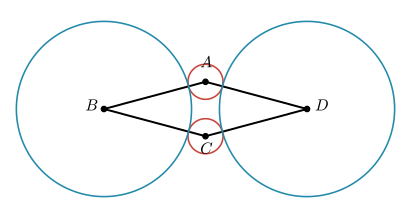
Solution.
1. The diagonals. The angle at $B$ is $30^\circ$ and the angle at $A$ is $150^\circ$. By the law of cosines:
$$AC^2 = 2 + 2 - 4\cos30^\circ = 4 - 2\sqrt3, \qquad BD^2 = 2 + 2 - 4\cos150^\circ = 4 + 2\sqrt3.$$Since $4 \pm 2\sqrt3 = 3 + 1 \pm 2\sqrt3 = (\sqrt3 \pm 1)^2$: $AC = \sqrt3 - 1$ and $BD = \sqrt3 + 1$.
2. The sectors. Neighboring circles have radii adding up to $r + (\sqrt2 - r) = \sqrt2$, the side of the rhombus: they touch without overlapping. Opposite ones do not intersect. So the common region is the union of four disjoint sectors, with the angles of the rhombus:
$$S = 2\cdot\frac{150}{360}\pi r^2 + 2\cdot\frac{30}{360}\pi(\sqrt2 - r)^2 = \frac{5\pi}{6}r^2 + \frac{\pi}{6}(2 - 2\sqrt2\,r + r^2) = \pi\left(r^2 - \frac{\sqrt2}{3}r + \frac13\right).$$3. The range of $r$. The circles at $A$ and $C$ do not intersect: $2r \le AC = \sqrt3 - 1$. Those at $B$ and $D$: $2(\sqrt2 - r) \le \sqrt3 + 1$. So
$$\sqrt2 - \frac{\sqrt3 + 1}{2} \le r \le \frac{\sqrt3 - 1}{2},$$that is, $0.048\ldots \le r \le 0.366\ldots$
4. The minimum. The vertex of the parabola in $r$ is $r = \frac{\sqrt2}{6} \approx 0.236$, inside the interval. So
$$S_{\min} = \pi\left(\frac{2}{36} - \frac{2}{18} + \frac13\right) = \pi\cdot\frac{1 - 2 + 6}{18} = \frac{5}{18}\pi.$$Answers: A=4, B=2, C=3, D=4, E=2, F=3, G=3, H=1, I=3, J=1, K=2, L=3, M=1, N=3, O=2, P=3, Q=1, R=2, S=3, T=1, U=2, V=2, W=6, X=5, YZ=18.