
Euler's Eyes
2026-10-26
The metre won, decimal time did not
In 1793, at the height of the French Revolution, the National Convention decided that time too would be decimal. The day would have 10 hours, each hour 100 minutes and each minute 100 seconds. Clockmakers made new dials, some with both scales side by side so that people would get used to them.
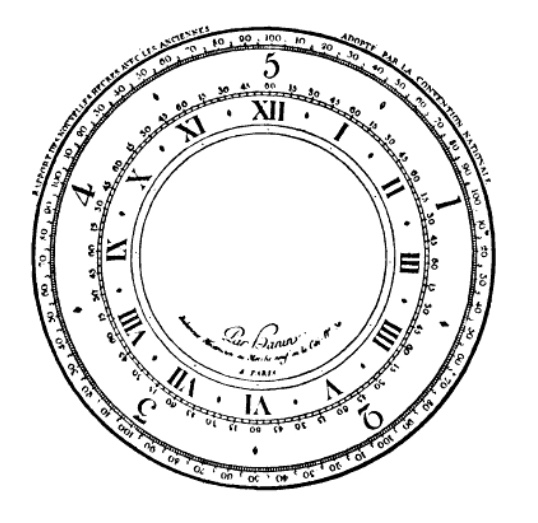
Decimal time became compulsory at the end of 1794 and was suspended in April 1795, seventeen months after it was decreed. Nobody wanted to change their household clock, church clocks went on striking twelve, and the new time had no practical advantage to make up for the bother. The Republican calendar, with months of 30 days divided into three “decades” of 10, lasted a little longer: Napoleon abolished it at the start of 1806.
The metre
The same 1795 law that buried decimal time created the metric system. The metre was defined as one ten-millionth of the distance from the North Pole to the equator, and two astronomers, Jean-Baptiste Delambre and Pierre Méchain, spent 1792 to 1798 measuring the arc of meridian between Dunkirk and Barcelona to fix it. The gram, the litre and the are came along, all tied to the metre and all divided by ten.
The metre won where the hour lost because it solved a real problem. France had hundreds of local measures with the same name and different values; trade suffered from this, and so did the state when it came to collecting taxes. The decimal system made conversions as easy as moving a decimal point, the same advantage of place value we saw in chapter 1. Even so, it only became compulsory in France in 1840.
The grad that was left
The revolutionaries also wanted to decimalise the angle: the right angle would have 100 grads (or centesimal grades), and the full turn 400. The idea had better luck than the hour: it was used by generations of French surveyors and cartographers and still appears as the GRAD mode of scientific calculators, next to DEG and RAD. But the Babylonian degree, with its 360 and its 60 minutes, never moved.
The lesson is that a notation does not win just by being logical. It wins when the community that will use it gains more than it loses from the change, and when whoever imposes it has the trust of those who will use it.
Exercise: a decimal late afternoon
What time is it, in decimal time, at 18:00 on an ordinary clock? And at 9:00?
At 18:00, $\frac{18}{24} = 0.75$ of the day has passed. In decimal time, $0.75 \times 10 = 7.5$ hours, that is, 7 hours and 50 decimal minutes. At 9:00, $\frac{9}{24} = 0.375$ of the day, or 3 hours and 75 decimal minutes. The calculation is easy because the decimal day is a fraction written in base 10: $0.375$ of the day reads directly as 3h75.
Exercise: degrees and grads
How many grads are there in an angle of $45°$? And how many degrees in $1$ grad?
Since $90° = 100$ grads, $45° = 50$ grads. And $1 \text{ grad} = \frac{90°}{100} = 0.9° = 54'$. Converting between the two systems is a rule of three, but within each one the choice of base matters: in grads, half and a quarter of the right angle are round numbers; in degrees, so is a third ($30°$).
Chapter index · ← Other scripts, other mathematics: rods, dots and knots · Tribal conventions: Einstein, Bourbaki and the initiated reader →