
Euler's Eyes
2022-10-15
Compound interest and Euler's number
John Napier was so important for applications in finance that he motivated Leonhard Euler to venture into this area. One of the irrational numbers most important with application in finance, is due to these two mathematicians.

Compound Interest
The history of compound interest and the number $e$ was thanks to Jacques Bernoulli between (1654-1705), who became interested in discovering the maximum value of interest on loans using the compound interest technique.
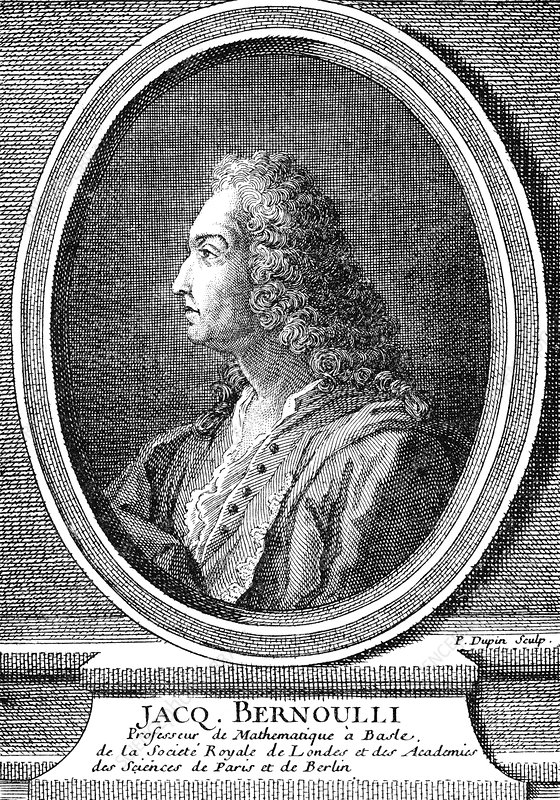
With the interest accumulated from the initial value, he dedicated himself to studying how to maximize the gain.
Suppose, with simple interest, a capital of R$ 1 with interest of 100% at the end of one year.
In this case, we earn 2 reais at the end of a year.
However, if a person proposes that instead of 1 year, the interest rate is proportional to the inverse of the period raised to the same period. In this case, he proposes compound interest per month (12 months = 1 year).
Once again, this person proposes that the interest rate is compounded per day (365 days = 1 year).
It doesn’t seem very advantageous to earn 0.71 cents more than in the first proposal. But if the capital was 100 reais, 71 reais may be more advantageous.

Bernoulli realized that interest has a certain limit and it seems that 2.71 is this factor. The mathematician Leonhard Euler between (1707 and 1783) was very interested in the results obtained by Bernoulli. This irrational number was one of the greatest revolutions in mathematics at the time.
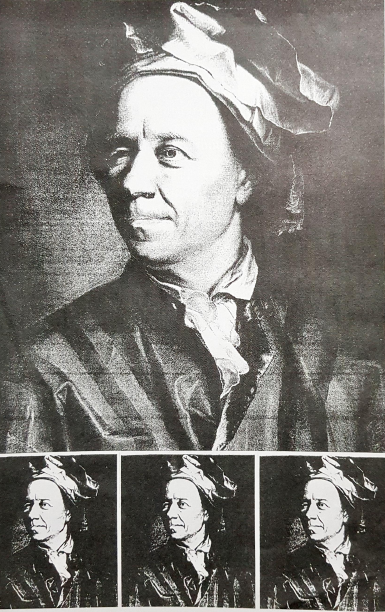
He demonstrated the irrationality of this number through exponential functions and used continued fractions. To illustrate better, we will show you step by step how to reach the interest rate limit.
Division of the year into 1 period
Initially we take:
- Capital $$C_0=100$$
- Interest J=100 % in the year
- End of first year $$C_1=C_0+100=200 \quad \Rightarrow \quad \left(1+\frac{1}{1}\right)^1=2$$
| Period | Simple Interest | Compound Interest |
|---|---|---|
| $0$ | $100$ | $100$ |
| $1$ | $100 \left(1+\frac{100}{100}~.~1\right)= 200\quad$ | $100~.~\left(1+\frac{100}{100}\right)^1=200$ |
Division of the year into 2 periods
Initially we take:
- Capital $$C_0=100$$
- Interest J = 50 % in the semester
- End of first semester $$C_1=C_0+50=150 \quad \Rightarrow \quad \left(1+\frac{1}{2}\right)^1=1.5$$
- End of second semester $$C_2=C_1+75=225 \quad \Rightarrow \quad \left(1+\frac{1}{2}\right)^2=2.25$$
| Period | Simple Interest | Compound Interest |
|---|---|---|
| 0 | $100$ | $100$ |
| 1 | $100~.~\left(1+\frac{50}{100}\right)= 150\quad$ | $100~.~\left(1+\frac{50}{100}\right)^1=150$ |
| 2 | $100~.~\left(1+\frac{50}{100}~.~2\right)= 200\quad$ | $100~.~\left(1+\frac{50}{100}\right)^2=225$ |
Division of the year into 3 periods
Initially we take:
- Capital $$C_0=100$$
- Interest J = 25 % in the quarter
- End of first quarter $$C_1=C_0+25=125 \quad \Rightarrow \quad \left(1+\frac{1}{4}\right)^1=1.25$$
- End of second quarter $$C_2=C_1+31.25=156.25 \quad \Rightarrow \quad \left(1+\frac{1}{4}\right)^2=1.5625$$
- End of third quarter $$C_3=C_2+39.06=195.31 \quad \Rightarrow \quad \left(1+\frac{1}{4}\right)^3=1.9531$$
- End of the fourth quarter $$C_4=C_3+48.83=244.14 \quad \Rightarrow \quad \left(1+\frac{1}{4}\right)^4=2.4414$$
| Period | Simple Interest | Compound Interest |
|---|---|---|
| 0 | $100$ | $100$ |
| 1 | $100~.~\left(1+\frac{25}{100}\right)= 125\quad$ | $100~.~\left(1+\frac{25}{100}\right)^1=125$ |
| 2 | $100~.~\left(1+\frac{25}{100}~.~2\right)= 150\quad$ | $100~.~\left(1+\frac{25}{100}\right)^2=156.25$ |
| 3 | $100~.~\left(1+\frac{25}{100}~.~3\right)= 175\quad$ | $100~.~\left(1+\frac{25}{100}\right)^3=195.31$ |
| 4 | $100~.~\left(1+\frac{25}{100}~.~4\right)= 200\quad$ | $100~.~\left(1+\frac{25}{100}\right)^4=244.1406$ |

Division of the year into n periods
The corrected capital for the nth period is given by: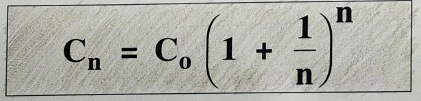
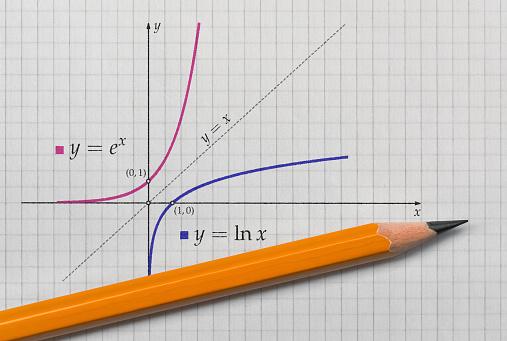
Limit for n periods
We know that even for any n periods, we have to have a limit. Leonhard Euler realized this and defined the universal constant, which he called
e by Euler, but named after John Napier. For this, we take:
We note that:
Thus, more generally:
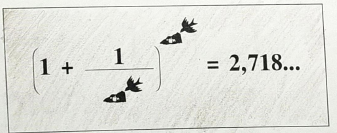

Euler number
University students on duty can recognize this result in Calculus I.
$$\lim_{n\rightarrow \infty} \left(1+\frac{1}{n}\right)^n = e$$

Euler also expanded into series:
$$e = 1 + \frac{1}{1} + \frac{1}{2~.~1} + \frac{1}{3~.~2~.~1} + \frac{1}{4~.~3~.~2~.~1} + \frac{1}{5~.~4~.~3~.~2~.~1} + \dots$$

Briefly, we have
$$\text{Euler Napier}\qquad \left(1+\frac{1}{\infty}\right)^\infty = e$$
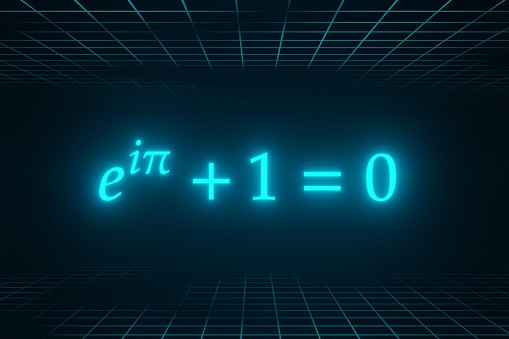
Just out of curiosity in complex numbers, Euler discovered the relationship.
So far this is what we can talk about compound interest. Wait for the next posts.