
Euler's Eyes
2022-11-21
Understanding Relationships
The concept of relations is the starting point for the concept of functions in real numbers. In addition, concepts of ordered pair, Cartesian product and the Cartesian plane itself. One of the main mathematicians who contributed to this concept was Julius Wilhelm Richar Dedekind.

Tribute to Dedekind
Our honoree today is Julius Wilhelm Richar Dedekind. He was one of four children in a Lutheran family from Braunschweig, Germany.

At the age of 19 he entered his doctorate in Gottingen, at 22 he completed it. A student of Dirichlet, he taught secondary education in Brunswick until the last years of his life. He was very concerned about the nature of functions and numbers. In this way, he has been focused on the problem of irrational numbers since 1858 when he taught Calculus.
Ordered Pair
Definition: Ordered pair is two numbers formed by the pair $(x,y)$ with coordinates $x$ and $y$ respectively.

From the concept of equality of sets, we observe that reversing the order of the elements does not produce a new pair:
- $\\{1,2\\} = \\{2, 1\\},$
- $\\{3, -1\\} = \\{-1, 3\\}$
- $\\{a, b\\} = \\{b, a\\}.$
In Mathematics there are situations where there is a need to distinguish two pairs in the order of the elements.
For example, in the system of equations:
In this case, $x = 2$ and $y = 1$ is the solution of this system of equations. However, for $x = 1$ and $y = 2$ this is not a solution.
In sets the solution would be:
- $\\{2, l\\}$ would be a solution and
- $\\{1, 2\\}$ would not be a solution.
There is a contradiction, because being $\\{2, 1\\} = \\{1, 2\\}$, the same set is and is not a solution.
Because of this we say that the solution is the ordered pair $(2, 1)$ where it is understood that:
- First element $2$ refers to the unknown $x$ and the
- Second element $1$ refers to the unknown $y$
According to the concept of ordered pair we have that:
$$(a,b)=(c,d) \quad \text{se, e somente se}\quad a=c \quad \text{ e } \quad b=d$$Cartesian Plane Coordinates
Definition: Abscissa is the horizontal number line, which we call the coordinate of the $x$ axis.
Definition: Ordinate is the vertical number line, which we call the axis coordinate $y$.
Quadrants
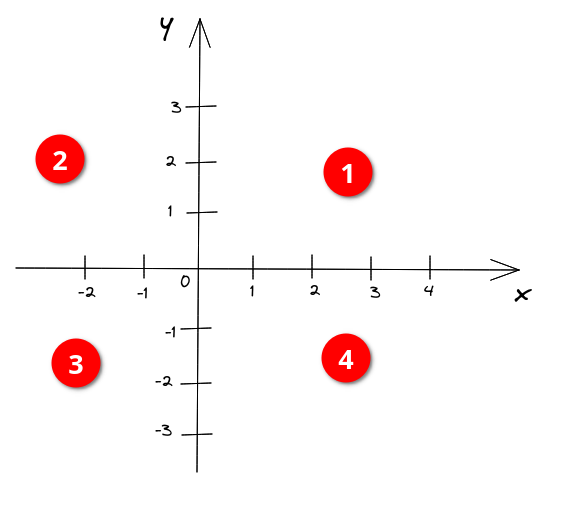
After defining ordered pairs, the next step is to classify these pairs. In a counterclockwise direction we can classify these pairs that we call quadrants. In this way, we have the quadrants:

- First quadrant: ordered pairs $(x,y)$ both positive
- Second quadrant: ordered pairs $(-x,y)$ negative abscissa > and positive ordinate
- Third quadrant: ordered pairs $(-x,-y)$ both negative
- Fourth quadrant: ordered pairs $(x,-y)$ positive abscissa and negative ordinate
Cartesian Product
In order to explore the concept of Cartesian product, let us consider the sets
- $A = \\{2, 3, 4\\}$
- $B = \\{2, 3, 4, 5, 6\\}$
The Cartesian product of $A$ by $B$ is the set
$$A \times B = \\{(x, y); x\in A \text{ e } y \in B \\}$$- $A\times B$: Cartesian product of $A$ by $B$
- $(x,y)$: ordered pair with coordinates:
- $x$ coordinate called abscissa
- $y$ coordinate called ordered
- such that:
- $x \in A$: $x$ belongs to $A$
- $y \in B$: $y$ belongs to $B$
Next, we will show it with the arrow diagram.

formed by $3 ~·~ 5 = 15$ elements represented by the figure. The set of ordered pairs $(x, y)$ of $A \times B$ such that $x | y$, where $x$ is a divisor of $y$.
Binary Relationship
The Cartesian plane from the previous section, in which are given by the divisors $x | y$. In this way, the relationship between the elements of $A$ and $B$ is given by:
The set $\mathcal{R}$ is contained in $A \times B$ and is formed by pairs $(x, y)$ in which the element $x$ of $A$ is “associated” with the element $y$ of $B$ through a certain “relationship” or “correspondence” criterion.
To represent the binary relationship visually, we will use the arrow diagram.

Definition (Binary Relation): Let the sets be $A$ and $B$, the binary relation of $A$ in $B$ is all subset $\mathcal{R}$ of $A \times B$
$\mathcal{R}$ is binary relation in $A$ in $B$ $\iff \mathcal{R} \subseteq A\times B$
In the case where the pair $(x,y)$ belongs to the relationship $\mathcal{R}$, we write $x \mathcal{R} y$.
$$(x,y) \in \mathcal{R} \quad \iff \quad x \mathcal{R} y$$
These are the concepts of relationships. Wait for the next posts.