
Euler's Eyes
2026-10-11
Positions of two segments
Consecutive, collinear, adjacent segments: names that describe how two pieces of straight line fit together.
Who discovered
This classification does not have an author: it is a modern didactic organization. The practice of joining segments, however, is very old. The Egyptian surveyors, who the Greek historian Herodotus (5th century BC) linked to the origin of geometry, remarked the fields after each flood of the Nile by amending measurements made with ropes. Centuries later, Heron of Alexandria (1st century AD) described in his Dioptra how to measure land using aligned sections.


The story
Herodotus says that, when the Nile took part of a piece of land, an employee of the pharaoh came to measure the loss to adjust the tax, and that the Greeks would have learned geometry from there. The story is a Greek account of Egypt, not an Egyptian document, but it shows how geometry was born linked to the measurement of land.
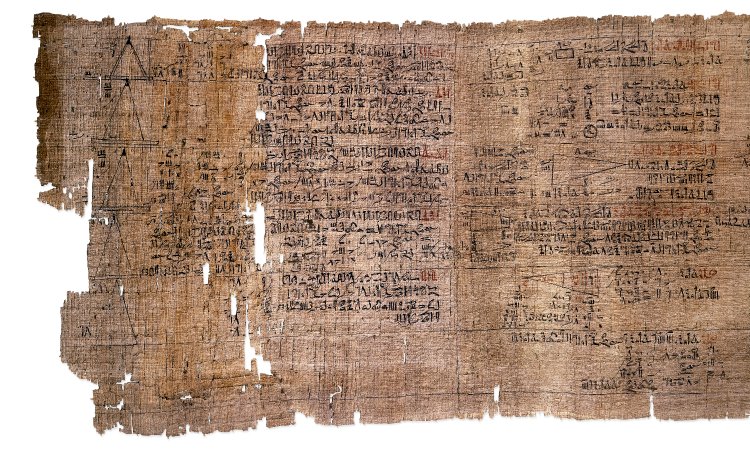
Measuring a long side to the pieces is exactly adding consecutive and collinear segments: the end of one chord is the beginning of the next, all on the same line. The nomenclature of this topic gives a precise name to this situation.
In everyday life
- GPS Routes. A route is drawn as a sequence of consecutive segments; on straight lines, they are also collinear.
- Carpenter’s articulated meter. Folding rulers are consecutive segments; stretched, they become collinear and adjacent.
- Plumbing. Pipes spliced by sleeves form adjacent segments; with an elbow, they remain consecutive, but are no longer collinear.
- Fences. Each gap between two posts is a segment; the entire fence is the sum of them.
Sources: Egyptian mathematics (MacTutor) · Heron of Alexandria (MacTutor).
Theory and constructions
DefiniçãoConsecutive, collinear and adjacent segments
- Two segments are consecutive if an end of one of them is also an end of the other.
- Two segments are collinear if they are on the same straight line.
- Two consecutive and collinear segments are adjacent if they have only one end in common (they have no common internal points).
In the figure below, drag the edges and watch the sorting change. The ends “stick” to each other and to the straight line of the other segment, to make it easier.