
Euler's Eyes
2026-10-11
orthocenter — heights
The three heights of a triangle also meet at a point, orthocenter. Interestingly, Euclid never proved this.
Who discovered
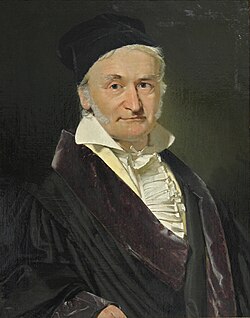
The The Elements do not demonstrate that the heights are concurrent. The first known published demonstration is by the Englishman William Chapple, in 1749. The most cited, however, is by Carl Friedrich Gauss (1810): he drew, for each vertex, the parallel to the opposite side, forming a larger triangle; the heights of the original triangle become the perpendicular bisectors of the larger one and therefore meet. The name orthocenter (from the Greek orthos, “straight”) was only created in the 19th century.
The story
Gauss’s proof is a good example of how a new problem can be reduced to one already solved: instead of studying the heights directly, he transformed them into perpendicular bisectors, whose competition Euclid had already proven.

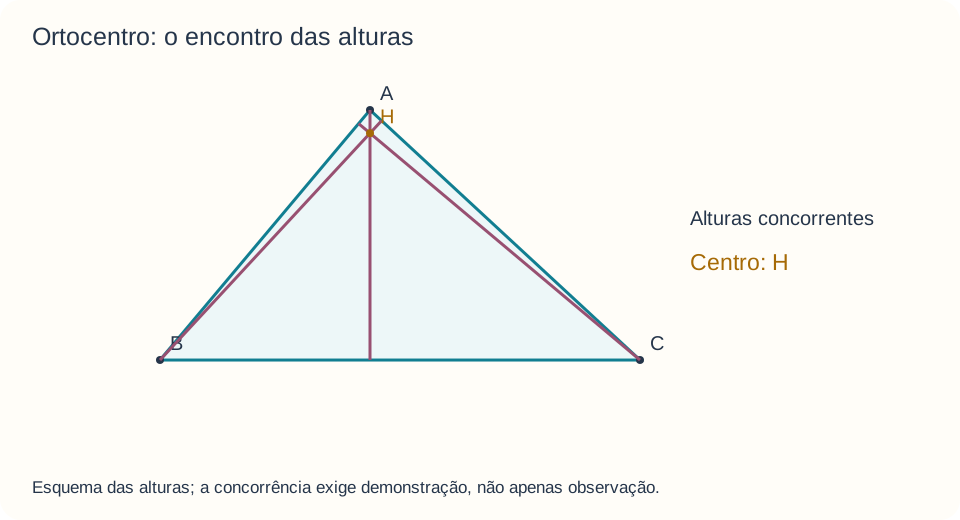
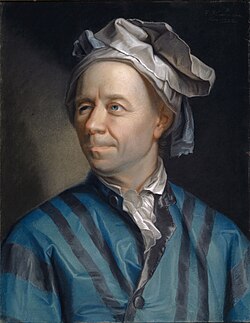
orthocenter has a curious behavior: it is inside the acute triangle, coincides with the vertex of the right angle in the right triangle and goes outside in the obtuse triangle. In 1765, Leonhard Euler discovered that it is aligned with centroid and circumcenter, as told in the curiosity “Euler’s straight line”, below.
In everyday life
- Height of roofs and ramps. The height of a triangle is the vertical distance that is measured on site; the area of a gable (triangular wall) uses base times height.
- Land area. Surveyors calculate the area of triangular lots by lowering a height to the side chosen as the base.
- Right triangle. In a square, two of the heights are the perpendicular sides themselves, and orthocenter is the straight corner.
- Trusses. In triangular structures, the struts perpendicular to one side follow the heights of the triangle.
Sources: Gauss (MacTutor) · Euler (MacTutor).
Theory and constructions
TeoremaCompetition from the heights
The three straight lines supporting the heights of a triangle intersect at the same point.
Demo
- Through the vertices $A$, $B$ and $C$, we draw straight lines parallel to the opposite sides, obtaining a larger triangle $MNP$, with $A \in \overline{NP}$, $B \in \overline{MP}$ and $C \in \overline{MN}$.
- $APBC$ and $ABCN$ are parallelograms, so $AP = BC = AN$: $A$ is the midpoint of $\overline{NP}$.
- Like $\overline{AH_1} \perp \overline{BC}$ and $\overline{NP} \parallel \overline{BC}$, the line $AH_1$ is perpendicular to $\overline{NP}$ through its midpoint: it is the perpendicular bisector of $\overline{NP}$.
- Likewise, $BH_2$ and $CH_3$ are the perpendicular bisectors of $\overline{MP}$ and $\overline{MN}$.
- perpendicular bisectors and $\triangle MNP$ are concurrent (section III). Therefore, the height lines of $\triangle ABC$ pass through the same point $H$.
Definiçãoorthocenter
The meeting point of the straight height supports is orthocenter.
ResumoThe four notable points
| Point | Meeting of | Property | Position |
|---|---|---|---|
| centroid $G$ | medians | divides the medians into $2 : 1$; center of gravity | always internal |
| incenter $I$ | angle bisectors internal | equidistant from the sides; registration center | always internal |
| circumcenter $O$ | perpendicular bisectors | equidistant from the vertices; center of the district | internal (acutangle), at the midpoint of the hypotenuse (rectangle), external (obtuse angle) |
| orthocenter $H$ | heights | — | internal (acutangle), at the vertex of the right angle (rectangle), external (obtuse angle) |