
Euler's Eyes
2026-10-13
Square root: the side of the square and the sign that forgot
Two questions that look the same:
| Question | Answer |
|---|---|
| What is $\sqrt9$? | $3$ |
| Which real numbers satisfy $x^2=9$? | $3$ and $-3$ |
Many people find the first line strange. If $(-3)^2$ also gives $9$, why isn’t $\sqrt9$ “$\pm3$”? The answer is in chapter 1, in the old name of the symbol. Radix quadrati was the side of the square. A square of area $9$ has side $3$, and no side measures $-3$.
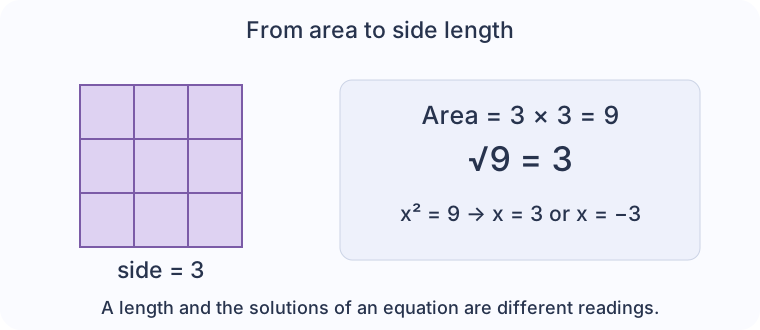
One sign, one value
Modern mathematics kept the memory of the square in a definition: for $a\ge0$, the symbol $\sqrt a$ denotes the only non-negative number whose square is $a$. There is also a syntactic reason for this. A sign that, given a number, returned sometimes one value and sometimes two could not go into calculations: what would $\sqrt9+1$ be? $4$ or $-2$? For $\sqrt{\phantom{a}}$ to work like the other operations, it has to give one answer, and geometry says which.
That does not erase the $-3$. It is still a solution of $x^2=9$, and the writing that shows both solutions is
$$x^2=9\iff x=\sqrt9\ \text{ or }\ x=-\sqrt9\iff x=\pm3.$$The $\pm$ appears outside the root, because it is the equation, not the symbol, that has two solutions. That is why the quadratic formula has a $\pm$ written in front of the radical: the radical alone gives one value, and the $\pm$ asks for both.
√(x²) is not x
A consequence that catches many people out: what is $\sqrt{x^2}$? The temptation is to “cancel” the root with the square and write $x$. Test with $x=-5$:
$$\sqrt{(-5)^2}=\sqrt{25}=5\ne-5.$$The root always returns the side, which is positive. The right answer is
$$\sqrt{x^2}=|x|,$$the absolute value of $x$. Here the active notation sets a trap: the shape of $\sqrt{x^2}$ suggests a cancellation that only holds when $x\ge0$.
The diagonal that does not fit
The side of the square hides yet another surprise. A square of side $1$ has a diagonal $d$, and by Pythagoras’ theorem $d^2=1^2+1^2=2$. So the diagonal is the side of a square of area $2$:
$$d=\sqrt2=1.41421356\ldots$$The Greeks discovered, probably in the fifth century BC, that this number is not a fraction: there are no whole numbers $p$ and $q$ with $\left(\frac pq\right)^2=2$. Legend has it that Hippasus of Metapontum, a Pythagorean, was thrown into the sea for revealing the secret. It is only a legend, but it shows the size of the shock: a segment that could be drawn with a ruler had a length no fraction could write.
Here the symbol does an enormous amount of work. The decimal script $1.41421356\ldots$ never ends and never repeats. The script $\sqrt2$ is exact and fits in two characters. It does not say how much the number is worth, but it says what it is: the side of the square of area $2$. With that name you can do exact calculations, such as $\left(\sqrt2\right)^2=2$ or $\sqrt8=2\sqrt2$, without ever writing a decimal place.
The sign and its object
In semiotic language, the problem of the square root is a case of semantics: the same shape $\sqrt{\phantom{a}}$ has a precise object, fixed by a definition, and that object does not coincide with what the shape seems to suggest. The figure of the square proves nothing about negative numbers, but it explains why the definition is what it is. A symbol that loses the memory of its origin becomes quicker to use and easier to misuse. Recovering that memory, as the old texts on this site insisted, is one way of giving the symbol back its active part.
Exercise: root and absolute value
Compute $\sqrt{x^2-6x+9}$ for $x=1$ and for $x=5$.
Since $x^2-6x+9=(x-3)^2$, we have $\sqrt{(x-3)^2}=|x-3|$. For $x=1$: $|1-3|=2$. For $x=5$: $|5-3|=2$. Checking directly: for $x=1$, $1-6+9=4$ and $\sqrt4=2$; for $x=5$, $25-30+9=4$ and $\sqrt4=2$. Anyone who had “cancelled” the root would have written $x-3$ and got $-2$ for $x=1$, an impossible value for a root.
Exercise: the side of a square of area 50
The side is $\sqrt{50}$. Since $50=25\cdot2$ and $25$ and $2$ are positive, $\sqrt{50}=\sqrt{25}\cdot\sqrt2=5\sqrt2\approx5\cdot1.4142=7.071$. Geometrically: a square of area $50$ is half of a square of side $10$ (area $100$), and its side is half the diagonal of that big square, $\frac{10\sqrt2}{2}=5\sqrt2$.
Chapter index · ← The equals sign is a balance, not an arrow · Formula, table and graph: treatment and conversion →