
Euler's Eyes
2026-10-15
What a group is: the six symmetries of the triangle
Cut an equilateral triangle out of paper, number its corners 1, 2 and 3 and place it over its outline drawn on the table. In how many ways can you pick the triangle up and put it back so that it covers exactly the same outline?
There are six. You can do nothing; turn it by $120°$ or $240°$; or flip the triangle over about one of its three axes, each passing through a corner and the midpoint of the opposite side.
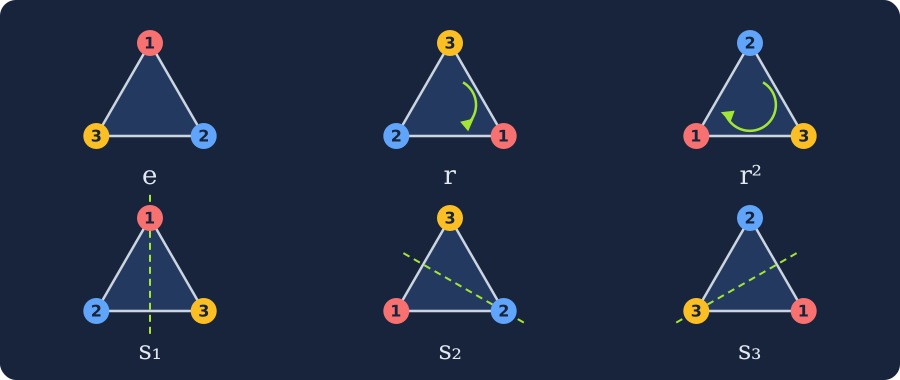
We call the move that does nothing $e$, the rotations $r$ and $r^2$, and the reflections $s_1, s_2, s_3$, where $s_1$ is the one in the vertical axis, $s_2$ the one in the axis through the bottom right corner and $s_3$ the one in the axis through the bottom left corner.
The table of symmetries
Doing two moves in a row, the result is always one of the six. For example, turning by $120°$ twice is turning by $240°$: $r$ followed by $r$ gives $r^2$. Turning three times brings you back to the start: $r^3=e$. We write $a\star b$ for “do $a$ and then $b$”. Testing every pair with the paper triangle gives the complete table:
| $a\star b$ | $e$ | $r$ | $r^2$ | $s_1$ | $s_2$ | $s_3$ |
|---|---|---|---|---|---|---|
| $e$ | $e$ | $r$ | $r^2$ | $s_1$ | $s_2$ | $s_3$ |
| $r$ | $r$ | $r^2$ | $e$ | $s_2$ | $s_3$ | $s_1$ |
| $r^2$ | $r^2$ | $e$ | $r$ | $s_3$ | $s_1$ | $s_2$ |
| $s_1$ | $s_1$ | $s_3$ | $s_2$ | $e$ | $r^2$ | $r$ |
| $s_2$ | $s_2$ | $s_1$ | $s_3$ | $r$ | $e$ | $r^2$ |
| $s_3$ | $s_3$ | $s_2$ | $s_1$ | $r^2$ | $r$ | $e$ |
The row gives the first move and the column the second. Check one entry with the paper: turning by $120°$, corner 1 goes to the bottom right and corner 3 goes to the top. Now reflecting in the vertical axis, corner 3 stays at the top and the bottom two swap places. Corner 2, which was at the bottom left, ends up at the bottom right, the same place where it was at the start. That is the effect of $s_2$: $r\star s_1=s_2$.
Order matters
Now do it the other way round: first $s_1$, then $r$. The table says $s_1\star r=s_3$. So
$$r\star s_1=s_2\neq s_3=s_1\star r.$$With numbers, $3\times5=5\times3$; with symmetries, the order changes the result. A group in which order never matters is called abelian. The group of the triangle is the smallest group that is not abelian.
The four rules
What makes this collection of six moves a group are four properties, which also hold for Galois’s permutations of roots:
- Closure. Composing two elements gives an element of the set. Only the six moves appear in the table.
- Associativity. $(a\star b)\star c=a\star(b\star c)$: doing three moves in a row gives the same result whichever pair is joined first.
- Identity element. There is $e$, with $e\star a=a\star e=a$.
- Inverses. Every move can be undone. The inverse of $r$ is $r^2$, because $r\star r^2=e$. Each reflection is its own inverse: $s_1\star s_1=e$.
Subgroups
The three rotations, $\{e, r, r^2\}$, form a group by themselves inside the group: composing rotations gives only rotations. This is a subgroup. So are $\{e, s_1\}$, $\{e, s_2\}$ and $\{e, s_3\}$. Their sizes, 1, 2, 3 and 6, are all divisors of 6. By Lagrange’s theorem this always happens: the size of a subgroup divides the size of the group. There is no subgroup with 4 or 5 elements.
The subgroup of rotations has a special property that will be decisive in the next post: it is normal. Roughly speaking, this means it looks the same when seen “from another side” of the triangle. If $g$ is any symmetry and $h$ is a rotation, then undoing $g$, doing $h$ and redoing $g$ gives a rotation again. For the subgroups $\{e, s_i\}$ this fails.
A probe that has to come back
Imagine a space probe shaped like a triangular prism that can only sit in six orientations, the six symmetries of the triangle. Crossing a cloud of particles, it suffers four impacts in a row, which its sensors record as $s_1$, $r$, $s_3$ and $r$. Where has it ended up? Just compose, from left to right, using the table:
$$s_1\star r=s_3,\qquad s_3\star s_3=e,\qquad e\star r=r.$$The four impacts amount to a single rotation $r$. To return to its original orientation before taking photographs, the probe needs a manoeuvre $x$ with $r\star x=e$, that is, the inverse of $r$: $x=r^2$. The on-board computer does not need to undo the four impacts one by one; a single manoeuvre does it. In a real satellite the rotations form an infinite group, but the calculation is the same: compose the turns and apply the inverse, never forgetting that order matters.
Exercise: solve the equation r ⋆ x = s₁, where the unknown x is a move of the triangle.
In the row of $r$, look for the column where $s_1$ appears: it is the column of $s_3$. So $x=s_3$. Another way: “divide” by $r$ on the left, applying the inverse: $x=r^2\star s_1$. The row of $r^2$, column $s_1$, gives $s_3$. It checks.
Exercise: show that s₁ ⋆ s₂ is a rotation. Which one?
From the table, $s_1\star s_2=r^2$. Two reflections in a row flip the triangle over twice, and it comes back the right way up. That is why the result must be a rotation. In general, composing two reflections in axes that make an angle $\theta$ gives a rotation by $2\theta$. Here the axes make $60°$, and the rotation is $120°$ one way or $240°$ the other.
Sources: Évariste Galois, Œuvres mathématiques, published by Joseph Liouville (1846) · Israel Kleiner, A History of Abstract Algebra (Birkhäuser, 2007) · Mark Armstrong, Groups and Symmetry (Springer, 1988).
All topics on Évariste Galois · ← Shuffling the roots: the group of an equation · When an equation can be solved by radicals →