
Euler's Eyes
2022-09-27
Circumferences
The main work on geometry, Euclid’s book Elements, has several results for straight lines and circles. In this post, we will show several results for this subject.
Basic Settings
Below we define some fundamental terms for working with circles.
Center
Definition (Center): is a point that is the same distance from any point on the circle.

Ray
Definition (Radius): is any straight line segment that runs from the center to the circumference.

String
Definition (Chord): is any straight line segment that has two ends on a circle.

Diameter
Definition (Diameter): is a chord that passes through the center of the circle. It is worth remembering that it is the largest chord in the circle. This chord is equal to twice the radius.
$$D = 2R$$

Tangent line
When working with straight lines and circles, we need some properties. The first of these is the tangent line.
Definition (Tangent Line): in a plane, we say a tangent line to a circle, one that is intercepted at a single point. The point of intersection is the point of tangency (T).

Lemma 1:
A straight line is tangent to a circle at a point if and only if it is perpendicular to the radius that ends at that point.
Secant line
The second of these is the secant line.
Definition (Secant Line): in a plane, we say secant line to a circle, one that is intercepted at more than one point.

Lemma 2:
A straight line is secant to a circle if and only intersects it at two points.
Proposed problems
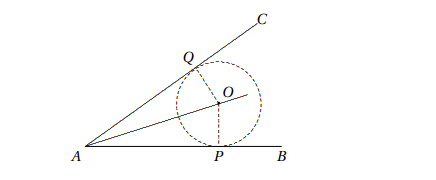
- Prove that, given an angle, the circles with their center at angle bisector (except the vertex of the angle) and a radius equal to the distance from that center to one of the sides of the angle are tangent to both sides (of the angle). Furthermore, every circle tangent to both sides of the angle has its center at angle bisector and the circle is inside the angle, with the exception of the two points of contact
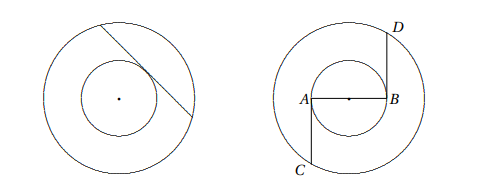
- Prove that, given two concentric circles, if a chord from the larger one is tangent to the smaller one, the point of contact is the midpoint of the chord.
Positions for two circles
Given two circles in a plane, there are some properties for the positions relative to them. In this case we have 3 situations:
- the circles intersect;
- the circles intersect at a single point;
- the circles intersect at two points.
Tangent Circles
Definition (Tangent Circles): in a plane, we say two tangent circles, when they intersect at a single point.
| Tangents Externally | Tangents Internally |
|---|---|

|

|
Tangents Externally
Lemma 3: Given two circles in a plane, if:
- the distance between their centers is greater than the sum of the radii;
- so they do not intersect;
- each one is outside the other.

In this case, we have the distance between the centers $(C_1, C_2)$ is greater than the sum of the radii $(R_1,R_2)$.
$$d(C_1, C_2) > R_1 + R_2$$Lemma 4: Given two circles in a plane, if
- the distance between their centers is equal to the sum of the radii;
- so they are externally tangent.

In this case, we have the distance between the centers $(C_1, C_2)$ is equal to the sum of the radii $(R_1,R_2)$.
$$d(C_1, C_2) = R_1 + R_2$$Tangents Internally
Lemma 5: Given two circles in a plane with different radii:
- if the distance between their centers is equal to the positive difference between the radii;
- so they are internally tangent.

Lemma 6: Given two circles in a plane with different radii,
- if the distance between their centers is smaller than the positive difference between the radii,
- then the circle with the smaller radius is inside the other.

Drying agents
Lemma 7: Given two circles in a plane, if:
- the distance between their centers is smaller than the sum of the radii;
- greater than their difference in absolute value;
- so they intersect at exactly two points

So far, that’s all. Wait for the next posts.