
Euler's Eyes
2026-10-14
L'Hôpital's rule: the lessons sold to a marquis
I acknowledge that I owe much to the insights of Messrs Bernoulli, above all to those of the younger, now professor at Groningen. I have made free use of their discoveries and of those of Mr Leibniz.
— Marquis de l'Hôpital, preface to the Analysis of the Infinitely Small (1696)
In 1691 the Marquis Guillaume de l’Hôpital was 30 years old and had a title, a castle and a passion: to understand Leibniz’s calculus, which had barely been published and which almost nobody in France could read. When the young Swiss Johann Bernoulli, who knew the calculus better than almost anyone, turned up in Paris, the marquis hired him as a private tutor.
The lessons continued by letter after Johann went back to Switzerland. On 17 March 1694 l’Hôpital wrote him an unusual proposal: a pension of 300 livres a year, on condition that Johann answer his questions, send him his discoveries and communicate them to nobody else. Johann, newly married and without a post, accepted.
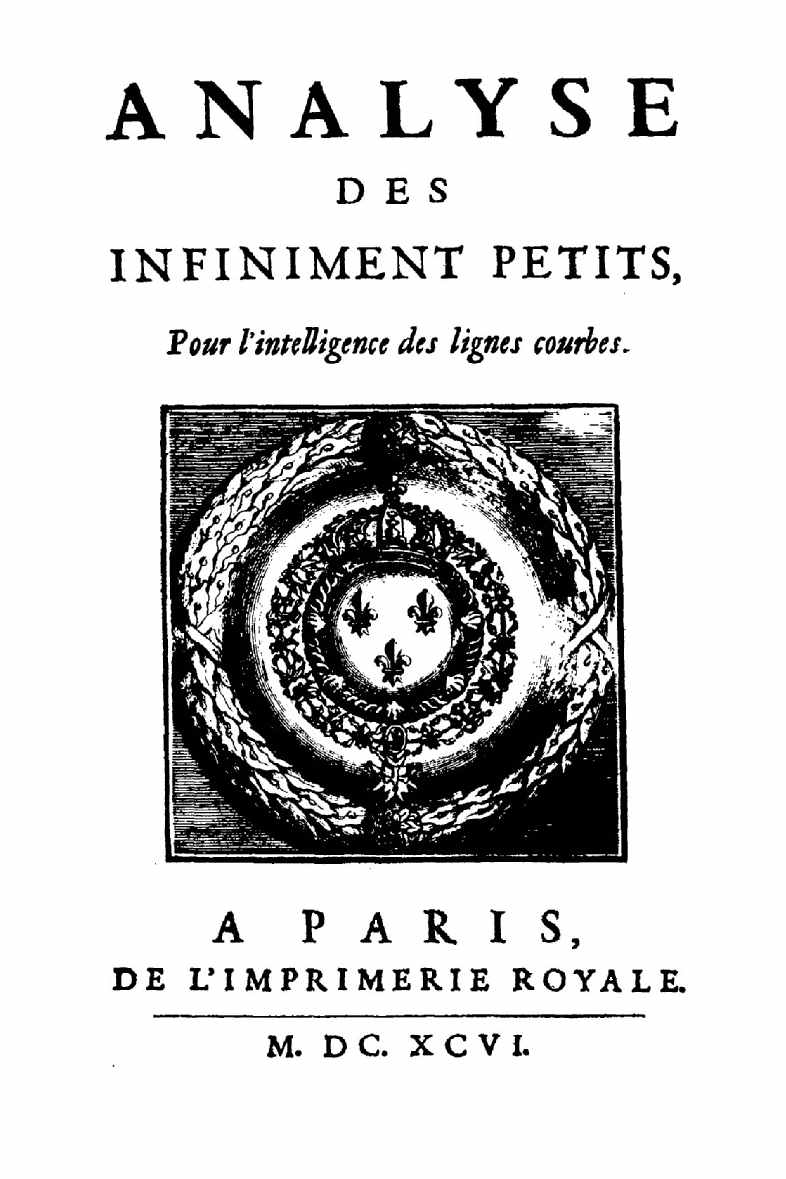
Two years later the Analysis of the Infinitely Small for the Understanding of Curved Lines came out in Paris, with no author’s name on the cover, but everyone knew it was l’Hôpital’s. It was the first book of differential calculus in history, clear and well organised, and it was used to teach the calculus in Europe for almost a century. In chapter 9 there was a rule for computing limits of the form $\frac00$.
The problem: zero divided by zero
We often want to know where a fraction $\frac{f(x)}{g(x)}$ goes as $x$ approaches a point $a$ at which both numerator and denominator go to zero. For example,
$$\lim_{x\to0}\frac{\sin x}{x}.$$Substituting $x=0$ gives $\frac00$, which means nothing. The fraction may tend to any value, or to none. We have to compare how fast the two functions go to zero.
Johann’s idea
Near $a$, a differentiable function looks like its tangent line:
$$f(x)\approx f(a)+f'(a)(x-a),\qquad g(x)\approx g(a)+g'(a)(x-a).$$If $f(a)=g(a)=0$, what is left is
$$\frac{f(x)}{g(x)}\approx\frac{f'(a)(x-a)}{g'(a)(x-a)}=\frac{f'(a)}{g'(a)}.$$The factor $(x-a)$, which caused the $\frac00$, cancels. The rule says that if $f(a)=g(a)=0$ and the limit on the right exists,
$$\boxed{\lim_{x\to a}\frac{f(x)}{g(x)}=\lim_{x\to a}\frac{f'(x)}{g'(x)}.}$$For the sine: $\lim\frac{\sin x}{x}=\lim\frac{\cos x}{1}=1$. If the new quotient also gives $\frac00$, the rule is applied again:
$$\lim_{x\to0}\frac{e^x-1-x}{x^2}=\lim_{x\to0}\frac{e^x-1}{2x}=\lim_{x\to0}\frac{e^x}{2}=\frac12.$$The rigorous proof uses Cauchy’s mean value theorem, from the nineteenth century. Johann reasoned with infinitesimals: $f$ and $g$ “almost zero” near $a$ are each an infinitesimal, and the ratio of two infinitesimals is the ratio of their differentials, $\frac{df}{dg}$.
The example of 1696
L’Hôpital’s book illustrates the rule with an example that takes some work: for $a>0$, compute the limit as $x\to a$ of
$$\frac{\sqrt{2a^3x-x^4}-a\sqrt[3]{a^2x}}{a-\sqrt[4]{ax^3}}.$$At $x=a$, the numerator is $\sqrt{a^4}-a\cdot a=0$ and the denominator is $a-a=0$. Differentiating the numerator,
$$\frac{2a^3-4x^3}{2\sqrt{2a^3x-x^4}}-\frac{a\cdot a^{2/3}}{3x^{2/3}}\ \xrightarrow{x=a}\ \frac{-2a^3}{2a^2}-\frac a3=-\frac{4a}3.$$Differentiating the denominator,
$$-\frac34\,a^{1/4}x^{-1/4}\ \xrightarrow{x=a}\ -\frac34.$$The limit is $\dfrac{-4a/3}{-3/4}=\dfrac{16a}9$. With $a=1$ and $x=0.999$, the original fraction gives $1.773$, already close to $\frac{16}9\approx1.778$.
Who invented the rule?
L’Hôpital died in 1704. Shortly afterwards, Johann began saying in public that the rule, and much of the book, were his. Hardly anyone believed him: it looked like the complaint of a man known for his difficult temper, against a dead nobleman who could not defend himself.
In 1921 a manuscript of the lectures on differential calculus that Johann had prepared in 1691 and 1692 was found in the Basel University Library and published the following year. The comparison showed that much of the Analysis follows those lectures closely, including the rule. But the story is less simple than a theft: l’Hôpital paid for the material, acknowledged the debt in his preface, as the quotation above shows, and wrote a clearer book than the lectures. The rule still bears his name.
Exercise: compute the limit of ln(1 + x)/x as x tends to zero.
At $x=0$, numerator and denominator are zero. The quotient of the derivatives is $\frac{1/(1+x)}{1}$, which tends to $1$. This limit says that near zero $\ln(1+x)\approx x$, the approximation banks use to convert small interest rates.
Exercise: what happens if we apply the rule to (1 + x)/x as x tends to zero?
A wrong conclusion. Here the numerator goes to $1$, not to zero: there is no indeterminate form, and the rule does not apply. The quotient of the derivatives would be $\frac11=1$, but the actual fraction goes to $+\infty$ from the right and to $-\infty$ from the left. Before using the rule, one must check that it really is $\frac00$ or $\frac\infty\infty$.
Sources: Guillaume de l’Hôpital, Analyse des infiniment petits pour l’intelligence des lignes courbes (Paris, 1696), section IX · Dirk J. Struik, “The origin of l’Hôpital’s rule”, The Mathematics Teacher 56 (1963) · biography of Johann Bernoulli, MacTutor.
All topics on Johann Bernoulli · ← The catenary: the hanging chain · The brachistochrone: the challenge of 1696 →