
Euler's Eyes
2026-09-26
ENEM 2023 – Solved mathematics: questions 166 to 180
Source: INEP – proof and template of the 2nd day, Notebook 5 – Yellow.
The ENEM Mathematics and Technologies test 2023 was administered on the 2nd day and will from question 136 to 180. This post addresses questions 166 to 180. The numbering used here is that of the Notebook 5 – Yellow; us In other notebooks the same questions appear in a different order.
Template
| Question | Subject | Template |
|---|---|---|
| 166 | Probability of independent events | C |
| 167 | Cumulative Volume Chart | B |
| 168 | Numbering systems (base 2) | C |
| 169 | Average of consecutive months | C |
| 170 | Compound interest in installments | D |
| 171 | Affine function | D |
| 172 | Distance × time and trajectory graph | A |
| 173 | Waiting time in line | E |
| 174 | Circular sector | B |
| 175 | Area of squares | D |
| 176 | Graph reading | A |
| 177 | Bar graph reading | Canceled |
| 178 | Covering area of a staircase | E |
| 179 | Location on map | E |
| 180 | System of 1st degree equations | B |
Question 166: White dots in the voucher urn (probability)
Statement
Aiming to attract more customers, the manager of a store announced a promotion in which each customer who makes a purchase can win a voucher to be used on your next purchase. To win your voucher, the customer needs to withdraw, at the by chance, a small ball from each of the two urns A and B made available by the manager, in which there are only black and white dots. Currently, the The probability of choosing, at random, a black ball from urn A is equal to 20% and the probability of choosing a black ball in urn B is 25%. Win the The customer who removes two black balls, one from each urn, will receive a voucher.
As the days went by, the manager realized that, for the promotion to be viable to business, it was necessary to change the customer’s hit probability without changing the promotion rule. To do this, he decided to change the number of white balls in ballot box B so that the probability of a customer winning the voucher becomes be less than or equal to 1%. It is known that urn B has 4 black dots and that, in In both urns, all marbles have the same probability of being drawn.
What is the minimum number of white marbles that the manager must add to urn B?
- A) 20
- B) 60
- C) 64
- D) 68
- E) 80
Resolution
1. Current situation of ballot box B. They are 4 black and the chance of black is 25%, so there are $4 / 0{,}25 = 16$ marbles in total: 4 black and 12 white.
2. New probability required in ballot box B. Withdrawals are independent, then $P(\text{voucher}) = P(\text{preta em A}) \cdot P(\text{preta em B})$:
$$0{,}20 \cdot P_B \leq 0{,}01 \quad\Rightarrow\quad P_B \leq 0{,}05$$3. Total number of marbles needed in B. They remain 4 black:
$$\frac{4}{N} \leq 0{,}05 \quad\Rightarrow\quad N \geq 80$$4. White ones to be added. The urn must have at least 80 marbles, with 76 white. As there is already 12:
$$76 - 12 = 64$$Answer: alternative C (64 dots).
Be careful with the catch: alternative E (80) is the total of dots of the ballot box, and D (68) forgets that the white 12 were already there, doing $80 - 12$. The question is how many whites to add.
To review, see Introduction to Probability.
Question 167: Smart tap water volume
Statement
Students working with robotics have created a “smart faucet” that automates opening and closing during hand cleaning. A technology works as follows: when you place your hands under the tap, it releases water for 3 seconds so that the person can wet them. In then stops the water supply for 5 seconds, while the person soaps your hands, and ends the cycle releasing water for rinsing for more 3 seconds. Consider the time ($t$), in seconds, counted from the instant that the cycle begins. The water flow through this tap is constant.
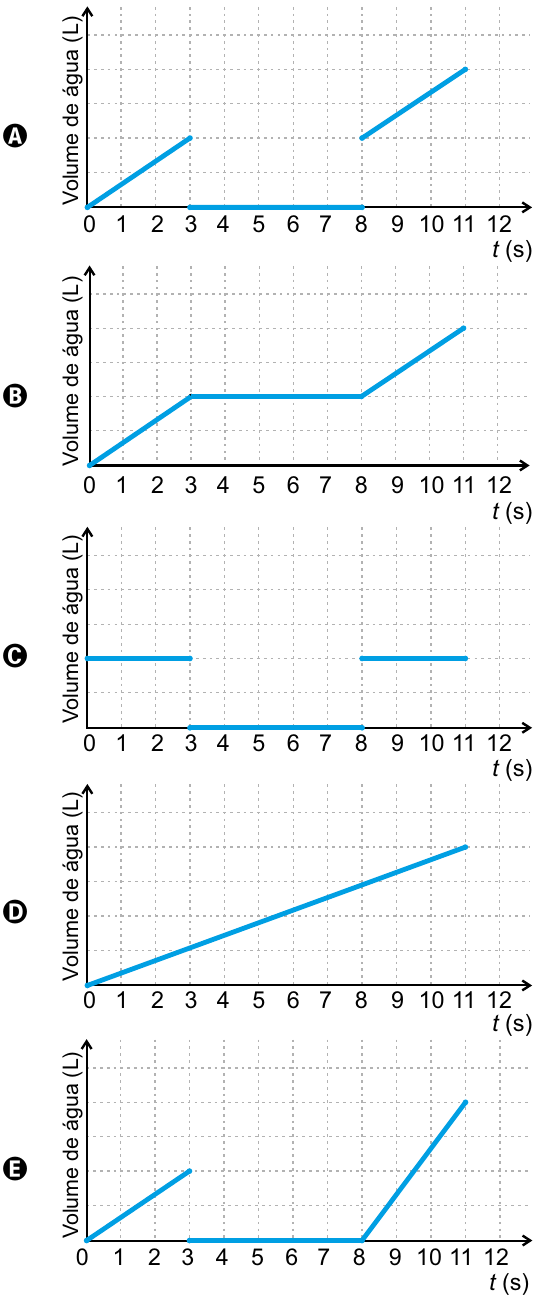
A sketch graph depicting the accumulated volume of water, in liters, released through this tap during a hand washing cycle, depending on the time ($t$), secondly, it is
Resolution
The keyword is accumulated: the graph shows the total water that has already left from the beginning, and that total never decreases.
1. From 0 to 3 s water leaves at a constant rate: the accumulated volume increases in straight line.
2. From 3 to 8 s the tap remains closed: no water comes out, but what has already come out continues counting. The graph is horizontal, at the same level reached in 3 s (does not return to zero).
3. From 8 to 11 s the water leaves again with the same flow rate: the graph returns to climb, with the same slope as the first section.
This is graph B.
Answer: alternative B.
Why the others are wrong:
- A and E return to zero between 3 and 8 s, as if the water already released “disappeared”. E still rises more steeply at the end, as if the flow had changed.
- C shows the flow (constant or zero), not the accumulated volume.
- D goes up without stopping, ignoring the break to soap up.
Question 168: Counting with okosa and urapum
Statement
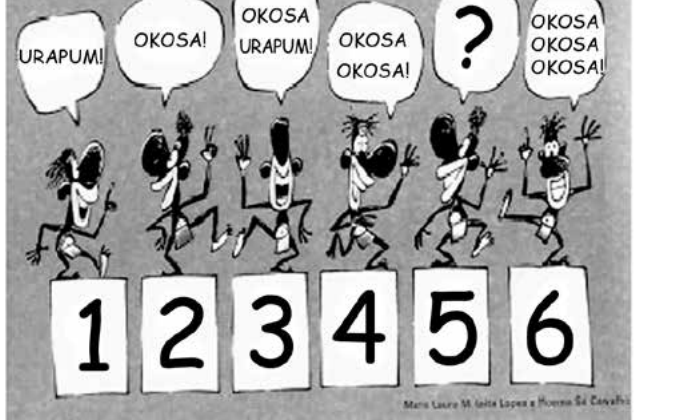
Cultural characteristics vary from people to people. There is news of a people who had different ways of counting than ours, as indicated in the comic follow.
According to the counting pattern indicated in the figure, the representations of the numerals five and seven, in this culture, must be, respectively,
- A) okosa urapum urapum urapum and okosa okosa urapum urapum urapum.
- B) okosa okosa urapum and okosa okosa okosa okosa urapum.
- C) okosa okosa urapum and okosa okosa okosa urapum.
- D) okosa urapum urapum and okosa urapum okosa urapum urapum.
- E) okosa okosa urapum and okosa okosa okosa okosa.
Resolution
1. Discover the pattern. From the comic:
| Number | 1 | 2 | 3 | 4 | 6 |
|---|---|---|---|---|---|
| Word | urapum | okosa | okosa urapum | okosa okosa | okosa okosa okosa |
“Okosa” is worth 2 and “urapum” is worth 1. People count in groups of two: use as many “okosa” as can fit and, if there are any left 1, add “urapum”.
2. Five. $5 = 2 + 2 + 1$: okosa okosa urapum.
3. Seven. $7 = 2 + 2 + 2 + 1$: okosa okosa okosa urapum.
Answer: alternative C.
Be careful with the catch: in alternative B, “okosa okosa okosa okosa urapum” is worth $4 \cdot 2 + 1 = 9$, and in E, “okosa okosa okosa okosa” is worth 8.
Question 169: Best month to plant (average of two months)
Statement
One type of seed needs plenty of water in the first two months after planting. planting. A producer intends to establish the best time to plant this type of seed, from October to March. After consulting the forecast monthly rainfall index (ImPC) of the region where planting will take place, for the rainy period of 2020 - 2021, he obtained the following data:
- October/2020: ImPC = 250 mm;
- November/2020: ImPC = 150 mm;
- December/2020: ImPC = 200 mm;
- January/2021: ImPC = 450 mm;
- February/2021: ImPC = 100 mm;
- March/2021: ImPC = 200 mm.
Based on these predictions, he needs to choose two consecutive months in which the monthly average precipitation is as high as possible.
At the beginning of which of these months should the producer plant this type of seed?
- A) October.
- B) November.
- C) December.
- D) January.
- E) February.
Resolution
1. Averages for each pair of consecutive months.
| Planting at the beginning of | Months | Average (mm) |
|---|---|---|
| October | oct. and nov. | $\frac{250 + 150}{2} = 200$ |
| November | nov. and ten. | $\frac{150 + 200}{2} = 175$ |
| December | ten. and Jan. | $\frac{200 + 450}{2} = 325$ |
| January | Jan. and Feb. | $\frac{450 + 100}{2} = 275$ |
| February | Feb. and sea. | $\frac{100 + 200}{2} = 150$ |
2. Choose the largest. The largest average is that of December and January (325 mm). For To take advantage of these two months, planting should be done in beginning of December.
Answer: alternative C (December).
Be careful with the catch: January alone has the highest rainfall (450 mm), but planting in January makes the seed spend the 2nd month in February, the earliest dry. You need to look at the pair of months (option D is the trap).
To review, see Position Measurements.
Question 170: Interest rate on financing in three installments
Statement
A store sells its products in two ways: in cash or financed in three equal monthly installments. To define the value of these installments in sales financed, the store increases the value of the product in cash by 20% and divides this new value by 3. The first installment must be paid at the time of purchase, and the two last, in 30 and 60 days after purchase.
A store customer decided to purchase, on finance, a product whose value at view is R$ 1 500,00.
Use 5,29 as an approximation for $\sqrt{28}$.
The monthly compound interest rate charged on this financing is
- A) 6,7%
- B) 10%
- C) 20%
- D) 21,5%
- E) 23,3%
Resolution
1. Value of installments. $1\thinspace 500 \cdot 1{,}20 = 1\thinspace 800$, and $1\thinspace 800 / 3 = 600$ reais per installment.
2. How much is actually financed. The first installment is paid instantly, so it works as input. The customer owes
$$1\thinspace 500 - 600 = 900 \text{ reais}$$and pays this debt with two installments of 600, in 1 and 2 months.
3. Compound interest equation. Bringing each installment to the date of purchase (dividing by $(1+i)^n$), the sum must give the debt:
$$\frac{600}{1+i} + \frac{600}{(1+i)^2} = 900$$Calling $x = \frac{1}{1+i}$ and dividing everything by 300:
$$2x^2 + 2x - 3 = 0$$4. Solve. By Bhaskara, with $\Delta = 4 + 24 = 28$ (only the positive root works):
$$x = \frac{-2 + \sqrt{28}}{4} \approx \frac{-2 + 5{,}29}{4} = \frac{3{,}29}{4} = 0{,}8225$$5. Fee.
$$1 + i = \frac{1}{0{,}8225} \approx 1{,}215 \quad\Rightarrow\quad i \approx 21{,}5\%$$Answer: alternative D (21,5%).
Be careful with the catch: alternative C (20%) is the total increase over the price, not the monthly rate. As the first installment is paid instantly and only 900 reais are financed, the monthly fee is higher than it seems.
To review, see Compound Interest and the Euler number and Bhãskara.
Question 171: Price of pumped concrete (related function)
Statement
To concrete the slab of his residence, a person hired a construction company. This company informs that the price $y$ of pumped concrete is made up of two parts: a fixed one, called pumping rate, and a variable one, which depends on the volume $x$ of concrete used. It is known that the pumping fee costs R$ 500,00 and that the cubic meter of concrete pumped is R$ 250,00.
The expression that represents the price $y$ as a function of the volume $x$, in cubic meters, is
- A) $y = 250x$
- B) $y = 500x$
- C) $y = 750x$
- D) $y = 250x + 500$
- E) $y = 500x + 250$
Resolution
1. Variable part. Each cubic meter costs 250 reais: $250x$.
2. Fixed part. The pumping fee, 500 reais, is paid once, regardless of volume.
3. Join.
$$y = 250x + 500$$Answer: alternative D.
Be careful with the catch: the alternative E switches roles: multiplies the fixed rate for volume and adds the price per cubic meter only once.
To review, see First Degree Functions.
Question 172: The security guard’s trajectory
Statement
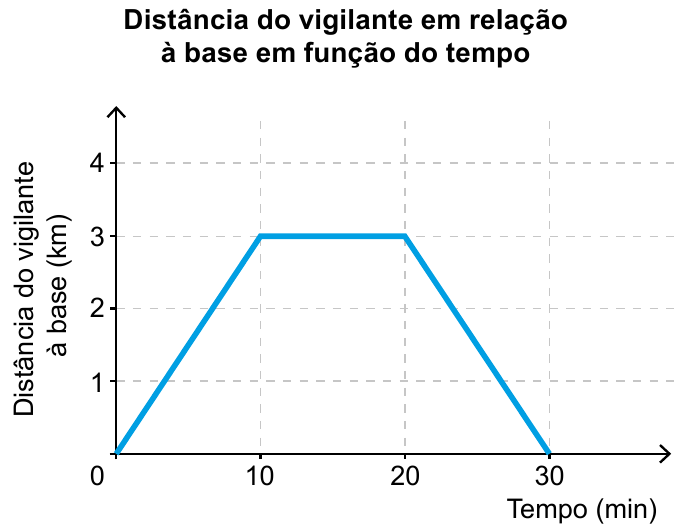
A home security company offers night patrol services in which security guards on motorcycles periodically monitor homes. The company has a base, from where it monitors the journey taken by guards during patrols and guides the movement of reinforcement teams when necessary. On a routine, uneventful patrol, a guard drove your motorcycle at a constant speed throughout the itinerary established, taking 30 minutes to complete. According to the records of the GPS allocated to the motorcycle, the distance from the security guard’s position to the base, along of the time taken to complete the journey, is described by the graph.
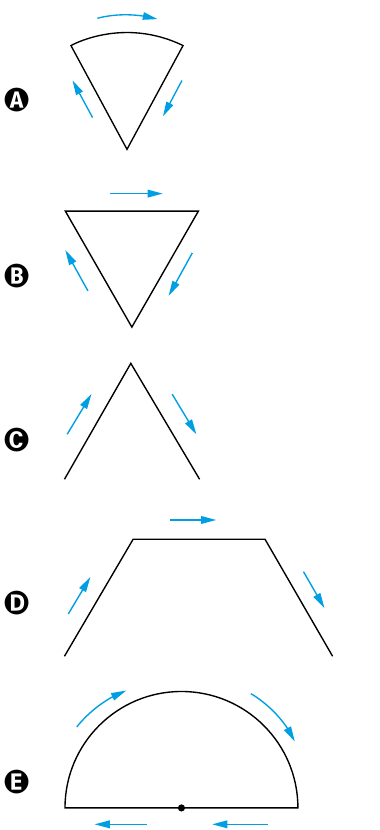
The top view of the trajectory taken by the security guard during the patrol recorded on the graph is described by the representation
Resolution
1. From 0 to 10 min. The distance to the base increases from 0 to 3 km in a straight line, and the speed is constant: the guard moves away from the base in a straight line (if curved, the distance would grow more slowly). It travels 3 km.
2. From 10 to 20 min. The distance to the base remains constant, equal to 3 km. The points that are always 3 km from the base form a circle with center at the base. So in this section he walks on a circle arc.
3. From 20 to 30 min. The distance drops from 3 km to 0 in a straight line: it goes back to the base in a straight line.
4. The figure. Two segments (rays) starting from the base and an arc of circumference between them: it is a circular sector, figure A.
(With constant speed, the arc covered in 10 min also measures 3 km, equal to the radius; the sector angle is 1 radian, about 57°, similar to the drawing.)
Answer: alternative A.
Be careful with the catch: B has the top side straight. Walking in a straight line segment, the distance to the base would decrease and then increase, and the graph would not have a horizontal section. E also has an arc, but it starts and ends in the middle of the diameter, and the distance to the base would not be 0 in tips would not even grow linearly.
Question 173: Cashier with shortest waiting time
Statement
A supermarket has five cashiers available for payment. Were screens are installed that show the average time taken by each cashier to start and finalize service for each customer, and the number of people present at the queue at each checkout in real time. A customer, when making a purchase, knowing that each of the five cashiers will start a new service at that At the moment, you want to spend as little time as possible waiting in line. He watches the screens displayed the following information.
- Box I: service 12 minutes, 5 people in line.
- Box II: service 6 minutes, 9 people in line.
- Box III: service 5 minutes, 6 people in line.
- Box IV: service 15 minutes, 2 people in line.
- Box V: service 9 minutes, 3 people in line.
To achieve their objective, the customer must choose the cashier
- A) I.
- B) II.
- C) III.
- D) IV.
- E) V.
Resolution
Each cashier will now start serving the first person in line. The customer will only be served after all people in the queue have been served.
1. Waiting time in each box (people in line × time per service):
| Box | Calculation | Wait (min) |
|---|---|---|
| I | $5 \cdot 12$ | 60 |
| II | $9 \cdot 6$ | 54 |
| III | $6 \cdot 5$ | 30 |
| IV | $2 \cdot 15$ | 30 |
| V | $3 \cdot 9$ | 27 |
2. Choose the shortest. Teller V has the shortest wait: 27 minutes.
Answer: alternative E (box V).
Be careful with the trick: choose the shortest queue (box IV, 2 people) or faster service (box III, 5 min) is not enough: what matters is the product of both information.
Question 174: The moon behind the tower (circular sector)
Statement
The figures painted on the painting in the living room of a residence represent the silhouettes of part of the towers of a castle and, in the background, that of a full moon. A The moon was painted in the shape of a circle, and the roof of the tallest tower was painted in the shape from equilateral triangle, it was painted overlaying part of the moon. The center of the moon coincides with one of the peaks of the roof of the tallest tower.

In this painting, the part of the moon hidden behind the castle’s tallest tower can be be represented by a
- A) icon.
- B) circular sector.
- C) circular segment.
- D) isosceles triangle.
- E) arc of circumference.
Resolution
1. What hides the moon. The top apex of the roof (equilateral triangle) is in the center of the circle. The two sides of the roof that come out of this apex there are, inside the moon, two rays of the circle, forming an angle of 60°.
2. The hidden part. It is the region of the moon between these two rays, limited by the arc of the moon’s edge. A region bounded by two radii and the arc between they is a circular sector (here, from 60°, i.e. $\frac{1}{6}$ of the moon).
Answer: alternative B (circular sector).
Be careful with the catch: circular segment (C) is the region between a rope and the arc, without passing through the center. Circumference arc (E) is just a curve, no area. And cone (A) is a solid, not a plane figure.
To review, see Introduction to Circumference.
Question 175: Sidewalk area around the pool
Statement
On the floor plan of a club, the pool is represented by a square whose area actual measures 400 m². A sidewalk will be built around this pool, constant width equal to 5 m.
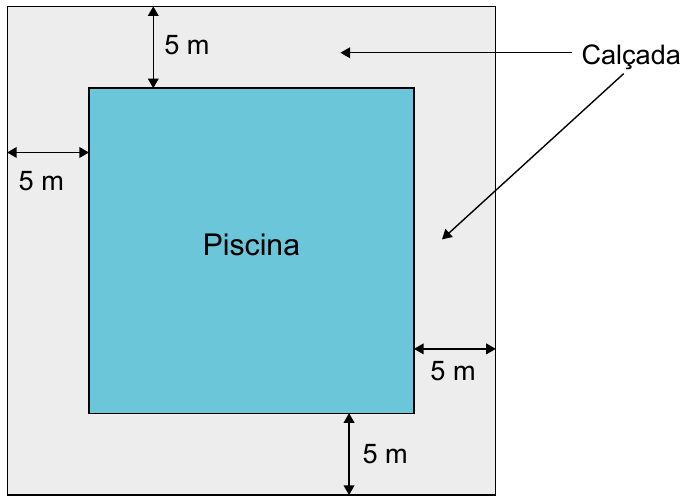
What is the measurement of the area, in square meters, occupied by the sidewalk?
- A) 1 000
- B) 900
- C) 600
- D) 500
- E) 400
Resolution
1. Pool side. $\ell^2 = 400 \Rightarrow \ell = 20$ m.
2. Side of the outer square. The sidewalk adds 5 m of each side:
$$20 + 5 + 5 = 30 \text{ m}$$3. Sidewalk area. Area of the large square minus pool area:
$$30^2 - 20^2 = 900 - 400 = 500 \text{ m}^2$$Answer: alternative D (500 m²).
Be careful with the catch: alternative B (900) is the total area (pool more sidewalk). And whoever adds 5 m only on one side (side 25 m) finds $625 - 400 = 225$, which is not an alternative.
To review, see Rectangle, Rhombus and Square.
Question 176: Minutes without internet signal
Statement
A person walks for 30 minutes and uses an application installed on their cell phone to monitor the variation in the strength of the internet signal received by the device during movement. Once you arrive at your destination, the app provided this chart:
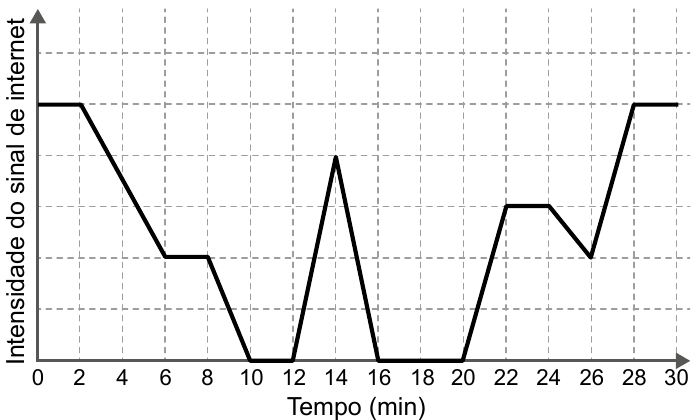
For how many minutes during this walk was this person’s cell phone dead? receive internet signal?
- A) 6
- B) 8
- C) 10
- D) 14
- E) 24
Resolution
“No signal” is when the intensity is zero, that is, when the graph is leaning against the axis of time.
1. Excerpts with zero intensity.
- from 10 to 12 min: $12 - 10 = 2$ minutes;
- from 16 to 20 min: $20 - 16 = 4$ minutes.
(At 14 min there is a peak: the signal returns for a time between 12 and 16 min.)
2. Total. $2 + 4 = 6$ minutes.
Answer: alternative A (6 minutes).
Be careful with the catch: alternative C (10) counts directly from 10 to 20 min, ignoring that the signal returned between 12 and 16 min.
Question 177: Campaign against influenza A-H1N1
Question canceled by INEP. In the official answer sheet of the Notebook 5 – Yellow, the question 177 appears as “Cancelled”; all candidates received the score. The template does not indicate the reason for cancellation, which is why we do not present resolution.
Statement
The graph shows some numbers for influenza A-H1N1. Among the categories that are in immunization process, one is already completely immunized, the workers of health.
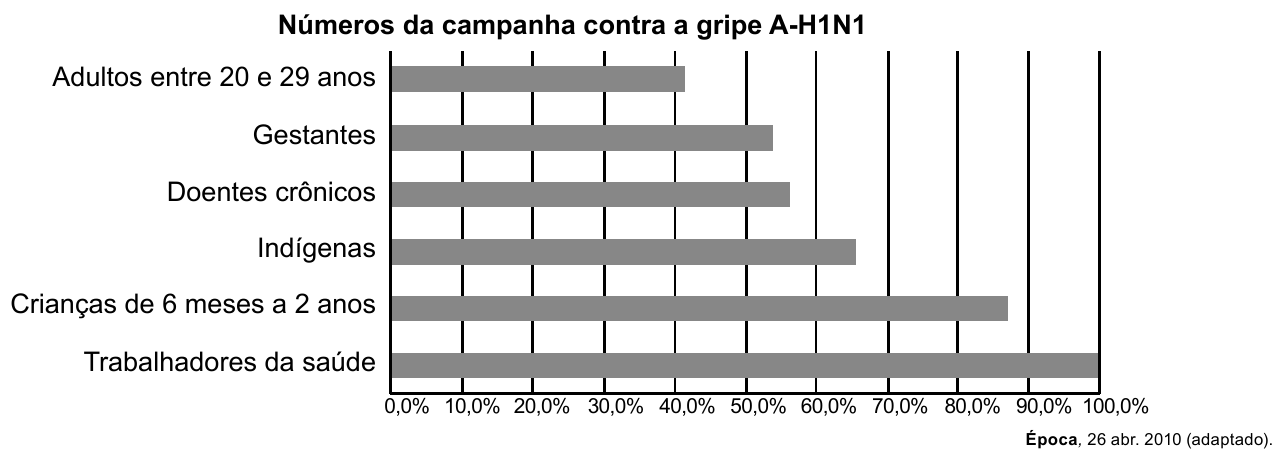
According to the graph, among the other categories, the one that is most exposed to A-H1N1 influenza virus is the category of
- A) indigenous people.
- B) pregnant women.
- C) chronically ill.
- D) adults between 20 and 29 years old.
- E) children from 6 months to 2 years.
Question 178: Ceramics for the three-step staircase
Statement
The figure represents a staircase with three steps, built in solid concrete, with your specified measurements.
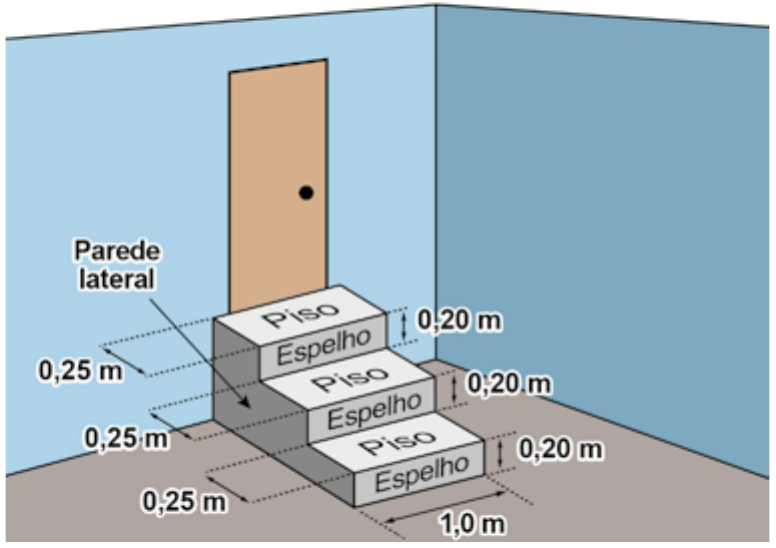
In this staircase, floors and mirrors have a rectangular shape, and the side walls have shape of a polygon whose adjacent sides are perpendicular. Floors, mirrors and side walls will be covered in ceramic.
The area to be covered in ceramics, in square meters, measures
- A) 1,20.
- B) 1,35.
- C) 1,65.
- D) 1,80.
- E) 1,95.
Resolution
All steps are 1,0 m wide, tread is 0,25 m deep and mirror 0,20 m high.
1. Floors. Three rectangles from $1{,}0 \times 0{,}25$:
$$3 \cdot 0{,}25 = 0{,}75 \text{ m}^2$$2. Mirrors. Three rectangles from $1{,}0 \times 0{,}20$:
$$3 \cdot 0{,}20 = 0{,}60 \text{ m}^2$$3. A side wall. It has a “ladder” shape. Dividing into three vertical columns 0,25 m wide, heights are 0,20 m, 0,40 m and 0,60 m:
$$0{,}25 \cdot (0{,}20 + 0{,}40 + 0{,}60) = 0{,}25 \cdot 1{,}20 = 0{,}30 \text{ m}^2$$There are two side walls (one on each side): $2 \cdot 0{,}30 = 0{,}60$ m².
4. Total.
$$0{,}75 + 0{,}60 + 0{,}60 = 1{,}95 \text{ m}^2$$Answer: alternative E (1,95 m²).
Be careful with the trick: covering just one side wall gives $0{,}75 + 0{,}60 + 0{,}30 = 1{,}65$ (alternative C), and forget about the walls sides gives 1,35 (alternative B).
Question 179: Armchair in the cinema (location)
Statement
A person has purchased a ticket to the cinema at the entrance of which a map with a two-dimensional representation of the positioning of the seats, as shown in the figure. This person, after consulting the map, began to climb one of the stairs and stopped at the position indicated by the star, facing north. She checked your ticket and noted that, to find your seat, you should start from the point where you were, continue climbing the stairs in the north direction for another four rows and look to your right, and your seat will be third.
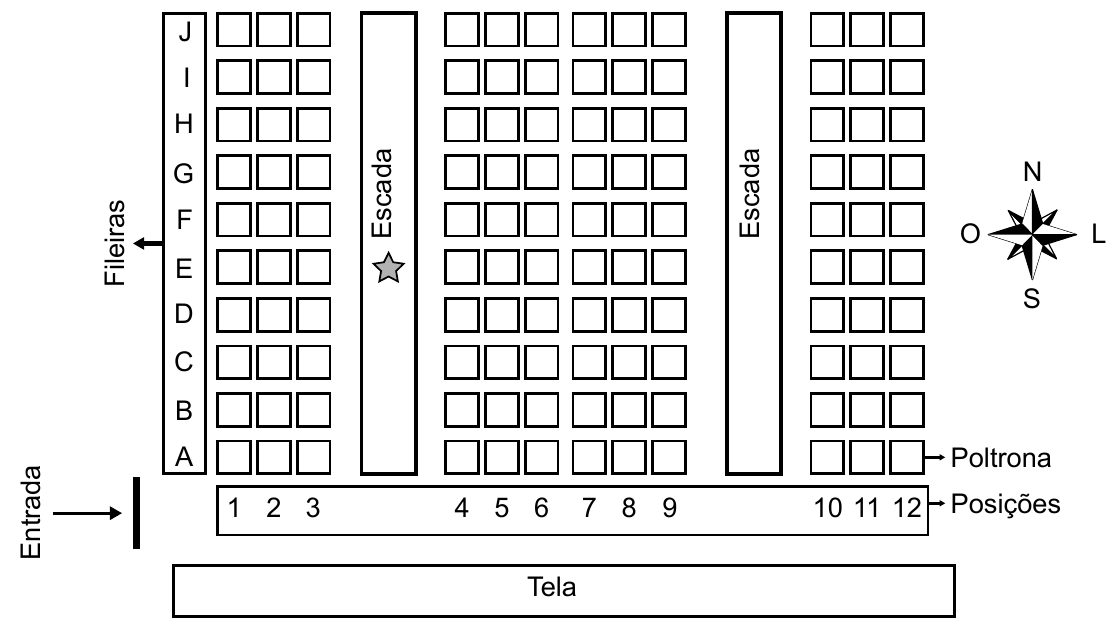
In this cinema, the seats are identified by a letter, which indicates the row, and a number, which provides the position of the seat in the row, respectively.
This person’s seat is the one identified by
- A) A6.
- B) H1.
- C) H6.
- D) I1.
- E) I6.
Resolution
1. Where the person is. The star is on the stairs on the left, at the height of the row E.
2. Move up four rows to the north. On the map, north is up (in direction to row J): E → F → G → H → I.
3. Look to the right. Whoever is facing north has east on the right. On the map, to the right of the left staircase are the positions 4, 5, 6, 7, 8, 9. A The first seat on the right is 4, the second is 5 and the third is 6.
The seat is I6.
Answer: alternative E (I6).
Be careful with the catch: going up “four more rows” from E takes to I, not to H (alternatives B and C count E as one of the four). And look at the left would lead to seats 3, 2, 1 (alternative D).
Question 180: Price of the red ticket card (system)
Statement
A city’s subway offers two types of tickets with different colors different colors, blue and red, being sold in cards, each with nine tickets of the same color and same unit value. Two blue ticket cards and a pack of red tickets are sold for R$ 32,40. It is known that the price of a blue ticket minus the price of a red ticket equals the price of a red ticket plus five cents.
What is the price, in reais, of a card of red tickets?
- A) 4,68
- B) 6,30
- C) 9,30
- D) 10,50
- E) 10,65
Resolution
Let $a$ be the price of a blue ticket and $v$ the price of a red one, in reais.
1. Assemble the equations.
- Two blue cards (18 tickets) and one red card (9 tickets) cost 32,40: $18a + 9v = 32{,}40$, that is, dividing by 9, $2a + v = 3{,}60$.
- Blue minus red equals red plus 0,05: $a - v = v + 0{,}05$, or that is, $a = 2v + 0{,}05$.
2. Solve by substitution.
$$2(2v + 0{,}05) + v = 3{,}60 \quad\Rightarrow\quad 5v + 0{,}10 = 3{,}60 \quad\Rightarrow\quad v = 0{,}70$$(And $a = 2 \cdot 0{,}70 + 0{,}05 = 1{,}45$. Checking: $18 \cdot 1{,}45 + 9 \cdot 0{,}70 = 26{,}10 + 6{,}30 = 32{,}40$.)
3. Red card. $9 \cdot 0{,}70 = 6{,}30$ real.
Answer: alternative B (R$ 6,30).
Be careful with the catch: the question is the price of the card (9 tickets), not from a ticket (R$ 0,70).
To review, see First Degree Equations.