
Euler's Eyes
2026-11-04
EJU 2017(第 2 回)– 数学 Course 2 详解
出处: JASSO——数学试卷英文版、 日文版 与官方答案。 文件见 2017 年第 2 回页面。
Course 2 是 EJU 的进阶数学考试。每个字母 $\boxed{\text{A}}$、$\boxed{\text{B}}$…… 代表 0 到 9 的一个 数字或负号;有些空格要填选项的编号。中文翻译由我们完成。
答案一览
| 题号 | 内容 | 答案 |
|---|---|---|
| I | 与 Course 1 第 I 题相同 | A=1, B=8, C=1, DE=−2, F=4, G=0, HI=−1, JK=−1, LM=−3; N=9, O=7, PQ=54, RS=13, TUV=108, WX=13, YZ=36 |
| II Q1 | 递推 | A=3, B=6, C=4, D=3, E=1, F=4, G=5, H=4, I=3, J=5, K=4, L=1 |
| II Q2 | 内切圆半径 | M=5, N=3, O=3, P=1, Q=1, R=2, S=4, T=1, U=1, V=1, W=4, XY=20, Z=3 |
| III | 对数不等式 | A=3, B=6, C=1, D=3, E=0, F=1, G=2, H=7, I=2 |
| IV | 圆与双曲线 | A=2, B=1, C=2, D=1, EF=12, G=5, HI=12, J=5, KL=12, M=1, NO=12, P=1, Q=6, R=2, S=3, T=1, U=4 |
第 I 题
Course 2 的第 I 题与 Course 1 完全相同(带约束的二次函数最小值、在三角形上移动的球)。完整解答见 Course 1 的文章。
答案: A=1, B=8, C=1, DE=−2, F=4, G=0, HI=−1, JK=−1, LM=−3; N=9, O=7, PQ=54, RS=13, TUV=108, WX=13, YZ=36。
第 II 题
Q1:含 3 的幂的递推
题目。 求 $a_1 = 18$,$a_{n+1} - 12a_n + 3^{n+2} = 0$ 的通项。令 $b_n = \dfrac{a_n}{\boxed{\text{A}}^n}$, 则 $b_1 = \boxed{\text{B}}$,$b_{n+1} - \boxed{\text{C}}\,b_n + \boxed{\text{D}} = 0$,可写成 $b_{n+1} - \boxed{\text{E}} = \boxed{\text{F}}\left(b_n - \boxed{\text{E}}\right)$。令 $c_n = b_n - \boxed{\text{E}}$, $(c_n)$ 是首项为 $\boxed{\text{G}}$、公比为 $\boxed{\text{H}}$ 的等比数列。所以 $a_n = \boxed{\text{I}}^n\left(\boxed{\text{J}}\cdot\boxed{\text{K}}^{n-1} + \boxed{\text{L}}\right)$。
解答。
1. 递推式除以 $3^{n+1}$,令 $b_n = \frac{a_n}{3^n}$:$b_{n+1} - 4b_n + 3 = 0$,$b_1 = \frac{18}{3} = 6$。
2. $b \mapsto 4b - 3$ 的不动点为 $b = 1$,所以 $b_{n+1} - 1 = 4(b_n - 1)$。数列 $c_n = b_n - 1$ 是 等比数列,$c_1 = 5$,公比 $4$:$c_n = 5\cdot4^{n-1}$。
3. $a_n = 3^n\left(5\cdot4^{n-1} + 1\right)$。(验算:$a_2 = 9\cdot21 = 189$,$12\cdot18 - 27 = 189$。)
答案: A=3, B=6, C=4, D=3, E=1, F=4, G=5, H=4, I=3, J=5, K=4, L=1。
Q2:等腰三角形的内切圆半径
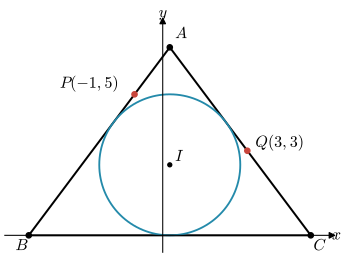
题目。 在 $xy$ 平面上,等腰三角形 $ABC$($AB = AC$)的底边 $BC$ 在 $x$ 轴上;边 $AB$ 过 $P(-1, 5)$, 边 $AC$ 过 $Q(3, 3)$。设 $\ell_1$ 为斜率为 $a$ 的直线 $AB$,$\ell_2$ 为直线 $AC$。则
$$\ell_1: y = ax + a + \boxed{\text{M}}, \qquad \ell_2: y = -ax + \boxed{\text{N}}\,a + \boxed{\text{O}}.$$内切圆的圆心 $I$ 与半径 $r$ 满足 $I = \left(\boxed{\text{P}} - \dfrac{\boxed{\text{Q}}}{a},\ r\right)$,
$$r = \frac{\boxed{\text{R}}\,a + \boxed{\text{S}}}{\boxed{\text{T}} + \sqrt{a^2 + \boxed{\text{U}}}}.$$特别地,当 $r = \frac52$ 时,顶点 $A$ 为 $\left(\dfrac{\boxed{\text{V}}}{\boxed{\text{W}}}, \dfrac{\boxed{\text{XY}}}{\boxed{\text{Z}}}\right)$。
解答。
1. 直线。 $\ell_1$ 过 $(-1, 5)$:$y = a(x + 1) + 5$。由于 $AB = AC$ 且 $BC$ 水平,$\ell_2$ 的斜率为 $-a$,过 $(3, 3)$:$y = -a(x - 3) + 3$。
2. 对称轴。 $A$ 是交点:$ax + a + 5 = -ax + 3a + 3$ 给出 $x = 1 - \frac1a$。内心在对称轴(过 $A$ 的竖直线)上,到 $x$ 轴的距离为 $r$:$I = \left(1 - \frac1a, r\right)$。
3. 半径。 $I$ 到 $\ell_1$($ax - y + a + 5 = 0$)的距离为 $r$。由于 $I$ 在 $\ell_1$ 下方,绝对值内的 式子为正:
$$\frac{a\left(1 - \frac1a\right) - r + a + 5}{\sqrt{a^2 + 1}} = \frac{2a + 4 - r}{\sqrt{a^2 + 1}} = r \implies r = \frac{2a + 4}{1 + \sqrt{a^2 + 1}}.$$4. $r = \frac52$ 时。 $4a + 8 = 5 + 5\sqrt{a^2 + 1}$,即 $4a + 3 = 5\sqrt{a^2 + 1}$。平方: $16a^2 + 24a + 9 = 25a^2 + 25$,即 $9a^2 - 24a + 16 = (3a - 4)^2 = 0$:$a = \frac43$。于是 $x_A = 1 - \frac34 = \frac14$,$y_A = \frac43\cdot\frac14 + \frac43 + 5 = \frac{20}{3}$。
答案: M=5, N=3, O=3, P=1, Q=1, R=2, S=4, T=1, U=1, V=1, W=4, XY=20, Z=3。
第 III 题:对所有 x 成立的对数不等式
题目。 求使
$$\frac{\log3x}{4x + 1} \le \log\left(\frac{2kx}{4x + 1}\right) \quad \text{①}$$对所有 $x > 0$ 成立的 $k$($\log$ 为自然对数)。
- 从 ⓪ $\frac{\log3x}{4x + 1} - \log(4x + 1) - \log2x$、① $\frac{\log3x}{4x + 1} - \log(4x + 1) + \log2x$、 ② $\frac{\log3x}{4x + 1} + \log(4x + 1) + \log2x$、③ $\frac{\log3x}{4x + 1} + \log(4x + 1) - \log2x$、 ④ $\frac{4\log3x}{(4x + 1)^2}$、⑤ $\frac{3x + 2 + \log3x}{(4x + 1)^2}$、⑥ $-\frac{4\log3x}{(4x + 1)^2}$、 ⑦ $\frac{3x - 2 - \log2x}{(4x + 1)^2}$、⑧ $-\frac{3\log2x}{(4x + 1)^2}$ 中选择 $\boxed{\text{A}}$ 与 $\boxed{\text{B}}$。变形 ①,$\log k \ge \boxed{\text{A}}$ ②。把 ② 的右边记为 $g(x)$,$g'(x) = \boxed{\text{B}}$。
- 从 ⓪ 递增、① 递减、② 取极大值、③ 取极小值中选择 $\boxed{\text{E}}$、$\boxed{\text{F}}$、$\boxed{\text{G}}$。 在 $0 < x < \frac{\boxed{\text{C}}}{\boxed{\text{D}}}$ 上 $g$ $\boxed{\text{E}}$;在 $x > \frac{\boxed{\text{C}}}{\boxed{\text{D}}}$ 上 $g$ $\boxed{\text{F}}$;在 $x = \frac{\boxed{\text{C}}}{\boxed{\text{D}}}$ 处 $g$ $\boxed{\text{G}}$。所以 ① 对所有 $x > 0$ 成立 当且仅当 $k \ge \dfrac{\boxed{\text{H}}}{\boxed{\text{I}}}$。
解答。
1. 分离 $\log k$。 右边为 $\log k + \log2x - \log(4x + 1)$。所以
$$\log k \ge g(x) = \frac{\log3x}{4x + 1} + \log(4x + 1) - \log2x \quad (\text{③}).$$2. 导数。 由商的求导法则,
$$g'(x) = \frac{\frac1x(4x + 1) - 4\log3x}{(4x + 1)^2} + \frac{4}{4x + 1} - \frac1x.$$不含对数的项相互抵消:$\frac{1}{x(4x + 1)} + \frac{4}{4x + 1} - \frac1x = \frac{1 + 4x - (4x + 1)}{x(4x + 1)} = 0$。 剩下 $g'(x) = -\frac{4\log3x}{(4x + 1)^2}$(⑥)。
3. 最大值。 $3x < 1$ 时 $g' > 0$,$3x > 1$ 时 $g' < 0$:$g$ 在 $\left(0, \frac13\right)$ 上递增,之后递减, 在 $x = \frac13$ 处取最大值
$$g\left(\tfrac13\right) = 0 + \log\frac73 - \log\frac23 = \log\frac72.$$4. ① 对所有 $x > 0$ 成立当且仅当 $\log k \ge \max g = \log\frac72$,即 $k \ge \frac72$。
答案: A=3, B=6, C=1, D=3, E=0, F=1, G=2, H=7, I=2。
第 IV 题:单位圆与双曲线 4xy = 1
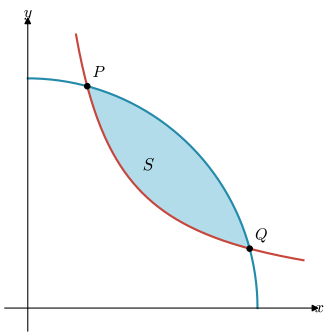
题目。 考虑曲线 $x^2 + y^2 = 1$ ① 与 $4xy = 1$ ②,$x > 0$,$y > 0$。求 ① 与 ② 围成区域的面积 $S$。
- 设交点为 $P$、$Q$,横坐标 $p < q$。令 $x = \cos\theta$,$y = \sin\theta$($0 < \theta < \frac\pi2$),由 ② 得 $\sin\boxed{\text{A}}\,\theta = \dfrac{\boxed{\text{B}}}{\boxed{\text{C}}}$。所以 $\theta = \dfrac{\boxed{\text{D}}}{\boxed{\text{EF}}}\pi$ 或 $\dfrac{\boxed{\text{G}}}{\boxed{\text{HI}}}\pi$ (前者较小),$p = \cos\dfrac{\boxed{\text{J}}}{\boxed{\text{KL}}}\pi$,$q = \cos\dfrac{\boxed{\text{M}}}{\boxed{\text{NO}}}\pi$。
- 由于 $S = \int_p^q\left(\sqrt{1 - x^2} - \frac{1}{4x}\right)dx$,计算 $I = \int_p^q\sqrt{1 - x^2}\,dx$ 与 $J = \int_p^q\frac1x\,dx$。令 $x = \cos\theta$,$I = \dfrac{\boxed{\text{P}}}{\boxed{\text{Q}}}\pi$; $J = \log\left(\boxed{\text{R}} + \sqrt{\boxed{\text{S}}}\right)$。所以 $S = \dfrac{\boxed{\text{P}}}{\boxed{\text{Q}}}\pi - \dfrac{\boxed{\text{T}}}{\boxed{\text{U}}}\log\left(\boxed{\text{R}} + \sqrt{\boxed{\text{S}}}\right)$。
解答。
1. 交点。 $4\cos\theta\sin\theta = 2\sin2\theta = 1$,所以 $\sin2\theta = \frac12$,$2\theta \in (0, \pi)$: $2\theta = \frac\pi6$ 或 $\frac{5\pi}{6}$,即 $\theta = \frac{\pi}{12}$ 或 $\frac{5\pi}{12}$。余弦递减,所以较小的 横坐标对应较大的角:$p = \cos\frac{5\pi}{12}$,$q = \cos\frac{\pi}{12}$。
2. $I$。 令 $x = \cos\theta$,$dx = -\sin\theta\,d\theta$,$\sqrt{1 - x^2} = \sin\theta$:
$$I = \int_{\pi/12}^{5\pi/12}\sin^2\theta\,d\theta = \left[\frac\theta2 - \frac{\sin2\theta}{4}\right]_{\pi/12}^{5\pi/12} = \frac{\pi}{6} - \frac{\sin\frac{5\pi}{6} - \sin\frac\pi6}{4} = \frac\pi6.$$3. $J$。 $J = \log\frac qp = \log\frac{\cos(\pi/12)}{\cos(5\pi/12)} = \log\frac{\cos(\pi/12)}{\sin(\pi/12)} = \log\cot\frac{\pi}{12}$, 而 $\cot15^\circ = 2 + \sqrt3$。所以 $J = \log(2 + \sqrt3)$。
4. $S = I - \frac14J = \frac\pi6 - \frac14\log(2 + \sqrt3) \approx 0.194$。
答案: A=2, B=1, C=2, D=1, EF=12, G=5, HI=12, J=5, KL=12, M=1, NO=12, P=1, Q=6, R=2, S=3, T=1, U=4。