Logo Euler's Eyes
  • Dark Theme
    Light Theme Dark Theme System Theme
Logo Inverted Logo
  • Tags
  • 1 Phase
  • 1st Phase
  • 2 Phase
  • 2 Phase,
  • 2nd Phase
  • 2° Degree Equation
  • Alan Turing
  • Algebra
  • Algebraic Expressions
  • Analysis
  • Analytic Geometry
  • Analytical Geometry
  • Angle Bisector
  • Angle Measurements
  • Angles
  • Apothem
  • Arc Capable
  • Arc Properties
  • Archimedes
  • Area
  • Arithmetic Progression
  • Artificial Intelligence
  • Axioms and Postulates
  • Basic Concepts of Statistics
  • Bernoulli
  • Bhaskara
  • Binary Numbers
  • Binomial
  • Biography
  • Calculating Machine
  • Calculation
  • Calculus
  • Calculus of Variations
  • Cartesian Plane
  • Cartesian Product of Sets
  • Cauchy
  • Central Angle
  • Centroid
  • Children
  • Circle
  • Circle Area
  • Circumcenter
  • Circumference
  • Circumference Ratio
  • Circumferences
  • Circumscript Segments
  • Classification in Mathematics
  • Combinatorial Analysis
  • Combinatorics
  • Comparison of Angles
  • Complement
  • Complex Numbers
  • Compound Interest
  • Computing
  • Concave Region
  • Congruence
  • Congruence of Triangles
  • Convex Region
  • Correspondence Law
  • Cosine Theorem
  • Count
  • Cryptography
  • Decision Theory
  • Demo
  • Derivative
  • Descartes
  • Diagonals
  • Diamond
  • Differential Equations
  • Dispersion Measures
  • Distance
  • Division
  • Domain and Image
  • Einstein
  • Elasticity
  • Electromagnetism
  • Elementary Descriptive Statistics
  • Elementary School I
  • Elementary School II
  • ENEM 2021
  • ENEM 2022
  • ENEM 2023
  • ENEM 2024
  • ENEM 2025
  • Entrance Exam
  • Equality
  • Equations
  • Equiprobable Events
  • Equivalence Between Sets
  • Equivalence Relations
  • Euclid
  • Euclid's Postulate
  • Euler
  • Euler Project
  • Even Numbers
  • Exercises for Adding Natural Numbers
  • Exponential Function
  • External Angles
  • Fees
  • Fermat
  • Fermat's Last Theorem
  • Financial Mathematics
  • First Degree Equations
  • First Degree Functions
  • Flat
  • Flat Figures
  • Flat Geometry
  • Fractions
  • Function Concept
  • Function Discovery
  • Functions
  • FUVEST 2021
  • FUVEST 2022
  • FUVEST 2023
  • FUVEST 2024
  • FUVEST 2025
  • FUVEST 2026
  • Galois
  • Game Theory
  • Gauss
  • Geometric Constructions
  • Geometric Shapes
  • Geometry
  • Geometry With Natural Numbers
  • Geometry With Sequences of Numbers
  • Golden Segment
  • Graph Reading
  • Graphics
  • Graphs for Integers
  • Gravitation
  • Greatest Common Divisor
  • Group Theory
  • Groups
  • Hamilton
  • Height
  • History of Mathematics
  • Incenter
  • Increases and Discounts
  • Inequalities
  • Inscribable Quadrilateral
  • Inscribed Angle
  • Integral
  • Internal Angles
  • Interval Operations
  • Intervals
  • Introduction
  • Introduction to Angles
  • Introduction to Circumference
  • Introduction to Function Theory
  • Introduction to Geometry
  • Introduction to Integers
  • Introduction to Logarithm Table
  • Introduction to Polygons
  • Introduction to Probability
  • Introduction to Quadrilaterals
  • Introduction to Radiciation
  • Introduction to Rational Numbers
  • Introduction to Real Numbers
  • Introduction to Sets
  • Introduction to Statistics
  • Introduction to Triangles
  • Johann Bernoulli
  • John Napier
  • John Nash
  • Kids
  • Lagrange
  • Language
  • Law of Cosines
  • Law of Sines
  • Least Common Multiple
  • Leibniz
  • Level 1
  • Level 2
  • Level 3
  • Limit
  • Linear Systems
  • Logarithm
  • Logarithm Properties
  • Logarithms
  • Logic
  • Magnification
  • Math Elements
  • Mathematical Biology
  • Mathematical Logic
  • Mathematical Notation
  • Mathematical Programming
  • Mathematics Education
  • Mathematics Elements
  • Mathematics for Children
  • Mathematics for Kids
  • Matrices
  • Maxwell
  • Measure
  • Mechanics
  • Medium Base
  • Metric Relationships
  • Midpoint
  • Modular Function
  • Multiplication
  • Napier
  • Natural Number Subtraction Exercises
  • Newton
  • Niels Henrik Abel
  • Notable Points of the Triangle
  • Notation
  • Notion of Infinity
  • Notions of Probability
  • Nth Root
  • Number And
  • Number Theory
  • Number Π
  • Numbering Systems
  • Numerical Calculation
  • Numerical Methods
  • OBMEP
  • OBMEP 2023
  • Obmep,
  • Odd Numbers
  • Operations With Rational Numbers
  • Operations With Sets
  • Operations With Venn-Euler Diagrams
  • Optics
  • Optimization
  • Orthocenter
  • Parallelism
  • Parallelogram
  • Parallels
  • Partial Derivatives
  • Pascal
  • Pascal's Triangle
  • Peano Axioms
  • Peirce
  • Percentage
  • Percentage Basics
  • Perimeter
  • Perpendicular Bisector
  • Perpendicularity
  • Perpendiculars
  • Philosophy
  • Physical
  • Physics
  • Pi Number
  • Pi Numbers
  • Pitot
  • Plane Geometry
  • Point
  • Point Power
  • Polygons
  • Polynomials
  • Position Measurements
  • Position Relative to the Circumference
  • Postulates
  • Potentiation of Integers
  • Power With Negative Exponent
  • Prime Numbers
  • Primitive Notions
  • Principia
  • Probability
  • Progressions
  • Proof
  • Properties
  • Properties of Polygons
  • Proportion
  • Proportionality
  • Proportions
  • Proportions and Geometry
  • Pure Mathematics
  • Pythagoras Theorem
  • Pythagorean Suits
  • Quadratic Function
  • Quadrilateral
  • Quadrilaterals
  • Quantifier
  • Quantity Analysis
  • Quaternions
  • R Programming
  • Real Numbers
  • Rectangle
  • Rectangle Triangles
  • Reduction
  • Reflection
  • Regions in Planes
  • Regular Polygons
  • Relations
  • Relationship Properties
  • Relativity
  • Rhombus
  • Right Angle
  • Right Triangle
  • Right Triangle Relationships
  • Rule of 3
  • Rule of Three
  • Saussure
  • Segment Angle
  • Semi-Inscribed Angle
  • Semi-Straight
  • Semiotics
  • Sequences
  • Series
  • Set Family
  • Set Partition
  • Set Theory
  • Signal Rule
  • Similarity
  • Similarity of Triangles
  • Simple Interest
  • Sines Theorem
  • Sophie Germain
  • Spatial Geometry
  • Square
  • Square Root
  • Statistic
  • Stewart Ratio
  • Straight
  • Straight Lines
  • Straight Segment
  • Sum of Angles
  • Supplement
  • Symmetry
  • Tangent
  • Thales' Theorem
  • The Number Zero
  • Theorems
  • Trapezium
  • Trapezius
  • Triangle
  • Triangles
  • Triangular Inequality
  • Trigonometry
  • Truth Table
  • Understanding Relationships
  • Vectors
  • Venn-Euler Diagrams
  • Whole Numbers
  • Wiles
  • Women in Mathematics
  • Year 2018
  • Year 2019
  • Year 2021
  • Year 2022
  • Évariste Galois
Hero Image
The life of John Napier

Timeline 1550Born at Merchiston Castle, near Edinburgh. His father, Archibald, is 16. 1563His mother dies. At 13, John enters the University of St Andrews. c. 1564Leaves St Andrews without a degree and goes to study on the Continent. 1571Returns to Scotland. 1572Marries Elizabeth Stirling. Goes to live at Gartness, where he builds a castle. 1593Publishes A Plaine Discovery of the Whole Revelation of Saint John, his most famous book in his lifetime. 1594Signs a contract to search for treasure hidden at Fast Castle. 1596Describes his “secret inventions” of war in a manuscript. 1608On his father’s death he becomes laird of Merchiston. 1614Publishes the Description of the Wonderful Canon of Logarithms. 1615Receives at Merchiston a visit from Henry Briggs, professor in London. 1617Publishes the Rabdologia, with his calculating rods. Dies on 4 April. 1619His son Robert publishes the Construction of the Wonderful Canon of Logarithms. The boy from Merchiston John Napier was born in 1550 in Merchiston Tower, a small stone castle a little over three kilometres from Edinburgh. His father, Sir Archibald Napier, was only 16. The family belonged to the Scottish nobility, and the name was spelled in many ways: Napier, Napeir, Nepair, and in Latin Neperus, from which comes the French form Neper.

October 15, 2026 Read
Hero Image
Multiplying by adding: the two progressions

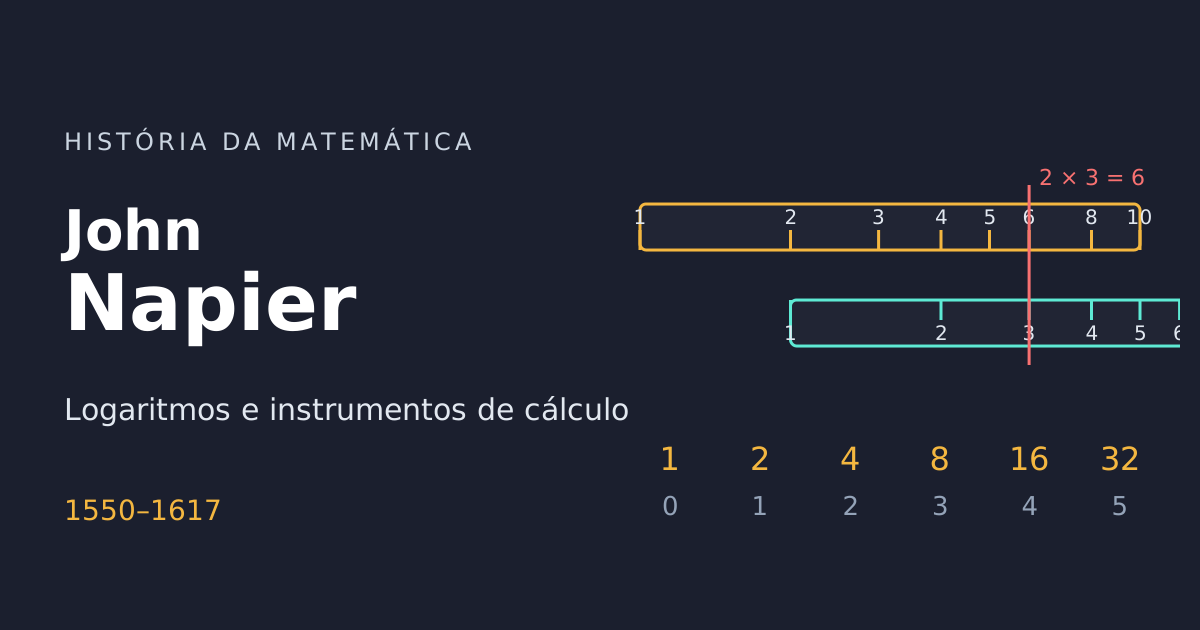
Write the powers of 2 in a row and, below them, the exponents: $$\begin{array}{c|ccccccccccc} 2^n & 1 & 2 & 4 & 8 & 16 & 32 & 64 & 128 & 256 & 512 & 1024\\ \hline n & 0 & 1 & 2 & 3 & 4 & 5 & 6 & 7 & 8 & 9 & 10 \end{array}$$The top row is a geometric progression: each number is the previous one times 2. The bottom row is an arithmetic progression: each number is the previous one plus 1. Now try to multiply $16\times64$. Under 16 is 4; under 64, 6. Add them: $4+6=10$. Above 10 is 1024. And indeed

October 15, 2026 Read
Hero Image
Napier's two points: the definition of the logarithm

Napier did not have the exponent notation we use today. To define logarithms he used an image of motion, long before Newton and Leibniz created the calculus. The definition Imagine two points that start together. The first, $P$, moves along a segment $AB$ of length $10^7$, and its speed at each instant equals the distance still left to $B$: it starts fast and keeps slowing down, never arriving. The second, $Q$, moves along an endless line, always at $P$’s initial speed.

October 15, 2026 Read
Hero Image
Briggs and base-10 logarithms

These numbers were first invented by the most illustrious John Napier, Baron of Merchiston; they were then changed, following his own opinion, by Henry Briggs. — Title page of Henry Briggs's Arithmetica logarithmica (1624) Henry Briggs was professor of geometry at Gresham College in London and one of the greatest calculators in England. In March 1615 he wrote to a friend that Napier had set his “head and hands a work” with his new logarithms, and that he hoped to meet him that summer. He did. In the conversation at Merchiston the two agreed that the tables would be far more practical with two changes: the logarithm of 1 would be 0, and that of 10 would be 1.

October 15, 2026 Read
Hero Image
Napier's bones: multiplying with rods

Logarithms were meant for the great calculations of astronomy. For everyday sums Napier invented something else, published in 1617, the year of his death, in a little book called Rabdologia, from the Greek rhabdos, rod, and lógos, calculation: calculation with rods. The rods Each rod, or “bone”, because the most expensive ones were made of ivory, carries at the top a digit from 0 to 9 and, below it, its multiples from 1 to 9, in nine small squares cut by a diagonal. The tens go above the diagonal and the units below. The rod for 7, for example, shows $0/7$, $1/4$, $2/1$, $2/8$, $3/5$, $4/2$, $4/9$, $5/6$, $6/3$.

October 15, 2026 Read
Hero Image
The slide rule: logarithms that slide

A table of logarithms still requires looking numbers up, adding and looking up again. A few years after Napier, the English realised that the logarithms could be put on a ruler and the addition done with the hands. Gunter’s scale In 1620 the astronomer Edmund Gunter, Briggs’s colleague at Gresham College, drew a ruler on which each number $x$ stood at a distance proportional to $\log x$ from the mark for 1:

October 15, 2026 Read
Hero Image
The legacy of John Napier

By shortening the labours, the invention of logarithms doubled, so to speak, the life of the astronomer. — Saying attributed to Pierre-Simon Laplace Few inventions spread so quickly. In less than ten years logarithms were in use in England, Holland, Germany and Italy. For three and a half centuries they were humanity’s main calculating tool. Kepler The first great user was Johannes Kepler, who saw Napier’s tables in 1617 and was delighted. In 1619 he wrote a letter of thanks to the Scottish baron, not knowing he had been dead for two years, and dedicated his Ephemerides of 1620 to him. Kepler computed his own tables of logarithms and used them in the Rudolphine Tables of 1627, the most accurate tables of planetary positions of the time, which confirmed the elliptical orbits.

October 15, 2026 Read
Hero Image
Image credits

Historical images and photographs All come from Wikimedia Commons. We use the thumbnails provided by Commons, unedited. Portrait of John Napier, unknown artist, 1616, National Galleries of Scotland: source page · public domain. Title page of the Mirifici logarithmorum canonis descriptio, 1614: source page · public domain. A page of the 1614 tables: source page · public domain. Title page of Briggs’s Arithmetica logarithmica, 1624, photo by Phidus: source page · CC BY-SA 4.0. Napier’s bones in the Whipple Museum, photo by Marsupium: source page · public domain. Merchiston Tower, photo by Kim Traynor: source page · CC BY-SA 3.0. Slide rule, photo by Jacek Halicki: source page · CC BY-SA 4.0. Blog figures The map, the journey graph and the interactive figures (the two progressions, the two points, Briggs’s scale, the bones and the slide rule) are original and work in every language of the site. The map uses OpenStreetMap data.

October 15, 2026 Read
Hero Image
FUVEST 2022 – 1st phase: Mathematics solved

Source: FUVEST – General Knowledge test, version V and rectified official template of the 1st phase (applied in 12/12/2021). The 1st phase of FUVEST 2022 had 90 questions from all subjects. This post brings the 12 mathematics questions, which in test V are questions 30 to 41. In the others versions (K, Q, X and Z) the same questions appear with different numbering and another order of alternatives, so always check the version of your test.

September 26, 2026 Read
Hero Image
FUVEST 2023 – 1st phase: Mathematics solved

Source: FUVEST – proof (version V) and official answer key of the 1st phase (General Knowledge Test, applied in 04/12/2022). The 1st phase of FUVEST 2023 had 90 questions from all subjects. This post brings the mathematics questions: 21, 22, 24, 36, 58 and 84 to 90. The numbering is that of Proof V; in other versions (K, Q, X and Z) the same questions appear in another order. The question 58 is interdisciplinary (CO₂ emissions), but is resolved with graph reading and area estimation, that’s why it’s here.

September 26, 2026 Read
Hero Image
FUVEST 2024 – 1st phase: Mathematics solved

Source: FUVEST – test of the 1st phase, version V and official template (rectified in 24/11/2023), available in the FUVEST collection 2024. The 1st phase of FUVEST 2024 (General Knowledge Test, 19/11/2023) had 90 questions from all disciplines. This post only contains 12 math questions. The numbering used here is that of Proof V; In versions K, Q, X and Z the same questions appear with other numbers. Template Question Subject Template 13 Matrices: product and social network B 31 Volume of cylinder and circular segment B 33 Percentage: cost variation A 34 Statistics: mode, median, mean and range A 35 Count: digital clock reflected B 48 Cobblestone Packaging D or E (both accepted) 49 Parallelogram and trigonometry C 59 Exponential and logarithmic function (inverse) D 60 Linear system and line graph E 63 Pythagorean Tree: geometric progression and logarithm C 84 Graph Reading: Homicide Rates E 85 Triangular and oblong numbers D Question 13: Matrices and connections in a social network Statement Matrices can be used to obtain information about a social network. To understand how this can be done, let’s consider as an example a small social network made up of 4 people: $P_1, P_2, P_3, P_4$. The matrix associated with this social network is the matrix $4 \times 4$:

September 26, 2026 Read
Hero Image
FUVEST 2026 – 1st phase: Mathematics solved

Source: FUVEST – test V1 and template of the General Knowledge Test (1st phase), applied in 23/11/2025. Files in FUVEST collection 2026. The 1st phase of FUVEST 2026 had 90 multiple choice questions from all disciplines. This post brings mathematics questions. The numbering used here is that of Proof V1; in versions V2, V3 and V4 the same issues appear in another order (the official template includes the correspondence table). Template Question Subject Template 3 Logical reasoning: election with tiebreaker Canceled 4 Logarithms: Shannon entropy A 6 Spatial geometry: regular pyramid E 7 Trigonometry: double arc equation D 18 Exponential function and logarithms E 30 Spatial geometry: cylinder volume B 36 Trigonometry in the right triangle E 37 Analytical geometry: circle equation A 55 Perfect numbers, primes and progressions B 74 Function graph transformations D Question 3: How many votes guarantee the election? Question canceled by FUVEST. In the official answer sheet, question 3 from Test V1 appears with an asterisk (nullified). FUVEST did not disclose the reason for the cancellation.

September 26, 2026 Read
Navigation
  • Start here
  • Recent posts
  • About Euler
  • App
  • Privacy
Contact me:
  • hirowat2@gmail.com

Euler's Eyes
© 2021 Euler Eyes.
Powered by Hugo Logo