Logo Euler's Eyes
  • Materials
  • English
    Port-BR
  • Dark Theme
    Light Theme Dark Theme System Theme
Logo Inverted Logo
  • Tags
  • 1 Phase
  • 1st Phase
  • 2 Phase
  • 2 Phase,
  • 2nd Phase
  • 2° Degree Equation
  • Accessibility
  • Addition Formulas
  • Adrien-Marie Legendre
  • Alan Turing
  • Algebra
  • Algebraic Curves
  • Algebraic Expressions
  • Algorithms
  • Ambiguous Case
  • Analysis
  • Analytic Geometry
  • Analytical Geometry
  • Ancient Greece
  • Angle Bisector
  • Angle Bisectors
  • Angles
  • Any Triangles
  • Apothem
  • Arc Capable
  • Arc Sine
  • Archimedes
  • Area
  • Areas
  • Arithmetic Progression
  • Arithmetic-Geometric Mean
  • Arthur Cayley
  • Artificial Intelligence
  • Astronomy
  • Augustin-Louis Cauchy
  • Axioms and Postulates
  • Basic Concepts of Statistics
  • Bayesian Statistics
  • Bernhard Riemann
  • Bernoulli
  • Bhaskara
  • Binary Numbers
  • Binomial
  • Binomial Theorem
  • Biography
  • Biology
  • Black Holes
  • Bolzano
  • Bows
  • Braille
  • Brazil
  • Calculating Machine
  • Calculation
  • Calculus
  • Calculus of Variations
  • Cambridge
  • Cartesian Plane
  • Cartesian Product of Sets
  • Cauchy
  • Cayley Transform
  • Cayley–Hamilton Theorem
  • Celestial Mechanics
  • Cellular Automata
  • Central Angle
  • Centroid
  • Chaos
  • Children
  • Circle
  • Circle Area
  • Circular Functions
  • Circumcenter
  • Circumference
  • Circumference Ratio
  • Circumferences
  • Classical Equations
  • Classification in Mathematics
  • Combinatorial Analysis
  • Combinatorics
  • Communities
  • Complement
  • Complementary Arcs
  • Complex Functions
  • Complex Numbers
  • Compound Interest
  • Computer Architecture
  • Computing
  • Congruence
  • Conics
  • Continuity
  • Conventions
  • Convergence
  • Correspondence Law
  • Cosecant
  • Cosine
  • Cosine of the Sum
  • Cotangent
  • Count
  • Cryptography
  • Culture
  • Cultures
  • Curvature
  • Curves
  • Decision Theory
  • Degree
  • Demo
  • Derivative
  • Derivatives
  • Descartes
  • Determinants
  • Determinism
  • Diagonals
  • Diagrams
  • Diamond
  • Differential Equations
  • Diffraction
  • Diophantine Equations
  • Dispersion Measures
  • Distance
  • Division
  • Domain and Image
  • Double Bow
  • Dreyfus Affair
  • Drying
  • Dynamical Systems
  • Economics
  • Einstein
  • EJU
  • EJU 2016
  • EJU 2017
  • EJU 2018
  • EJU 2019
  • EJU 2020
  • EJU 2021
  • Elasticity
  • Electromagnetism
  • Electrostatics
  • Elementary Descriptive Statistics
  • Elementary School I
  • Elementary School II
  • Elliptic Functions
  • Elliptic Integrals
  • ENEM 2021
  • ENEM 2022
  • ENEM 2023
  • ENEM 2024
  • ENEM 2025
  • Engineering
  • Entrance Exam
  • Equality
  • Equations
  • Equiprobable Events
  • Equivalence Between Sets
  • Equivalence Relations
  • Errors
  • Ethnomathematics
  • Euclid
  • Euclid's Postulate
  • Euler
  • Euler Project
  • Even and Odd Functions
  • Even Numbers
  • Exercises for Adding Natural Numbers
  • Exponential Function
  • External Angles
  • Fees
  • Fermat
  • Fermat's Last Theorem
  • Financial Mathematics
  • First Degree Equations
  • First Degree Functions
  • Flat
  • Flat Figures
  • Four Colour Problem
  • Fourier
  • Fourier Analysis
  • Fractions
  • French Revolution
  • Function Concept
  • Function Discovery
  • Functions
  • Fundamental Equations
  • Fundamental Relationships
  • FUVEST 2021
  • FUVEST 2022
  • FUVEST 2023
  • FUVEST 2024
  • FUVEST 2025
  • FUVEST 2026
  • FUVEST 2027
  • Gabriel Cramer
  • Galois
  • Game Theory
  • Gamma Function
  • Gauss
  • Geneva
  • Geodesy
  • Geometric Constructions
  • Geometric Shapes
  • Geometry
  • Geometry With Natural Numbers
  • Geometry With Sequences of Numbers
  • Golden Segment
  • Graph Reading
  • Graph Theory
  • Graphics
  • Graphs
  • Graphs for Integers
  • Gravitation
  • Greatest Common Divisor
  • Group Theory
  • Groups
  • Göttingen
  • Half Bow
  • Hamilton
  • Height
  • Henri Poincaré
  • Heron's Formula
  • History
  • History of Mathematics
  • Hydrostatics
  • Identities
  • Incenter
  • Increases and Discounts
  • Inequalities
  • Infinity
  • Inscribable Quadrilateral
  • Inscribed Angle
  • Integral
  • Integrals
  • Internal Angles
  • Interval Operations
  • Intervals
  • Introduction
  • Introduction to Function Theory
  • Introduction to Geometry
  • Introduction to Integers
  • Introduction to Logarithm Table
  • Introduction to Probability
  • Introduction to Radiciation
  • Introduction to Rational Numbers
  • Introduction to Real Numbers
  • Introduction to Sets
  • Introduction to Statistics
  • Inverse Functions
  • ITA 2022
  • ITA 2023
  • ITA 2024
  • ITA 2025
  • ITA 2026
  • Iverson
  • James Joseph Sylvester
  • Johann Bernoulli
  • John Napier
  • John Nash
  • John Von Neumann
  • Lagrange
  • Language
  • Laplace
  • Large Numbers
  • Latex
  • Law of Cosines
  • Law of Large Numbers
  • Law of Sines
  • Law of Tangents
  • Lean
  • Learning
  • Least Common Multiple
  • Least Squares
  • Legacy
  • Legendre Polynomials
  • Legendre Transform
  • Leibniz
  • Level 1
  • Level 2
  • Level 3
  • Limit
  • Limits
  • Linear Algebra
  • Linear Systems
  • Logarithm
  • Logarithm Properties
  • Logarithms
  • Logic
  • Maclaurin
  • Magnification
  • Manuscripts
  • Maria Gaetana Agnesi
  • Materials
  • Math Elements
  • Mathematical Biology
  • Mathematical Logic
  • Mathematical Notation
  • Mathematical Physics
  • Mathematical Programming
  • Mathematics Education
  • Mathematics Elements
  • Mathematics for Children
  • Mathematics Teaching
  • Matrices
  • Maxwell
  • Measure
  • Mechanics
  • Medians
  • Medium Base
  • Mental Arithmetic
  • Metric Relationships
  • Metric System
  • MEXT 2017
  • MEXT 2018
  • MEXT 2019
  • MEXT 2023
  • MEXT 2024
  • MEXT 2025
  • MEXT Scholarship
  • Midpoint
  • Milan
  • Modular Function
  • Multiplication
  • Names
  • Nancy
  • Napier
  • Napoleon
  • Natural Number Subtraction Exercises
  • Newton
  • Niels Henrik Abel
  • Non-Euclidean Geometry
  • Notable Arcs
  • Notation
  • Notion of Infinity
  • Notions of Probability
  • Nth Root
  • Number And
  • Number Bases
  • Number Theory
  • Number Π
  • Numbering Systems
  • Numeration
  • Numerical Calculation
  • Numerical Methods
  • Obmep
  • OBMEP 2023
  • Obmep,
  • Octonions
  • Odd Numbers
  • Operations With Rational Numbers
  • Operations With Sets
  • Operations With Venn-Euler Diagrams
  • Optics
  • Optimization
  • Orthocenter
  • Parallel Postulate
  • Parallelism
  • Parallelogram
  • Parallels
  • Paris
  • Partial Derivatives
  • Pascal
  • Pascal's Triangle
  • Peano Axioms
  • Peirce
  • Percentage
  • Percentage Basics
  • Perelman
  • Perimeter
  • Period
  • Periodic Functions
  • Permutations
  • Perpendicular Bisector
  • Perpendicularity
  • Perpendiculars
  • Philosophy
  • Philosophy of Science
  • Physical
  • Physics
  • Pi
  • Pi Number
  • Pi Numbers
  • Pierre-Simon Laplace
  • Pitot
  • Plane Geometry
  • Point
  • Point Power
  • Polygons
  • Polyhedra
  • Polynomials
  • Poncelet
  • Position Measurements
  • Postulates
  • Potentiation of Integers
  • Power With Negative Exponent
  • Prime Numbers
  • Primitive Notions
  • Principia
  • Probability
  • Problem Solving
  • Programming Languages
  • Progressions
  • Projective Geometry
  • Proof
  • Properties
  • Proportion
  • Proportionality
  • Proportions
  • Proportions and Geometry
  • Prostapheresis
  • Pure Mathematics
  • Pythagoras Theorem
  • Pythagorean Suits
  • Pólya
  • Quadrants
  • Quadratic Function
  • Quadratic Functions
  • Quadratic Reciprocity
  • Quadrilateral
  • Quadrilaterals
  • Quantifier
  • Quantity Analysis
  • Quantum Mechanics
  • Quaternions
  • R Programming
  • Radian
  • Ramanujan
  • Randomness
  • Real Numbers
  • Rectangle Triangles
  • Reduction
  • Reduction to the First Quadrant
  • Reflection
  • Regular Polygons
  • Relations
  • Relationship Properties
  • Relativity
  • Residues
  • Riemann Hypothesis
  • Right Angle
  • Right Triangle
  • Rigour
  • Rule of 3
  • Rule of Three
  • Saussure
  • Seki Takakazu
  • Semi-Straight
  • Semiotics
  • Sequences
  • Series
  • Set Family
  • Set Partition
  • Set Theory
  • Sets
  • Signal Rule
  • Similarity
  • Simple Interest
  • Simulation
  • Siméon Denis Poisson
  • Sine
  • Sine of the Sum
  • Solar System
  • Solid Geometry
  • Solving Triangles
  • Sophie Germain
  • Spatial Geometry
  • Specialized Training College
  • Spherical Trigonometry
  • Square Root
  • Statistic
  • Statistics
  • Stewart Ratio
  • Straight
  • Straight Segment
  • Study in Japan
  • Sum of Angles
  • Supplement
  • Symmetry
  • Syracuse
  • Tangent
  • Tangentoid
  • Tests
  • Thales' Theorem
  • The Number Zero
  • Theorems
  • Thermodynamics
  • Topology
  • Transformation Into Product
  • Transformations
  • Transforms
  • Trapezium
  • Triangle
  • Triangle Area
  • Triangles
  • Triangular Inequality
  • Trigonometric Cycle
  • Trigonometric Equations
  • Trigonometric Inequalities
  • Trigonometric Table
  • Trigonometry
  • Triple Bow
  • Truth Table
  • Understanding Relationships
  • University of Bologna
  • Utility
  • Vectors
  • Venn-Euler Diagrams
  • Volumes
  • Werner's Formulas
  • Whole Numbers
  • Wiles
  • William Rowan Hamilton
  • Women in Mathematics
  • Writing
  • Year 2018
  • Year 2019
  • Year 2021
  • Year 2022
  • Zeta Function
  • École Polytechnique
  • Évariste Galois
Hero Image
The life of Siméon Denis Poisson

Timeline 1781Born on 21 June in Pithiviers, son of a former soldier. 1796After failing as a surgeon’s apprentice, studies at the École Centrale of Fontainebleau. 1798Enters the École Polytechnique in first place. 1800Still a student, publishes two papers praised by Legendre; becomes a tutor at the school. 1806Succeeds Fourier as professor at the École Polytechnique. 1809Introduces the brackets that bear his name, studying the stability of the Solar System. 1812Elected to the Academy of Sciences. Publishes the theory of electricity in conductors. 1813Writes Poisson’s equation. 1818Predicts the bright spot at the centre of the shadow of a disc. 1831With Lacroix, turns down Galois’s memoir on equations. 1837Publishes the Researches on the probability of judgements. Made a peer of France. 1840Dies on 25 April at Sceaux, aged 58. The baby on the nail Siméon Denis Poisson was born on 21 June 1781 in Pithiviers, a small town about eighty kilometres south of Paris. His father, also called Siméon, had been a soldier and, after leaving the army, bought a modest post in local administration. The family was large and the mother could not look after all the children on her own, so little Siméon was handed over to a nurse.

October 22, 2026 Read
Hero Image
Poisson brackets

The oldest question in celestial mechanics is whether the Solar System is stable. The planets attract one another, and each slightly disturbs the orbits of the others. Can these small disturbances add up over millions of years and, for example, carry the Earth away from the Sun? Or do they merely oscillate, with no lasting effect? Stability In the 1770s and 1780s, Lagrange and Laplace showed that the major axes of the orbits, which determine the planets’ periods, undergo no secular variations, that is, variations that keep growing in the same direction, as long as the disturbances are considered to first order in the planets’ masses. It was a reassuring result, but an approximate one.

October 23, 2026 Read
Hero Image
Poisson's equation

To compute the attraction that an extended body, such as the Earth, exerts on a point, one has to add up the attraction of every little piece of the body. Lagrange and Laplace realised that it was simpler to work with a single function, the potential: the sum of the masses of each piece divided by their distance to the point, $$V(x, y, z) = \int \frac{\rho\,dv}{r},$$where $\rho$ is the density. The attractive force is obtained by differentiating $V$.

October 24, 2026 Read
Hero Image
Poisson's spot

At the beginning of the nineteenth century, most French physicists followed Newton: light was made of tiny particles, deflected by forces when they pass close to the edge of an object. The Englishman Thomas Young, in 1801, and the Frenchman Augustin Fresnel, from 1815, defended another idea: light was a wave, and the light and dark fringes that appear near shadows came from interference between waves. The competition of 1818 In 1817 the Academy of Sciences set diffraction, the way light bends around obstacles, as the subject of its grand prize. The judging committee consisted of Arago, Biot, Gay-Lussac, Laplace and Poisson; three of them, Laplace, Biot and Poisson, were supporters of particles. Fresnel entered a long memoir in which he computed the fringes by adding up the contributions of waves coming from each point of the opening, and the results agreed with the measurements.
October 25, 2026 Read
Hero Image
The Poisson summation formula

Poisson spent a good part of his life computing definite integrals and summing series, often to solve problems in physics, such as the propagation of heat that Fourier had studied. In one of these works, the continuation of his memoir on definite integrals and the summation of series, published in 1823, a formula appears that is now one of the central tools of analysis. The formula For a function $f$ that decreases quickly in both directions, define its Fourier transform

October 26, 2026 Read
Hero Image
Poisson's ratio

Pull the ends of a rubber band: it gets longer and, at the same time, thinner. Squeeze an eraser between your fingers: it gets shorter and fatter. Almost every material does this, to a greater or lesser degree. The number In 1829, in a great memoir on the equilibrium and motion of elastic bodies, Poisson studied a bar stretched at its ends. If the length increases by a fraction $\varepsilon$ (the longitudinal strain), the width decreases by a proportional fraction, $\nu\,\varepsilon$. The number

October 27, 2026 Read
Hero Image
Juries and the law of large numbers

In France in the 1830s, serious crimes were tried by a jury of twelve citizens, and the rule for convicting changed with the government. Until 1831 a majority of 7 votes to 5 was enough; in 1831 a majority of 8 to 4 became necessary; in 1835 the rule went back to 7 to 5. Which rule convicts more innocent people? Which lets more guilty ones go? Since Condorcet, in the eighteenth century, French mathematicians had believed that such questions could be answered by the calculus of probabilities.

October 28, 2026 Read
Hero Image
The Poisson distribution

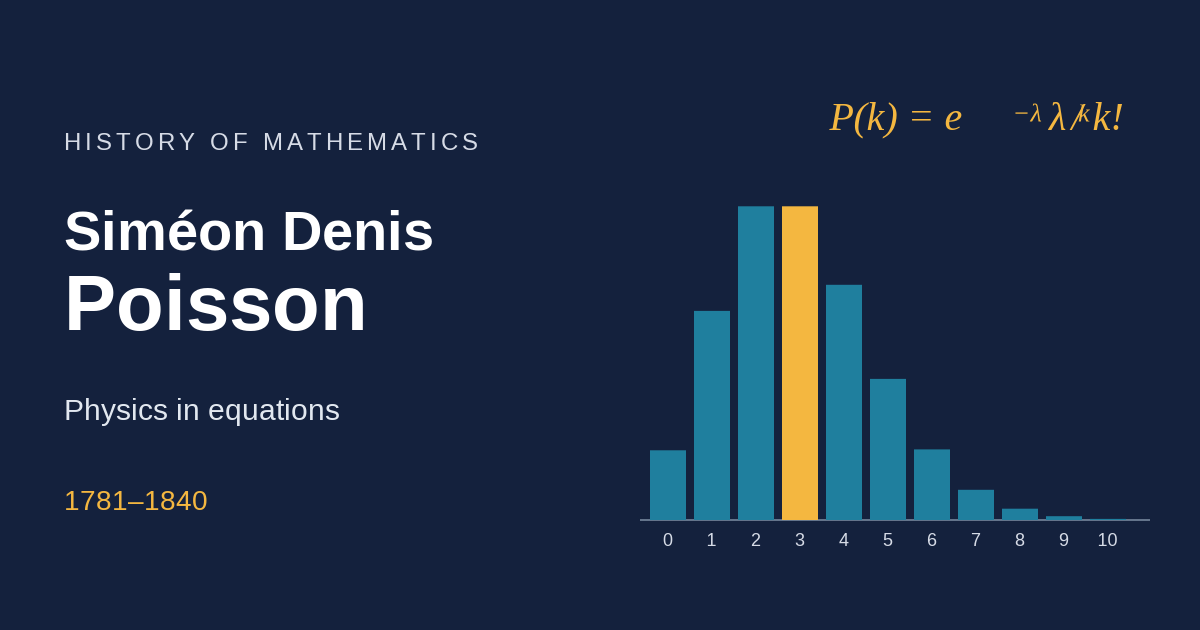
How many typing errors are there on a page? How many calls reach a telephone exchange in a minute? How many atoms of a radioactive sample decay in a second? In all these cases there is an enormous number of opportunities (letters, customers, atoms) and, in each one, a tiny chance of the event occurring. Poisson’s calculation In his 1837 book on the probability of judgements, Poisson studied the binomial distribution, the probability of $k$ successes in $n$ trials each with probability $p$:

October 29, 2026 Read
Hero Image
The legacy of Siméon Denis Poisson

Things of every kind are subject to a universal law which may be called the law of large numbers. It consists in this: if we observe very considerable numbers of events of the same nature, we shall find among these numbers ratios that are almost constant. — Siméon Denis Poisson, Researches on the probability of judgements (1837) Poisson published more than three hundred works and several treatises, among them a Treatise on mechanics (1811, enlarged in 1833) that trained generations of engineers, the New theory of capillary action (1831) and the Mathematical theory of heat (1835). But his name has survived above all through what spread as formulas.

October 30, 2026 Read
Hero Image
Image credits

Historical images and photographs All come from Wikimedia Commons. We use the files or thumbnails provided by Commons, reduced to at most 800 pixels wide, with no other editing. Portrait of Siméon Denis Poisson, lithograph by François-Séraphin Delpech (before 1840): source page · public domain. Poisson at 23, charcoal drawing by E. Marcellot (1804), collection of the École Polytechnique: source page · public domain. Bronze medallion by Pierre-Jean David d’Angers (1836): source page · CC0. Poisson’s house in Pithiviers, photo by Peter Potrowl: source page · CC BY-SA 4.0. Poisson’s spot in a laser experiment, photo by Clement Eustache: source page · CC BY-SA 4.0. Title page of the Researches on the probability of judgements (1837): source page · public domain. Poisson’s grave in the cemetery of Père-Lachaise, photo by Olegivanov53: source page · CC BY-SA 4.0. Figures made for the blog The cover and the four interactive figures (the brightness on the axis behind a disc and an aperture, the two sums of Poisson’s formula for the Gaussian, the law of large numbers with different probabilities, and the binomial compared with the Poisson distribution) are original illustrations, with text in each of the site’s languages.

October 31, 2026 Read
Navigation
  • Start here
  • Recent posts
  • About Euler
  • App
  • Privacy
  • About us
  • Contact
Contact me:
  • hirowat2@gmail.com

Euler's Eyes
© 2021 Euler Eyes.
Powered by Hugo Logo