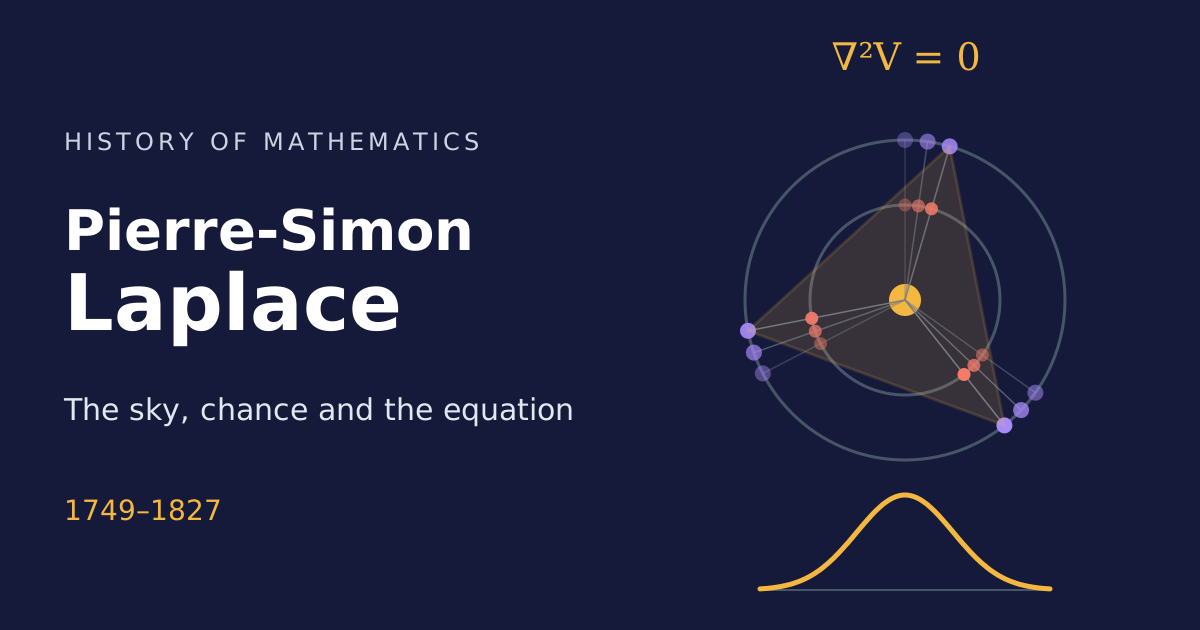
Timeline 1749Born on 23 March in Beaumont-en-Auge, Normandy, the son of a cider merchant. 1765Enters the University of Caen to study theology. 1768Goes to Paris with a letter of recommendation to d’Alembert. 1770Becomes professor of mathematics at the Military School in Paris. 1773Is elected to the Academy of Sciences, at the third attempt. 1783Publishes with Lavoisier the memoir on heat and the ice calorimeter. 1785Examines the cadet Napoleon Bonaparte. Explains the great inequality of Jupiter and Saturn. 1788Marries Marie-Charlotte de Courty de Romanges. 1793Leaves Paris during the Terror. 1796Publishes the Exposition of the System of the World. 1799The first two volumes of Celestial Mechanics appear. He is Minister of the Interior for six weeks. 1806Becomes a count of the Empire. 1812Publishes the Analytic Theory of Probabilities. 1814Publishes the Philosophical Essay on Probabilities. 1817Receives the title of marquis from Louis XVIII. 1827Dies in Paris on 5 March. ◀ Previous Follow the journey Next ▶ 1749–1765 Beaumont-en-AugeHe is born on 23 March 1749, the son of a cider merchant. He studies at the town’s Benedictine school. 1765–1768 CaenHe enters the University of Caen to study theology. Two teachers, Gadbled and Le Canu, discover his talent for mathematics. 1769–1793 ParisHe arrives in Paris with a letter for d’Alembert, who finds him a post as professor at the École Militaire. In 1785 he examines the young Napoleon. 1793–1794 MelunDuring the Terror he leaves Paris with his family and takes refuge some 50 km from the capital. He returns after Robespierre’s fall. 1795–1814 ParisHe teaches at the École Normale, leads the Bureau des Longitudes, is Minister of the Interior for six weeks and then a senator and chancellor of the Senate, which meets at the Luxembourg. 1806–1827 ArcueilHe buys a country house next to that of the chemist Berthollet. The Society of Arcueil, a circle of young scientists, meets there. 1888 Saint-Julien-de-MaillocHe dies in Paris on 5 March 1827 and is buried at Père-Lachaise. In 1888 his remains are moved to the family mausoleum in Normandy. Enable JavaScript to see the map. The stages are listed below. From Normandy to Paris, with the refuge during the Terror and the country house at Arcueil, and back to Normandy for the grave. Map: © OpenStreetMap contributors
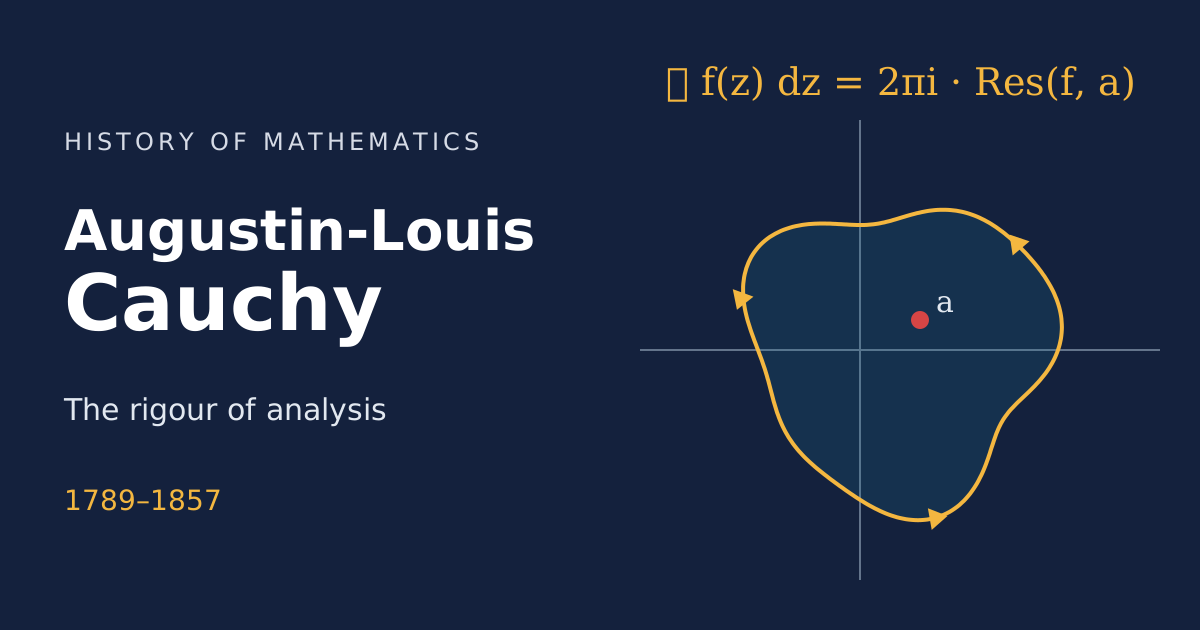
Timeline 1789Born on 21 August in Paris, five weeks after the fall of the Bastille. 1794During the Terror, the family takes refuge in Arcueil, next door to Laplace. 1805Enters the École Polytechnique, second in the entrance examination. 1810Goes to Cherbourg as an engineer on Napoleon’s military harbour. 1813Returns to Paris in poor health and proves Fermat’s polygonal number theorem. 1816Appointed to the Academy of Sciences by royal decree, in place of Monge. 1821Publishes the Cours d’analyse of the École Polytechnique. 1825Presents the memoir on integrals between imaginary limits. 1830Refuses to swear allegiance to Louis-Philippe and goes into exile. 1833In Prague, becomes tutor to the Duke of Bordeaux, grandson of Charles X. 1838Returns to Paris. 1848The new republic abolishes the oath; the following year he takes up the chair at the Sorbonne. 1857Dies on 23 May at Sceaux, aged 67. A child of the Revolution Augustin-Louis Cauchy was born in Paris on 21 August 1789. The Bastille had fallen on 14 July, and his father, Louis-François Cauchy, was a senior official of the Paris police, an Ancien Régime post that became dangerous overnight. In 1794, during the Terror, the family fled to their country house in Arcueil, south of the city. There they knew hunger and poverty; Augustin was a frail child, and poor health stayed with him all his life.