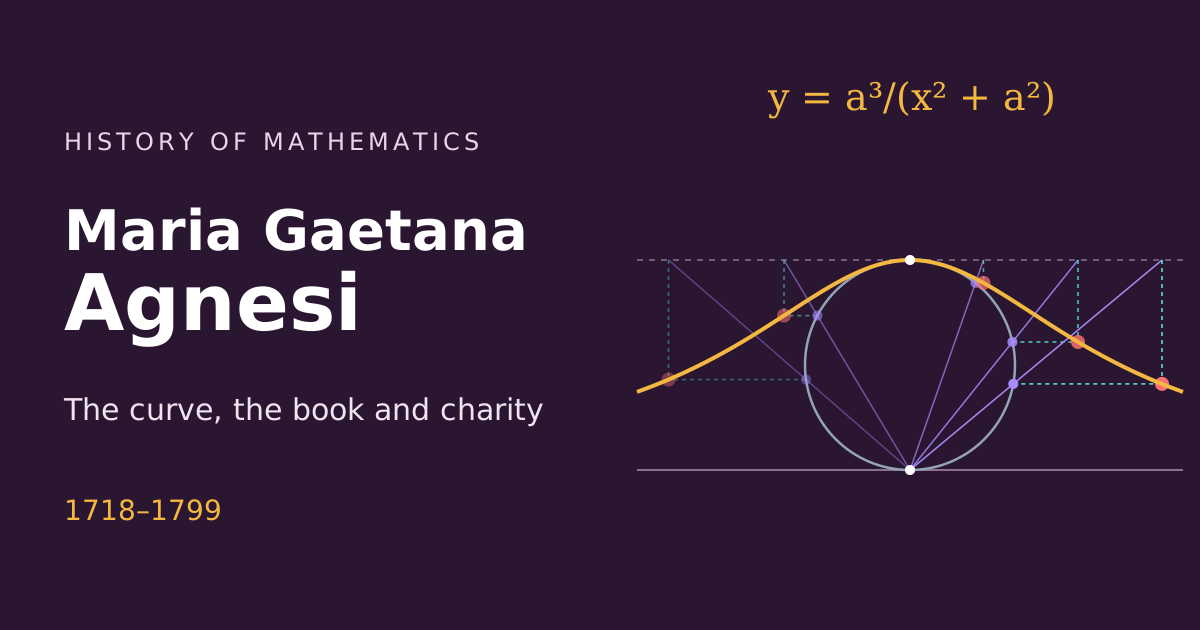
The second book of the Instituzioni analitiche is devoted to differential calculus, and one of its main applications is the one every student learns: finding maxima and minima. Agnesi teaches the method with dozens of examples, of curves and of geometric problems, always in the same sequence: write the quantity, differentiate, set the differential equal to zero and check. The highest point At a maximum or a minimum, the curve is momentarily horizontal: the tangent line has slope zero. Since the slope of the tangent is the derivative, the candidates for maximum and minimum are the points where $y' = 0$.
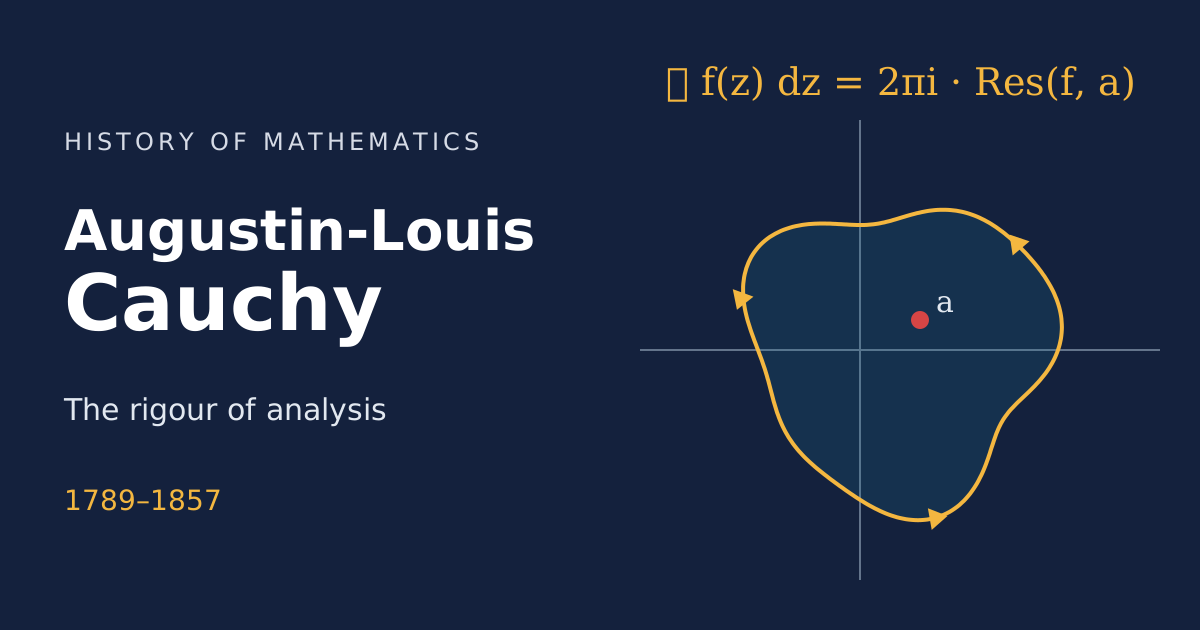
Two years after the Cours d’analyse, Cauchy published the Résumé des leçons données à l’École royale polytechnique sur le calcul infinitésimal (1823). In forty short lessons he rebuilt differential and integral calculus on the idea of limit. It is, in essence, the outline that calculus textbooks still follow today. The derivative For Lagrange, the derivative of $f$ was the coefficient of $i$ in the power series of $f(x + i)$. Cauchy defined it as a limit: