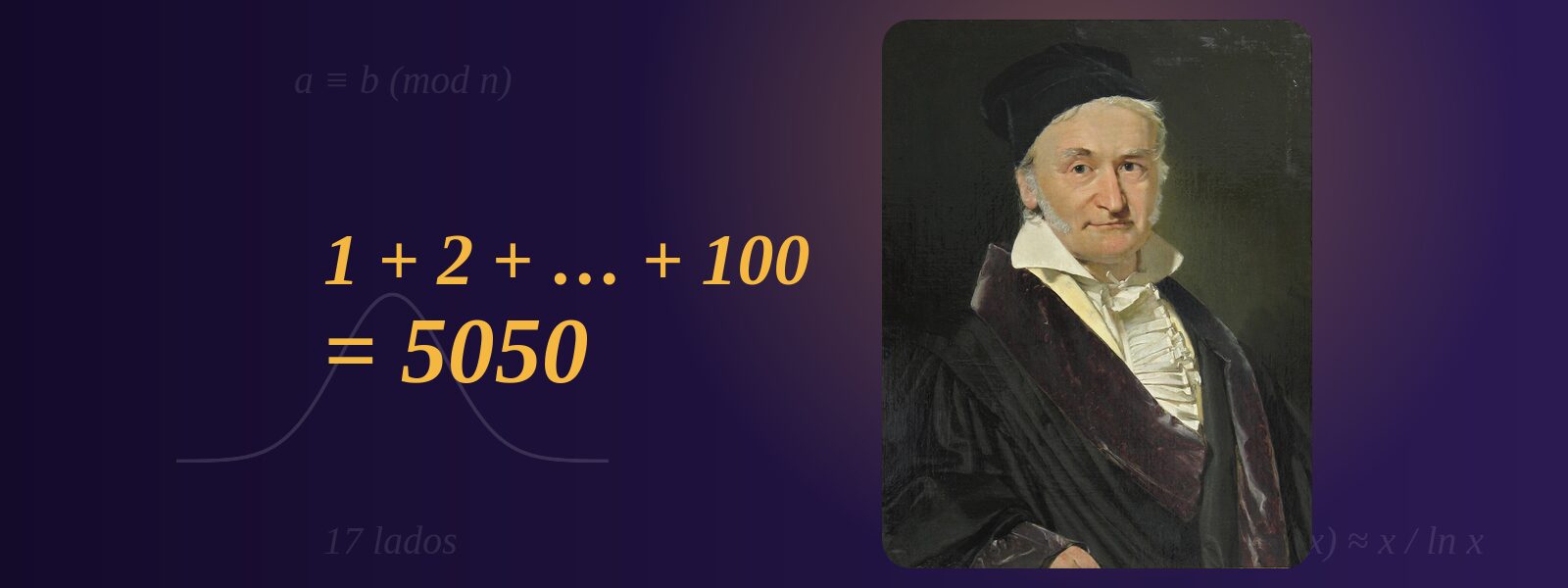
Hero Image
The life of Carl Friedrich Gauss

Timeline 1777Born on 30 April, in Braunschweig, son of a gardener and bricklayer. 1786Around 9 years, sum of 1 to 100 in seconds at school. 1791Duke Carl Wilhelm Ferdinand starts paying for his studies. 1795Enter the University of Göttingen. 1796In March 30, discover how to construct the regular polygon with 17 sides. Start your math journal. 1799Doctorate from Helmstedt, with proof of the fundamental theorem of algebra. 1801Publishes the Disquisitiones Arithmeticae and calculates the orbit of the dwarf planet Ceres. 1807He became director of the Göttingen Observatory, where he remained until his death. 1809Publishes the Theoria motus, with the least squares method and the normal curve. 1818Start measuring the Kingdom of Hannover with triangles. In 1821 he invents the heliotrope. 1827Publishes the Theorema Egregium, on the curvature of surfaces. 1833With Wilhelm Weber, he set up one of the first electric telegraphs. 1855Dies on 23 February, in Göttingen. ◀ Previous Follow the journey Next ▶ 1777–1795 BrunswickThe son of a gardener and bricklayer, he adds 1 to 100 in seconds at school. Duke Carl Wilhelm Ferdinand starts paying for his studies. 1795–1798 GöttingenHe studies at the university. On 30 March 1796 he discovers how to construct the regular 17-gon and begins his diary. 1799 HelmstedtHe takes his doctorate with a proof of the fundamental theorem of algebra. 1799–1807 BrunswickHe publishes the Disquisitiones Arithmeticae (1801) and computes the orbit of Ceres. Here he receives the letters of “Monsieur Le Blanc”. 1807–1855 Göttingen ObservatoryHe directs the observatory for almost fifty years. He surveys the Kingdom of Hanover with triangles, publishes the Theorema Egregium and builds a telegraph with Weber. He dies in 1855. Enable JavaScript to see the map. The stages are listed below. Gauss hardly travelled. He spent his life within a hundred kilometres of Braunschweig and Göttingen. Map: © OpenStreetMap contributors

Hero Image
Other contributions and legacy

Other contributions Physics: Gauss’s law of electromagnetism, the study of Earth’s magnetism and the Gauss unit. Complex numbers: Gaussian integers, numbers $a + bi$ with $a$ and $b$ integers. Astronomy and geodesy: orbits of planets and comets, the heliotrope and the Hannover measurement. Algorithms: a method for calculating the date of Easter and, in a manuscript by 1805, a version of the fast Fourier transform, rediscovered in 1965 and used today in every cell phone. To remember Gauss was born poor in Braunschweig, studied under a duke and spent his life in Göttingen. Added from 1 to 100 by joining pairs: $1 + 2 + \cdots + n = \frac{n(n+1)}{2}$. At 18 years he showed how to construct a polygon with 17 sides, using only square roots. He created the congruence notation, $a \equiv b \pmod n$, the mathematics of the clock and nines-out. He proved that every polynomial of degree $n$ has $n$ complex roots. Estimated the number of primes: $\pi(x) \approx x / \ln x$. He rediscovered Ceres with the least squares method, which shows why the average is the best estimate. He gave the name to the normal curve, the Gaussian bell. He showed that curvature can be measured from within the surface: this is why there is no perfect flat map. He named the determinant and organized the elimination that solves systems of equations. With two well-chosen points, $\pm 1/\sqrt{3}$, he calculated exact integrals for polynomials up to degree 3. All topics by Carl Friedrich Gauss · ← Gaussian quadrature: integrate with two points · Image credits →