Hero Image
The life of Pierre de Fermat

Timeline c. 1607Born at Beaumont-de-Lomagne, in the south of France. The exact year is disputed. 1626Graduates in law from the University of Orléans. 1629–1631In Bordeaux, studies the work of Viète and reconstructs lost books of Greek geometry. 1631Becomes a councillor in the Parlement of Toulouse. Gains the right to use “de” in his name. 1636Begins corresponding with Marin Mersenne. He already has his analytic geometry and his method of maxima and minima. 1637Around this year, writes in the margin of Diophantus’s Arithmetica the note of the “last theorem”. 1640Announces the little theorem and the conjecture about the numbers $2^{2^n}+1$. 1652Nearly dies of plague. He is even reported dead. 1654Exchanges letters with Blaise Pascal and, with him, founds probability theory. 1662Derives the law of refraction from the principle of least time. 1665Dies on 12 January in Castres. 1670His son Samuel publishes Diophantus’s Arithmetica with his father’s margin notes. ◀ Previous Follow the journey Next ▶ c. 1607 Beaumont-de-LomagneHe is born into a family of leather merchants. The exact year is still debated. 1626 OrléansHe graduates in law from the University of Orléans. 1629–1631 BordeauxHe studies the work of Viète and reconstructs lost books of Greek geometry. He already has his method of maxima and minima. 1631–1665 ToulouseA councillor in the Parlement. In his spare time he writes to Mersenne and Pascal and notes the “last theorem” in the margin of Diophantus. 1665 CastresHe dies on 12 January, while serving at the court in Castres. Enable JavaScript to see the map. The stages are listed below. Fermat’s life in south-western France, between the law and mathematics. Map: © OpenStreetMap contributors

Hero Image
The life of Gottfried Wilhelm Leibniz

Timeline 1646Born on 1 July in Leipzig, in the Holy Roman Empire. 1661Enters the University of Leipzig, aged 14. 1666Publishes De arte combinatoria. Leipzig refuses him a doctorate in law; Altdorf awards it the following year. 1672Goes to Paris on a diplomatic mission. Begins to study mathematics seriously with Christiaan Huygens. 1673Presents his calculating machine in London and is elected to the Royal Society. 1675In manuscripts of October and November, creates the symbols $\int$ and $d$. 1676Moves to Hanover, where he will work as librarian and counsellor for 40 years. 1684Publishes the first paper on differential calculus in the journal Acta Eruditorum. 1700Founds the Berlin Academy of Sciences and becomes its first president. 1703Publishes his explanation of binary arithmetic. 1716Dies on 14 November in Hanover. ◀ Previous Follow the journey Next ▶ 1646–1666 LeipzigHe is born and studies in Leipzig. The university refuses him a doctorate in law, saying he is too young. 1666–1667 AltdorfHe obtains his doctorate within a few months, near Nuremberg, and turns down the professorship he is offered. 1668–1672 MainzHe enters the service of the Prince-Archbishop of Mainz as a jurist and adviser. 1672–1676 ParisHe arrives on a diplomatic mission and learns mathematics from Christiaan Huygens. In 1675 he creates the symbols $\int$ and $d$. 1673 LondonHe shows his calculating machine at the Royal Society and is elected a fellow. 1676 The HagueOn his way to Hanover he visits the philosopher Baruch Spinoza. 1676–1716 HanoverLibrarian and adviser to the dukes for forty years. He publishes the calculus (1684) and binary arithmetic (1703). He dies in 1716. 1687–1690 RomeHe travels for three years through archives in Germany, Austria and Italy to write the history of the ducal family. 1700 BerlinHe founds the Berlin Academy of Sciences and becomes its first president. Enable JavaScript to see the map. The stages are listed below. The journeys of Leibniz, diplomat, librarian and mathematician. Map: © OpenStreetMap contributors

Hero Image
The life of Isaac Newton

Timeline 1643Born on 4 January at Woolsthorpe, England. In English records of the time the date is 25 December 1642. 1661Enters Trinity College, Cambridge, as a poor student. 1665–1667With the university closed by the plague, he returns home. He develops series, fluxions, the theory of colours and his first ideas on gravity. 1669Aged 26, becomes Lucasian Professor of Mathematics, succeeding Isaac Barrow. 1672Presents his reflecting telescope and publishes his theory of light and colours. 1687Publishes the Principia, paid for out of Edmond Halley’s own pocket. 1696Moves to the Royal Mint in London, first as Warden and, from 1699, as Master. 1703Becomes President of the Royal Society. 1704Publishes Opticks. 1727Dies on 31 March in London. He is buried in Westminster Abbey. ◀ Previous Follow the journey Next ▶ 1643–1661 WoolsthorpeHe is born on a farm, the posthumous son of a farmer, and goes to school in nearby Grantham. 1661–1665 CambridgeHe enters Trinity College as a poor student who pays his way by serving other students. 1665–1667 WoolsthorpeWith the university closed by the plague, he goes home. He develops series, fluxions, the theory of colours and his first ideas on gravity. 1667–1696 CambridgeHe holds the Lucasian chair, builds the reflecting telescope and writes the Principia (1687). 1696–1727 LondonHe runs the Royal Mint, at the Tower of London, and presides over the Royal Society. He dies in 1727 and is buried in Westminster Abbey. Enable JavaScript to see the map. The stages are listed below. Newton’s three places, from Woolsthorpe to Cambridge and London. Map: © OpenStreetMap contributors

Hero Image
The life of Carl Friedrich Gauss

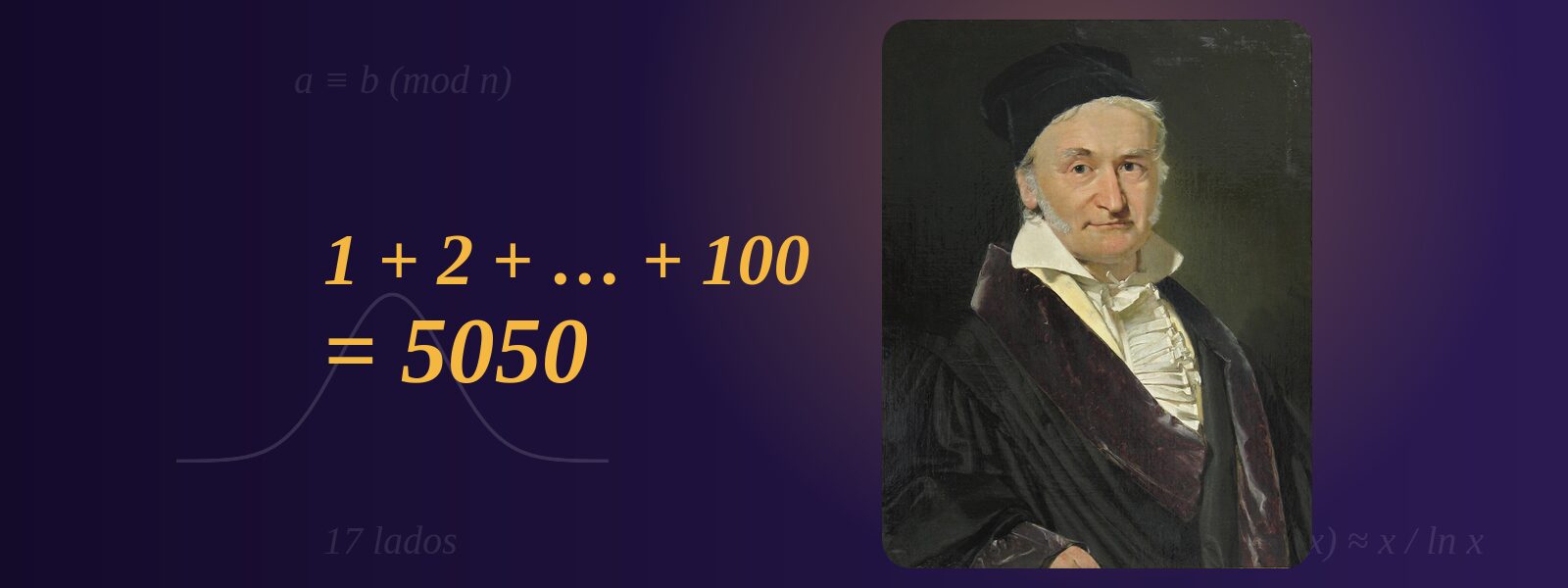
Timeline 1777Born on 30 April, in Braunschweig, son of a gardener and bricklayer. 1786Around 9 years, sum of 1 to 100 in seconds at school. 1791Duke Carl Wilhelm Ferdinand starts paying for his studies. 1795Enter the University of Göttingen. 1796In March 30, discover how to construct the regular polygon with 17 sides. Start your math journal. 1799Doctorate from Helmstedt, with proof of the fundamental theorem of algebra. 1801Publishes the Disquisitiones Arithmeticae and calculates the orbit of the dwarf planet Ceres. 1807He became director of the Göttingen Observatory, where he remained until his death. 1809Publishes the Theoria motus, with the least squares method and the normal curve. 1818Start measuring the Kingdom of Hannover with triangles. In 1821 he invents the heliotrope. 1827Publishes the Theorema Egregium, on the curvature of surfaces. 1833With Wilhelm Weber, he set up one of the first electric telegraphs. 1855Dies on 23 February, in Göttingen. ◀ Previous Follow the journey Next ▶ 1777–1795 BrunswickThe son of a gardener and bricklayer, he adds 1 to 100 in seconds at school. Duke Carl Wilhelm Ferdinand starts paying for his studies. 1795–1798 GöttingenHe studies at the university. On 30 March 1796 he discovers how to construct the regular 17-gon and begins his diary. 1799 HelmstedtHe takes his doctorate with a proof of the fundamental theorem of algebra. 1799–1807 BrunswickHe publishes the Disquisitiones Arithmeticae (1801) and computes the orbit of Ceres. Here he receives the letters of “Monsieur Le Blanc”. 1807–1855 Göttingen ObservatoryHe directs the observatory for almost fifty years. He surveys the Kingdom of Hanover with triangles, publishes the Theorema Egregium and builds a telegraph with Weber. He dies in 1855. Enable JavaScript to see the map. The stages are listed below. Gauss hardly travelled. He spent his life within a hundred kilometres of Braunschweig and Göttingen. Map: © OpenStreetMap contributors

Hero Image
The life of René Descartes

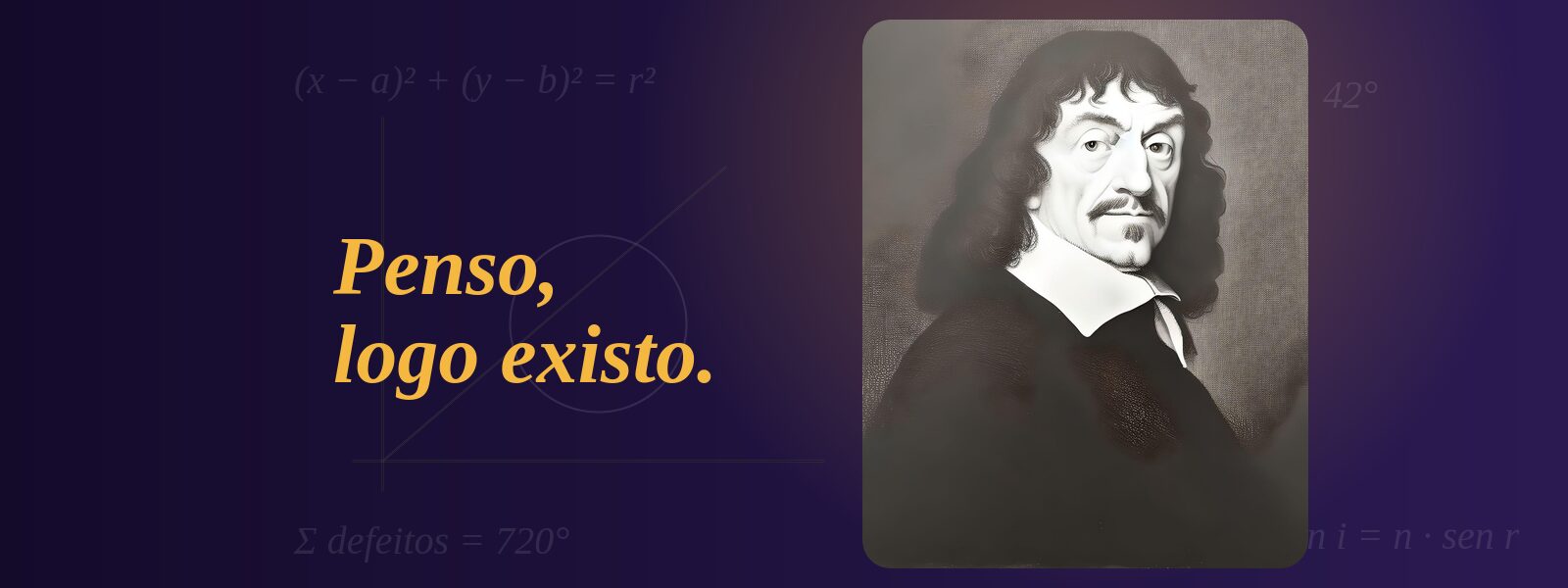
Timeline 1596Born on March 31, in La Haye, in the Touraine region, France. 1607Enter the Jesuit school of La Flèche, one of the best in Europe. 1616He graduated in Law from the University of Poitiers. 1618He joins the army of Maurice of Nassau, in the Netherlands, and meets Isaac Beeckman. 1619On the night of 10 November, he has three dreams that he decides to follow as a mission. 1628He moves to the Netherlands, where he lives for about 20 years. 1633He gave up publishing The World upon learning of Galileo’s conviction. 1637Publishes the Method Discourse, with the appendix Geometry. 1641Publishes the Meditations on First Philosophy. 1643He begins exchanging letters with Princess Elisabeth of Bohemia. 1649He goes to Stockholm, at the invitation of Queen Christina of Sweden. 1650Dies in 11 February, in Stockholm. ◀ Previous Follow the journey Next ▶ 1596 La HayeBorn in a small town in Touraine, now called Descartes in his honour. 1607–1614 La FlècheHe studies at the Jesuit college of La Flèche, one of the best in Europe, and is allowed to stay in bed in the mornings. 1616 PoitiersHe graduates in law from the University of Poitiers. 1618 BredaHe joins the army of Maurice of Nassau and meets Isaac Beeckman, who challenges him with problems in physics and mathematics. 1619 near UlmOn a winter night, in a room heated by a stove, he has the three dreams he decides to follow as a mission. 1628–1649 HollandHe lives for about twenty years in the United Provinces, moving house many times. In Leiden he publishes the Discourse on Method (1637), with La Géométrie. 1649–1650 StockholmHe goes at the invitation of Queen Christina, who wants lessons at five in the morning. He dies of pneumonia on 11 February 1650. Enable JavaScript to see the map. The stages are listed below. Descartes’s path, from Touraine to Holland and, at the end of his life, to Sweden. Map: © OpenStreetMap contributors
Hero Image
The life of Leonhard Euler

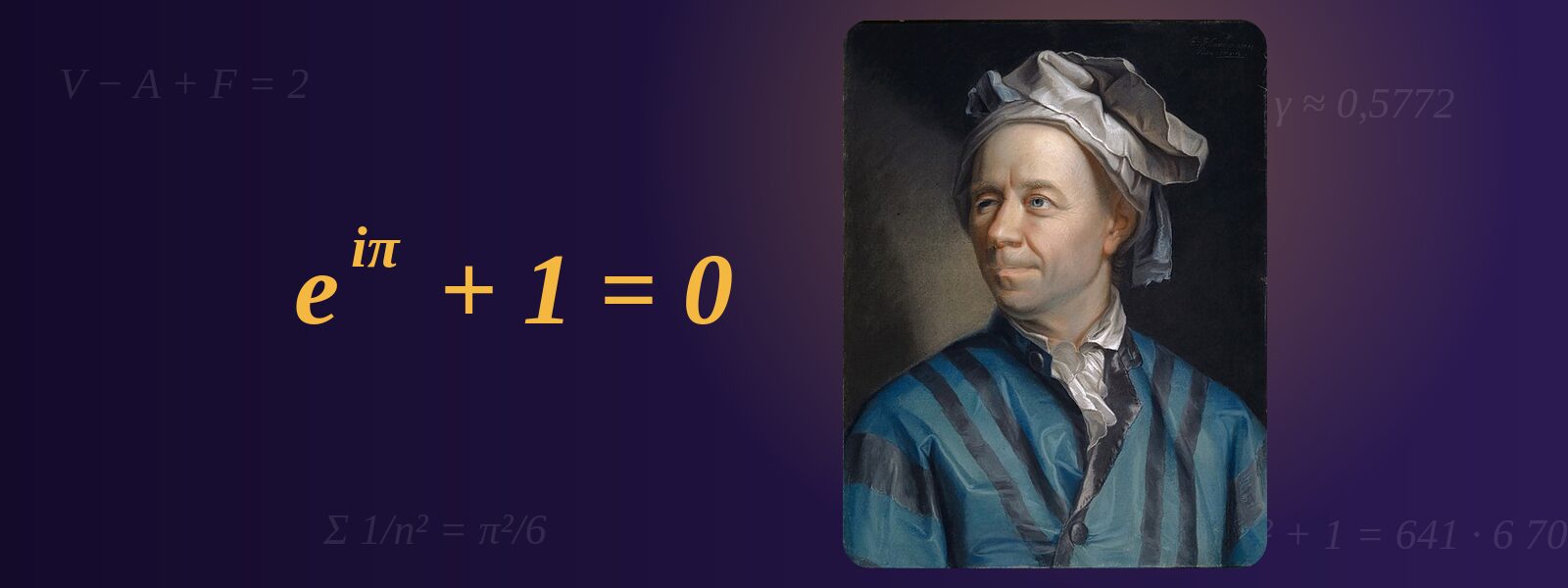
Timeline 1707Born on April 15, in Basel, Switzerland. 1720Enters the University of Basel, at 13 years old. He began studying with Johann Bernoulli. 1727Moves to the Academy of Sciences in Saint Petersburg, Russia. 1735Solve the Basel problem and analyze the Königsberg bridges. 1738He loses almost all vision in his right eye. 1741He goes to the Berlin Academy, at the invitation of Frederick II of Prussia. 1748Publishes the Introductio in analysin infiniterum, where $e^{ix} = \cos x + i \sin x$ appears. 1750In a letter to Goldbach, he states the formula for polyhedra $V - A + F = 2$. 1766Returns to Saint Petersburg, at the invitation of Catherine the Great. A cataract affects the left eye. 1771Cataract surgery fails and he is left practically blind. Keep working. 1783Dies in 18 September, in Saint Petersburg. ◀ Previous Follow the journey Next ▶ 1707–1727 BaselBorn and raised in Switzerland. At 13 he enters the university and starts Saturday lessons with Johann Bernoulli. 1727 LübeckHe travels down the Rhine by boat, crosses Germany by coach and sets sail from Lübeck for Russia. 1727–1741 Saint PetersburgHe works at the Academy of Sciences. He solves the Basel problem, studies the Königsberg bridges and loses the sight of his right eye. 1741–1766 BerlinAt the invitation of Frederick II he moves to the Berlin Academy. He publishes the Introductio in analysin infinitorum and the formula $e^{ix}=\cos x+i\sin x$. 1766–1783 Saint PetersburgHe returns at the invitation of Catherine the Great. He goes almost blind but keeps dictating papers until his death in 1783. Enable JavaScript to see the map. The stages are listed below. Euler’s cities, from Basel to Saint Petersburg. Click a stage or use Follow the journey. Map: © OpenStreetMap contributors