Hero Image
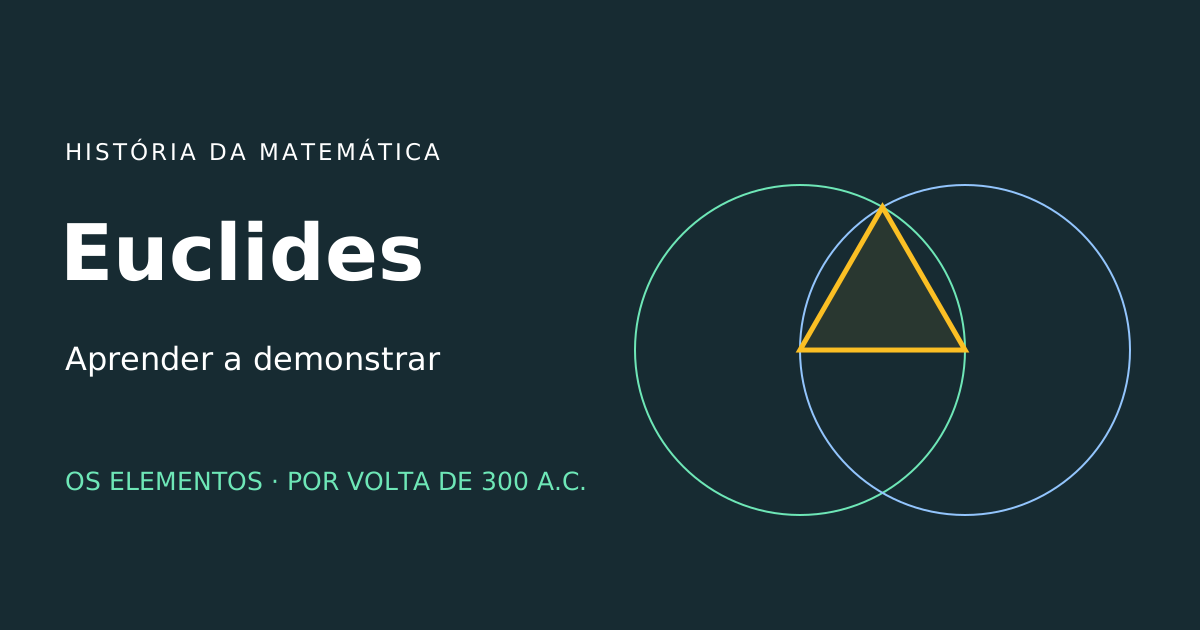
Euclid of Alexandria: the author without a face

Timeline c. 530 BCPythagoras and his followers study numbers and figures in southern Italy. c. 387 BCPlato founds the Academy in Athens. Over the door, according to tradition: “Let no one ignorant of geometry enter”. 331 BCAlexander the Great founds Alexandria, in the Nile delta. c. 300 BCEuclid teaches in Alexandria, in the time of King Ptolemy I, and writes the Elements. c. 250 BCArchimedes, in Syracuse, cites the Elements. c. AD 100A papyrus found at Oxyrhynchus, in Egypt, preserves a passage from Book II. c. 370Theon of Alexandria prepares the edition that will be copied over the following centuries. c. 450Proclus writes his commentary on Book I, with the little news we have of Euclid. c. 800The Elements are translated into Arabic in Baghdad. c. 1120Adelard of Bath translates the Arabic text into Latin. 1482First printed edition, in Venice, by Erhard Ratdolt. ◀ Previous Follow the journey Next ▶ c. 387 a.C. AthensPlato founds the Academy. The geometry Euclid will organise grows up in the Greek schools. c. 300 a.C. AlexandriaEuclid teaches in the time of Ptolemy I and writes the thirteen books of the Elements. c. 250 a.C. SyracuseArchimedes already cites the Elements in his works. c. 100 OxyrhynchusA papyrus found in the town’s rubbish heaps preserves a passage from Book II, with a figure. c. 370 AlexandriaTheon of Alexandria prepares the edition that will be copied for a thousand years. c. 450 AthensProclus writes his commentary on Book I, with the little news we have about Euclid. c. 800 BaghdadIn the House of Wisdom the Elements are translated into Arabic. c. 1120 BathAdelard of Bath translates the Arabic text into Latin, and the book returns to Europe. 1482 VeniceErhard Ratdolt prints the first edition, with the figures in the margins. More than a thousand editions followed. Enable JavaScript to see the map. The stages are listed below. The journey of the Elements, from Athens and Alexandria to the first printed edition in Venice. Map: © OpenStreetMap contributors

Hero Image
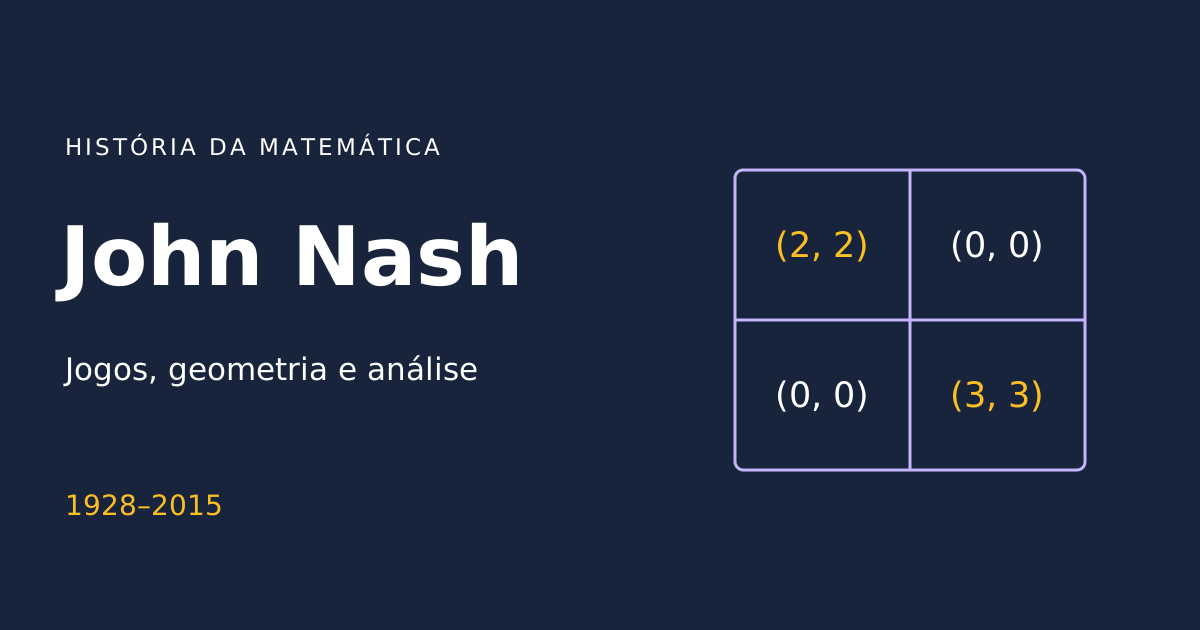
The life of John Nash

Timeline 1928Born on 13 June in Bluefield, West Virginia, in the United States. 1945Enters the Carnegie Institute of Technology, in Pittsburgh, to study chemical engineering. Switches to mathematics. 1948Arrives at Princeton. Invents the game his colleagues call “Nash”, known today as Hex. 1950Defends the thesis “Non-cooperative games”, with the Nash equilibrium. Publishes “The bargaining problem”. 1951Becomes an instructor at MIT. 1956Publishes the isometric embedding theorem. 1957Marries Alicia Lardé, a physics student at MIT. 1958Publishes the result on the regularity of parabolic equations. 1959First psychiatric hospitalisation. Three decades of illness begin. 1994Receives the Nobel Prize in Economics, with John Harsanyi and Reinhard Selten. 2001Remarries Alicia. The film A Beautiful Mind is released. 2015Receives the Abel Prize, with Louis Nirenberg. Dies in a car crash on 23 May, together with Alicia. ◀ Previous Follow the journey Next ▶ 1928–1945 BluefieldHe grows up in a railway and coal town. He reads Men of Mathematics and proves Fermat’s little theorem by himself. 1945–1948 PittsburghAt the Carnegie Institute of Technology he swaps chemical engineering for mathematics and has the bargaining idea. 1948–1951 PrincetonHe invents Hex and defends his 28-page thesis with the Nash equilibrium. 1951–1959 MITA professor at MIT. He proves the embedding theorem and the result on parabolic equations. In 1959 his illness begins. 1970–2015 PrincetonHe wanders the corridors as “the phantom of Fine Hall” and recovers at the end of the 1980s. 1994 StockholmHe receives the Nobel Prize in Economics, with John Harsanyi and Reinhard Selten. 2015 OsloHe receives the Abel Prize, with Louis Nirenberg. On the way home, on 23 May, he and Alicia die in a taxi crash in New Jersey. Enable JavaScript to see the map. The stages are listed below. John Nash’s places, from Bluefield to Princeton, and the journeys to receive the Nobel and the Abel. Map: © OpenStreetMap contributors

Hero Image
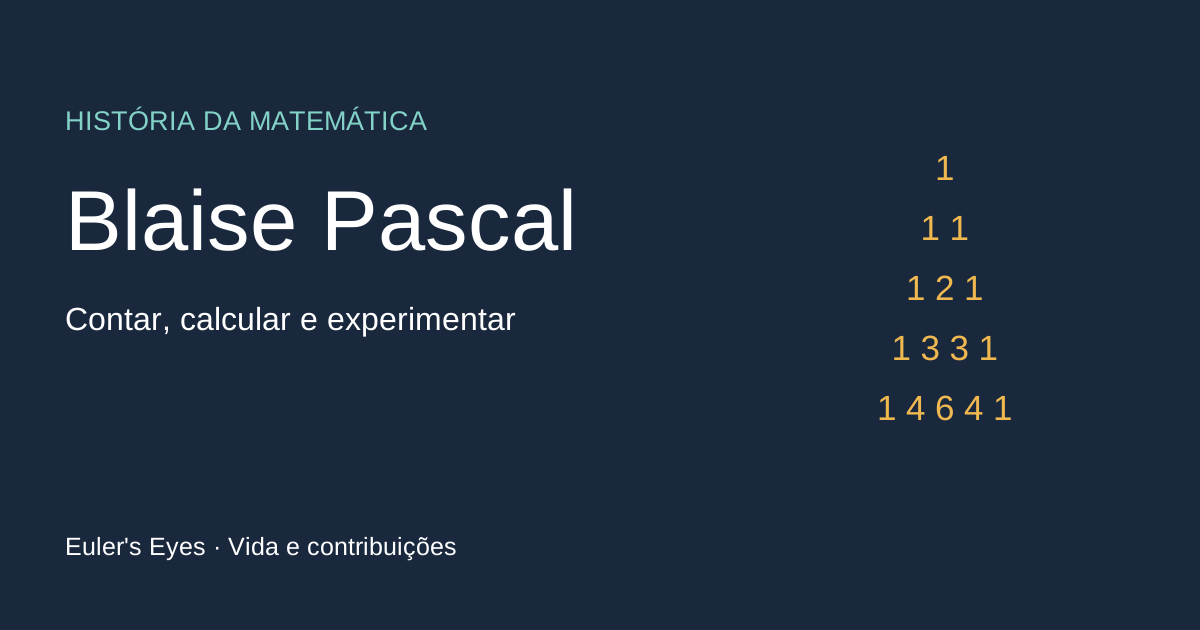
The life of Blaise Pascal

Timeline 1623Born on 19 June in Clermont, in the Auvergne region of France. 1626His mother, Antoinette Begon, dies. Blaise is 3. 1631His father, Étienne Pascal, moves to Paris with his three children. 1635At 12, he rediscovers on his own that the angles of a triangle add up to two right angles. 1640At 16, he publishes the Essay on conics, with the hexagon theorem. 1642Starts building a calculating machine to help his father, a tax official in Rouen. 1647Publishes the New experiments concerning the vacuum. Descartes visits him. 1648Florin Périer, his brother-in-law, measures the weight of air by climbing the Puy de Dôme. 1654Exchanges letters with Fermat about games of chance and writes the Treatise on the arithmetic triangle. On 23 November he has his “night of fire”. 1656Begins publishing the Provincial letters under a pseudonym. 1658Solves the problems of the cycloid and launches a contest about them. 1662Opens a line of public coaches in Paris. Dies on 19 August, aged 39. 1670His friends publish the Pensées, put together from his notes. ◀ Previous Follow the journey Next ▶ 1623–1631 ClermontHe is born in Clermont, in Auvergne. His mother dies when he is three. 1631–1639 ParisHis father teaches him at home and takes him to Mersenne’s gatherings. At 16 he writes the Essay on conics. 1640–1647 RouenHis father is a tax collector in Normandy. To help him, Blaise builds the Pascaline and carries out his experiments on the vacuum. 1648 Puy de DômeAt Pascal’s request his brother-in-law Florin Périer climbs the mountain with a barometer and shows that the air weighs less at the top. 1647–1662 ParisThe letters to Fermat on games of chance, the night of fire, the Provincial Letters, the cycloid and the public coaches. He dies in 1662, aged 39. 1655 Port-Royal-des-ChampsAfter the night of fire he spends periods at the convent where his sister Jacqueline lives and defends Port-Royal against the Jesuits. Enable JavaScript to see the map. The stages are listed below. Pascal between Clermont, Paris and Rouen, and the mountain that weighed the air. Map: © OpenStreetMap contributors