Logo Euler's Eyes
  • Dark Theme
    Light Theme Dark Theme System Theme
Logo Inverted Logo
  • Tags
  • 1 Phase
  • 1st Phase
  • 2 Phase
  • 2 Phase,
  • 2nd Phase
  • 2° Degree Equation
  • Alan Turing
  • Algebra
  • Algebraic Expressions
  • Analysis
  • Analytic Geometry
  • Analytical Geometry
  • Angle Bisector
  • Angle Measurements
  • Angles
  • Apothem
  • Arc Capable
  • Arc Properties
  • Archimedes
  • Area
  • Arithmetic Progression
  • Artificial Intelligence
  • Axioms and Postulates
  • Basic Concepts of Statistics
  • Bernoulli
  • Bhaskara
  • Binary Numbers
  • Binomial
  • Biography
  • Calculating Machine
  • Calculation
  • Calculus
  • Calculus of Variations
  • Cartesian Plane
  • Cartesian Product of Sets
  • Cauchy
  • Central Angle
  • Centroid
  • Children
  • Circle
  • Circle Area
  • Circumcenter
  • Circumference
  • Circumference Ratio
  • Circumferences
  • Circumscript Segments
  • Classification in Mathematics
  • Combinatorial Analysis
  • Combinatorics
  • Comparison of Angles
  • Complement
  • Complex Numbers
  • Compound Interest
  • Computing
  • Concave Region
  • Congruence
  • Congruence of Triangles
  • Convex Region
  • Correspondence Law
  • Cosine Theorem
  • Count
  • Cryptography
  • Decision Theory
  • Demo
  • Derivative
  • Descartes
  • Diagonals
  • Diamond
  • Differential Equations
  • Dispersion Measures
  • Distance
  • Division
  • Domain and Image
  • Einstein
  • Elasticity
  • Electromagnetism
  • Elementary Descriptive Statistics
  • Elementary School I
  • Elementary School II
  • ENEM 2021
  • ENEM 2022
  • ENEM 2023
  • ENEM 2024
  • ENEM 2025
  • Entrance Exam
  • Equality
  • Equations
  • Equiprobable Events
  • Equivalence Between Sets
  • Equivalence Relations
  • Euclid
  • Euclid's Postulate
  • Euler
  • Euler Project
  • Even Numbers
  • Exercises for Adding Natural Numbers
  • Exponential Function
  • External Angles
  • Fees
  • Fermat
  • Fermat's Last Theorem
  • Financial Mathematics
  • First Degree Equations
  • First Degree Functions
  • Flat
  • Flat Figures
  • Flat Geometry
  • Fractions
  • Function Concept
  • Function Discovery
  • Functions
  • FUVEST 2021
  • FUVEST 2022
  • FUVEST 2023
  • FUVEST 2024
  • FUVEST 2025
  • FUVEST 2026
  • Galois
  • Game Theory
  • Gauss
  • Geometric Constructions
  • Geometric Shapes
  • Geometry
  • Geometry With Natural Numbers
  • Geometry With Sequences of Numbers
  • Golden Segment
  • Graph Reading
  • Graphics
  • Graphs for Integers
  • Gravitation
  • Greatest Common Divisor
  • Group Theory
  • Groups
  • Hamilton
  • Height
  • History of Mathematics
  • Incenter
  • Increases and Discounts
  • Inequalities
  • Inscribable Quadrilateral
  • Inscribed Angle
  • Integral
  • Internal Angles
  • Interval Operations
  • Intervals
  • Introduction
  • Introduction to Angles
  • Introduction to Circumference
  • Introduction to Function Theory
  • Introduction to Geometry
  • Introduction to Integers
  • Introduction to Logarithm Table
  • Introduction to Polygons
  • Introduction to Probability
  • Introduction to Quadrilaterals
  • Introduction to Radiciation
  • Introduction to Rational Numbers
  • Introduction to Real Numbers
  • Introduction to Sets
  • Introduction to Statistics
  • Introduction to Triangles
  • Johann Bernoulli
  • John Napier
  • John Nash
  • Kids
  • Lagrange
  • Language
  • Law of Cosines
  • Law of Sines
  • Least Common Multiple
  • Leibniz
  • Level 1
  • Level 2
  • Level 3
  • Limit
  • Linear Systems
  • Logarithm
  • Logarithm Properties
  • Logarithms
  • Logic
  • Magnification
  • Math Elements
  • Mathematical Biology
  • Mathematical Logic
  • Mathematical Notation
  • Mathematical Programming
  • Mathematics Education
  • Mathematics Elements
  • Mathematics for Children
  • Mathematics for Kids
  • Matrices
  • Maxwell
  • Measure
  • Mechanics
  • Medium Base
  • Metric Relationships
  • Midpoint
  • Modular Function
  • Multiplication
  • Napier
  • Natural Number Subtraction Exercises
  • Newton
  • Niels Henrik Abel
  • Notable Points of the Triangle
  • Notation
  • Notion of Infinity
  • Notions of Probability
  • Nth Root
  • Number And
  • Number Theory
  • Number Π
  • Numbering Systems
  • Numerical Calculation
  • Numerical Methods
  • OBMEP
  • OBMEP 2023
  • Obmep,
  • Odd Numbers
  • Operations With Rational Numbers
  • Operations With Sets
  • Operations With Venn-Euler Diagrams
  • Optics
  • Optimization
  • Orthocenter
  • Parallelism
  • Parallelogram
  • Parallels
  • Partial Derivatives
  • Pascal
  • Pascal's Triangle
  • Peano Axioms
  • Peirce
  • Percentage
  • Percentage Basics
  • Perimeter
  • Perpendicular Bisector
  • Perpendicularity
  • Perpendiculars
  • Philosophy
  • Physical
  • Physics
  • Pi Number
  • Pi Numbers
  • Pitot
  • Plane Geometry
  • Point
  • Point Power
  • Polygons
  • Polynomials
  • Position Measurements
  • Position Relative to the Circumference
  • Postulates
  • Potentiation of Integers
  • Power With Negative Exponent
  • Prime Numbers
  • Primitive Notions
  • Principia
  • Probability
  • Progressions
  • Proof
  • Properties
  • Properties of Polygons
  • Proportion
  • Proportionality
  • Proportions
  • Proportions and Geometry
  • Pure Mathematics
  • Pythagoras Theorem
  • Pythagorean Suits
  • Quadratic Function
  • Quadrilateral
  • Quadrilaterals
  • Quantifier
  • Quantity Analysis
  • Quaternions
  • R Programming
  • Real Numbers
  • Rectangle
  • Rectangle Triangles
  • Reduction
  • Reflection
  • Regions in Planes
  • Regular Polygons
  • Relations
  • Relationship Properties
  • Relativity
  • Rhombus
  • Right Angle
  • Right Triangle
  • Right Triangle Relationships
  • Rule of 3
  • Rule of Three
  • Saussure
  • Segment Angle
  • Semi-Inscribed Angle
  • Semi-Straight
  • Semiotics
  • Sequences
  • Series
  • Set Family
  • Set Partition
  • Set Theory
  • Signal Rule
  • Similarity
  • Similarity of Triangles
  • Simple Interest
  • Sines Theorem
  • Sophie Germain
  • Spatial Geometry
  • Square
  • Square Root
  • Statistic
  • Stewart Ratio
  • Straight
  • Straight Lines
  • Straight Segment
  • Sum of Angles
  • Supplement
  • Symmetry
  • Tangent
  • Thales' Theorem
  • The Number Zero
  • Theorems
  • Trapezium
  • Trapezius
  • Triangle
  • Triangles
  • Triangular Inequality
  • Trigonometry
  • Truth Table
  • Understanding Relationships
  • Vectors
  • Venn-Euler Diagrams
  • Whole Numbers
  • Wiles
  • Women in Mathematics
  • Year 2018
  • Year 2019
  • Year 2021
  • Year 2022
  • Évariste Galois
Hero Image
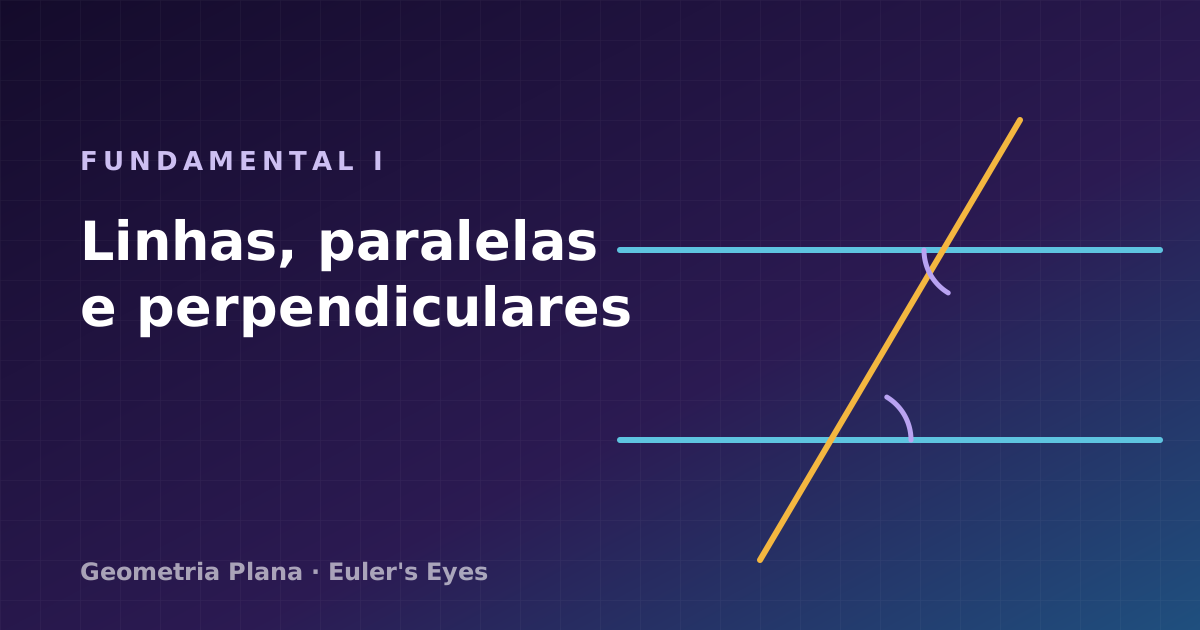
Straight and curved, parallel and perpendicular lines

A stretched thread, the path of an ant, the outline of a cloud: these are all lines. Some are straight, others curve. Straight and curved, open and closed A straight line does not change direction, like a tightly stretched string. A curved line changes direction all the time, like the path of a snake. A closed line ends where it began, like the outline of a circle. An open line has two loose ends. A line made only of straight pieces is a polygonal. When it is closed, it draws a polygon.

October 12, 2026 Read
Hero Image
Exercises from chapter 1 — Primitive notions and propositions

Exercises and resolutions Exercise 1 — Classify as true (V) or false (F) An infinite number of straight lines pass through a point. VF Verdadeiro. Take the point $P$ and infinite points outside it: each one determines with $P$ a different straight line. A straight line passes through two distinct points. VF Verdadeiro. It is the postulate of determination. A straight line contains two distinct points. VF Verdadeiro. By the postulate of existence, it contains infinities. Two distinct points determine one and only one straight line. VF Verdadeiro. Existence and uniqueness: postulate of determination. A single straight line passes through three given points. VF Falso. Only if they are collinear. Three non-collinear points are not on the same straight line. ↻ Recomeçar

October 11, 2026 Read
Hero Image
Competing straights

Two different intersecting lines have exactly one point in common. It seems obvious — and that’s precisely why it took so long to be written. Who discovered Greek geometers used the fact all the time, but Euclid did not include it among his postulates. Some older editions of The Elements added the phrase “two straight lines do not enclose a space” to cover the gap; the philologist J. L. Heiberg, who critically edited the work at the end of the 19th century, considered this excerpt to be a later addition. The modern version comes from David Hilbert’s incidence axioms (1899): if two distinct straight lines had two common points, they would contradict the postulate that two points determine a single straight line.

October 11, 2026 Read
Hero Image
Primitive propositions

If point, line and plane are not defined, someone needs to tell the rules of the game. These rules are the postulates. Who discovered The idea of ​​starting a theory with statements accepted without proof is Greek. Aristotle (4th century BC) already discussed why every demonstrative science needs initial principles, and Euclid put this into practice in The Elements, opening the work with five postulates — the first says that it is possible to draw a straight line from one point to another. In 1899, David Hilbert completed the list with about twenty axioms, including rules that Euclid used without stating.

October 11, 2026 Read
Hero Image
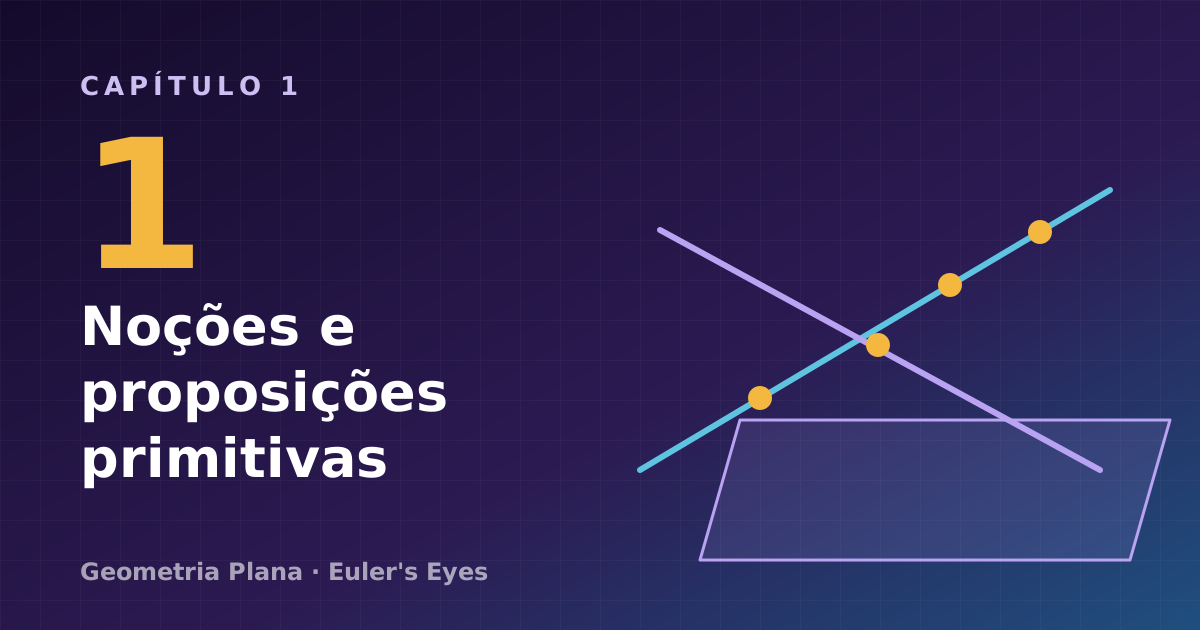
Primitive notions

Point, line and plane are the pieces with which all geometry is assembled — and, interestingly, they have no definition. Who discovered Nobody “discovered” the point or the straight line: they are ideas as old as the habit of measuring land and drawing plans. The first person who attempted to define them in writing was Euclid of Alexandria, around 300 BC, in the The Elements: “point is that which has no parts” and “line is length without width”. More than two thousand years later, in 1899, the German David Hilbert proposed the solution adopted today: leaving the point, line and plane undefined and describing only how they relate to each other.

October 11, 2026 Read
Hero Image
A little history

Further reading The word geometry comes from the Greek: geo (earth) and metry (measure) — measuring the earth. Egyptians, Babylonians, Sumerians, Hindus and Persians already used geometry to distribute fertile land after floods, build houses and temples and follow the sky. But it was the Greeks who were the first to treat it rigorously, as a deductive science, with definitions, postulates and theorems. The Greek tradition: knowledge organized in books and schools. Euclid’s The Elements, the most famous work in geometry. Frontispiece of the first English edition of The Elements (1570). According to tradition, Tales of Miletus took geometry from Egypt to Greece. After him came two schools that studied figures and numbers through analysis and deduction: the Pythagorean, by Pythagoras of Samos, and the Platonic, by Plato. The culmination of this period is the collection The Elements, written by Euclid in Alexandria around 300 BC. It deals with plane figures, circles, triangles and quadrilaterals — and it is from this that the method we follow in this book comes from.
October 11, 2026 Read
Hero Image
Pythagorean Suits

Pythagorean suits are important in architectural constructions, which aroused the interests of the Greeks. They were extremely important, thanks to them we have one of the most beautiful and lasting architectures, which survives to this day. The Pythagorean suits Initially, let’s define what the Pythagorean suit is. Definition (Pythagorean Terno): is any set of natural numbers $x,y$ and $z$ (terns) such that: $$x^2 + y^2 = z^2$$ This definition was used by Euclid in Alexandria, who used concepts from the Pythagorean theorem, which corresponds to the right triangle:

October 21, 2022 Read
Hero Image
Triangles and Circles

The triangle is one of the most frequently discussed geometric figures in the study of geometry. Its relationship with circles is fundamental to understanding various geometry results. Some of these results are called notable points of the triangle. Similarity of Triangles In the proportions post, we saw concepts of similarity of triangles. Here we will show that the similarity of triangles can be demonstrated by circles. Triangles inside the circle Lemma 1: Let AB and CD be different chords of a circle that intersect at a point P inside the circle. Then $$\dfrac{AP}{CP} = \dfrac{PD}{PB} $$

October 1, 2022 Read
Hero Image
Angles and Circumferences

Learning about angles in circles is fundamental. This concept was extensively addressed by Euclid and the Greeks in general, such as Pythagoras and Archimedes. Bow Definition: Let $A$ and $B$ be points on a circle in a plane. The straight line $\vec{AB}$ (arc) separates the plane into two half-planes, each containing a part of the circle. Central Angle Definition: Let $A$ and $B$ be points of a circle on a center plane $C$. The central angle $\angle ACB$ determined by $A$ and $B$ or determined by the chord $AB$.

September 30, 2022 Read
Hero Image
Circumferences

The main work on geometry, Euclid’s book Elements, has several results for straight lines and circles. In this post, we will show several results for this subject. Basic Settings Below we define some fundamental terms for working with circles. Center Definition (Center): is a point that is the same distance from any point on the circle. Ray Definition (Radius): is any straight line segment that runs from the center to the circumference.

September 27, 2022 Read
Navigation
  • Start here
  • Recent posts
  • About Euler
  • App
  • Privacy
Contact me:
  • hirowat2@gmail.com

Euler's Eyes
© 2021 Euler Eyes.
Powered by Hugo Logo