
Euler's Eyes
2024-06-28
Polygon Properties
In previous posts we talked about regular polygons. Now, let’s talk about the properties of polygons.

Constituent Elements
Each polygon is made up of fundamental elements such as vertices, sides, diagonals and internal and external angles. Vertices are the points where two sides meet, and sides are the line segments that connect these vertices. Diagonals are straight segments that connect two non-consecutive vertices, and internal angles are formed by the intersection of two consecutive sides.

Polygon diagonals
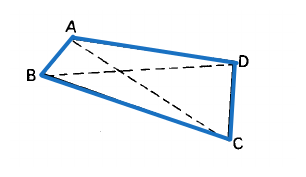
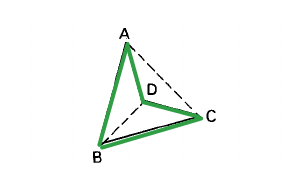
Definition: Be a polygon with $n$ sides ($n\geq 3$), the diagonal of a polygon is a segment whose ends are non-consecutive vertices of the polygon.
| Convex quadrilateral | Concave quadrilateral |
|---|---|
|
|
| $AC$ and $BD$ are the diagonals | $AC$ and $BD$ are the diagonals |
The number of diagonals $d$ of a polygon with $n$ sides ($n\geq 3$) is given by:
$$d = \frac{n(n-3)}{2}$$
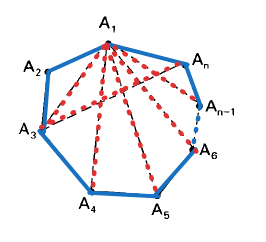
Let $A_1 A_2 \dots A_n$ be a polygon with $n$ sides. When we fix an end to one of the vertices $A_1$ without loss of generality, we have $(n-3)$ diagonals. In this case, for the remaining vertices, we will also have $(n-3)$ vertices. With this, in total we have:
$$n(n-3)~\text{ diagonals}$$But, each diagonal is counted twice as it has ends at 2 vertices. For example, $\overline{A_1 A_3}$ and $\overline{A_3 A_1}$ are counted as diagonals, which is one, because $\overline{A_1 A_3}=\overline{A_3 A_1}$.
Therefore, the number $d$ of diagonals is:
$$d = \frac{n(n-3)}{2}$$Internal angles of a convex polygon
The sum $S_i$ of the internal angles of a convex polygon with $n$ sides with $n\geq 3$ is given by:
$$S_i = (n-2)~.~2 \text{ rectos} $$$$S_i = (n-2)~.~180^\circ$$
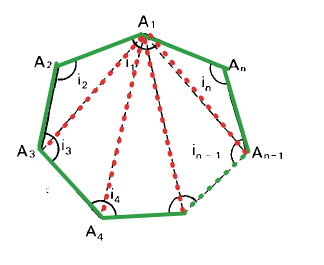
Let $A_1 A_2 \dots A_n$ be a convex polygon with $n$ sides. By fixing an end to one of the vertices we draw all the diagonals. In this way, we obtain $(n-2)$ triangles and the sum $S_i$ of the polygon’s internal angles:
$$S_i = i_1 + i_2 + \dots+ i_n$$is equal to the sum of the internal angles of the $(n-2)$ triangles.
Therefore:
$$S_i = (n-2)~.~2 \text{ rectos} $$$$S_i = (n-2)~.~180^\circ$$
Exterior angles of a convex polygon
The sum $S_e$ of the external angles of a convex polygon with $n$ sides with $n\geq 3$ is given by:
$$S_e = 4 \text{ straight} $$$$S_e = 360^\circ $$
Let $A_1 A_2 \dots A_n$ be a convex polygon with $n$ sides. We define the external angles:
$$e_1, e_2, \dots, e_n$$supplementary adjacent to the respective internal angles:
$$i_1, i_2, \dots, i_n$$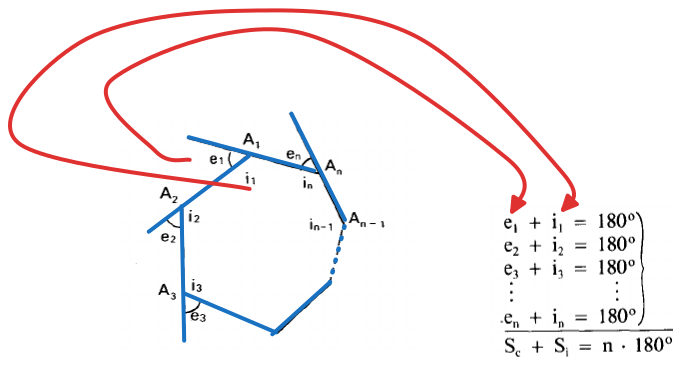
Therefore, the sum of the internal and external angles is given by:
From the previous property, we have that $S_i = = (n-2)~.~180^\circ$
Angle expressions for a regular polygon
The interior angles of a regular polygon are congruent. Therefore,
$$n ~.~a_i = S_i$$$$n ~.~a_i = (n-2)~.~180^\circ$$
$$a_i =\frac{ (n-2)~.~180^\circ}{n}$$
Likewise, for the external angle:
$$n ~.~a_e = S_e$$$$n ~.~a_e = 360^\circ$$
$$a_e = \frac{360^\circ}{n}$$
Therefore, from the above expressions, we obtain
$$a_i + a_e = 180^\circ$$Solved exercises

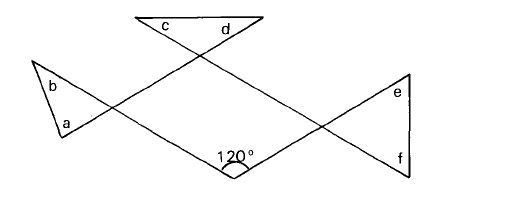
- In the following figure, determine the sum of the angle measures. $$\hat{a} + \hat{b} + \hat{c} + \hat{d}+ \hat{e} + \hat{f}$$
Resolution:
Here, we will use the exterior angle theorem for triangles from the parallelism post. In the figure we have 3 triangles with their respective external angles $\hat{a}+\hat{b}$, $\hat{c}+\hat{d}$, $\hat{e}+\hat{f} $. Thus, the internal angles of the quadrilateral are the complement of $180^\circ$, that is,
$$180^\circ-(\hat{a}+\hat{b})$$$$180^\circ-(\hat{c}+\hat{d})$$
$$180^\circ-(\ hat{e}+\hat{f})$$
.
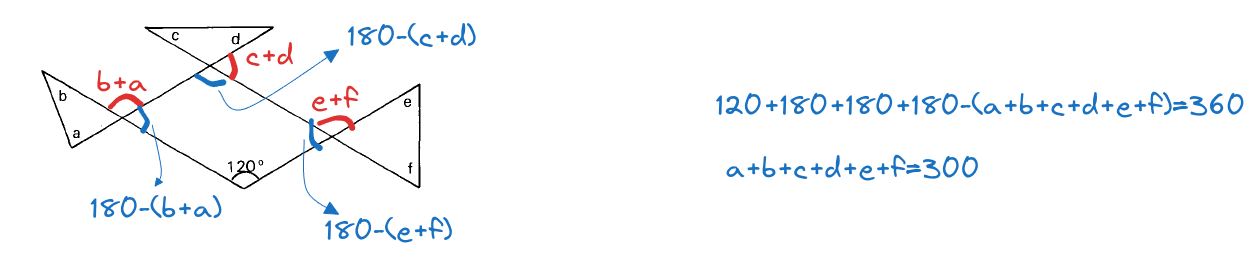
Since the sum of the interior angles of a quadrilateral is $360^\circ$.
$$120^\circ + 180^\circ-(\hat{a}+\hat{b}) + 180^\circ-(\hat{c}+\hat{d}) + 180^\circ-( \hat{e}+\hat{f})=360^\circ$$Therefore,
$$\hat{a}+\hat{b} + \hat{c}+\hat{d} + \hat{e}+\hat{f} = 300^\circ$$
- The numbers that express the number of sides of three polygons are: $$\\{n-3, ~n, ~n+3\\}$$ Determine the number of diagonals of each of the polygons, knowing that the sum of all internal angles is worth $3240^\circ$.
Resolution:
Let $n_1 = n-3$, $n_2=n$, $n_3=n+3$ be the sides of 3 polygons. It is worth remembering that the sum of the internal angles of a triangle is given by:
$$S_i = (n-2)~.~180^\circ$$From the statement, we have:
$$S_{i1} + S_{i2}+S_{i3} = 3240^\circ$$When we use this information we have:
This implies:
$$n_1 = 8-3=5^\circ \quad \Rightarrow \quad d_1 = \frac{5(5-3)}{2}=5$$$$n_2 = 8^\circ \quad \Rightarrow \quad d_2 = \frac{8(8-3)}{2}=20$$
$$n_3 = 8+3=11^\circ \quad \Rightarrow \quad d_3 = \frac{11(11-3)}{2}=44$$
Considerations
The study of polygons is a rich and dynamic field of mathematics. Its properties not only provide fertile ground for mathematical exploration, but also have practical applications in many areas. As we continue to explore these incredible shapes, we will undoubtedly discover even more about the properties and potential of polygons.
Here a small contribution was made to regular polygons, wait for the next posts.