
Euler's Eyes
2024-05-16
Parallelism
In the previous post we talked about congruence of triangles. Now, let’s talk about parallelism, which are fundamental concepts in plane geometry, especially in triangles. Parallelism in geometry is a fundamental concept that describes the relationship between lines and planes.
The History of Parallelism in Geometry
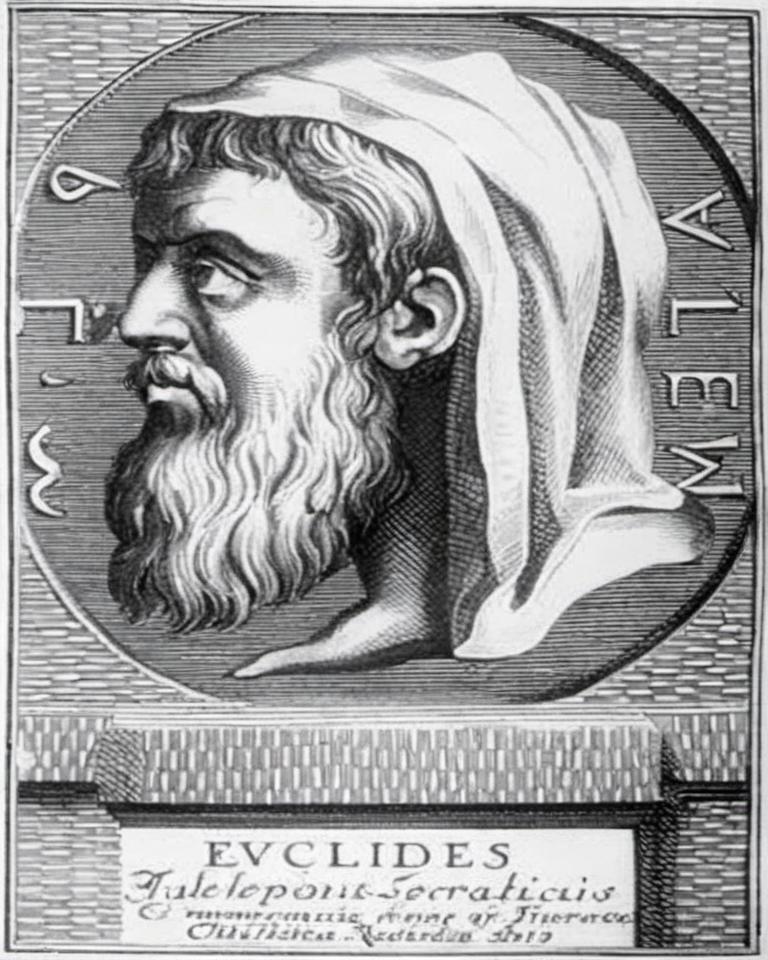
The concept of parallelism in geometry has its roots in antiquity, specifically with the Greek mathematician Euclid, around 300 BC. He introduced the parallel postulate, which states that a single straight line passes through a point parallel to a given straight line. This postulate is one of the bases of Euclidean Geometry, which is the geometry we study on a daily basis.

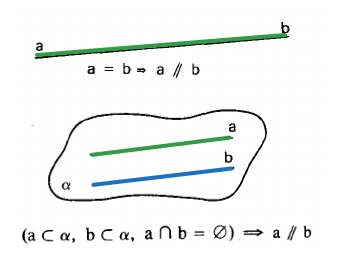
Over time, the concept of parallelism evolved and expanded beyond straight lines, also encompassing planes in Euclidean space. Thus, two lines are parallel if they have no points in common and are contained in the same plane. Likewise, two planes are parallel if they have no points in common.
The study of parallelism in geometry continues to be an active area of research and has applications in a variety of areas, from physics to engineering and architecture. Therefore, parallelism is a fundamental concept that has played a crucial role in the history of mathematics and continues to be relevant today.

Concepts and properties
Parallelism is a study of the relative positions between straight lines and planes, focusing on the properties resulting from these positions and the interactions between these elements.
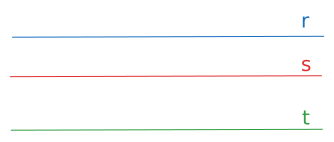
Parallel Lines: Two lines are considered parallel when they are contained in the same plane and there is no point in common between them. This is characterized by Euclid’s postulate, which states that a single straight line passes through a point parallel to a given straight line.
Definition: Two lines are parallel (//) if, and only if, they are coincident (equal) or coplanar1 and have no common point.
| Train line | Parallel lines |
|---|---|

|
|
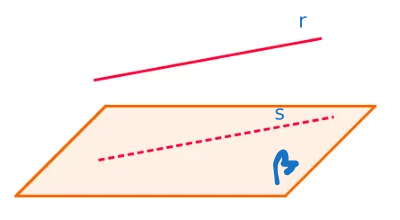
Line Parallel to the Plane: A straight line and a plane are parallel when they have no points in common. To verify this, a straight line outside the plane is considered. If there is a line belonging to this plane parallel to the line considered, then the line will be parallel to the plane.
| Fence with parallel lines | Lines parallel to the plane |
|---|---|

|
|
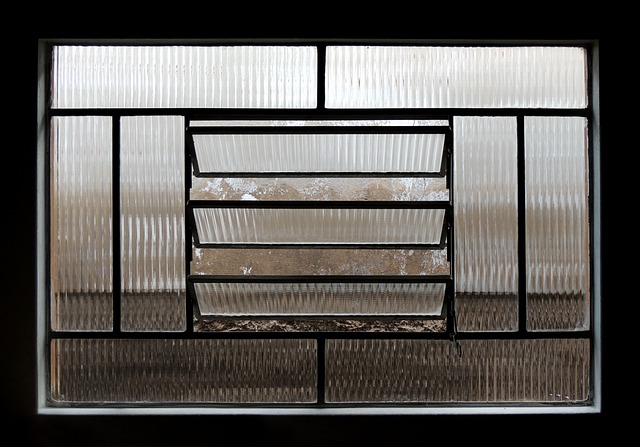
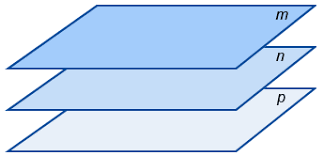
Parallel Planes: Two planes are considered parallel when they have no point in common1. When two planes are parallel, any line that belongs to one of them is parallel to the other1.
| Windows with Parallel Planes | Parallel Plans |
|---|---|
|
|
Parallelism Properties:
- When two distinct planes are parallel, any straight line on one of them is parallel to the other.
- When a straight line is parallel to a plane, it is parallel to at least one straight line in that plane.
- When a straight line is not contained in a plane and is parallel to a straight line in the plane, it is parallel to the plane.
- If a plane intersects two parallel planes, the intersections are two parallel lines.
- When a plane contains two competing straight lines, parallel to another plane, then the planes considered are parallel.
Transverse Lines
Let $a$ and $b$ be two distinct lines, parallel or not, and $t$ be a line concurrent with $a$ and $b$:
- $t$ is a transversal of $a$ and $b$
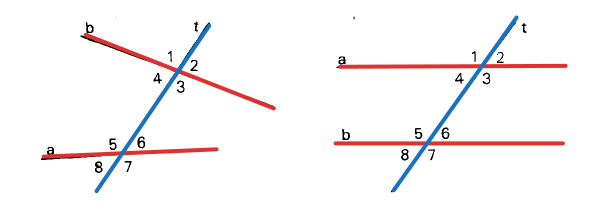
As for the angles, we have:
| Alternates | Correspondents | Collateral |
|---|---|---|
| $\hat{1}$ and $\hat{7}$ | $\hat{1}$ and $\hat{5}$ | $\hat{1}$ and $\hat{8}$ |
| $\hat{2}$ and $\hat{8}$ | $\hat{2}$ and $\hat{6}$ | $\hat{2}$ and $\hat{7}$ |
| $\hat{3}$ and $\hat{5}$ | $\hat{3}$ and $\hat{7}$ | $\hat{3}$ and $\hat{6}$ |
| $\hat{4}$ and $\hat{6}$ | $\hat{4}$ and $\hat{8}$ | $\hat{4}$ and $\hat{5}$ |
For alternates:
| Internal alternates | External alternates |
|---|---|
| $\hat{3}$ and $\hat{5}$ | $\hat{1}$ and $\hat{7}$ |
| $\hat{4}$ and $\hat{6}$ | $\hat{2}$ and $\hat{8}$ |
For collaterals:
| Internal collateral | External collateral |
|---|---|
| $\hat{3}$ and $\hat{6}$ | $\hat{1}$ and $\hat{8}$ |
| $\hat{1}$ and $\hat{8}$ | $\hat{2}$ and $\hat{7}$ |
One of the most important results is parallel lines and corresponding and alternating angles, as shown in the following animation.
Existence of parallel
Theorem: (Existence of parallel) If two distinct coplanar lines and a transversal determine congruent alternate angles (or corresponding angles), then these two lines are parallel.
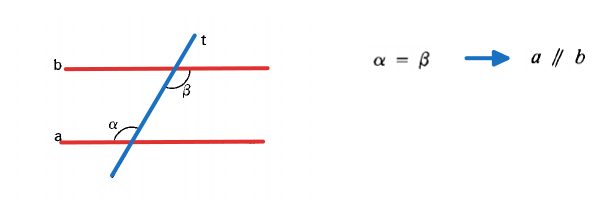
Demonstration:
| Hypothesis | Thesis |
|---|---|
| $\alpha \equiv \beta \quad \Rightarrow \quad$ | $a \parallel b$ |
To prove the result, let’s absurdly assume that $a$ and $b$ are not parallel. In this case, we would have a point $P$ in common and the intersection is equal to the point $P$, that is, $a\cap b = \\{P\\}$. Furthermore, $a\cap t = \\{A\\}$ and $b\cap t = \\{B\\}$ .
As a result, we have a triangle $ABP$ as follows:
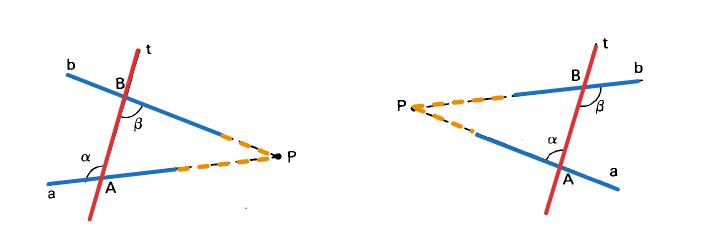
Using the exterior angle theorem applied to the triangle $ABP$ we have:
$$\alpha > \beta$$or
$$\alpha < \beta$$which is absurd, according to the hypothesis.
Therefore, the lines $a$ and $b$ are parallel ($a \parallel b$).
$\blacksquare$
Parallel construction
Here, we will construct a straight line $b$, parallel to a given straight line $a$, through a given point $P$ outside $a$.
- Initially we pass a straight line $t$ passing through $P$, which determines a point $M$ in $a$.
- We take in $a$ a point $A$ different (distinct) from $M$.
- We construct, with vertex $P$, with one side $\overrightarrow{PM}$ an angle $M\hat{P}B$ congruent to the angle $A\hat{M}P$ with $B$ in the half-plane opposite to that of $A$ in relation to the straight line $\overrightarrow{PM}$.
- The line $\overrightarrow{PB}$ is the line $b$
In fact, let $A\hat{M}P=\alpha$ and $M\hat{P}B=\beta$, by the parallel existence theorem we have that:
$$\alpha=\beta \qquad \Rightarrow \qquad a \parallel b$$Uniqueness of parallel (Euclid’s Postulate)
The uniqueness of the straight line parallel to any straight line is Euclid’s postulate. It is what we characterize as Euclidean Geometry.
Axiom: (Euclid’s Postulate) A single straight line passes through a point parallel to any given straight line.
From this axiom, we prove the following theorem:
Theorem: (Uniqueness of the parallel) If two distinct parallel lines intersect a transversal, then the alternate angles (or corresponding angles) are congruent.
If $a\neq b$ with $a \parallel b$ then $\alpha \equiv \beta $.
Demonstration:
| Hypothesis | Thesis |
|---|---|
| If $a\neq b$ with $a \parallel b \quad \Rightarrow \quad$ | $\alpha \equiv \beta $ |
If $\alpha$ and $\beta$ were not congruent, there would be a straight line $x,$ distinct from $b,$ passing through $P.$
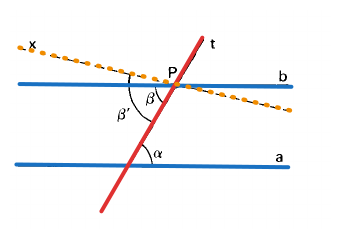
Let the point $P$ be the intersection of the straight line $b$ and the straight line $t$
$$\\{P\\} = b\cap t$$such that $\hat{xt}=\beta'$ alternates between $\alpha$ and $\beta'\equiv \alpha$.
From the parallel existence theorem we have that
$$\alpha=\beta' \qquad \Rightarrow \qquad x \parallel a$$Through the point $P$ we would have two different (distinct) lines $x$ and $b$, both parallel to the line $a,$ which is absurd!!
The absurdity is because it contradicts the postulate of parallels.
Therefore, $\alpha$ is congruent to $\beta,$ that is,
$$\alpha \equiv \beta$$$\blacksquare$
Necessary and sufficient condition for parallel lines
Theorem: (Parallel lines) A necessary and sufficient condition for two distinct lines to be parallel is that they form congruent alternate angles (or corresponding angles) with a transversal.
$$\alpha=\beta \qquad \Leftrightarrow \qquad a \parallel b$$
Demonstration:
Just use the existence and uniqueness theorem.
$\blacksquare$
External Angle
One of the results widely used in Euclidean geometry is the external angle in a triangle.
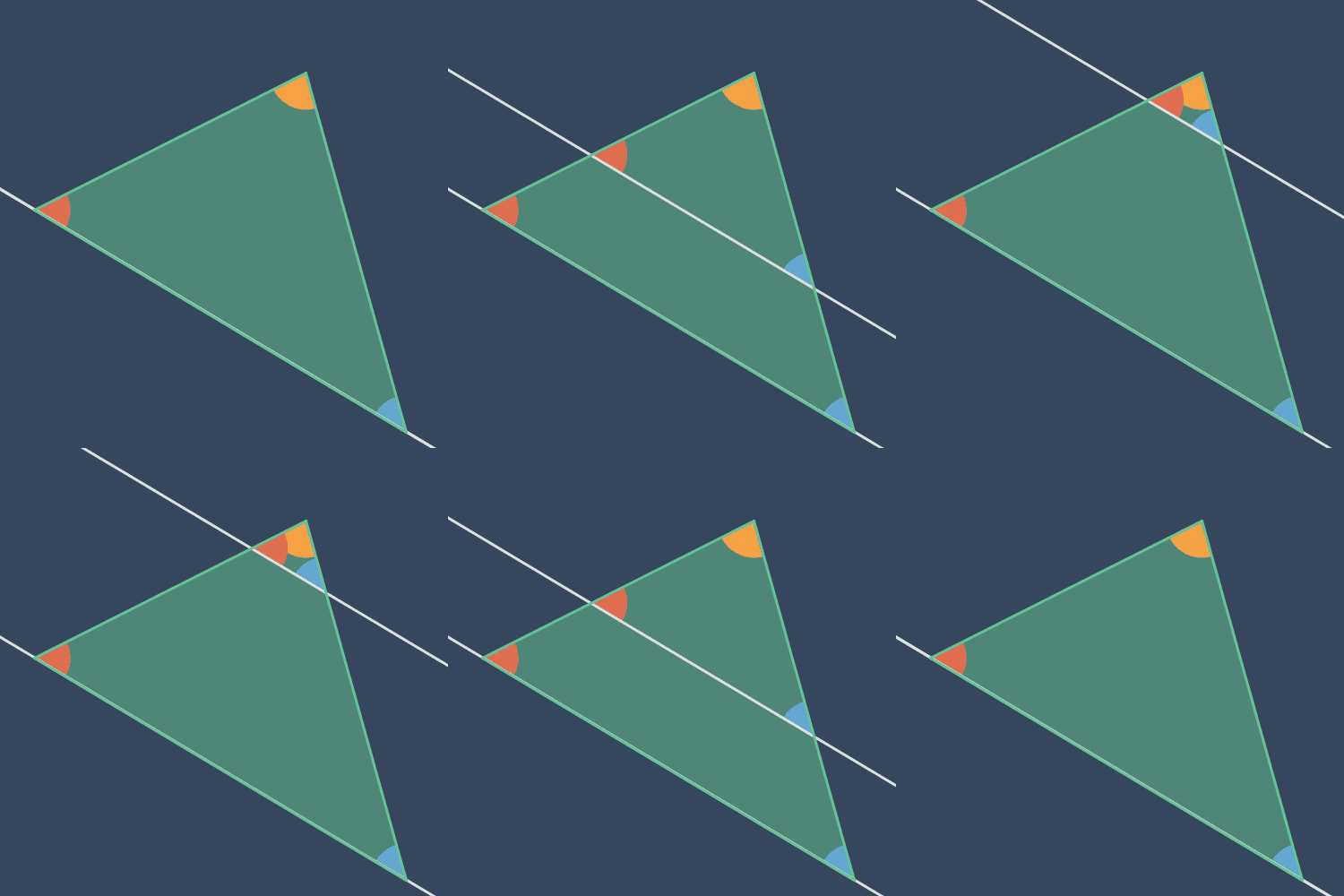
Theorem: (External Angle) In every triangle, any external angle is equal to the sum of the two internal angles not adjacent to it.
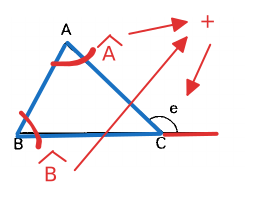
Demonstration:
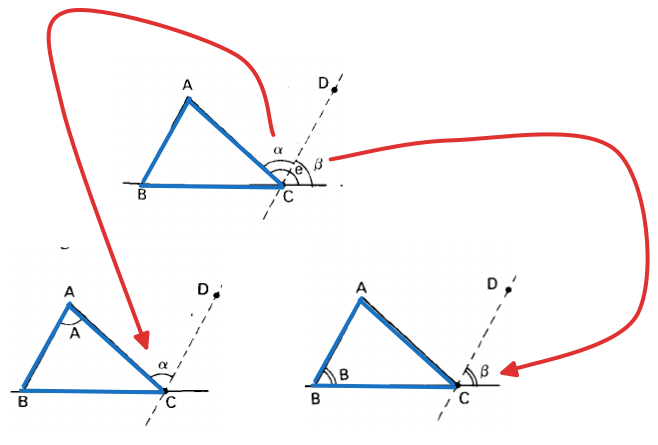
Through the point $C$, we draw a straight line $\overleftrightarrow{CD}$ parallel to the straight line $\overleftrightarrow{AB}$. It has the angles $\alpha$ and $\beta$ as shown below:
| Parallel lines | Angle congruence | Property |
|---|---|---|
| $\overleftrightarrow{AB} \parallel \overleftrightarrow{CD} \qquad \Rightarrow \qquad $ | $\alpha \equiv \hat{A} $ | alternates |
| $\overleftrightarrow{AB} \parallel \overleftrightarrow{CD} \qquad \Rightarrow \qquad $ | $\beta \equiv \hat{B} $ | correspondents |
When we add the two rows of the table we have:
$$\alpha + \beta = \hat{A} + \hat{B}$$or
$$\hat{e} = \hat{A} + \hat{B}$$$\blacksquare$
Sum of internal angles of a triangle
The sum of the angles of any triangle is equal to two right angles.
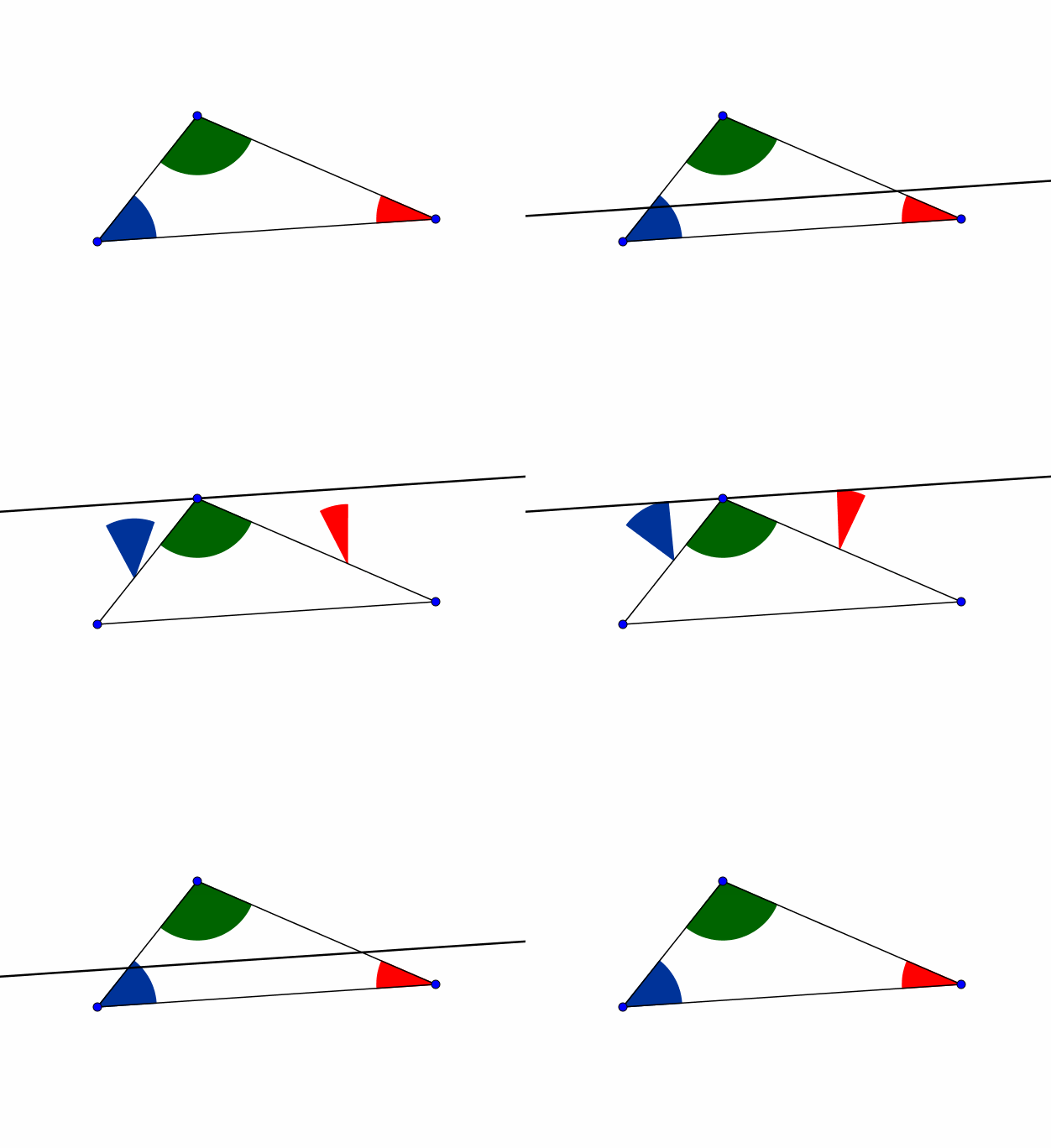
Demonstration:
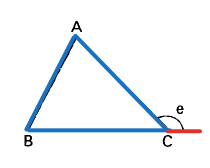
As the angles $\hat{e}$ and $\hat{C}$ are supplementary, this implies
$$\hat{e}+ \hat{C} = 2 \perp = 2\times 90^\circ = 180^\circ$$From the exterior angle theorem we have
$$\hat{e} = \hat{A} + \hat{B}$$From these two results we have
$$m(\hat{A}) + m(\hat{B}) + m(\hat{C}) = 180^\circ$$or
$$\hat{A} +\hat{B} + \hat{C} = 180^\circ$$$\blacksquare$
Angles of parallel sides
Theorem: (Angles with parallel sides) Two angles with respectively parallel sides are congruent or supplementary.
Demonstration:
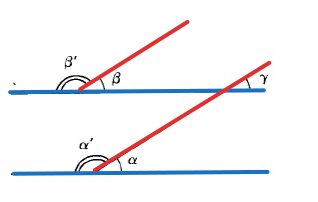
Let the angles of measurements $\alpha$ and $\alpha'$ be supplementary adjacent and $\beta$ and $\beta'$ supplementary adjacent.
By the parallelism $\alpha = \gamma$ and $\beta = \gamma$ which results in
$$\alpha = \beta$$As a consequence:
$$\alpha' = \beta'$$It is
$$\alpha + \beta' = 180^\circ$$$$\alpha' + \beta = 180^\circ$$
$\blacksquare$
Here a small introduction to parallelism was made, wait for the next posts.
-
coplanar: Located on the same plane as another, especially talking about geometric figures. ↩︎