
Euler's Eyes
2024-06-06
Introduction to Quadrilaterals
In this post, the central point of the topic is quadrilaterals, which are the foundations for beginning the study of geometry.
The history of quadrilaterals dates back to ancient times, with the famous Greek mathematician Euclid being one of the first to study their properties.
The pioneering geometers in the study of quadrilaterals were Thales of Miletus (c. 624 – 546 BC), Pythagoras of Samos (c. 585 – 500 BC), Euclid of Alexandria (c. 365 – 300 BC).
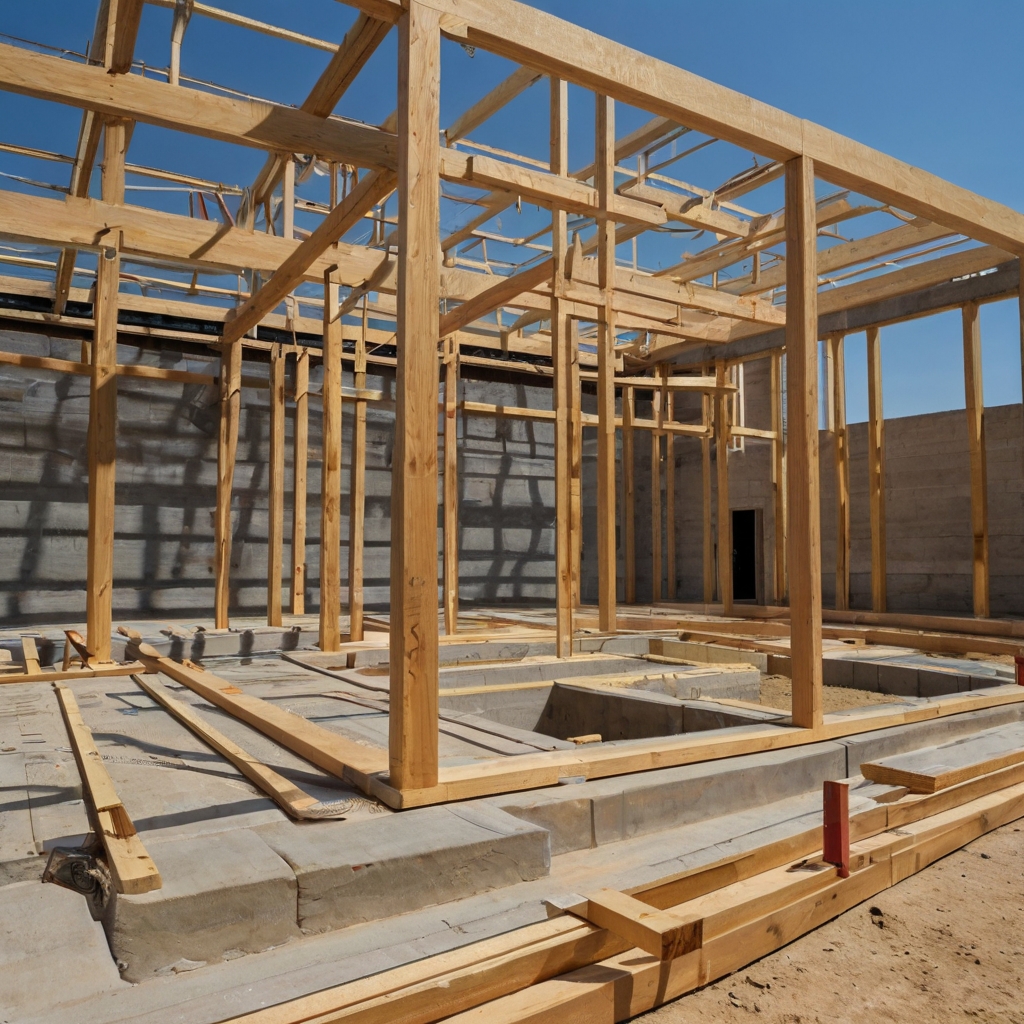
Some current games use the concept of quadrilaterals a lot, like Minecraft. Another use is civil constructions with the concept of containers and metallic structures.
| Minecraft | Steve | Metallic Structure |
|---|---|---|

|

|

|
Quadrilateral - Definitions
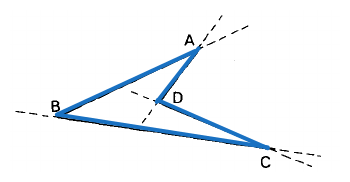
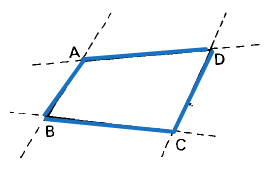
Definition: Let A, B, C and D be four points on the same plane, all distinct and three non-collinear (three or more points will be called non-collinear if we cannot draw a single straight line that contains them) . If the segments $\overline{AB}$, $\overline{BC}$, $\overline{CD}$ and $\overline{DA}$ intersect only at the ends, the union of these four segments is a quadrilateral.
$$ABCD = \overline{AB} \cup \overline{BC} \cup \overline{CD} \cup \overline{DA}$$
| ABCD Concave | ABCD Convex |
|---|---|
|
|
Quadrilateral ABCD has the following terms:
- $\overline{AB}$, $\overline{BC}$, $\overline{CD}$ and $\overline{DA}$ are the sides
- $\hat{A}=D\hat{A}B$, $\hat{B}=A\hat{B}C$, $\hat{C}=B\hat{C}D$ and $ \hat{D}=C\hat{D}A$ are the angles
- $\overline{AC}$ and $\overline{BD}$ are the diagonals.
A quadrilateral has:
- 2 diagonals ($d=2$)
- sum of internal angles equal to $360^\circ$ and
- sum of the exterior angles is equal to $360^\circ$.
Notable Quadrilaterals
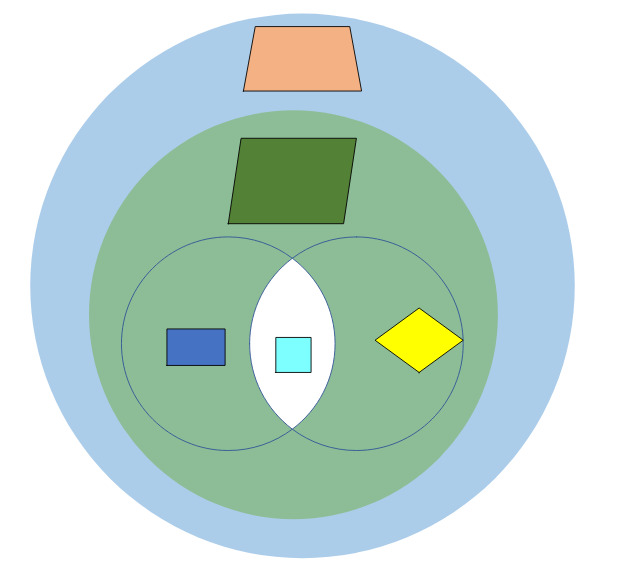
Notable quadrilaterals are trapezoids, parallelograms, rectangles, rhombuses and squares.
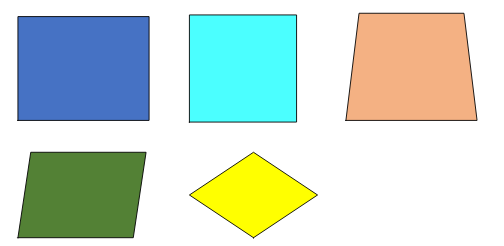
- Square of all quadrilaterals is the one that has properties in common with all the others.
- Rectangle, also called Oblong by Euclid.
- Trapezium was not included in Euclid’s definition, but it is any case within quadrilaterals.
- Parallelogram, also known as Rhomboid by Euclid.
- Losango, also known as Rombo by Euclides.
Square
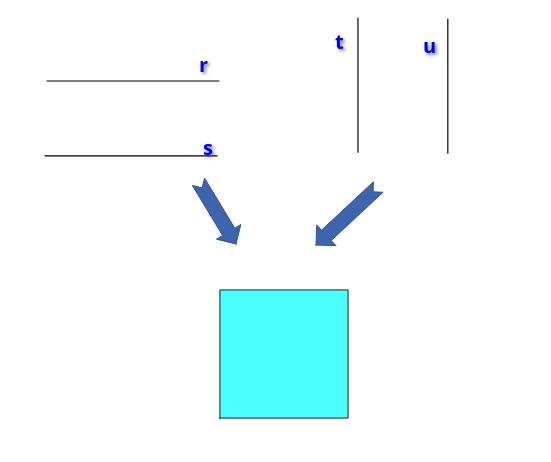
The square can be defined as two pairs of parallel lines, with a horizontal pair and a vertical pair. It is worth remembering that these pairs are equal and perpendicular.
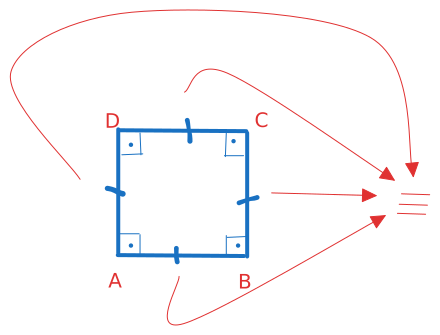
Definition: A convex flat quadrilateral is a square if, and only if, it has four congruent angles and four congruent sides.
- $\overline{AB}$, $\overline{BC}$, $\overline{CD}$ and $\overline{DA}$ are congruent
- $\hat{A}=D\hat{A}B$, $\hat{B}=A\hat{B}C$, $\hat{C}=B\hat{C}D$ and $ \hat{D}=C\hat{D}A$ are congruent angles and equal to $90^\circ$.
Rectangle
The rectangle can be defined as two pairs of parallel lines, with a horizontal pair and a vertical pair. It is worth remembering that these pairs are not always equal, but they are perpendicular.

Definition: A convex flat quadrilateral is a rectangle if, and only if, it has four congruent angles.
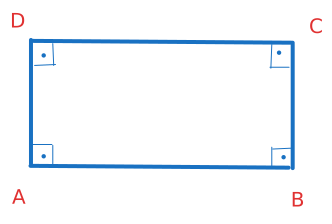
- $\hat{A}=D\hat{A}B$, $\hat{B}=A\hat{B}C$, $\hat{C}=B\hat{C}D$ and $ \hat{D}=C\hat{D}A$ are congruent angles and equal to $90^\circ$.
Rhombus
The rhombus is a polygon that has four congruent sides. This means that all sides are the same measurement. Rhombuses are geometric figures formed by straight segments that meet only at their extremes.

Definition: A convex flat quadrilateral is a rhombus if, and only if, its four sides are congruent.
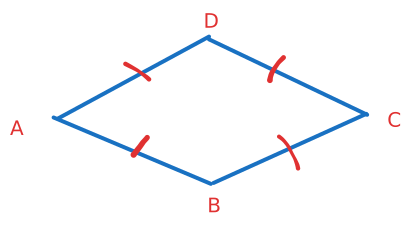
- $\overline{AB}$, $\overline{BC}$, $\overline{CD}$ and $\overline{DA}$ are congruent.
Parallelogram
Every parallelogram has rectangle, rhombus and square as subsets.

Definition: A convex flat quadrilateral is a parallelogram if, and only if, its opposite sides are parallel.
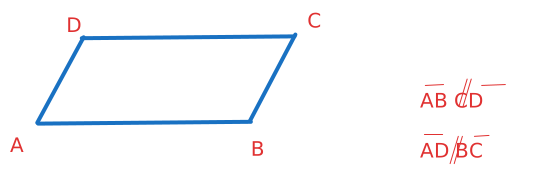
- $\overline{AB}$, $\overline{BC}$, $\overline{CD}$ and $\overline{DA}$ are parallel.
Trapezium
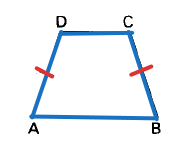
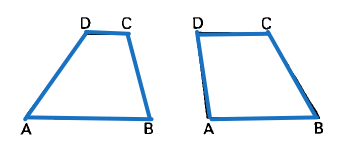
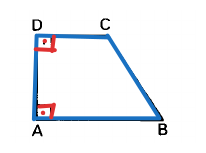
A trapezoid is a flat geometric figure formed by four sides. Two of them are parallel and are called bases.

Definition: A convex flat quadrilateral is a trapezoid if, and only if, it has two parallel sides.
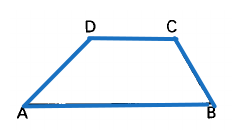
Regarding the definitions of non-base sides:
| Isosceles trapezoid | Scalene trapezoid | Rectangle trapezoid |
|---|---|---|
|
|
|
| whether these sides are congruent. $\quad$ | if these sides are not congruent. | It is a trapezoid with two right angles. |
This is a small introduction to the concepts of quadrilaterals, wait for the next posts.