
Euler's Eyes
2024-06-25
Introduction to Polygons
In previous posts we talked about triangles. Now, let’s talk about Polygons. Polygons are fascinating geometric figures that have been an integral part of mathematics and human culture since time immemorial. The word “polygon” originates from the Greek “polígonos”, which means “many angles” and reflects the nature of these shapes, limited by straight lines and a variable number of sides.
History
Polygons have a fascinating history, from their discovery by ancient mathematicians to their application in various areas of knowledge. The first records of polygons date back to antiquity, in the Egyptian and Mesopotamian civilizations. Ancient people already used these shapes to measure land, build monuments and even to symbolize religious concepts.

In mathematics, polygons are flat figures formed by straight segments called sides. They have been studied since antiquity, with emphasis on the works of Euclid and Archimedes. These mathematicians contributed significantly to the understanding of the properties of polygons, such as the number of sides, internal and external angles, and side measurements.

I use Polygons in everyday life
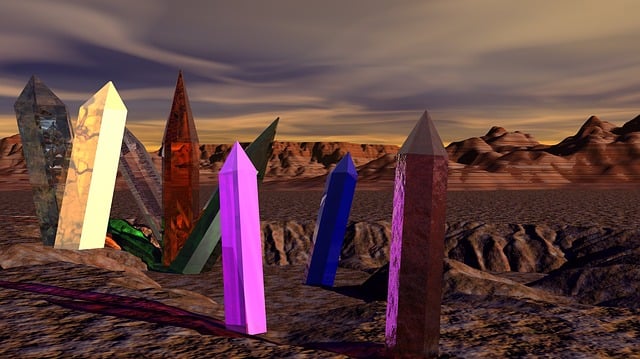
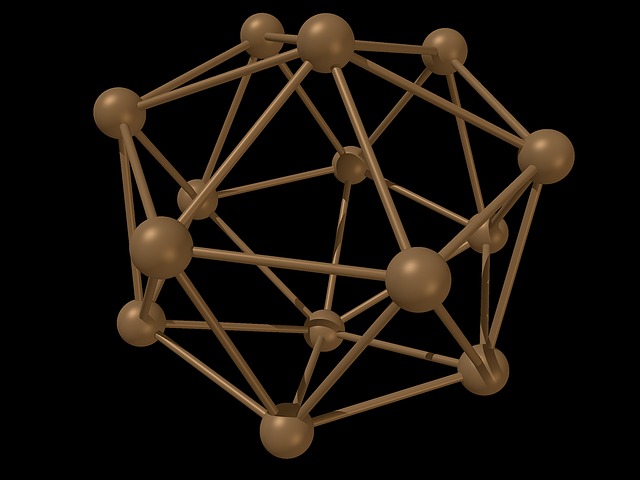
In the modern world, polygons are everywhere. They are fundamental in architecture, art, design and even in nature, such as in the shapes of crystals and the molecular structure of chemical compounds. Digital technology also benefits from polygons, especially in computer graphics, where polygonal shapes are used to build 3D models and animations.
| Crystals | Molecules |
|---|---|
|
|
Education and Research
In the educational field, polygons are essential tools for teaching mathematical concepts and developing spatial reasoning skills. Research on polygons continues to evolve, with mathematicians exploring new properties and applications in areas such as cryptography, optimization, and game theory.
| Cryptography | Games |
|---|---|

|

|
Definitions
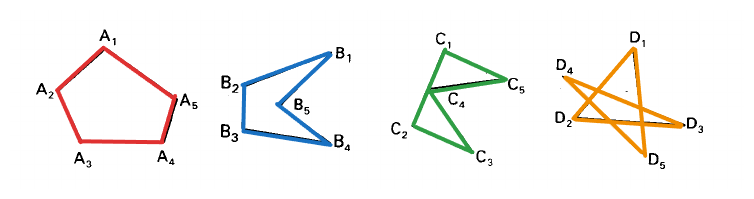
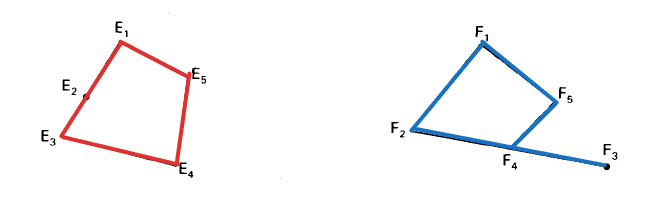
Definition: given a sequence of points on a plane $(A_1, A_2,\dots, A_n)$ with $n\geq 3$, all distinct, in which the three consecutive points are not collinear (points that are not on the same straight line). The union of segments $\overline{A_1 A_2}$, $\overline{A_2 A_3}$, $\dots$, $\overline{A_{n-1} A_n}$, $\overline{A_{n} A_1 }$ is called a polygon.
$$\overline{A_1 A_2} \cup \overline{A_2 A_3}\cup \dots \cup \overline{A_{n-1} A_n}\cup \overline{A_{n} A_1}$$
| Polygons | No Polygons |
|---|---|
|
|
Elements
Let the polygon be $A_1 A_2\dots A_n$ we define the elements:
Polygon vertices: $A_1, A_2,\dots, A_n$.
Sides of the polygon: $\overline{A_1 A_2}, \overline{A_2 A_3}$, $\dots$, $\overline{A_{n-1} A_n}$, $\overline{A_{ n} A_1}$
Polygon angles: $\hat{A_1} = A_n \hat{A_1}A_2$, $\dots$, $\hat{A_n} = A_{n-1} \hat{A_n}A_1$
Polygon with $n$ vertices, has $n$ sides and $n$ angles.
Simple polygons
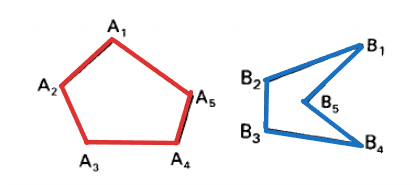
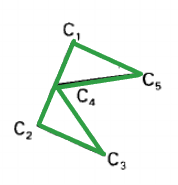
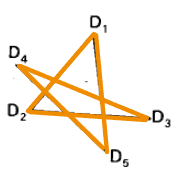
A polygon is simple if, and only if, the intersection of any non-consecutive sides is empty.
| Simple polygons | Complex Polygon | Intertwined Complex Polygon |
|---|---|---|
|
|
|
Concave and convex polygons
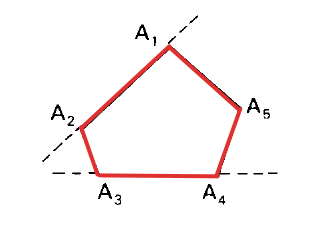
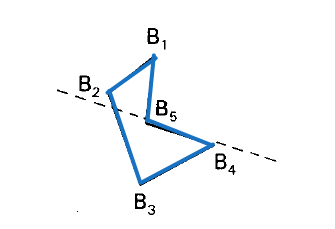
A simple polygon is a convex polygon if, and only if, the straight line determined by two consecutive vertices leaves all other $n-2$ vertices in the same semi-plane.
| Convex polygon | Concave polygon |
|---|---|
|
|
Name of polygons
| $n$ | Name | Sides |
|---|---|---|
| $3$ | triangle or trilateral | 3 sides |
| $4$ | quadrangle or quadrilateral | 4 sides |
| $5$ | pentagon | 5 sides |
| $6$ | hexagon | 6 sides |
| $7$ | heptagon | 7 sides |
| $8$ | octagon | 8 sides |
| $9$ | eneagon | 9 sides |
| $10$ | decagon | 10 sides |
| $11$ | undecagon | 11 sides |
| $12$ | dodecagon | 12 sides |
| $13$ | tridecagon | 13 sides |
| $14$ | tetradecagon | 14 sides |
| $15$ | pentadecagon | 15 sides |
| $20$ | icosagon | 20 sides |
Considerations
The journey of the polygons is a testament to human ingenuity and the never-ending quest for knowledge. From their ancient origins to their contemporary applications, polygons continue to be a source of inspiration and innovation. They are not just shapes; they are tools that shape our world and expand our understanding of the universe. Here a small contribution was made to polygons, wait for the next posts.