
Euler's Eyes
2024-06-05
Tales' Theorem
In the previous post we talked about similarity of triangles. Now, let’s talk about Thales’ Theorem, which are fundamental concepts in plane geometry, especially in triangles.
Story of Thales of Miletus
Thales of Miletus was an important pre-Socratic Greek thinker, philosopher and mathematician. He is considered by some to be the “Father of Science” and “Western Philosophy”. His main ideas expanded theoretical horizons in the areas of mathematics, philosophy and astronomy. Let’s explore more about his life and contributions.

Biography of Thales of Miletus
Thales was born around 623 or 624 BC in the ancient Greek colony of Miletus, located in the region of Ionia (present-day Turkey). He was a man of many skills and learning, respected by his Greek people. In it, he sought rational answers to natural phenomena and the reasons for existence, breaking with the religious point of view of the time.

He founded the “Ionian School”, considered the oldest philosophical school, where thinkers sought cosmological explanations through the observation of nature. Thales traveled to Egypt and Babylon, deepening his knowledge and becoming a much admired man.
Alongside other philosophers, such as Anaximander and Anaximenes, he founded the “School of Miletus” (Milésima), whose followers were followers of philosophy based on anthropomorphic gods and natural phenomena.
Astronomy and Mathematics
Thales made many astronomical observations and even predicted a solar eclipse in 585 BC. In mathematics, he contributed theories about the similarity of triangles, parallel lines and properties of circles.

Philosophy of Thales of Miletus
Thales was based on three main theses:
- Everything we know is made of water, and man is another entity in this environment.
- All things, including inanimate things, are full of life.
- Changes and generation can only be achieved by condensation and rarefaction.

For Thales, the search for knowledge was the most beautiful object we could have. Thales of Miletus died approximately in 556 or 558 BC in his hometown.
Definitions
Beam of parallel lines (F): is a set of coplanar lines parallel to each other.
Transversal of the bundle of parallel lines (T): is a straight line in the beam plane that competes with all the straight lines in the beam.
Corresponding points of two transversals: are transversal points that are on the same straight line of the beam.
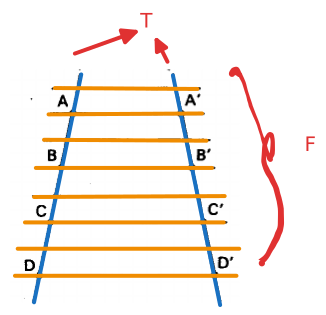
Concurrent segments of two transversals: are segments whose ends are the respective corresponding points.
Property
If two straight lines are transversals of a bundle of distinct parallel lines and a segment of one of them is divided into $p$ parts congruent to each other and through the division points are led from the bundle, then the corresponding segment of the other transversal:
- is also divided into $p$ parts
- these parts are also congruent with each other
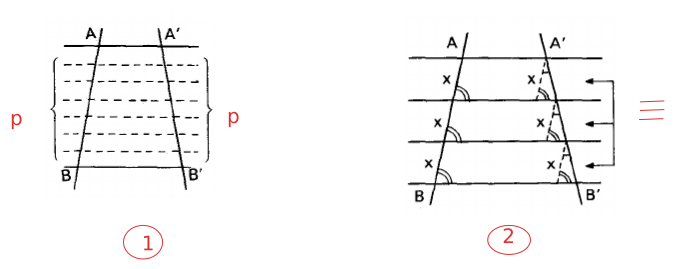
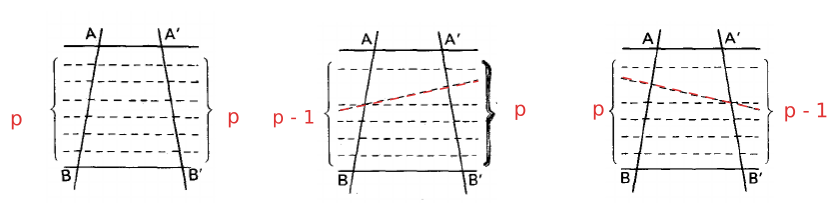
Part 1 Let $\overline{AB}$ and $\overline{A' B'}$ be corresponding segments and $\overline{AB}$ is divided into $p$ parts by straight lines of the beam.
If $\overline{A' B'}$ were divided into fewer parts (or more parts), we would have at least two straight lines of the beam meeting at points of $\overline{AB}$ (or $\overline{A' B'}$),
Which is absurd, because the straight lines of the beam are parallel.
Part 2 $\overline{AB}$ is divided into parts congruent to $x$.
Through the division points of $\overline{A' B'}$, taking the parallels to $\overline{AB}$, we obtain a triangle for each division.
All triangles are congruent by the ALA case. Just note that parallelograms and parallel-sided angles are obtained.
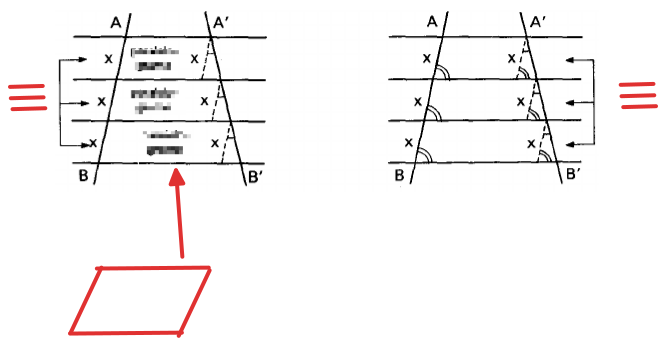
In this way, $\overline{A' B'}$ is divided into congruent parts by the division points
Thales’ Theorem
The next topic using proportionalities is the theorem of Thales of Miletus. This great geometer was highly recognized in the 6th century BC.
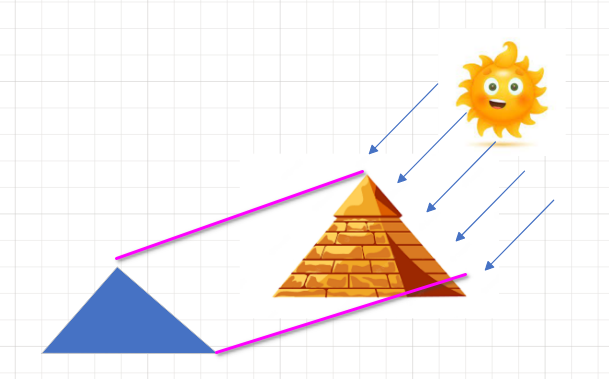
These great contributions made him recognized as one of the precursors of descriptive geometry.
Tales’ Theorem: is proportionality applied to geometry. If a bundle of parallel lines, with at least three straight lines, is intersected by two transversal lines, then any two segments of one of the transversals are proportional to the corresponding segments of the other.
Three parallels cut by two transversals, forming four segments.
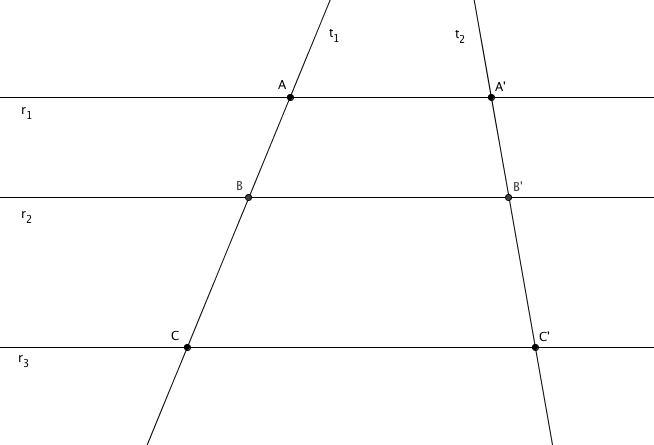
When using the concept of similarity of triangles, we observe the following figure:
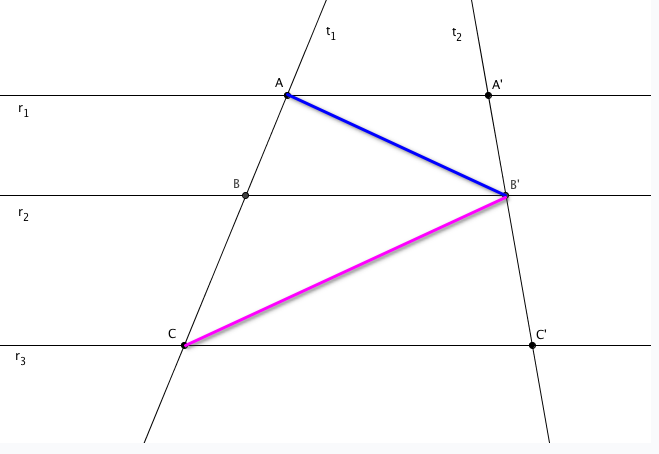
Therefore, we obtain the following proportionality relationship.
$$\dfrac{\bar{AB} }{\bar{A^\prime B^\prime} } = \dfrac{\bar{BC} }{\bar{B^\prime C^\prime} } $$Proof of Thales’ theorem
Initially we have:
| Hypothesis | Thesis |
|---|---|
| $\overline{AB}$ and $\overline{CD}$ are two segments of a transversal, and $\overline{A' B'}$ and $\overline{C' D'}$ are respective counterparts of the other | $$\frac{\overline{AB}}{\overline{CD}} = \frac{\overline{A' B'}}{\overline{C' D'}}$$ |
Case 1
Let $\overline{AB}$ and $\overline{CD}$ be commensurable (a commensurable line segment is one that is a multiple of one unit).
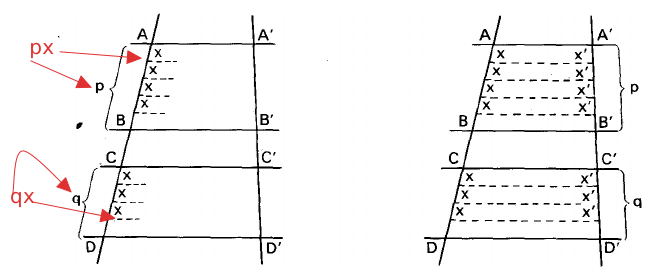
There is a segment $x$ that is a submultiple of $\overline{AB}=px$ and $\overline{CD}=qx$. When we take the ratio of the two segments we have:
$$\frac{AB}{CD}=\frac{p}{q}$$In the same and analogous way and using the property for $\overline{A' B'}=px'$ and for $\overline{C' D'}=qx'$, we have:
$$\frac{A' B'}{C' D'}=\frac{p}{q}$$Consequently
$$\frac{\overline{AB}}{\overline{CD}} = \frac{\overline{A' B'}}{\overline{C' D'}}$$Case 2
Let $\overline{AB}$ and $\overline{CD}$ be incommensurable (incommensurable is a multiple of an irrational number such as $\pi$).
There is no common submultiple segment of $\overline{AB}$ and $\overline{CD}$.
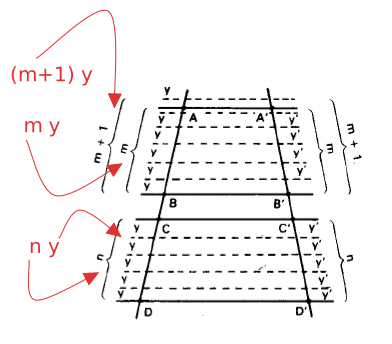
The first step is to take a segment $y$ that is a submultiple of $\overline{CD}$, with $n$ being the integer of this submultiple.
$$\overline{CD}=n.y \quad (*)$$As by hypothesis $\overline{AB}$ and $\overline{CD}$ are incommensurable, we successively mark $y$ in $\overline{AB}$ for a certain integer $m$ times. From this, we obtain that $\overline{AB}$ is between $m$ and its successor $m+1$:
$$m.y < \overline{AB} < (m+1).y \quad (**)$$When we divide (**) by (*) we obtain:
$$\frac{m}{n} < \frac{\overline{AB}}{\overline{CD}} < \frac{m+1}{n}$$Now, we conduct beam straight lines through the division points of $\overline{AB}$ and $\overline{CD}$, with the property of this post, we have:
$$\overline{C' D'}=n.y' \quad (1)$$$$m.y' < \overline{A' B'} < (m+1).y' \quad (2)$$
When we divide (1) by (2) we obtain:
$$\frac{m}{n} < \frac{\overline{A' B'}}{\overline{C' D'}} < \frac{m+1}{n}$$As the numbers $\frac{m}{n}$ and $\frac{m+1}{n}$ are unique and form a neighboring class and very close to real numbers, then.
$$\frac{\overline{AB}}{\overline{CD}} = \frac{\overline{A' B'}}{\overline{C' D'}}$$$\blacksquare$
Tales Example
Find the $x$.
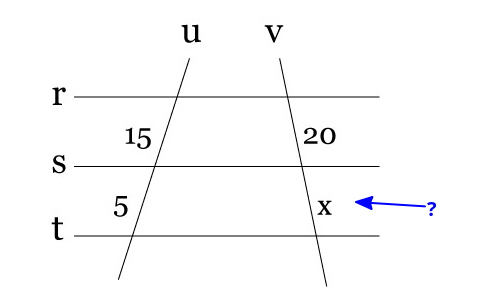
From Tales’ theorem we obtain:
$$\dfrac{15}{5} = \dfrac{20 }{x }$$$$x = \dfrac{100 }{15 }$$
$$x = \dfrac{20 }{3 }$$
Here was a small introduction to Thales’ Theorem, wait for the next posts.