
Euler's Eyes
2024-06-25
Notable points of the triangle
In the previous post we talked about Thales’ theorem. Now, let’s talk notable points of the triangle.
History
The term “ceviana” comes from the name of the Italian mathematician Giovanni Ceva. A cevian is a line segment that connects a vertex of a triangle to any point on the line that contains the opposite side. The notable points of the triangle came from studies of Cevians.
Examples of cevians include the median, height, and bisector. The median, for example, connects the vertex from which it starts to the midpoint of the side opposite that vertex. The barycenter is the meeting point of the medians and represents the center of gravity of the triangle.
Cevian
Cevian is any segment that starts from a vertex of a triangle and cuts the side opposite that vertex. Examples of cevians are:
- median,
- height and
- bisector.
Barycenter - Medians
Definition: The three medians of a triangle intersect at the same point that divides each median into two parts such that the part containing the vertex is twice the size of the other. A second way to define is given a triangle, the meeting point of its medians is called the centroid or barycenter.

With this, we have the following result:
Theorem 1: The medians of any triangle meet at a point whose distance to any vertex is equal to 2/3 of the measurement of the corresponding median.
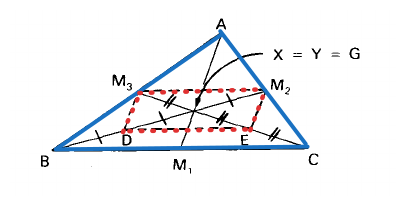
Demonstration:
Let $X$ be the point given by the intersection between the straight line segments such that:
$$\overline{BM_2}\cap \overline{CM_3} = \\{X\\}$$Let $\overline{M_2 M_3}$ be the average base of the triangle, that is:
$$\overline{M_2 M_3} = \frac{\overline{BC}}{2}$$with $\overline{M_2 M_2}$ parallel to $\overline{BC}$.
We take a segment $\overline{DE}$ parallel to $\overline{BC}$ with:
$$\overline{DE} = \frac{\overline{BC}}{2}$$With this, we obtain the parallelogram $M_2 M_3DE$ and with the congruences:
$$\overline{DX}\equiv \overline{X M_2}$$$$\overline{EX}\equiv \overline{X M_3}$$
Therefore, from the congruences we obtain:
$$\overline{BX}=2~.~\overline{X M_2}$$$$\overline{CX}=2~.~\overline{X M_3}$$
Therefore, the median $\overline{B M_2}$ intersects the median $\overline{C M_3}$ at a point $X$ such that:
$$\overline{CX}=2~.~\overline{X M_3}$$The result is analogous for other medians.
$\blacksquare$
Incenter - Internal bisectors
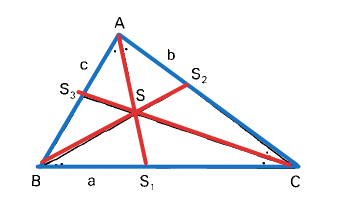
Theorem 2: The bisectors of any triangle meet at a point in its interior equidistant from the sides. More specifically, the three internal bisectors of a triangle intersect at the same point that is at an equal distance from the sides of the triangle.
Demonstration:
Let $S$ be the interior point of the triangle, such that this point is the intersection between the straight segments $\overline{BS_2}$ and $\overline{CS_3}$.
$$\overline{BS_2}\cap \overline{CS_3} = \\{S\\}$$It is worth remembering that the point $S$ belongs to the segments $\overline{BS_2}$ and $\overline{CS_3}$. As a consequence we have that the distances from $S$ to the vertices are equal.
$$S \in \overline{BS_2} \quad \Rightarrow \quad d_{S,a} = d_{S,c}$$$$S \in \overline{CS_3} \quad \Rightarrow \quad d_{S,a} = d_{S,b}$$
From this, we get:
$$d_{S,c} = d_{S,b} \quad \Rightarrow \quad S\in \overline{AS_1}$$Therefore, the three distances from point $S$ to the vertices are equal.
$$\overline{AS_1} \cap \overline{BS_2} \cap \overline{CS_3} = \\{S\\} \quad \text{e}\quad d_{S,a} = d_{S,b } = d_{S,c} $$$\blacksquare$
Definition (Incenter): It is the meeting point (intersection) between its internal bisectors.
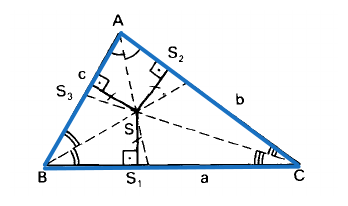
Note: The incenter is the center of the circle inscribed in the triangle.

Circumcenter - Bisectors
To show the circumcenter, let’s define what a perpendicular bisector is.
Definition (Mediatrix): It is the geometric locus of points that are equidistant from two distinct points A and B.
Theorem 3: The three perpendicular bisectors of the sides of any triangle meet at a point that is equidistant (same distance) from its vertices.
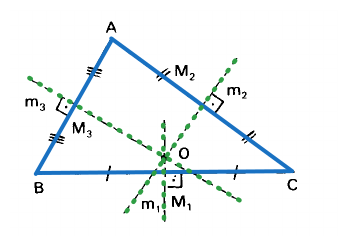
Demonstration:
Let $O$ be the meeting point or intersection between two perpendicular bisectors.
$$m_2 \cap m_3 = \\{O\\}$$It is worth remembering that this point belongs to the perpendicular bisector, that is,
$$O \in m_2 \quad \Rightarrow \quad \overline{OA} \equiv \overline{OC}$$$$O \in m_3 \quad \Rightarrow \quad \overline{OA} \equiv \overline{OB}$$
As a consequence $\overline{OB} \equiv \overline{OC}$, which implies the point $O$ belongs to perpendicular bisector 1 $O\in m_1$.
Therefore,
$$m_1 \cap m_2 \cap m_3 = \\{O\\} \quad \text{e} \quad \overline{OA} \equiv \overline{OB} \equiv \overline{OC}$$$\blacksquare$
Definition (Circumcenter): It is the meeting point between its mediatrices.
Note: The circumcenter is the center of the circle circumscribing the triangle.

Orthocenter - Heights
Theorem 3: The heights (support lines) of any triangle meet at a point.
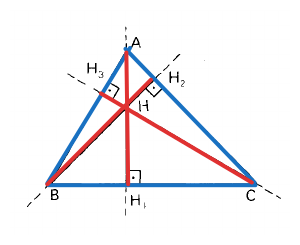
Demonstration:
Through the vertices $A$, $B$, $C$ of the triangle, we draw straight lines parallel to the opposite sides and obtain the triangle $MNP$.
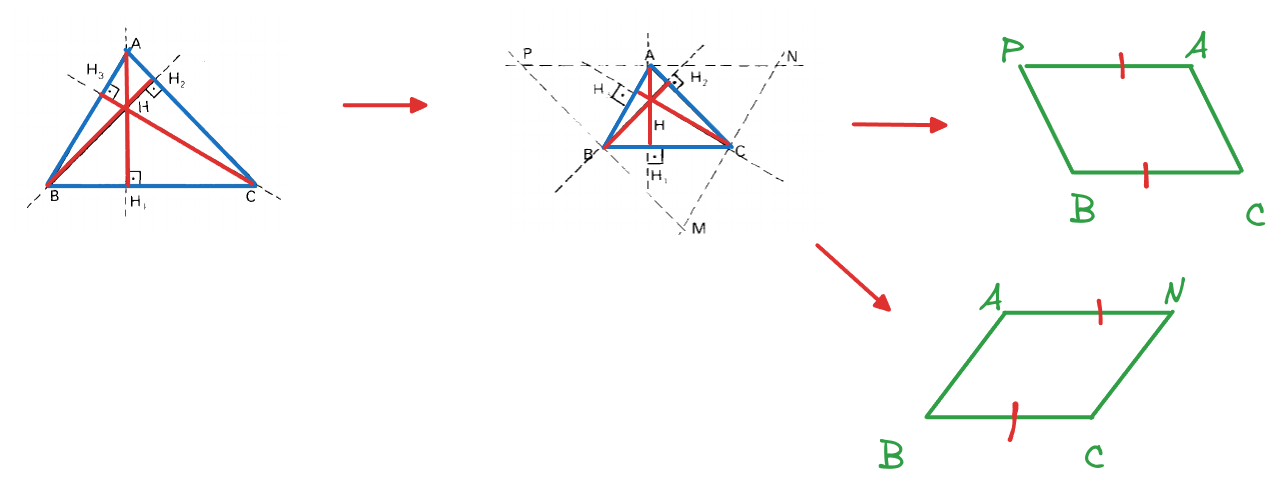
The vertices of the triangle belong to the line segments constructed from the external triangle and with parallel lines.
$$A\in \overline{NP} \quad \text{e} \quad \overline{NP} \parallel \overline{BC}$$$$B\in \overline{MP} \quad \text{e} \quad \overline{MP} \parallel \overline{AC}$$
$$C\in \overline{MN} \quad \text{e} \quad \overline{MN} \parallel \overline{AB}$$
From the properties of the parallelogram, we obtain:
$$APBC \text{ is parallelogram} \quad \Rightarrow \quad \overline{AP}\equiv \overline{BC}$$$$ABCN \text{ is parallelogram} \quad \Rightarrow \quad \overline{AN}\equiv \overline{BC}$$
From this, we obtain that $A$ is the midpoint of $\overline{NP}$.
As a consequence $\overleftrightarrow{AH_1}$ is perpendicular to $\overline{BC}$ and $\overline{NP}$ is parallel to $\overline{BC}$, which implies $\overleftrightarrow{AH_1}$ perpendicular to $\ overline{NP}$.
Therefore, the straight line $\overleftrightarrow{AH_1}$ is a perpendicular bisector of $NP$. The other bisectors are analogous.
Therefore, the perpendicular bisectors $\overleftrightarrow{AH_1}$, $\overleftrightarrow{BH_2}$ and $\overleftrightarrow{CH_3}$ of the sides of the triangle intersect at a point $H$.
$$\overleftrightarrow{AH_1}\cap \overleftrightarrow{BH_2} \cap \overleftrightarrow{CH_3} = \\{H\\}$$$\blacksquare$
Definition (Orthocenter): It is the meeting point of the heights.

Solved exercises
With $G$ being the center of triangle $ABC$, determine $x$, $y$ and $z$, with $AG=10$, $BG=y$ and $CG=14$
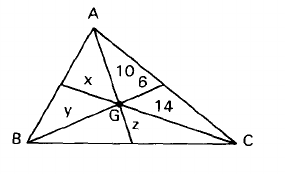
Resolution:
As $G$ is the centroid, the three medians of a triangle intersect at the same point that divides each median into two parts such that the part containing the vertex is twice the size of the other. Like this,
$$2x = \overline{CG}$$$$x = \frac{14}{2} = 7$$
In the same way,
$$2y = 6$$$$y = 3$$
and finally,
$$2z = \overline{AG}$$$$z = \frac{10}{2} = 5$$
Here a small contribution was made to notable points of the triangle, wait for the next posts.