
Euler's Eyes
2024-05-29
Perpendicularity
In the previous post we talked about parallelism of triangles. Now, let’s talk about perpendicularity, which are fundamental concepts in plane geometry, especially in triangles.
Perpendicularity is a fundamental concept in geometry that describes the relationship between two lines or straight segments that meet forming an angle of 90 degrees. These lines are called perpendiculars.

History of perpendicularity
Although there is no single specific mathematician credited with discovering perpendicularity, several ancient mathematicians and cultures contributed to the development of this concept, such as:
- Greeks: Euclid, Pythagoras.
- Egyptians and Babylonians.
Euclides: The Greek mathematician Euclid (approximately 300 BC) established many geometric principles, including the definition of right angles and the relationship between perpendicular lines.

Pythagoras: Pythagoras’ theorem, which relates the sides of a right-angled triangle, is also closely linked to perpendicularity. Although Pythagoras did not specifically study perpendicularity, his work influenced the development of this concept.

Egyptians: The ancient Egyptians were skilled in practical geometry, especially in building pyramids and monuments. They applied concepts of perpendicularity to ensure that structures were stable and accurate.

Babylonians: The Babylonians also had geometric knowledge and used perpendicularity in their constructions and measurements.

Perpendicular lines
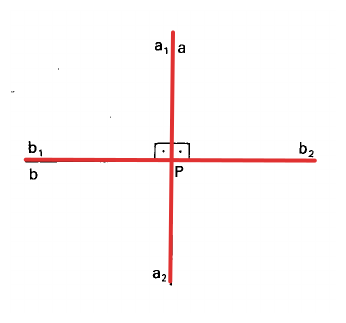
Definition: Two lines are perpendicular ($\perp$), if, and only if, they are concurrent and form congruent supplementary adjacent angles.
$$a\perp b \quad \Leftrightarrow \quad a\cap b = \\{P\\} \quad\text{e} \quad a_1 \hat{P} b_1 = a_1 \hat{P} b_2$$
Oblique straight lines
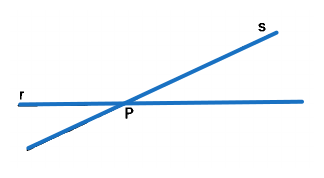
Definition: Two lines are concurrent and not perpendicular, so we say that these lines are oblique.
Existence of the right angle
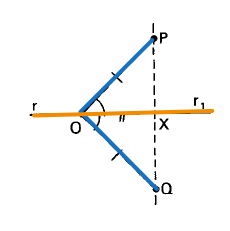
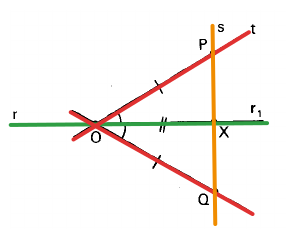
Initially, we consider a straight line $r$ and its point $O$. Take two points $P$ and $Q$ in opposite half-planes with respect to $r$ such that:
$$r_1\hat{O}P \equiv r_1\hat{O}Q $$It is
$$\overline{OP} \equiv \overline{OQ} $$where $r_1$ is one of the rays of $r$ with origin $O$.
The segment $\overline{PQ}$ intersects $r$ at a point $X$. With this, we have three cases.
| Case 1 | Case 2 | Case 3 |
|---|---|---|
|
|
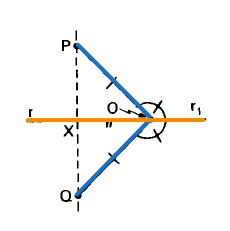
|
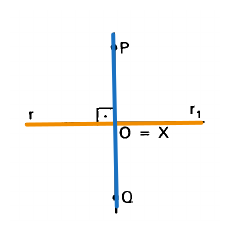
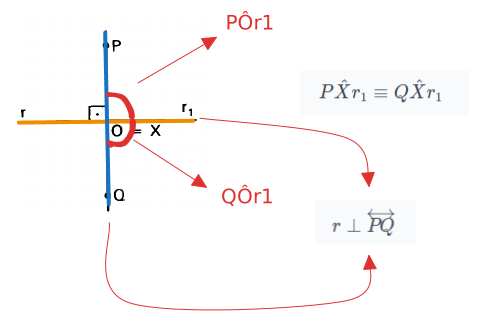
Case 2: we have $X=O$, we have congruent angles
$$P\hat{X}r_1 \equiv Q\hat{X}r_1$$Therefore, the lines r and the segment $\overleftrightarrow{PQ}$ are perpendicular, in symbols:
$$r \perp \overleftrightarrow{PQ}$$Therefore, the angle $P\hat{X}r_1$ is right.
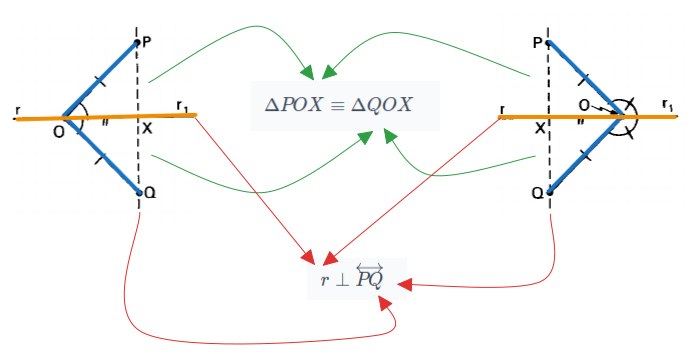
Case 1 and 3: we have congruence between the triangles $POX$ and $QOX$, or in symbols:
$$\Delta POX \equiv \Delta QOX$$For the chaos LAL (side angle side) of the post triangle congruence
Then, we have the congruence of the angles $P\hat{X}O$ and $Q\hat{X}O$, in symbols:
$$P\hat{X}O \equiv Q\hat{X}O$$Therefore, the lines r and the segment $\overleftrightarrow{PQ}$ are perpendicular, in symbols:
$$r \perp \overleftrightarrow{PQ}$$Therefore, the angle $P\hat{X}O$ is right.
Existence and uniqueness of the perpendicular
In a plane through a given point on a given straight line passes a single straight line perpendicular to the given straight line.
or
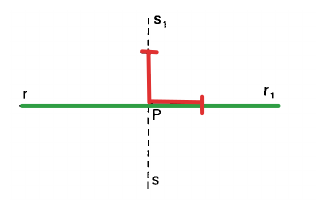
In a plane through a point $P$ on a straight line $r$ there is a single straight line $s$ perpendicular to $r$.
Case 1
| Existence | Uniqueness |
|---|---|
|
|
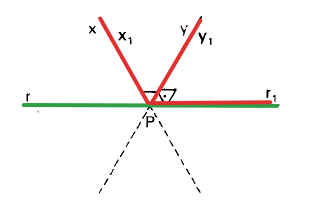
Existence: the straight line $s$ that contains $s_1$ is perpendicular to $r$, as $r_1 \hat{P} s_1$ is straight.
Uniqueness: Suppose that two distinct lines $x$ and $y$ with $x\neq y$ passing through $P$ were both perpendicular to $r$.
With the rays $Px_1$ of $x$ and $Py_1$ of $y$ located in the same half-plane as those determined by $r$ and with $Pr_1$ ray of $r$. It implies:
- $x$ perpendicular to $r$ ($x\perp r$) in $P$ implies $r_1\hat{P} x_1$ is congruent to the right angle.
- $y$ perpendicular to $r$ ($y\perp r$) in $P$ implies $r_1\hat{P} y_1$ is congruent to the right angle.
If $Px_1$ is distinct from $Py_1$, the above result is absurd, according to the angle transport postulate.
Therefore, the line perpendicular to $r$ through $P$ is unique.
Case 2
| Existence | Uniqueness |
|---|---|
|
|
Existence: cases 1 and 3 of the existence of the right angle. Therefore, $s$ is perpendicular to $r$ ($s \perp r$).
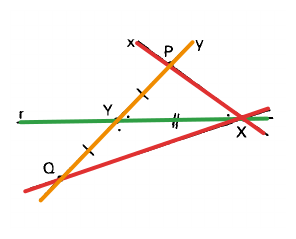
Uniqueness: Suppose that two distinct lines $x$ and $y$ with $x\neq y$ passing through $P$ were both perpendicular to $r$.
Let $X$ and $Y$ be the points of intersection $x$ and $y$ with $r$ and let $Q$ be the point on the ray opposite $\overrightarrow{YP}$ such that:
- $\overline{YQ}$ congruent to $\overline{YP}$
- $y$ perpendicular to $r$ implies that the angles $P\hat{Y}X$ and $Q\hat{Y}X$ are congruent.
- $x$ perpendicular to $r$ implies that $P\hat{X}Y$ is a right angle.
For the chaos LAL (side angle side) of the post triangle congruence
Then, we have the congruence of the angles $P\hat{X}Y$ and $Q\hat{X}Y$, in symbols:
$$P\hat{X}Y \equiv Q\hat{X}Y$$From item 3 it implies that $Q\hat{X}Y$ is straight, which implies that the ray $\overleftrightarrow{XQ}$ is perpendicular to $r$.
From this, we observe the following absurdity:
Through a point $X$ on the line $r$ we have two distinct lines $x$ and $\overleftrightarrow{XQ}$, both perpendicular to $r$, which contradicts case 1.
Therefore, the line perpendicular to $r$ through $P$ is unique.
Height of a triangle
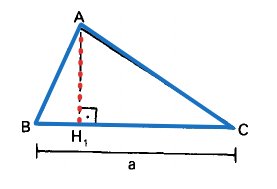
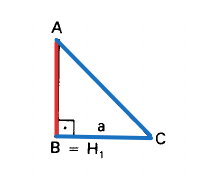
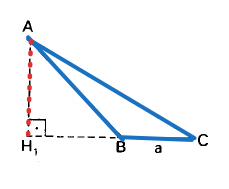
Definition: Height of a triangle is the straight line segment perpendicular to the straight line supporting one side of the triangle with ends on this straight line and at the vertex opposite the side considered.
| Case 1 | Case 2 | Case 3 |
|---|---|---|
|
|
|
| $\overline{AH_1}$ is the height relative to the side $\overline{BC}\quad$ | $\overline{AH_1}$ is the height relative to the side $a\quad $ | $\overline{AH_1 }$ is the height relative to the vertex $A$ |
Bisector of a segment
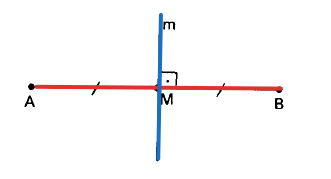
Definition: The perpendicular bisector of a segment is the straight line perpendicular to the segment through its midpoint.
Solved exercises
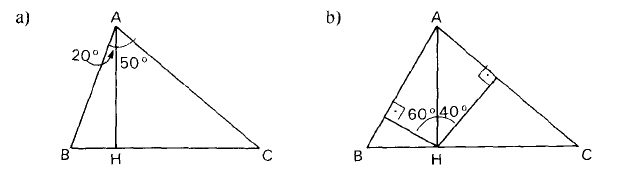
1. If $\overline{AH}$ is the height relative to the side $\overline{BC}$ of the triangle $ABC$. Determine the angles $\hat{B}$ and $\hat{C}$.
Resolution:
a) The sum of the interior angles of the triangle is $180^\circ$
As $\overline{AH}$ is relative height (hypothesis) then we have right angles ($90^\circ$) in the base $A\hat{H}C$ and $A\hat{H}B$.
In this way, we use the internal sum of angles of the triangle.
$$20^\circ+90^\circ+\hat{B}=180^\circ \quad \Rightarrow \quad \hat{B}=70^\circ$$$$50^\circ+90^\circ+\hat{C}=180^\circ \quad \Rightarrow \quad \hat{C}=40^\circ$$
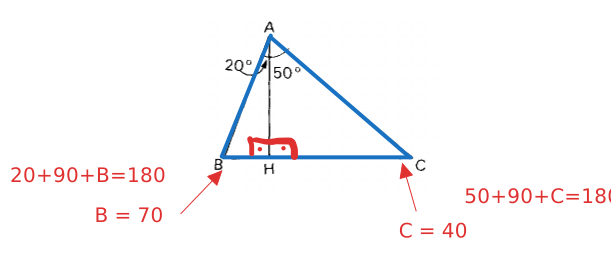
b) The sum of the interior angles of the triangle is $180^\circ$
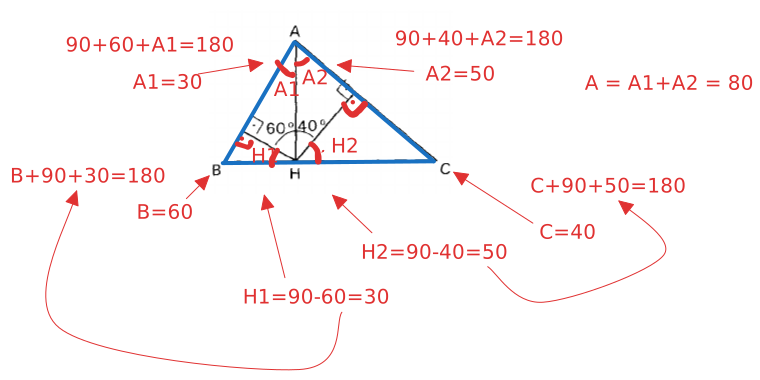
As $\overline{AH}$ is relative height (hypothesis) then we have right angles ($90^\circ$) in the base $A\hat{H}C$ and $A\hat{H}B$.
Therefore, just use the complement of the right angle in these angles.
$$60^\circ+\hat{H1}=90^\circ \quad \Rightarrow \quad \hat{H1}=30^\circ$$$$40^\circ+\hat{H2}=90^\circ \quad \Rightarrow \quad \hat{H2}=50^\circ$$
By hypothesis, we have heights relative to the sides $\overline{AC}$ and $\overline{AC}$. Consequently, we have right angles referring to these heights.
In this way, we use the internal sum of angles of the triangle.
$$30^\circ+90^\circ+\hat{B}=180^\circ \quad \Rightarrow \quad \hat{B}=60^\circ$$$$50^\circ+90^\circ+\hat{C}=180^\circ \quad \Rightarrow \quad \hat{C}=40^\circ$$
2. The triangle $ABC$ below is isosceles with base $\overline{BC}$. Determine $x$.
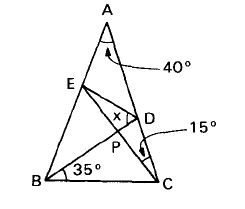
Resolution:
The triangle $ABC$ is isoscelesn so the angles $\hat{B}$ and $\hat{C}$ are equal:
$$40^\circ+\hat{B}+\underbrace{\hat{C}}_{\hat{B}}=180^\circ \quad \Rightarrow \quad \hat{B}=70^\circ $$With this, we have to:
$$15^\circ+\hat{C_1}=70^\circ \quad \Rightarrow \quad \hat{C_1}=55^\circ$$$$35^\circ+\hat{B_2}=70^\circ \quad \Rightarrow \quad \hat{B_2}=35^\circ$$
From the latter, we have that the triangle $CBE$ is isosceles and $\overline{BD}$ is the bisector and height relative to this triangle. Therefore, angle $P$ is right ($90^\circ$).
From the triangle $B_1 CD_2$ we obtain the angle $\hat{D_2}$
$$70^\circ+35^\circ+\hat{D_2}=180^\circ \quad \Rightarrow \quad \hat{D_2}=75^\circ$$The external angle of the triangle $D_3 E A$ is given by the sum of the 2 internal ones:
$$40^\circ+\hat{D_3}=x+75^\circ \quad \Rightarrow \quad 35=x-\hat{D_3}\quad (*)$$From triangle $CPD_2$ we obtain the external angle:
$$90^\circ+15^\circ=x+\hat{D_3} \quad \Rightarrow \quad 105=x+\hat{D_3}\quad (**)$$When we add the two equations (*) and (**) we have:
$$2x=105^\circ+35^\circ$$$$2x=140^\circ$$
Therefore, we have that the angle is given by:
$$x=70^\circ$$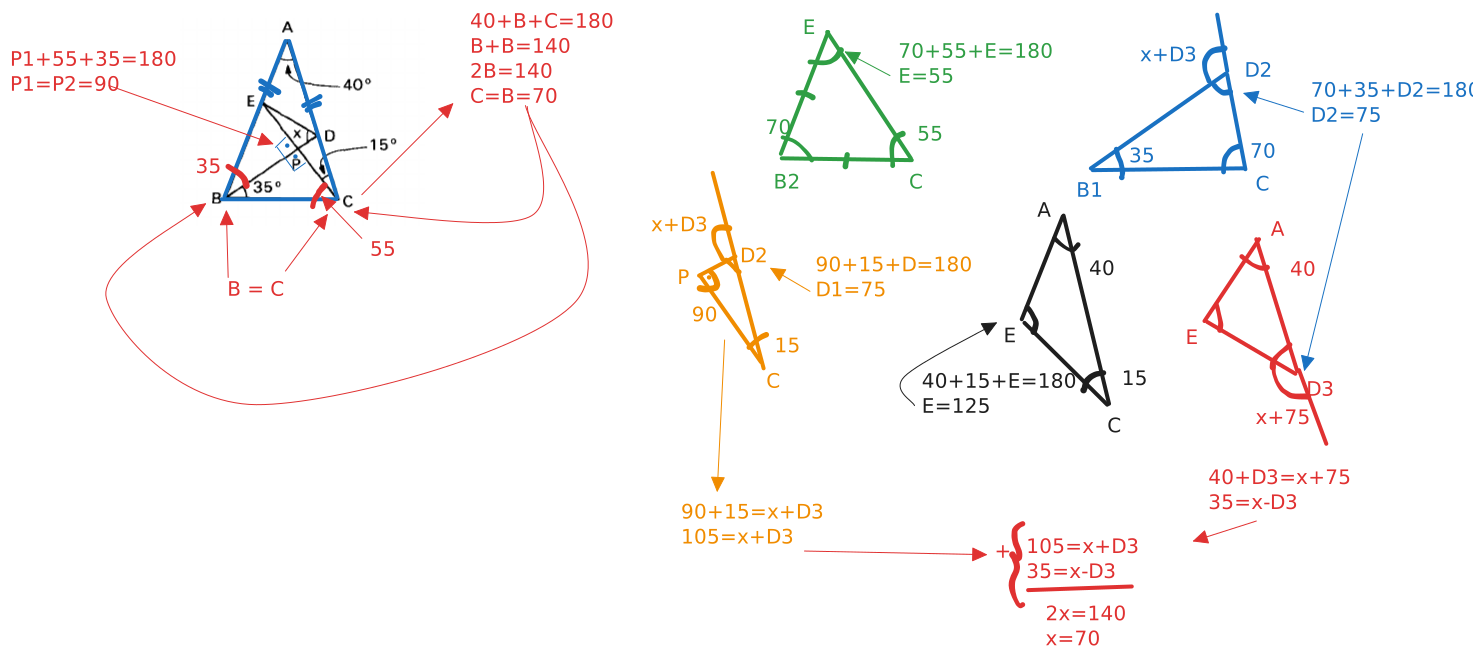
Here a small introduction to perpendicularity was made, wait for the next posts.