
Euler's Eyes
2024-05-13
Congruence of Triangles
In the previous post we talked about initial concepts about triangles. Now, let’s talk about properties, specifically about the congruence of triangles.
History
The congruence of triangles is a fundamental concept in geometry, and its discovery dates back many centuries ago. Let’s explore a little of this story:
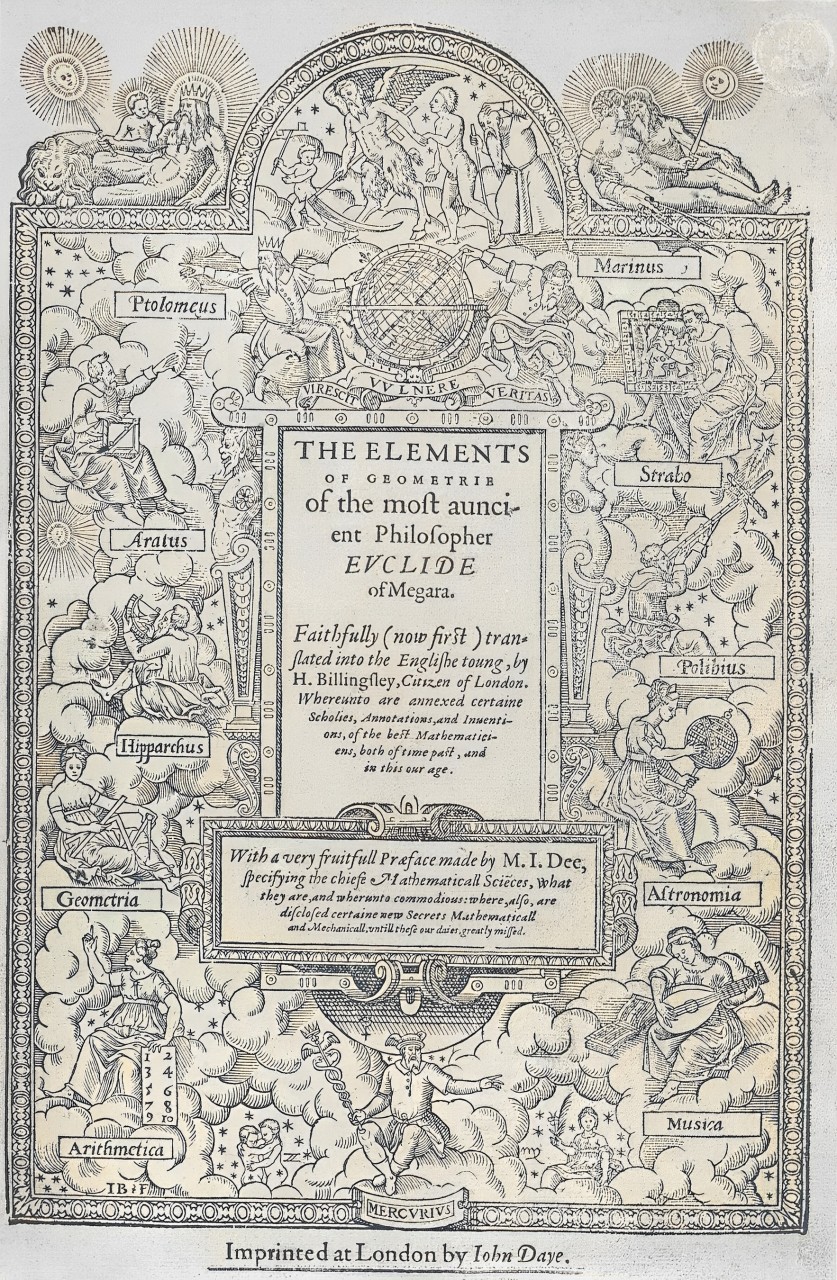
- Euclid and the Elements: The Greek mathematician Euclid, around 300 BC, formalized the principles of geometry in his famous book “The Elements”. In this work, he established the criteria for the congruence of triangles, as
- LLL - Side Side Side,
- LAL - Side Angle Side,
- ALA - Angle Side Angle and
- LAAo - Side Angle Opposite angle.
These criteria are known as “congruence postulates”.
| Elements - Euclid of Alexandria |
|---|
|
- Indian Mathematical Tradition: In ancient India, mathematicians such as Bhaskara I (7th century) also studied the congruence of triangles. They developed methods for determining when two triangles were congruent based on sides and angles.

- Arab Contributions: During the Middle Ages, Arab scholars, such as Al-Biruni and Al-Kashi, expanded knowledge about geometry and congruence of triangles. They also explored trigonometry and its applications.

- European Renaissance: In the Renaissance, mathematicians such as Leonardo da Vinci and Luca Pacioli revisited the principles of geometry and contributed to the understanding of the congruence of triangles.
In approximately 600 BC (before Christ), in Egypt, the Congruence of Triangles was first applied. At the request of a messenger from the pharaoh, Thales of Miletus, who was considered one of the seven wise men of classical antiquity, calculated the height of Cheops’ pyramid.
Definition: A triangle is congruent ($\equiv$) to another if, and only if, it is possible to establish a correspondence between its vertices so that:
- its sides are neatly congruent to the sides of the other;
- their angles are orderly congruent to each other’s angles.
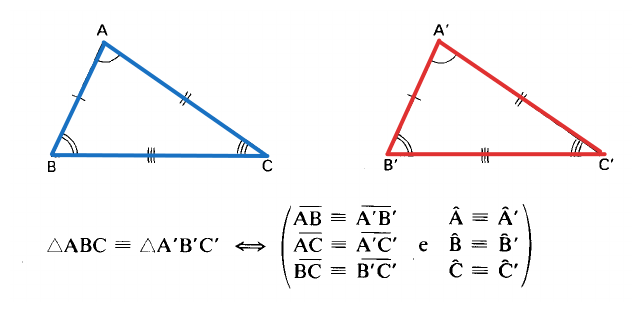
The definition conditions are three between sides and three between angles are total.
There are minimum conditions for two triangles to be congruent. These are the so-called cases or congruence criteria.

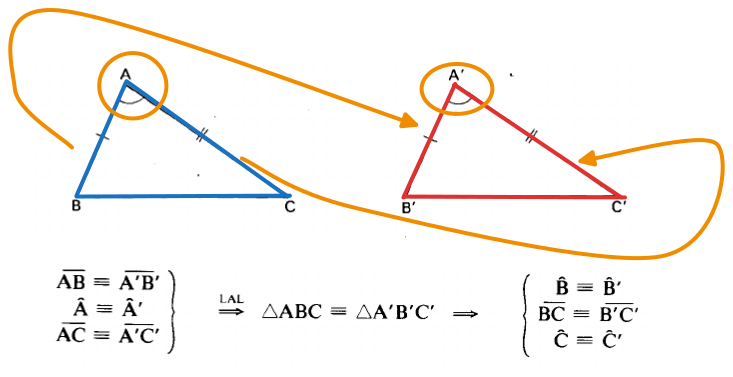
Postulated Case Side Angle Side - LAL
LAL: If two triangles have two sides and the included angle congruent, then they are congruent.
Isosceles triangle theorem
If a triangle has two congruent sides, then the angles opposite those sides are congruent.
or
Every isosceles triangle is an isoangle.
Demonstration:
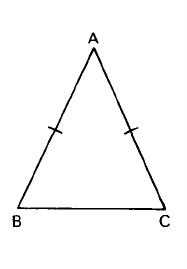
| Hypothesis | Thesis |
|---|---|
| $$\overline{AB} \equiv \overline{AC} \qquad\Rightarrow \qquad$$ | $$\hat{B}\equiv \hat{C}$$ |
Let us consider triangles ABC and ACB. With hypotheses:
$$\overline{AB} \equiv \overline{AC}$$$$B\hat{A}C \equiv C\hat{A}B$$
$$\overline{AC} \equiv \overline{AB}$$
Using the LAL criterion, we have:
$$\Delta ABC \equiv \Delta ACB$$Therefore,
$$\hat{B} \equiv \hat{C}$$
Postulated Case Angle Side Angle - ALA
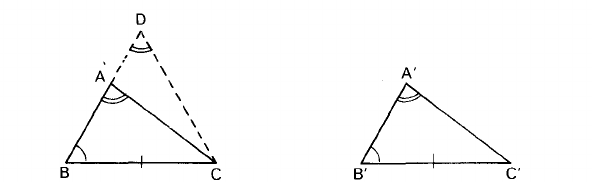
ALA: If two triangles have two angles and one side that are congruent, then they are congruent.
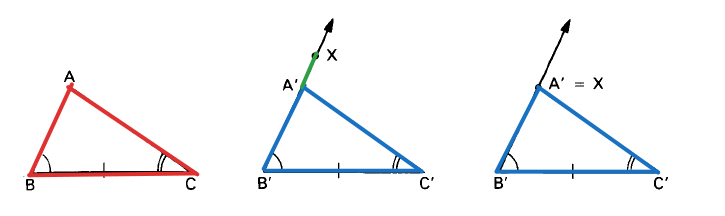
Let the angles adjacent to the side $\overline{BC}$ are $\hat{B}$ and $\hat{C}$ and the angles adjacent to the side $\overline{B' C'}$ are $\hat{ B'}$ and $\hat{C'}$
If the criteria
$$\hat{B} \equiv \hat{B'}, \quad \overline{BC} \equiv \overline{B' C'}, \quad \hat{C} \equiv \hat{C'}$$Then
Triangles $ABC$ and $A'B'C'$ are congruent.
Demonstration:
First, let’s prove that $\overline{B A}\equiv \overline{B' A'}$, as we will fall back on case 1.
By the segment transport postulate, we obtain on the ray $\overrightarrow{B' A'} $ a point $X$ such that $\overline{B' X}\equiv \overline{B' A'}$. Therefore,
$$\overline{BC}\equiv \overline{B' C'}$$$$\hat{B} \equiv \hat{B'}$$
$$\overline{B' X}\equiv \overline{B' A'}$$
Using the LAL criterion, we have $\Delta ABC \equiv \Delta XB' C'$. Thus, we get
$$B\hat{C}A \equiv B' \hat{C'}X$$From the hypothesis, we have that the angles $B\hat{C}A \equiv B' \hat{C'}A'$ with $B\hat{C}A \equiv B' \hat{C'}X$ and With angle transport postulate, we have
$$\overleftrightarrow{B' A'}\quad \text{e} \quad \overleftrightarrow{C' X} = \overleftrightarrow{C' A'}$$intersect at a single point $X=A'$
With this, $X\equiv A'$ we have
$$\overline{B' A'}\equiv \overline{B A}$$Therefore,
$$\overline{BA}\equiv \overline{B' A'}$$$$\hat{B} \equiv \hat{B'}$$
$$\overline{B' C}\equiv \overline{B' C'}$$
by the LAL criterion, it implies that the triangles $ABC$ and $A' B' C'$ are congruent.
$\blacksquare$
With this result, we have a round trip to the isosceles triangle theorem, that is
If a triangle has two congruent sides if and only if the angles opposite these sides are congruent.
Case Postulated Side Side Side - LLL
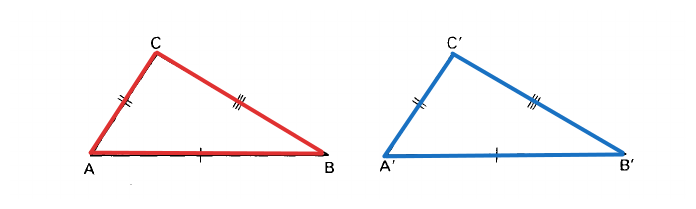
LLL: If two triangles have neatly three congruent sides, then they are congruent.
Demonstration:
| Hypothesis | Thesis |
|---|---|
| $$\overline{AB} \equiv \overline{A' B'} (1) ~ \overline{AC} \equiv \overline{A' C'}~\overline{BC} \equiv \overline{B' C '} \qquad\Rightarrow \qquad$$ | $$\Delta ABC\equiv \Delta A' B' C'$$ |
By the angle transport and segment transport postulate, we obtain a point $X$ such that:
$$X\hat{A'}B \equiv C\hat{A'}B ~(4)$$$$\overline{A' X} \equiv \overline{AC} ~(5)$$
where $X$ is in the opposite half-plane to $C'$ in relation to the straight line $\overleftrightarrow{A'B'}$
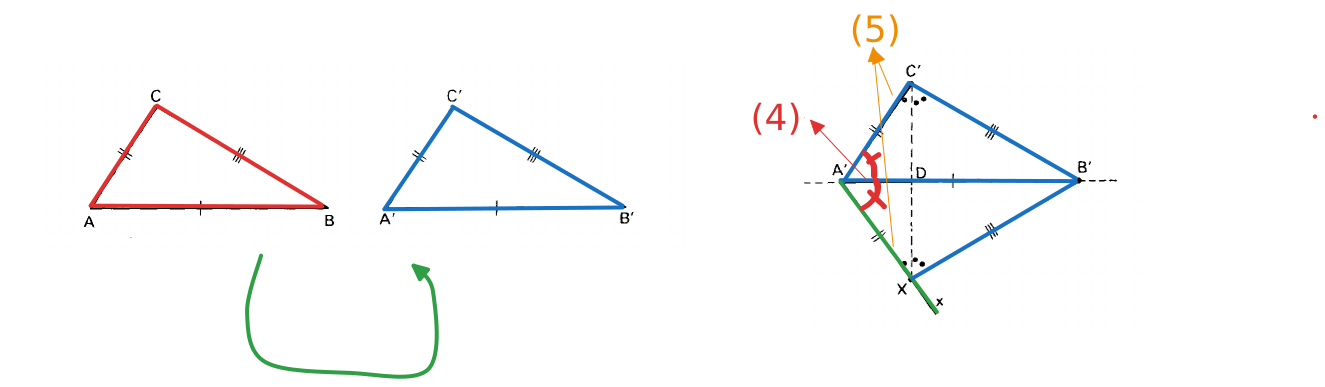
From (5) and (2) comes:
$$\overline{A' X} \equiv \overline{A'C'} ~(6)$$Let $D$ be the point of intersection of $\overline{C' X}$ with the straight line $\overleftrightarrow{A'B'}$
From (1), (4) and (5) using the LAL criterion, we have that the triangle $ABC$ is congruent to the triangle $A' B' X'$ (7). As a consequence:
$$\overline{XB'} \equiv \overline{CB }\quad \Rightarrow{(3) \quad \overline{XB'} \equiv \overline{C' B }~ (8)}$$The triangle $A' C' X$ is isosceles with base $\overline{C’ )
The triangle $B' C' X$ is isosceles with base $\overline{C’ )
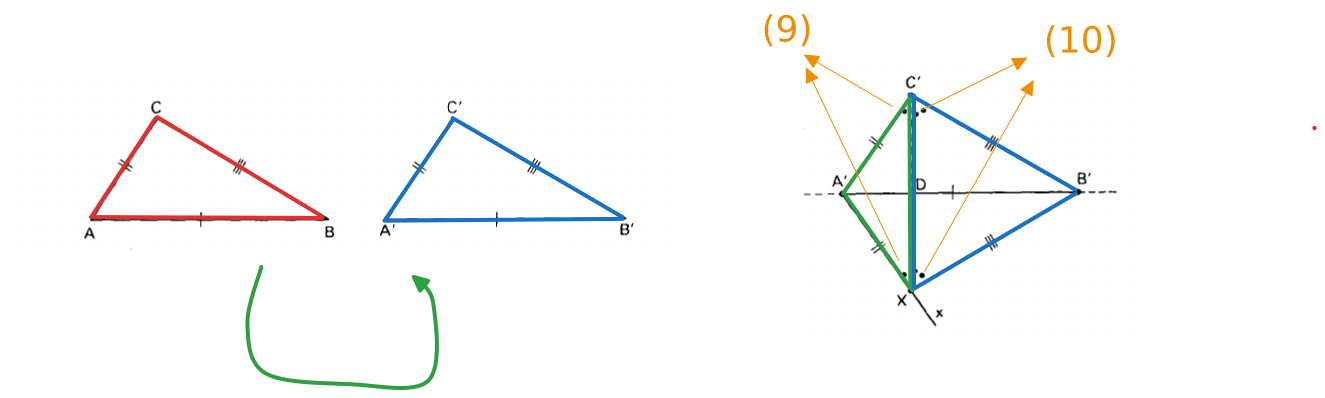
From (9) and (10) we have that:
$$A \hat{C'} B \equiv A' \hat{X}B'~(11)$$From (6), (11) and (8) it implies that the triangles $A' B' C'$ and $A' B' X$ are congruent, so consequently the triangles $A BC$ and $A' B' C'$ are congruent.
$\blacksquare$
Existence of the midpoint
Given a straight line segment $\overline{AB}$, using angle and segment transport postulates, we construct:
$$C\hat{B}A \equiv D\hat{B}A$$$$\overline{AC} \equiv \overline{DB}$$
with $C$ and $D$ in opposite half-planes in relation to the straight line $\overleftrightarrow{AB}$
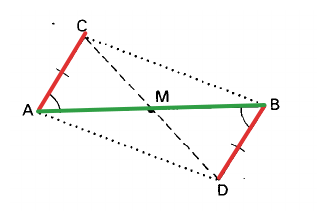
The segment $\overline{CD}$ intersects the segment $\overline{AB}$ at a point $M$. As a consequence we have the following congruencies:
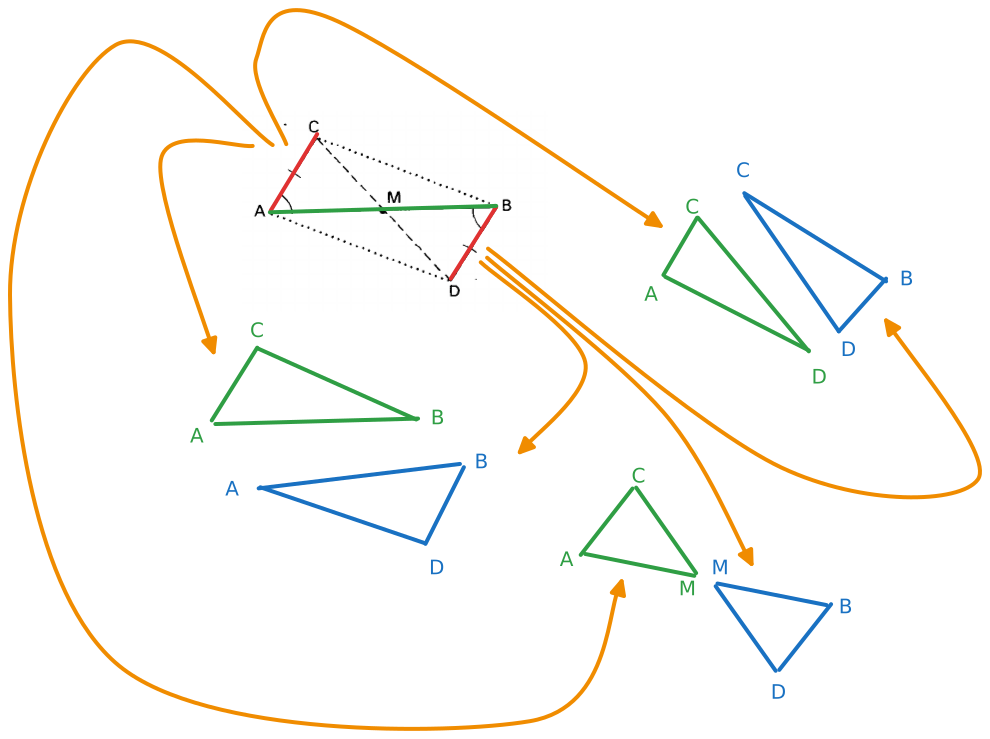 $$\Delta CAB \equiv \Delta DBA$$
By the LAL criterion, $\overline{AB}$ common side.
$$\Delta CAD \equiv \Delta DBC$$By ALA criterion with sum of angles or by LLL.
$$\Delta AMD \equiv \Delta BMC$$By ALA criteria. As a consequence of this, $\overline{AM} \equiv \overline{BM}$, that is, $M$ is the midpoint of $\overline{AB}$.
Postulated Case Side Angle Opposite Angle - LAA0
LAA0: If two triangles have an orderly side, an adjacent angle, and the angle opposite that side congruent, then they are congruent.
Solved exercises
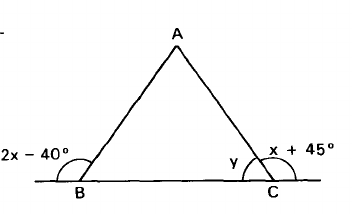
1) If triangle ABC is isosceles with base $\overline{BC}$, determine x and y.
Solution:
As the triangle is isosceles with base $\overline{BC}$, the angle adjacent to $2x-40^\circ$ is $y$, so we have:
$$2x-40^\circ = x-45^\circ$$$$2x-40^\circ {\color{red}{-x}}= x-45^\circ {\color{red}{-x}}$$
$$x-40^\circ {\color{red}{+40}}= 45^\circ {\color{red}{+40}}$$
$$x= 85^\circ$$
Still, we have to
$$y + \underbrace{x}_{85^\circ}+45^\circ = 180^\circ$$$$y + 85^\circ+45^\circ = 180^\circ$$
$$y +130^\circ = 180^\circ$$
$$y +130^\circ {\color{red}{-130}} = 180^\circ{\color{red}{-130}}$$
$$y = 50^\circ$$
Therefore $y=50^\circ$.
2) If the perimeter of an equilateral triangle is 75 cm, how long is each side?
Solution:
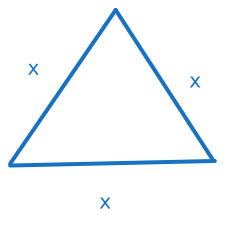
As it is an equilateral triangle, the three sides are equal. Therefore, the perimeter is given by:
$$\text{perimeter}=p=75~\text{cm}$$$$x+x+x=75$$
$$3x=75$$
$$3x{\color{red}{~.~\frac{1}{3}}} =75{\color{red}{~.~ \frac{1}{3}}} $$
$$x = 25~\text{cm} $$
3) In the figure $\overline{BF}\equiv \overline{CD}$, $m(A\hat{B}C)=m(F\hat{D}E)$ and $m (B\hat{A}C)=m(D\hat{E}F)$. Prove that $\overline{AC} \equiv \overline{EF}$.
Solution:
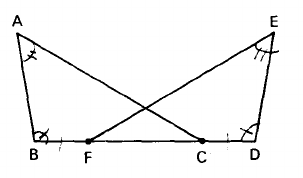
From the hypothesis we have that $\overline{BF}\equiv \overline{CD}$, then:
$$\overline{BF}+\overline{FC}\equiv \overline{CD}+\overline{FC}$$$$\overline{BD}\equiv \overline{DF}$$
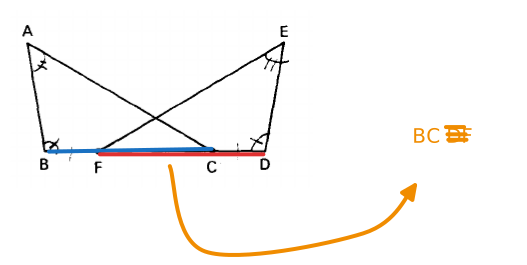
From the hypotheses $m(A\hat{B}C)=m(F\hat{D}E)$, $m(B\hat{A}C)=m(D\hat{E}F)$ and that $\overline{BD}\equiv \overline{DF}$, we will use the ALA criterion to assert that the triangles $ABC$ and $EDF$ are congruent.
Therefore,
$$\overline{AC} \equiv \overline{EF}$$These are the initial concepts of triangle congruence. Wait for the next posts.