
Euler's Eyes
2024-07-11
Right triangle relations
The right triangle is a geometric figure that fascinates mathematicians and students due to its simultaneous simplicity and complexity. The metric relations of the right triangle are a set of formulas that relate the lengths of the sides and the projections of the legs on the hypotenuse. These relationships are fundamental to understanding more advanced concepts in trigonometry and analytical geometry.

The best known of these relationships is the Pythagorean Theorem, which states that in a right triangle, the square of the hypotenuse (the side opposite the right angle) is equal to the sum of the squares of the other two sides, the legs. Mathematically, this is expressed as $a^2 = b^2 + c^2$, where $a$ is the hypotenuse and $b$ and $c$ are the legs.

Other important metric relationships will also be deduced in this post. These relationships are extremely useful in several practical applications, such as engineering, architecture and even navigation. They allow you to calculate inaccessible distances and solve complex problems with relative ease.
The Pythagorean suits
Initially we will define what the Pythagorean suit is, for more details see the post by Pythagorean suits.
Definition (Pythagorean Terno): is any set of natural numbers $x,y$ and $z$ (terns) such that:
$$x^2 + y^2 = z^2$$
This definition was used by Euclid in Alexandria, who used concepts from the Pythagorean theorem, which corresponds to the right triangle:

It is worth remembering that the Sumerians knew Pythagoras’ theorem, long before the best-known author. They knew the most common relationship at the time, which was the set $(x,y.z) = (3,4,5)$ given by:
$$3^2+ 4^2 = 5^2$$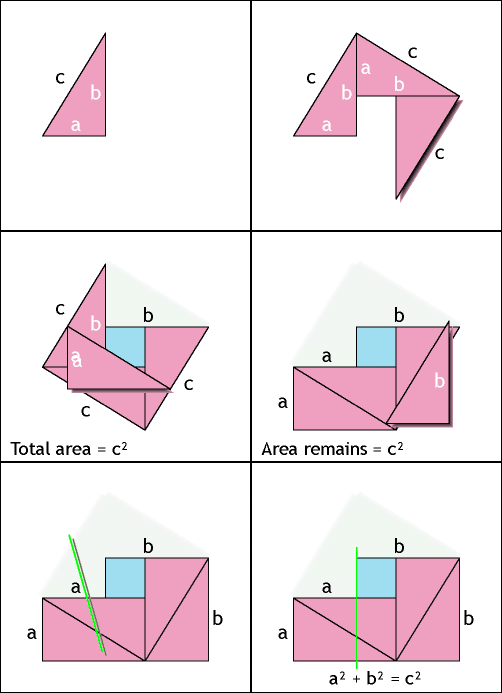
However, only Pythagoras proved that there are sets of natural numbers $(x,y,z)$ such that $x^2 + y^2 = z^2$
The History of Metric Relations in the Right Triangle
Right triangle metric relationships are a set of formulas that relate the lengths of the sides of a right triangle. These relationships are fundamental to trigonometry and analytical geometry, and have been used throughout history to solve a variety of practical and theoretical problems.
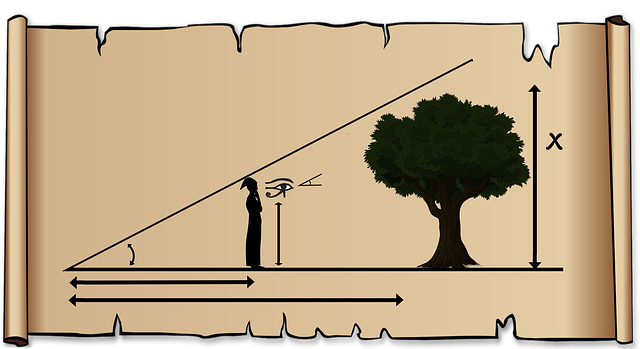
In addition to the Pythagorean Theorem, there are other metric relationships in the right triangle that are equally important. For example, the projections of the legs on the hypotenuse and the height relative to the hypotenuse are elements that also have specific relationships with each other. These relationships can be used to find unknown lengths when some of the other lengths are known, a very useful technique in many areas of mathematics.
The discovery and proof of these metric relationships are attributed to several mathematicians throughout history. While the Pythagorean Theorem is associated with Pythagoras, many of the other metric relationships were discovered by mathematicians in Ancient Greece, India, the Islamic world, and Europe during the Middle Ages and Renaissance. Mathematicians such as Euclid and Bhaskara contributed significantly to the development of understanding of these relationships.
Pythagorean theorem
In the introduction to this book, we started with the concepts of sides of a square. Our radix quadratum.
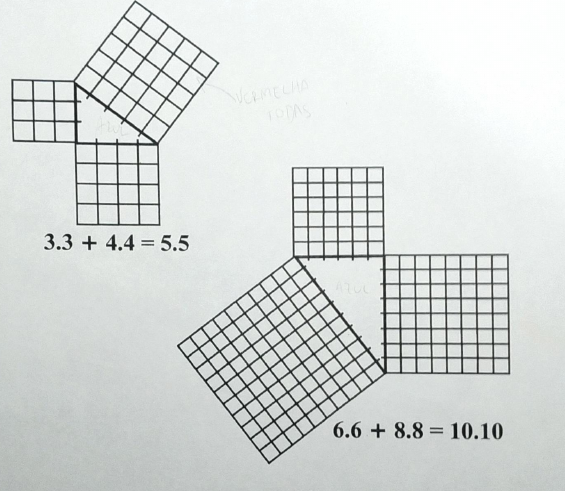
From the figure, we notice that we have area of squares, which in current mathematics is side $\times$ side.
Example 1:
$$\text{Area 1} = 3\times 3 = 9$$$$\text{Area 2} = 4\times 4 = 16$$
$$\text{Area 3} = 5\times 5 = 25$$
$$\text{Area 1} + \text{Area 1} = \text{Area 3}$$
Example 2:
$$\text{Area 1} = 6\times 6 = 36$$$$\text{Area 2} = 8\times 8 = 64$$
$$\text{Area 3} = 10\times 10 = 100$$
$$\text{Area 1} + \text{Area 1} = \text{Area 3}$$
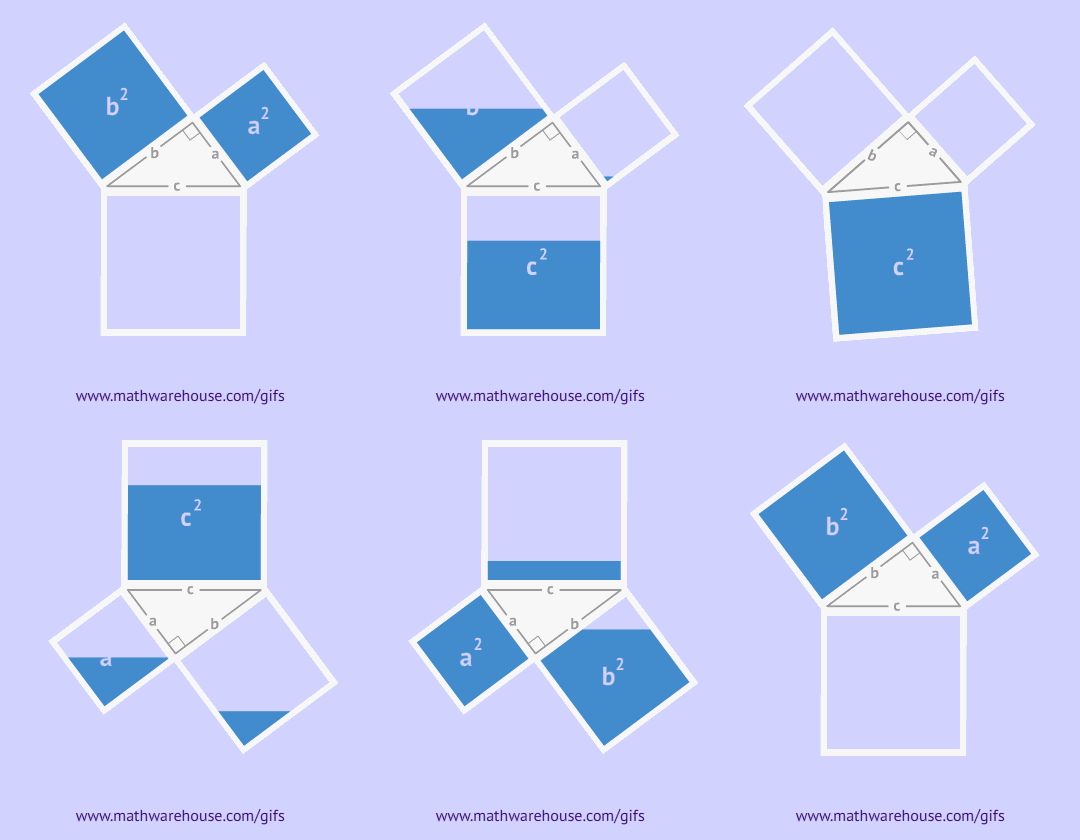
When we generalize the concept, we have the Pythagorean Theorem.
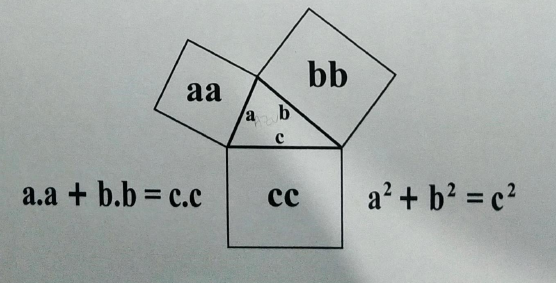
The square (quadratum) of side (latus) a plus (et) the square (quadratum) of side (latus) b
is equal (aequalis) to the square (quadratum) of side (latus) c.
Presentation of the right triangle
The right-angled triangle, by the derivation of the name, has one of the right angles (90 degrees), that is, two sides of the triangle are perpendicular1, as in two sides of a square. Below, according to history, we present the names forcefully imposed by textbooks.

What we know as Cathetos represent that which is perpendicular ⊥, whereas what we know as Hypotenuse is that which is below
two perpendicular lines (stretched).

Next, let’s define some terms:
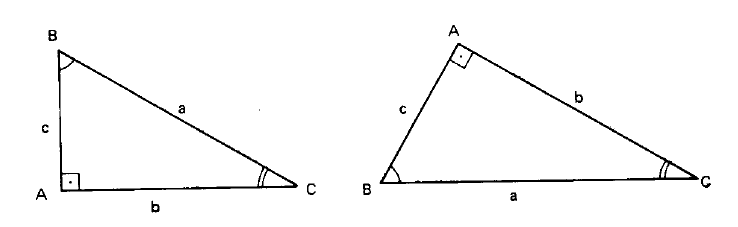
- sides: AB, BC, AC
- internal angles: $B\hat{A} C$, $A\hat{B} C$, $A\hat{C} B$
- side measurements:
- a = BC measurement
- b = AC measurement
- c = measure of AB
- angle measurements:
- $\hat{A}$= measure of $B\hat{A} C$
- $\hat{B}$ = measure of $A\hat{B} C$
- $\hat{C}$= measure of $A\hat{C} B$
Equilateral triangle
The equilateral triangle can be derived from the words equi (equal) latero (sides) and can be obtained from a right-angled triangle. The right triangle is half (½) of an equilateral triangle.
From the right triangle we notice that the hypotenuse in the following example has distance a, one of the legs has distance h and the other leg a/2. As shown in the following figure:
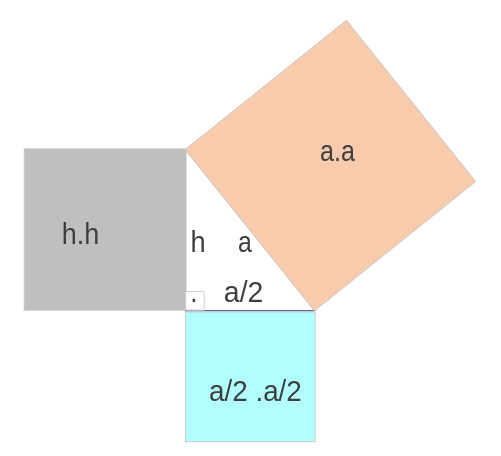
When we unfold the right triangle, we obtain the equilateral triangle (3 equal sides) below.

Example 1:
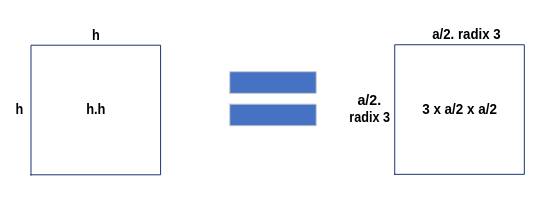
With this, we obtain:
$$h= \frac{a}{2}~.~\text{radix}~ 3$$or
$$h= \frac{a}{2}~.~\sqrt{3}$$Metric relations of a right triangle
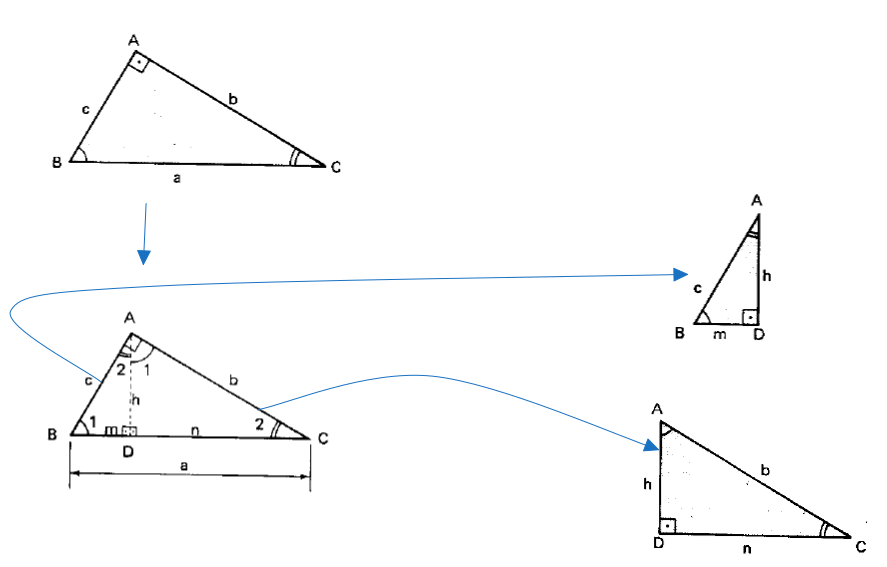
If we take a right triangle ABC and conduct AD perpendicular to BC, with D in BC, we obtain:
- AD = height relative to the hypoten uses (measurement: h)
- BD = projection of side AB onto the hypotenuse (measurement: m)
- CD = projection of AC on the hypotenuse (measurement: n)
- $\hat{B}\equiv \hat{1}$ and $\hat{C}\equiv \hat{2}$ since $AB \perp AC$ and $BC \perp AD$
Property 1
The similarity of the triangles $ABC$ and $ABD$ ($\Delta ABC \sim \Delta ABD$) implies $\dfrac{a}{c} = \dfrac{c}{m}.$ Therefore
$$c² = a. m$$
The similarity of the triangles $ABC$ and $ACD$ ($\Delta ABC \sim \Delta ACD$) implies $\dfrac{a}{b} = \dfrac{b}{n}.$ Therefore
$$b² = a. n$$
Property 2
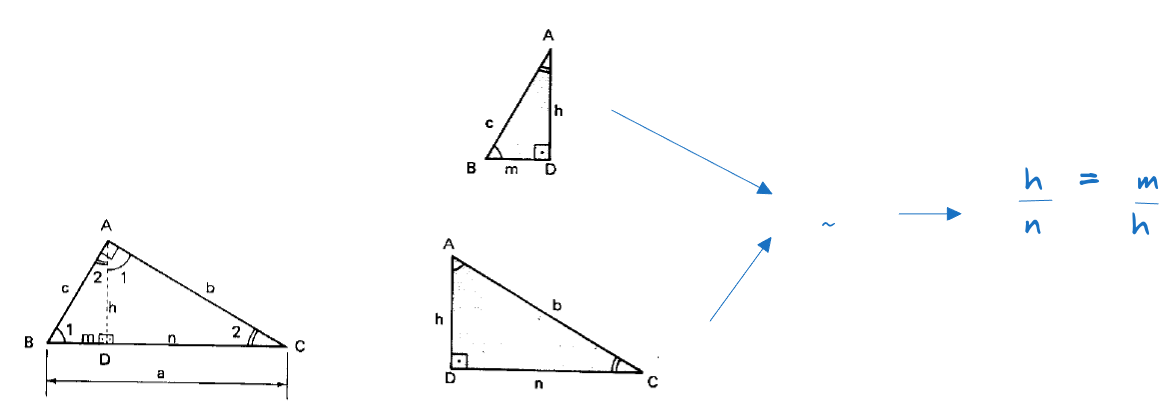
The similarity of the triangles $ABD$ and $ACD$ ($\Delta ABD \sim \Delta ACD$) implies $\dfrac{h}{n} = \dfrac{m}{h}.$ Therefore
$$h² = m. n$$
Property 3 (Pythagorean Theorem)
From property 1 we have that $c^2 = a.m$ and $b^2 = a.n$. When we add these two equations:
$$b^2 + c^2 = a.n + a.m = a(n+m) = a.a = a^2$$With this, we have the Pythagorean theorem:
$$b^2 + c^2 = a^2$$
Property 4 (right triangle inscribed in a circle)
Another notable property of right-angled triangles can be seen if we take the midpoints of the sides (M, N, O) and connect them as shown in the figure.
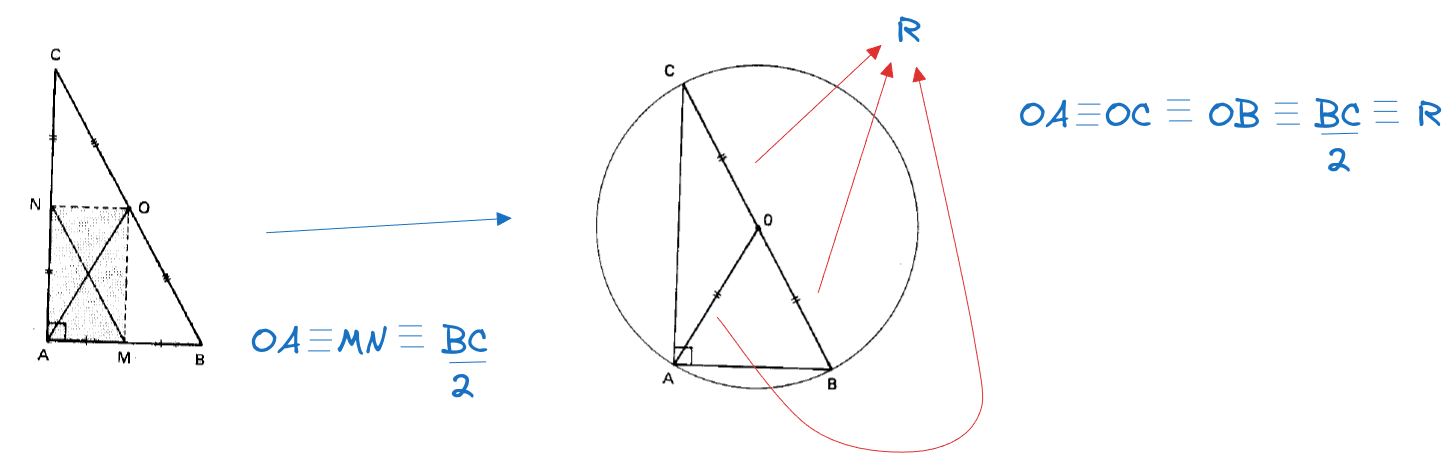
The AMON polygon is a rectangle, therefore:
$$OA \equiv MN \equiv \dfrac{BC}{2}$$
that is, the median relative to the hypotenuse is equal to half of it.
As a consequence we have to:
$$OA \equiv OB \equiv OC \equiv \dfrac{BC}{2} \equiv r$$
where $r$ is the radius of the circle.
Solved exercises
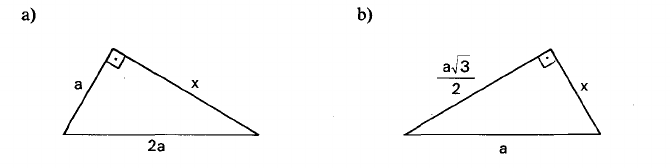
Exercise 1: Determine x as a function of a
Resolution:
a) As the base of the right triangle is half the hypotenuse, when we fold this rectangle, we have an equilateral triangle. In this case, $x$ is given by the height of an equilateral triangle:
$$\text{height} = h = \frac{\text{side} \sqrt{3} }{2}$$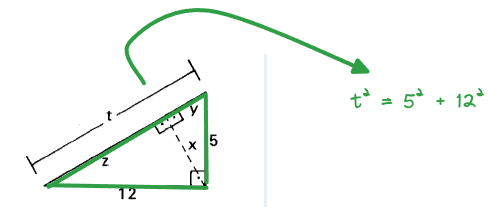
Therefore, we have to:
$$x = \frac{2a \sqrt{3} }{2} = a\sqrt{3}$$b) Analogous to item a, we have an equilateral triangle. Thus, $x$ is half the side of the equilateral triangle.
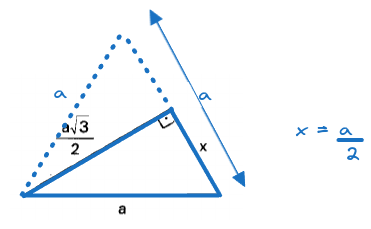 $$x = \frac{\text{side} }{2} = \frac{a}{2}$$
Exercise 2: Determine x, y, z and t:
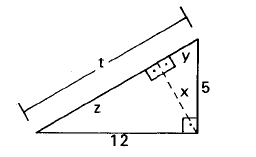
Resolution:
For $t$ we just need to use the Pythagorean theorem, as $t$ is the hypotenuse.
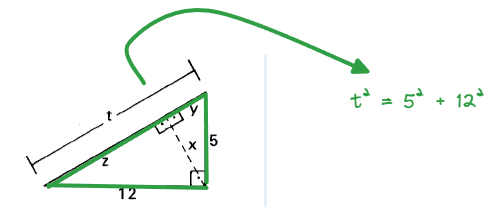 $$t^2 = 5^2 + 12^2 $$
$$t^2 = 252 + 144 $$
$$t^2 = 169 $$
$$t = \sqrt{169} $$
$$t = 13 $$
From property 1, we have:
$$c^2 = y~. ~t$$$$5^2 = y~. ~13$$
$$ y= \frac{25}{13}$$
It is
$$b^2 = z~. ~t$$$$144 = z~. ~13$$
$$ z= \frac{144}{13}$$
From property 2, we have:
$$x^2 = y ~.~ z$$$$x^2 = \frac{25}{13} ~.~ \frac{144}{13}$$
$$x^2 = \frac{25 ~.~ 144}{13 ~.~ 13} $$
$$x = \sqrt{\frac{5^2 ~.~ 12^2}{13^2} }$$
$$x = \frac{60}{13} $$
Exercise 3: Determine x in the trapezoid:
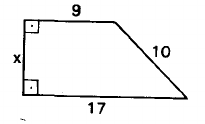
Resolution:
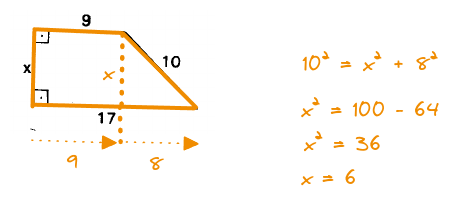
Pythagoras:
$$a^2 = b^2 + c^2$$$$10^2 = x^2 + 8^2$$
$$x^2 = 100 - 64$$
$$x^2 = 36$$
$$x^2 = 6^2$$
$$x = 6$$
Exercise 4: Determine x in the parallelogram:
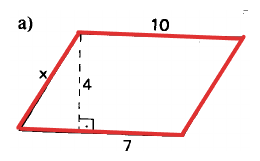
Resolution:
Let us make the relations in the figure:
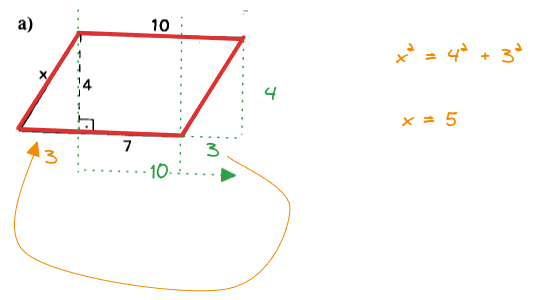
This is a classic right triangle, the famous $3-4-5$.
Therefore, the value of $x=5$.
Considerations
In summary, right triangle metric relations are an indispensable tool in the arsenal of anyone working in mathematics. They are the key to unlocking a world of possibilities in exploring shapes and patterns, proving once again that mathematics is truly the language of the universe. Here a small contribution was made to right triangle relations, wait for the next posts.
-
Perpendicular lines are when two straight lines intersect, forming a right angle between them, that is, an angle of 90º. ↩︎