
Euler's Eyes
2024-05-10
Introduction to Triangles
A triangle is a three-sided polygon, in which we use straight segments for the sides. It is a particular case of quadrilaterals, as it is a quadrilateral divided by 2.

Definition: Given three non-collinear points A, B and C1, the meeting of the segments $\overline{AB}$, $\overline{AC}$ and $\overline{BC}$ is called a triangle.
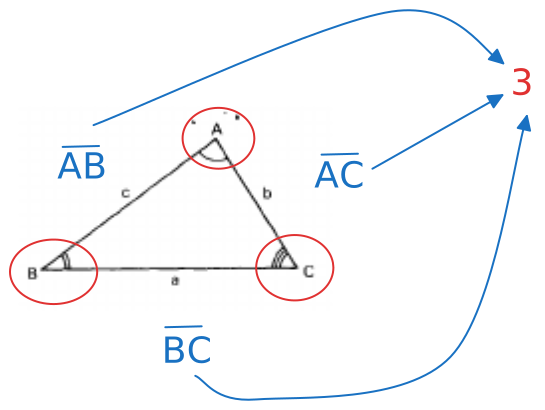
Basic elements
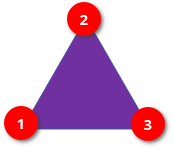
Vertices: can be defined as meeting points between the sides of a triangle.
- Generally speaking, vertices are meeting points between sides of any polygon.
- From the previous figure, points A, B and C are vertices of the triangle ($\Delta ABC$)
In particular, a triangle is formed by 3 vertices.
Sides: these are the straight segments that determine the polygon, in this case the triangle. The segments:
- $\overline{AB}$ of measure $c$
- $\overline{AC}$ of measure $b$
- $\overline{BC}$ of measure $a$
These line segments are sides of the triangle.
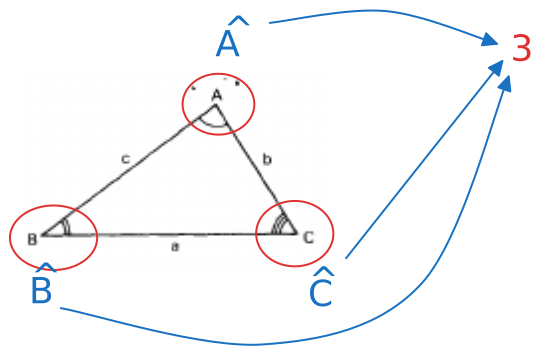
Angles: is the meeting of two rays that have a common origin, called the vertex of the angle. The angles:
- $B\hat{A}C$ or $\hat{A}$
- $A\hat{B}C$ or $\hat{B}$
- $A\hat{C}B$ or $\hat{C}$
They are angles of $\Delta ABC$ or more strictly, internal angles of $\Delta ABC$.
Note: We say that the sides:
- the side $\overline{BC}$ is opposite the angle $\hat{A}$
- the side $\overline{AC}$ is opposite the angle $\hat{B}$
- the side $\overline{AB}$ is opposite the angle $\hat{C}$
Diagonal: is the straight line segment that connects two non-consecutive vertices of any flat and spatial polygon.
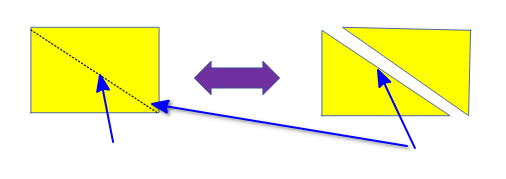
One of the important properties of triangles is that they have diagonals. An important observation is that there is no triangle that has two non-consecutive vertices. The diagonal of a quadrilateral, for example, is one of the sides of a triangle.
Triangle
Another definition for triangle is the origin of the name:
- Tri is defined as 3 (three);
- Angle is the “opening” between two straight segments, connected by a vertex.
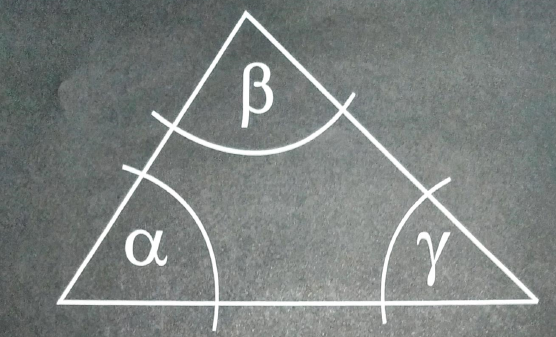
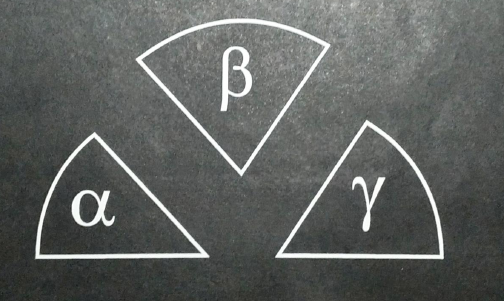
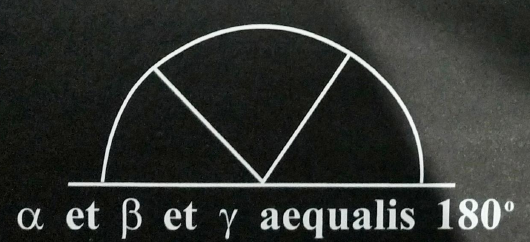
The first Canon (law of God) defined by Euclid is:
Canon α et (more) β et (more) γ aequalis (equal) 180°
God’s law α + β + γ = 180°
| Triangle | Angles | Half Turn |
|---|---|---|
|
|
|
Classification of Triangles
In terms of curiosity, we will classify the triangles, but it is not necessary to memorize, just know that these definitions exist.
Classification according to sides
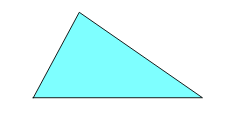
| Scalene triangle | Isosceles triangles | Equilateral triangle |
|---|---|---|
|
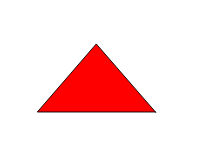
|
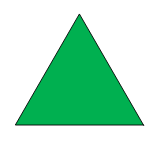
|
Classification regarding angles
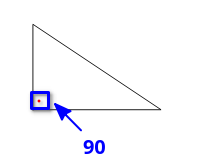
| Acute triangle | Obtuse angle triangles | Right triangle |
|---|---|---|
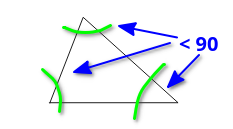
|
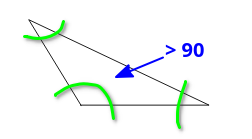
|
|
Note: The last one in the table is called a right-angled triangle, as one of the angles is exactly the angle of the vertices of a rectangle that is ninety degrees (90°).
These are the initial concepts of triangles. Wait for the next posts.
-
Collinear points: they are points that belong to the same straight line. ↩︎