
Euler's Eyes
2024-06-07
Trapeze
In this post the central point of the topic is trapezoids, as well as their properties.
A trapezoid is a flat geometric figure formed by four sides. Two of them are parallel and are called bases.
The geometry of the trapezoid has its roots in Ancient Greece, where mathematicians such as Euclid and Archimedes studied its properties1. The name “trapezium” comes from the Greek trapezion, which means “square table”. The trapeze was also used by the Egyptians in the construction of pyramids and temples.
Application of Trapezoidal Geometry
Trapezoidal geometry is applied in several areas, such as architecture, engineering and design. For example, the shape of a roof can be modeled as a trapezoid to calculate the amount of materials needed for its construction.
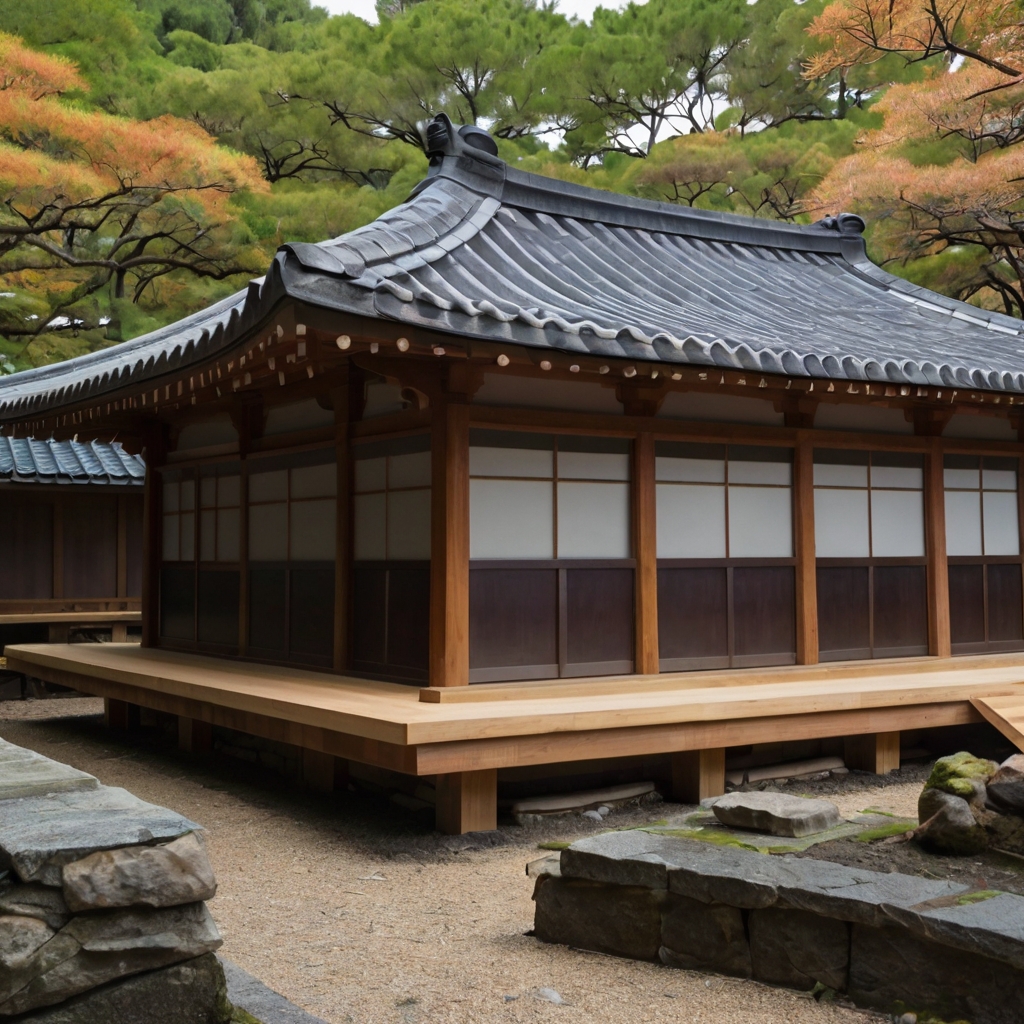
Furthermore, trapezoid geometry is used in the manufacture of mechanical parts and in the creation of art and decorative objects.

Definition
Definition: A convex flat quadrilateral is a trapezoid if, and only if, it has two parallel sides.
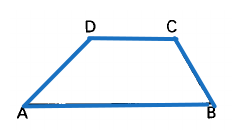
Any trapezoid
In any trapezoid $ABCD$ of bases $\overline{AB}$ and $\overline{CD}$ we have:
$$\hat{A}+ \hat{B} = \hat{C}+ \hat{D}=180^\circ$$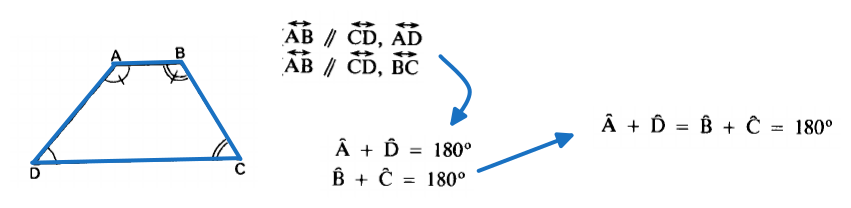
Isosceles trapezoid - Congruent angles
The angles of each base of an isosceles trapezoid are congruent
Demonstration:
| Hypothesis | Thesis |
|---|---|
| $\overline{AB}$ and $\overline{CD}$ are bases of the isosceles trapezoid $\quad \Rightarrow \quad$ | $\hat{C}\equiv \hat{D}$ and $\hat{A}\equiv \hat{B}$ |
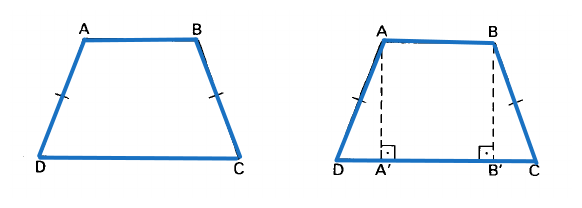
Initially we will draw the perpendiculars to the bases through the vertices $A$ and $B$ of the smaller base. With this, we obtain the points $A'$ and $B'$ in the larger base $\overline{CD}$.
Let us note that $\overline{AA' } \equiv \overline{BB' }$ as they are the distance between parallel lines.
The right triangles $AA' D$ and $BB' C$ are congruent due to the special case since $\overline{AA'} \equiv \overline{BB'}$ and $\overline{AD} \equiv \overline{BC }$. consequently, we have:
$$\hat{C}\equiv \hat{D}$$As $\hat{A}$ and $\hat{B}$ are supplementary of $\hat{D}$ and $\hat{C}$.
Therefore
$$\hat{A}\equiv \hat{B}$$$\blacksquare$
Isosceles trapezoid - Congruent diagonals
The diagonals of an isosceles trapezoid are congruent.
Demonstration:
| Hypothesis | Thesis |
|---|---|
| $ABCD$ is a trapezoid of bases $\overline{AB}$ and $\overline{CD}$, with $\overline{AD}\equiv \overline{BC}\quad $ | $$\overline{AB}\equiv \overline{CD}$$ |
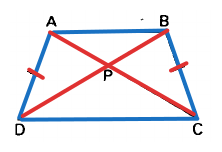
Let us note that of the triangles $ADC$ and $BCD$
$$\overline{AD}\equiv \overline{BC}, ~\hat{D}\equiv \hat{C}, ~\overline{DC}\equiv \overline{CD}$$Using the side-to-side angle (LAL) criterion, we have that triangles $ADC$ and $BCD$ are congruent.
With this, we have to
$$\overline{AC}\equiv \overline{BD}$$$\blacksquare$
This is a small introduction to the trapezoid concepts, wait for the next posts.