
Euler's Eyes
2024-06-14
Parallelogram
In this post the central point of the topic is Parallelograms, as well as their properties. A parallelogram is a quadrilateral with four sides, where opposite sides are parallel.
Introduction
Every parallelogram has rectangle, rhombus and square as subsets.

Definition: A convex flat quadrilateral is a parallelogram if, and only if, its opposite sides are parallel.
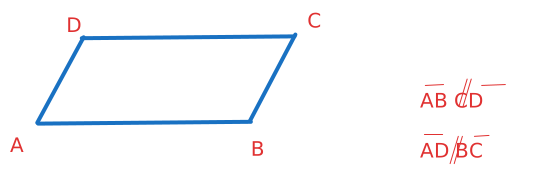
- $\overline{AB}$, $\overline{BC}$, $\overline{CD}$ and $\overline{DA}$ are parallel.
General concepts of the Parallelogram
- Opposite sides of a parallelogram are congruent, that is, they have the same measurement.
- Opposite angles of the parallelogram are congruent (same measurement).
- The consecutive angles of the parallelogram are supplementary, whose sum totals 180°.
- The sum of internal or external angles adds up to 360°.
- The diagonals of the parallelogram intersect at their respective midpoints (middle of the figure).
A little of history
The history of the parallelogram in mathematics is intrinsically linked to the evolution of geometry. The parallelogram, like a quadrilateral with opposite sides parallel, is a fundamental figure in plane geometry.
The introduction of quadrilaterals, including the parallelogram, marks a significant moment in the mathematical journey: the transition from basic geometry to advanced geometry. Studying the parallelogram and its properties helps deepen our understanding of geometry and provides the basis for exploring other complex geometric figures.
The parallelogram concept also played a crucial role in the development of geometric transformations such as the Shear Transformation. These transformations are operations that change the shape or position of a geometric figure in a specific way, and the parallelogram is often used to illustrate these concepts.
Therefore, the parallelogram is not just a simple geometric figure, but a fundamental piece in the history of mathematics and the evolution of geometry. It continues to be an important topic in mathematics curriculum around the world, helping students develop a deeper understanding of geometric principles.
Applications in everyday life
The parallelogram has several practical applications in different fields:
Mathematics: The parallelogram is used to solve geometry problems, such as calculating areas and perimeters.
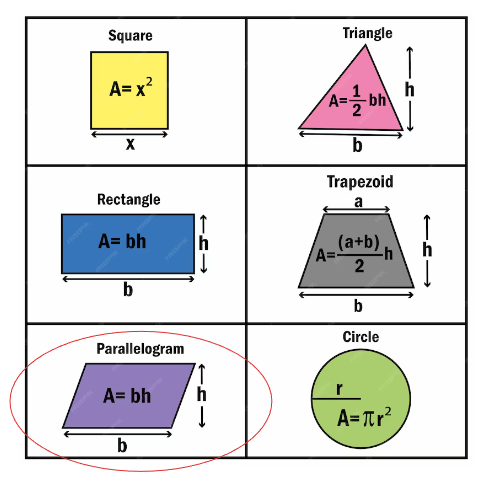
Engineering: In engineering, the parallelogram is used to build stable structures.

Architecture: Architects use parallelograms to draw plans and projects.
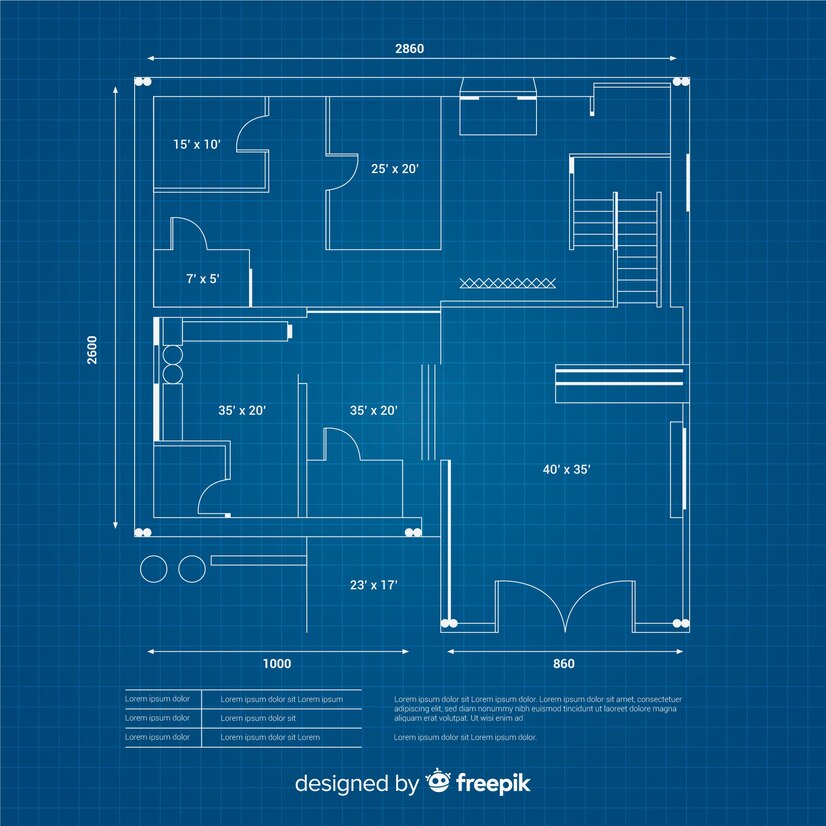
Geography: The parallelogram is used to interpret maps and house plans.
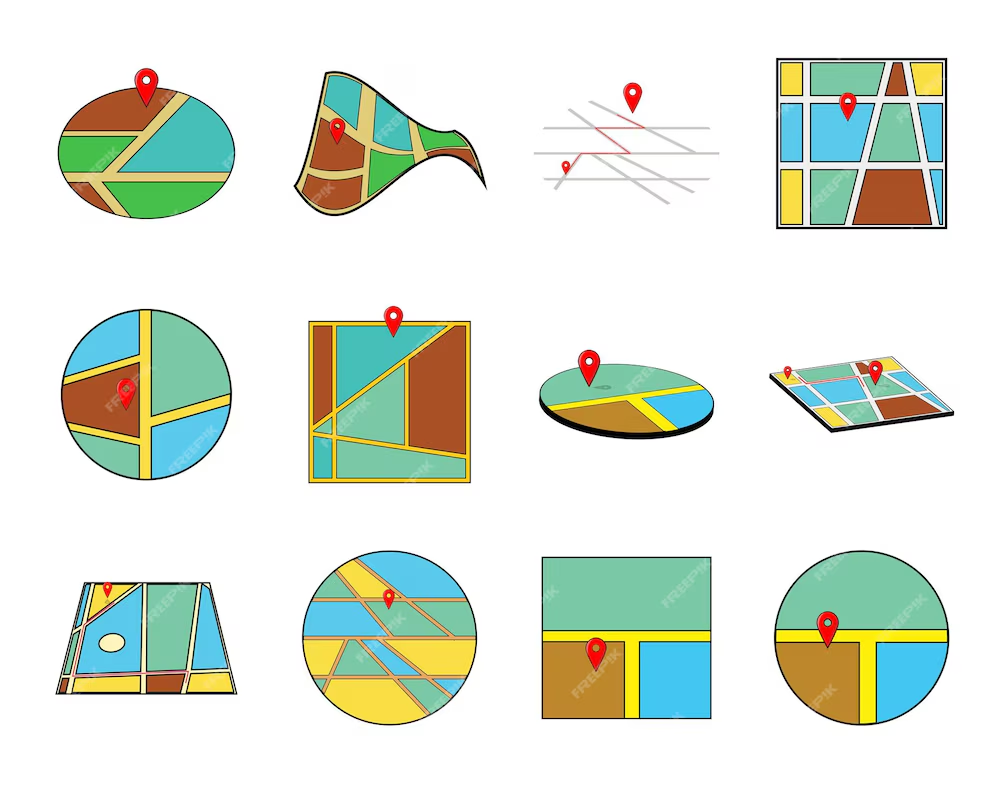
These are just some of the many practical applications of the parallelogram. Understanding the properties of parallelograms is fundamental to applying these concepts in real-world situations.
Congruent opposite angles
Theorem: Opposite angles congruent
- In every parallelogram, any two opposite angles are congruent.
- Every convex quadrilateral that has congruent opposite angles is a parallelogram.
Demonstration:
To prove 1, we have:
| Hypothesis | Thesis |
|---|---|
| $$ABCD ~\text{ is parallelogram } \qquad\Rightarrow \qquad$$ | $$\hat{A}\equiv \hat{C}\quad \text{e}\quad \hat{B}\equiv \hat{D}$$ |
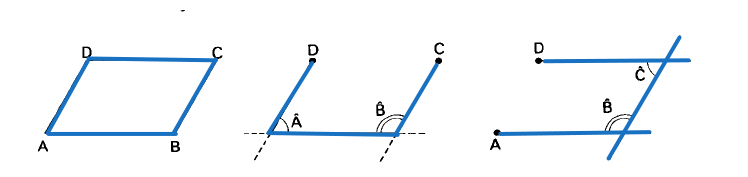
As by hypothesis $ABCD$ is a parallelogram, this implies:
$$\overleftrightarrow{AD} \parallel \overleftrightarrow{BC} \qquad\Rightarrow \qquad \hat{A} + \hat{B} = 180^\circ$$$$\overleftrightarrow{AB} \parallel \overleftrightarrow{CD} \qquad\Rightarrow \qquad \hat{B} + \hat{C} = 180^\circ$$
Therefore, $\hat{A}\equiv \hat{C}$, analogously $\hat{B}\equiv \hat{D}$.
To prove the second property we have:
| Hypothesis | Thesis |
|---|---|
| $$\hat{A}\equiv \hat{C}\quad \text{e}\quad \hat{B}\equiv \hat{D} \qquad\Rightarrow \qquad$$ | $$ABCD ~\text{ is parallelogram }$$ |
As per hypothesis $\hat{A}\equiv \hat{C}\quad \text{e}\quad \hat{B}\equiv \hat{D}$, this implies
$$\hat{A} + \hat{B} = \hat{C} + \hat{D}$$It is worth remembering that, as $ABCD$ is a quadrilateral, then $\hat{A} + \hat{B}+ \hat{C} + \hat{D} = 360^\circ$
As a consequence
$$\overleftrightarrow{AD} \parallel \overleftrightarrow{BC}$$$$\overleftrightarrow{AB} \parallel \overleftrightarrow{CD}$$
Therefore, $ABCD$ is a parallelogram.
$\blacksquare$
As a consequence we have:
Every rectangle is a parallelogram.
Congruent opposite sides
Theorem: Opposite sides congruent
- In every parallelogram, any two opposite sides are congruent.
- Every convex quadrilateral that has congruent opposite angles is a parallelogram.
Demonstration:
To prove 1, we have:
| Hypothesis | Thesis |
|---|---|
| $$ABCD ~\text{ is parallelogram } \qquad\Rightarrow \qquad$$ | $$\overline{AB}\equiv \overline{CD}\quad \text{e}\quad \overline{AB}\equiv \overline{CD}$$ |
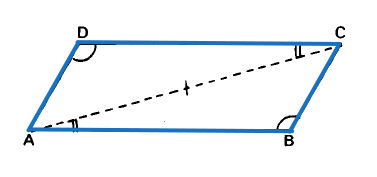
As by hypothesis $ABCD$ is a parallelogram, $\hat{B}\equiv \hat{D}$ and as $\overline{AB}$ is parallel $\overline{CD}$, this implies $B\hat{ A}C = D\hat{C}A$
Therefore, $\overline{AB}\equiv \overline{CD}\quad \text{e}\quad \overline{AB}\equiv \overline{CD}$
To prove the second property we have:
| Hypothesis | Thesis |
|---|---|
| $$\overline{AB}\equiv \overline{CD}\quad \text{e}\quad \overline{BC}\equiv \overline{DA} \qquad\Rightarrow \qquad$$ | $$ABCD ~\text{ is parallelogram }$$ |
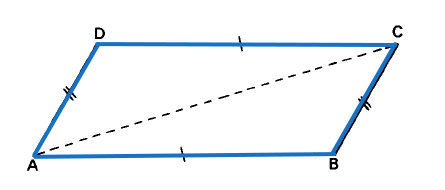
As by hypothesis $ABCD$ is a parallelogram, $\overline{AB}\equiv \overline{CD}$ and $\overline{BC}\equiv \overline{DA}$ imply
$$\overline{AD} \parallel \overline{BC}$$$$\overline{AB} \parallel \overline{CD}$$
Therefore, $ABCD$ is a parallelogram.
$\blacksquare$
As a consequence we have:
Every rhombus is a parallelogram.
Diagonals as midpoint
Diagonals as midpoint
- In every parallelogram, the diagonals intersect at their respective midpoints.
- Every convex quadrilateral in which the diagonals intersect at their respective midpoints is a parallelogram.
As a consequence we have:
If two straight segments intersect at their respective midpoints, then their ends are vertices of a parallelogram.
Two parallel and congruent sides
Two parallel and congruent sides
- Every convex quadrilateral that has two parallel and congruent sides is a parallelogram.
- If two line segments are parallel and congruent, then their ends are vertices of a parallelogram.
Demonstration:
Just use the congruent opposite sides and congruent opposite angles theorems.
Therefore, $ABCD$ is a parallelogram.
$\blacksquare$
This is a small introduction to the concepts of Parallelogram, wait for the next posts.