
Euler's Eyes
2022-12-01
Primitive Notions
Here we start the series of posts for plane geometry. In it, we will talk from very primitive concepts, to more advanced concepts, aimed at children (elementary to medium).
Start using geometry
The Greeks of ancient civilization were one of the most famous people in the art of thinking. They were responsible for the heyday of philosophical, scientific, political, social and artistic ideals and had a decisive influence on the western world.

The definition of geometry is a Greek concept that comes from meters (to measure) and geo (earth), more specifically to measure the Earth. The Greeks were the first to use the concept of geometry used more rigorously than in other civilizations, such as the Egyptians, Babylonians, among others.

Egyptians and other civilizations studied geometry to share fertile lands, build houses, are some examples of geometric applications. Of the main Greeks who were very important for the contribution of geometry, we can mention Euclid, Pythagoras, Archimedes and Apollonius. The best known work of this period is Elements by Euclid (around 500 BC), which explains the geometry of plane shapes, circles, quadrilaterals, triangles, among others. In this work he cites Thales of Miletus as the main person responsible for introducing Geometry in Greece, based on research studies on Egyptian works.
Geometry Schools
In this post specifically we will talk about the mathematics developed in this period. Before the philosophical and deductive thoughts of mathematics, people such as the Egyptians, Sumerians, Hindus and Persians investigated numbers and geometric shapes without as much rigor as the Greeks. This splendid people were the first to use a deductive science, with definitions, postulates, axioms and theorems.
There were two schools:
- Pythagorean, in honor of Pythagoras of Samos;
- Platonic, named after Plato.
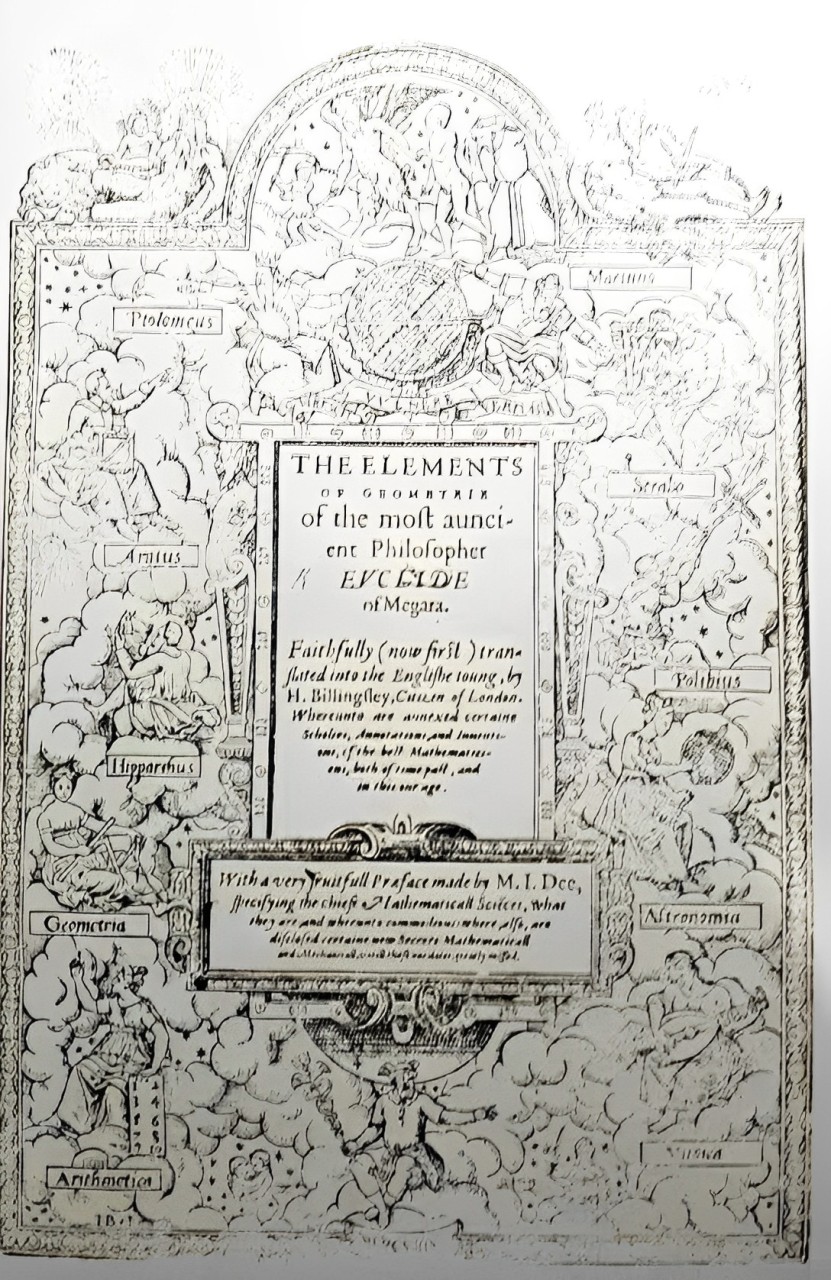
These schools devoted themselves to the study of figures and numbers using methods of analysis and deduction. The most important works of this period are displayed in the Elementos collection written by Euclid in Alexandria around 300 BC. Ç.
| Elements - Euclid of Alexandria |
|---|
|
Primitive notions
The first concepts that the Greeks initiated, for the development of geometry are the concepts of:
- Point
- Straight
- Plan
Next, let’s establish some notation standards for these three items:
- Point: capital letters
- A, B, C etc.
- Straight: lowercase letters
- a, b, c etc.
- Flat: Greek letters
- $\alpha, \beta,\gamma, \dots$
Graphic notions:
- Point: point A

- Line: line r

- Plan: plan $\alpha$

Axioms and Postulates
In ancient Greece, mathematicians like Euclid used the concepts of axioms and postulates a lot.
Axioms and postulates are accepted facts without a demonstration. More specifically, we have no way of proving results whose facts are accepted without a demonstration. Everything starts with the axiom, as it is the starting point of reasoning.

In the case of an axiom it is a statement that we assume to be true. The use of the axioms in general:
- We want to define a certain subject
- We say which axioms this satisfies
- With that, we deduce everything we can from such axioms.
- That is, everything that satisfies such axioms will also satisfy their consequences.
Postulate of existence
In this post, based on the book Elementos by Euclid, we will enunciate some postulates for point, line and plane.
Postulate 1: On a line, as well as outside it, there are infinitely many points.
Postulate 2: In a plane, there are infinite points.
What does “infinite points” mean? Think of a big number, infinity is bigger than that, that is, as many points as you want.
Example: position of points and lines.

- The points $A, C$ and $H$ belong to the line $r$.
- The points $B$ and $M$ do not belong to the line $r$.
- The points $A, C$ and $H$ are collinear (from Latin cum + linea + ar was placed on a straight line).
- Points $M$ and $M$ are distinct (different).
Postulate of Determination
Postulate (Line): two distinct points determine a single (one, and only) line that passes through them.
Example: the distinct points $A$ and $B$ determine the line.
Note: $ \overleftrightarrow{AB}$

Postulate (Plane): three non-collinear points determine a single plane passing through them.
Example: non-collinear points $A, B$ and $C$ determine a plane.
Note: $ \alpha$

Postulate of inclusion
Postulate (Coplanar): if a line has two distinct points in a plane, then the line is contained in that same plane.

This is a small introduction of geometry concepts, wait for the next posts.