
Euler's Eyes
2022-12-02
Straight lines
In this post we are going to talk about an important concept for plane geometry, which are concepts of lines, line segments, semi-lines, among others.
Line segment
Definition (Line segment): given two distinct points, the union of the set of these two points with the set of points that are between them, is a line segment.

In symbolic terms we have the sets:
$$\overline{AB} = \\{A,B\\}\cup \\{\text{for all } X \text{ between } A \text{ and } B\\}$$Consecutive segments
Definition (Consecutive Segments): two line segments are consecutive if and only if one endpoint of one of them is also the endpoint of the other.

Collinear segments
Definition (Collinear segments): two line segments are collinear if and only if they lie on the same line.

- $\overline{AB}$ and $\overline{CD}$ are collinear and not consecutive
- $\overline{MN}$ and $\overline{NP}$ are collinear and consecutive
Adjacent segments
Definition (Adjacent Segments): two consecutive and collinear line segments are adjacent (neighbors) if and only if they have only one endpoint in common.

- $\overline{AC}$ and $\overline{CB}$ are not non-adjacent
- $\overline{AC}\cap \overline{CB} = \overline{CB}$
- $\overline{MN}$ and $\overline{NP}$ are adjacent
- $\overline{MN}\cap \overline{NP} = \\{N\\}$

Semi-line
Definition (Semi-line): given two distinct points $A$ and $B$, the union of the line segment $\overline{AB}$ with the set of points $X$ such that $B$ is between $A$ and $X$ is the ray $ \overrightarrow{AB}$.

In symbolic terms we have the sets:
$$\overrightarrow{AB} = \overline{AB}\cup \\{\text{for all } X \text{ such that } B \text{ is between } A \text{ and } X\\}$$Straight lines
In Elements, as mentioned earlier, Euclid was one of the first to treat geometry with principles such as axioms and postulates. For the definition of straight lines, we can cite 2 axioms enunciated by Euclid:
- We can draw a single line connecting any two distinct points.
- Any line segment can be continued in only one way.
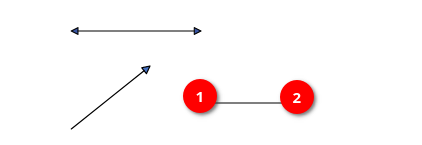
Definition (Line): given two distinct points $A$ and $B$, the distinct points $A$ and $B$ determine the line.
Note: $ \overleftrightarrow{AB}$

Classification of lines
- Concurrent Lines: when the lines r and s are crossed at a point.
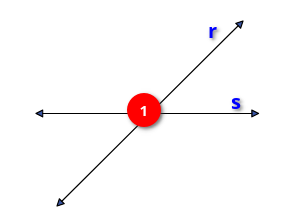
- Parallel Lines: when the lines r and s are placed side by side in any direction and are not crossed at any point.
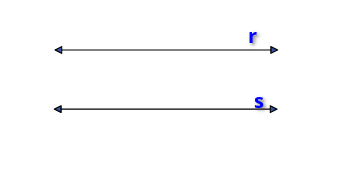
- Coincident Lines: when the lines r and s coincide (“One on top of the other”).
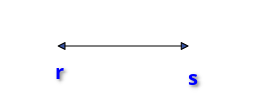
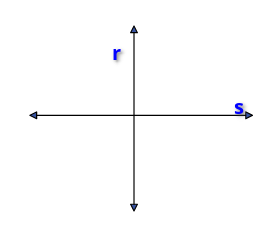
- Perpendicular Lines: when the lines r and s are perpendicular, when the lines are crossed horizontally and vertically. Since we do not define angles, we will not quote about the angle property of perpendicular lines.
This is a small introduction to the concepts of straight lines, wait for the next posts.