
Euler's Eyes
2026-10-12
Chapter 16 — Regular Polygons
Capítulo 16 · Neste capítulo você vai
Regular polygons
- recognize regular polygons and prove that they are inscriptible and circumscriptible;
- identify center, apothem and centric angle;
- calculate side and apothem of the square, hexagon and equilateral triangle as a function of the radius;
- obtain the side of the regular decagon and pentagon and recognize the golden segment.
Hexagonal nuts, honeycombs, the STOP sign, the gears of a clock: regular polygons are where you need to repeat the same piece around a center. In this chapter, we prove that every regular polygon fits exactly between two circles with the same center and we calculate its sides and apothem from the radius — calculations that, almost two thousand years ago, were used to create the first trigonometric tables.


I. Concepts and properties
Dividing a circle into equal parts produces a regular polygon. The converse also applies: every regular polygon has a circle that passes through all the vertices and another that touches all the sides.
Who discovered
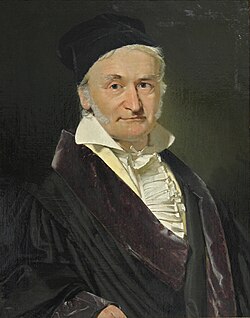
Inscribing and circumscribing regular polygons is the subject of book IV of The Elements by Euclid (c. 300 BC): he constructs with ruler and compass the equilateral triangle, the square, the pentagon (proposition IV.11), the hexagon (IV.15) and the 15 sided polygon (IV.16). For two thousand years no one went beyond this, until Carl Friedrich Gauss, in 1796, constructed the regular 17 sided polygon and, in 1801, showed which regular polygons can be constructed; in 1837, Pierre Wantzel proved the others impossible.

The story
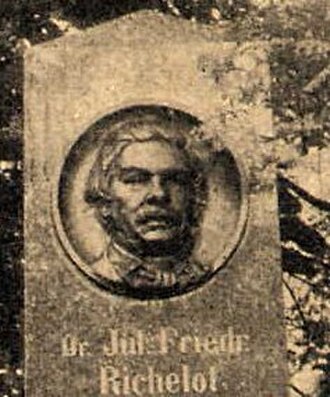
The result of Gauss and Wantzel says that a regular polygon with $n$ sides can be constructed with straightedge and compass exactly when $n$ is a power of 2 multiplied by different Fermat primes — primes of the form $2^{2^k} + 1$, such as 3, 5, 17, 257 and 65 537. That is why the heptagon (7 sides) and the nonagon (9 sides) cannot be constructed, but the polygon with 257 sides can: in 1832, Friedrich Richelot published its construction.
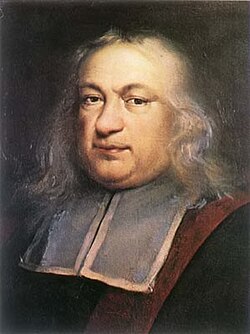
Regular polygons were also the path of Archimedes to the number π: by inscribing and circumscribing polygons with 6, 12, 24, 48 and 96 sides in a circle, he obtained $3\tfrac{10}{71} < \pi < 3\tfrac{1}{7}$.
In everyday life
- Nuts and screws. The hexagonal head allows the wrench to be used in six positions; the distance between opposite faces is twice apothem.
- STOP sign. The regular octagon is recognized by its shape even when the sign is covered in snow or viewed from behind.
- Gears and sprockets. Teeth are distributed like the vertices of a regular inscribed polygon.
- Mosaics and floors. Regular triangles, squares and hexagons cover the plane without gaps because their internal angles divide 360°.
Sources: Elements, book IV (D. Joyce) · Gauss (MacTutor) · Wantzel (MacTutor).
Theory and constructions
Definition
DefiniçãoRegular polygon
A convex polygon is regular if, and only if, it has all of its congruent sides and all of its congruent interior angles. Thus, equilateral triangle is the regular triangle and the square is the regular quadrilateral.
A regular polygon is equilateral and equiangular.
Properties
TeoremaDivision of the circle into congruent arcs
Dividing a circle into $n$ ($n \geq 3$) congruent arcs:
a) the chords determined by two consecutive division points form a regular polygon with $n$ sides inscribed on the circumference;
b) the tangents drawn by the division points determine a regular polygon with $n$ sides circumscribed to the circumference.
View the demo
a) Let $A, B, C, D, \ldots, M, N$ be the $n$ division points of the circle $\lambda$. The polygon $ABCD\ldots MN$ has $n$ sides and is inscribed, as all vertices belong to $\lambda$. Since the arcs $\overset{\frown}{AB}, \overset{\frown}{BC}, \ldots, \overset{\frown}{NA}$ are congruent, the chords are also: $AB = BC = CD = \ldots = NA$ (1). The angles $\hat A, \hat B, \ldots, \hat N$ are congruent (2), as each is an inscribed angle that measures half the sum of $n - 2$ of the congruent arcs. In the pentagon, for example, $\hat A = \dfrac{\overset{\frown}{BC} + \overset{\frown}{CD} + \overset{\frown}{DE}}{2}$. From (1) and (2), the polygon is regular.
b) Through the division points we conduct tangents and obtain the polygon $A'B'C'\ldots N'$ circumscribed by $\lambda$. The triangles $A'AB$, $B'BC$, …, $N'NA$ are isosceles (their base angles are segment angles that measure half of one of the congruent arcs) and congruent to each other in the ALA case, as the bases $AB, BC, \ldots$ are sides of the regular polygon in part a). Hence $\hat A' = \hat B' = \ldots = \hat N'$ (1) and, for convenient summation, $A'B' = B'C' = \ldots = N'A'$ (2). From (1) and (2), the circumscribed polygon is regular.
TeoremaRegular polygon is inscribable
Every regular polygon can be inscribed in a circle; that is, given a regular polygon, there is a single circle that passes through its vertices.
View the demo
Let $ABCD\ldots MN$ be the regular polygon (think of the pentagon $ABCDE$). Through the points $A$, $B$ and $C$ we draw the circle $\lambda$ with center $O$. The triangles $OBA$ and $OCD$ are congruent in the LAL case: $AB = CD$ (sides of the polygon), $OB = OC$ (rays) and $O\hat BA = O\hat CD$ (difference between the congruent angles $\hat B$ and $\hat C$ of the polygon and the base angles of isosceles triangle $BOC$). Logo $OA = OD$ and $D \in \lambda$. Similarly, $E \in \lambda$, …, $N \in \lambda$. The uniqueness comes from the uniqueness of the circle that passes through $A$, $B$ and $C$.
TeoremaRegular polygon is circumscribable
Every regular polygon is circumscribed by a circle; that is, given a regular polygon, there is a single circle inscribed in the polygon.
View the demo
According to the previous theorem, the polygon is inscribed in a circle $\lambda$ with center $O$. The sides are congruent chords of $\lambda$, so they are equally distant from $O$: $A', B', C', \ldots$ being the midpoints of the sides, $OA' = OB' = OC' = \ldots$. Then $O$ is the center of a circle $\lambda'$ that passes through $A', B', C', \ldots$; like $\overline{OA'} \perp \overline{AB}$, $\overline{OB'} \perp \overline{BC}$, …, the sides are tangent to $\lambda'$. If there were another inscribed circle, it would pass through $A', B', C', \ldots$ and coincide with $\lambda'$.
AtençãoNotice
The last two properties are reciprocals of the first. The circles inscribed and circumscribed by a regular polygon are concentric.
Notable elements
DefiniçãoCenter, apothem and centric angle
- Center of a regular polygon is the common center of the circumscribed and inscribed circles.
- apothem is the segment with one end at the center and the other at the midpoint of a side. apothem is the radius of the inscribed circle.
- Centric angle is the angle with a vertex at the center and sides passing through two consecutive vertices. They are all congruent and measure
PropriedadeDiagonals through the center
If a regular polygon has an even number of sides, it has diagonals passing through the center: those that join opposite vertices. If it has an odd number of sides, no diagonal passes through the center.
II. Calculation of side and apothem
Using the radius of the circumscribed circle, the side $\ell_n$ and apothem $a_n$ of any regular polygon are calculated. The cases of the decagon and the pentagon reveal the golden segment.
Who discovered
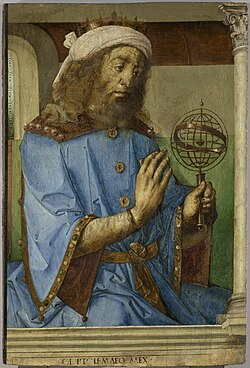
The calculations in this topic are in book XIII of The Elements by Euclid. The proposition XIII.9 shows that the side of the regular decagon is the largest segment of the division of the radius into mean and extreme ratio — our golden segment, defined in book VI —, and XIII.10 proves that the square on the side of the pentagon is equal to the sum of the squares of the sides of the hexagon and the decagon inscribed in the same circle. Claudius Ptolemy (2nd century) used exactly these results to calculate the first chords of his trigonometric table.
The story
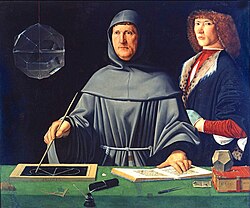
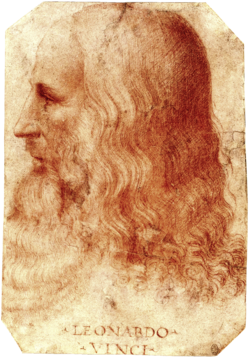
The expression “divine proportion” comes from the Italian friar Luca Pacioli, who published in 1509 the book De divina proportione, illustrated by Leonardo da Vinci; The name “golden section” was popularized in the 19th century by the German Martin Ohm. The golden ratio, $\dfrac{1 + \sqrt5}{2} \approx 1{,}618$, also appears in the Fibonacci sequence: the ratio between two consecutive terms approaches it.
Many popular claims about the golden ratio in paintings, temples, and the human body are exaggerated or false. But in the regular pentagon it is real: the ratio between the diagonal and the side is exactly $\dfrac{1 + \sqrt5}{2}$.
In everyday life
- Five-pointed stars. The stars on the Brazilian flag and many others are drawn from the diagonals of a regular pentagon.
- Soccer ball. The classic ball is stitched with 12 pentagons and 20 regular hexagons.
- Engineering. The side of a regular polygon inscribed in a circle of known radius gives the size of the parts of a circular structure, such as a dome or a Ferris wheel.
- Technical drawing. To draw a hex nut from the diameter, use $\ell_6 = R$: the side of the hexagon is equal to the radius.
Sources: Elements, proposition XIII.9 · Elements, proposition XIII.10 · Pacioli (MacTutor) · Reason golden (MacTutor).
Theory and constructions
We will indicate by $\ell_n$ the side and by $a_n$ the apothem of the regular polygon with $n$ sides inscribed in a circle of radius $R$.
Square, hexagon and equilateral triangle
ResumoSide and apothem as a function of radius
| Polygon | Side $\ell_n$ | apothem $a_n$ |
|---|---|---|
| Square | $\ell_4 = R\sqrt{2}$ | $a_4 = \dfrac{R\sqrt{2}}{2}$ |
| Hexagon | $\ell_6 = R$ | $a_6 = \dfrac{R\sqrt{3}}{2}$ |
| equilateral triangle | $\ell_3 = R\sqrt{3}$ | $a_3 = \dfrac{R}{2}$ |
View deductions (problems 1, 2 and 3)
Square. In the right triangle $AOB$, with $OA = OB = R$: $\ell_4^2 = R^2 + R^2$, then $\ell_4 = R\sqrt{2}$. The apothem is half of the side: $a_4 = \dfrac{\ell_4}{2} = \dfrac{R\sqrt{2}}{2}$.
Hexagon. The centric angle measures 60°, and the triangle $AOB$ is isosceles with an angle of 60° at the vertex: it is equilateral. Therefore $\ell_6 = R$, and apothem is the height of equilateral triangle from side $R$: $a_6 = \dfrac{R\sqrt{3}}{2}$.
equilateral triangle. Since $BC = \ell_3$ and $\overline{AD}$ are diameters, we have $CD = \ell_6 = R$. The triangle $ACD$ is rectangular in $C$: $\ell_3^2 = (2R)^2 - R^2 = 3R^2$, therefore $\ell_3 = R\sqrt{3}$. As $O$ is the centroid of the triangle $ABC$, $2a_3 = R$ and $a_3 = \dfrac{R}{2}$.
Regular decagon and golden segment
PropriedadeSide of the regular decagon
$$\ell_{10} = \frac{R}{2}\left(\sqrt{5} - 1\right).$$View deduction (problem 4)
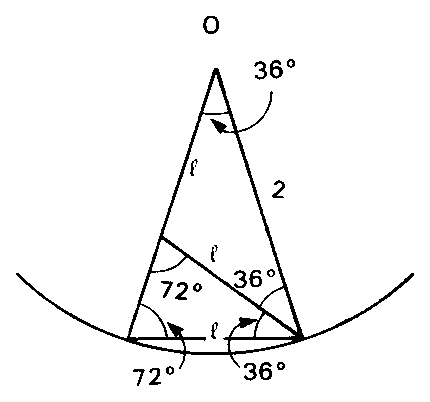
In isosceles triangle $AOB$, with $\hat O = 36°$ and $\hat A = \hat B = 72°$, we trace to angle bisector $\overline{BC}$ from $\hat B$. The triangle $BAC$ is isosceles ($\hat A = \hat C = 72°$), therefore $BC = \ell_{10}$; the triangle $COB$ is isosceles ($\hat O = \hat B = 36°$), therefore $OC = \ell_{10}$. Then $CA = R - \ell_{10}$. By the internal angle bisector theorem in the triangle $AOB$:
$$\frac{R}{\ell_{10}} = \frac{\ell_{10}}{R - \ell_{10}} \;\Rightarrow\; \ell_{10}^2 + R\,\ell_{10} - R^2 = 0 \;\Rightarrow\; \ell_{10} = \frac{-R \pm R\sqrt{5}}{2}.$$Neglecting the negative solution: $\ell_{10} = \dfrac{R}{2}(\sqrt{5} - 1)$.
Definiçãogolden segment
$x$ is the measurement of the golden segment of a measurement segment $a$ if, and only if,
$$\frac{a}{x} = \frac{x}{a - x}.$$The ratio $\dfrac{x}{a}$ is called golden ratio. From the proportion, $x^2 + ax - a^2 = 0$, and then $x = \dfrac{\sqrt{5} - 1}{2}\,a$. By the previous deduction, the side of the regular decagon is the golden segment of the radius.
regular pentagon
TeoremaSide of a regular pentagon
The side of the regular pentagon is the hypotenuse of a right-angled triangle whose legs are the sides of the regular hexagon and decagon inscribed in the same circle: $\ell_5^2 = \ell_6^2 + \ell_{10}^2$. Hence
$$\ell_5 = \frac{R}{2}\sqrt{10 - 2\sqrt{5}}.$$View the demo (issue 5)
Let $AB = \ell_{10}$ and, on the line $AB$, be a point $C$ such that $AC = R$. In the circle with center $A$ and radius $R$, the central angle of 72° corresponds to $OC = \ell_5$ (because $72° = \tfrac{1}{5}\cdot 360°$). Leading through $C$ the tangent $\overline{CD}$ to the circle $\lambda$ with center $O$ and radius $R$, the power of $C$ with respect to $\lambda$ gives
$$(CD)^2 = (CA)\cdot(CB) = R\,(R - \ell_{10}) = \ell_{10}^2 \;\Rightarrow\; CD = \ell_{10}$$(using the golden ratio from the previous deduction). In the triangle $ODC$, rectangle in $D$: $OC = \ell_5$ (hypotenuse), $CD = \ell_{10}$ and $OD = R = \ell_6$ (legs). By Pythagoras’ theorem:
$$\ell_5^2 = R^2 + \left(\frac{\sqrt{5} - 1}{2}R\right)^2 = \frac{10 - 2\sqrt{5}}{4}R^2 \;\Rightarrow\; \ell_5 = \frac{R}{2}\sqrt{10 - 2\sqrt{5}}.$$General formula of apothem and side of $2n$ sided polygon
Propriedadeapothem as a function of R and side
In triangle $AMO$, rectangle at $M$ (midpoint of the side):
$$a_n^2 = R^2 - \frac{\ell_n^2}{4} \;\Rightarrow\; a_n = \frac{1}{2}\sqrt{4R^2 - \ell_n^2}.$$Replacing $\ell_{10}$ and $\ell_5$: $a_{10} = \dfrac{R}{4}\sqrt{10 + 2\sqrt{5}}$ and $a_5 = \dfrac{R}{4}\left(\sqrt{5} + 1\right)$.
PropriedadeSide of 2n-sided polygon
Indicating by $\ell_{2n}$ the side of the regular polygon with $2n$ sides inscribed in the same circle:
$$\ell_{2n} = \sqrt{R\left(2R - \sqrt{4R^2 - \ell_n^2}\right)}.$$Know $\ell_6$, obtain $\ell_{12}$; with $\ell_{12}$, we obtain $\ell_{24}$, and so on — exactly Archimedes’ path to the polygon with 96 sides.
View deduction (problem 7)
Let $\overline{AB} = \ell_n$, $M$ be its midpoint and $C$ be the midpoint of the arc $\overset{\frown}{AB}$, so that $AC = \ell_{2n}$ and $MC = R - a_n$. In the right triangle $AMC$:
$$\ell_{2n}^2 = \left(\frac{\ell_n}{2}\right)^2 + (R - a_n)^2 = \frac{\ell_n^2}{4} + R^2 - 2Ra_n + a_n^2 = 2R^2 - 2Ra_n,$$because $a_n^2 + \dfrac{\ell_n^2}{4} = R^2$. Replacing $a_n = \tfrac{1}{2}\sqrt{4R^2 - \ell_n^2}$: $\ell_{2n}^2 = R\left(2R - \sqrt{4R^2 - \ell_n^2}\right)$.
Exercises
Concepts and properties
Determine the measures of the angles $x$, $y$ and $z$ in the cases: a) regular hexagon; b) regular pentagon.
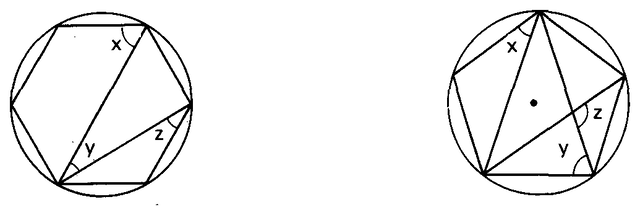
Ver resposta
a) $x = 60°$, $y = 30°$, $z = 30°$ · b) $x = 36°$, $y = 72°$, $z = 108°$
In the figure we have a equilateral triangle and a square inscribed in the same circle. Determine $A\hat OP$, with $\overline{AB}$ parallel to $\overline{PQ}$.
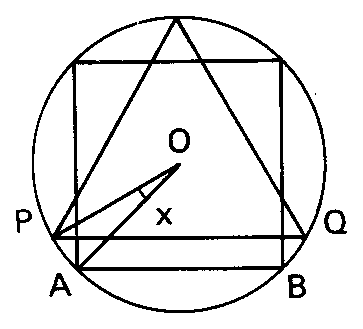
Ver resposta
15°
In the figure, $\overline{AB}$ is the side of the regular pentadecagon and $\overline{PQ}$ is the side of the regular hexagon, inscribed in the same circle. Determine $A\hat QP$, where $\overline{AB}$ and $\overline{PQ}$ are parallel.
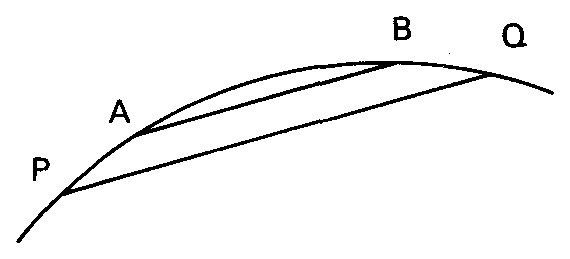
Ver resposta
9°
Determine the number of sides of a regular convex polygon whose interior angles measure 179° each.
Ver resposta
360 sides
Determine the measure of the angle formed by the extensions of the sides $\overline{AB}$ and $\overline{CD}$ of a regular polygon $ABCDE\ldots$ with 30 sides.
Ver resposta
24°
Given two regular polygons, with $(n + 1)$ sides and $n$ sides, respectively, determine $n$, knowing that the interior angle of the first polygon exceeds the interior angle of the second by 5°.
See the resolution of the book
If the difference between the internal angles is 5°, the difference between the external angle of the 2nd polygon and the external angle of the 1st is also 5°. Then
$$\frac{360°}{n} - \frac{360°}{n + 1} = 5° \;\Rightarrow\; 72(n + 1) - 72n = n(n + 1) \;\Rightarrow\; n^2 + n - 72 = 0 \;\Rightarrow\; n = -9 \text{ ou } n = 8.$$Answer: $n = 8$.
Ver resposta
$n = 8$
How many measurements, two different ones, do we obtain when we measure the diagonals of a: a) regular hexagon; b) regular octagon; c) regular decagon; d) regular dodecagon; e) regular heptagon; f) regular nonagon; g) polygon with $n$ sides, for $n$ pair; h) polygon with $n$ sides, for $n$ odd?
Ver resposta
a) 2 · b) 3 · c) 4 · d) 5 · e) 2 · f) 3 · g) $\dfrac{n - 2}{2}$ · h) $\dfrac{n - 3}{2}$
When measuring the diagonals of a regular polygon, 6 measurements were found, two by two different. Find the sum of the interior angles of this polygon.
Ver resposta
2 160° or 2 340°
From a regular polygon $ABCDE\ldots$ we know that the angle $A\hat CB$ measures 10°. How many diagonals of this polygon do not pass through the center?
Ver resposta
126
The angle $A\hat BC$ of a regular polygon $ABCDEF\ldots$ measures 30°… Determine the sum of the internal angles of this polygon, knowing that the angle $A\hat CB$ formed by the diagonal measures 15°.
Ver resposta
1 800°
The perpendicular bisectors of the sides $\overline{AB}$ and $\overline{CD}$ of a regular polygon $ABCDEF\ldots$ form an angle, which contains $B$ and $C$, of 20°. How many diagonals of this polygon pass through the center?
Ver resposta
18
The angle bisectors of the interior angles $\hat A$ and $\hat E$ of a regular polygon $ABCDEFG\ldots$ are perpendicular. What is the sum of the interior angles of this polygon?
Ver resposta
2 520°
The perpendicular bisectors of sides $\overline{AB}$ and $\overline{DE}$ of a regular polygon $ABCDE\ldots$ form an angle, which contains $B$, $C$, and $D$, and exceeds the exterior angle of that polygon by 20°. How many measurements, two by two different, do we obtain when measuring the diagonals of this polygon?
Ver resposta
17
The lines that contain the sides $\overline{AB}$ and $\overline{EF}$ of a regular polygon $ABCDEFG\ldots$ form an angle, which contains $C$ and $D$, and is twice the exterior angle of the polygon. How many diagonals does this polygon have?
Ver resposta
54
The difference between the number of sides of two regular polygons is 4 and the difference between their exterior angles is 3°. Determine the number of sides of these polygons.
Ver resposta
20 e 24
Remembering that in equilateral triangle orthocenter, centroid, incenter (center of the inscribed circle) and circumcenter (center of the circumscribed circle) are coincident and that centroid divides the median into two parts that measure $\tfrac{1}{3}$ and $\tfrac{2}{3}$ of the latter, with 6 being the side of the equilateral triangle, determine: a) the height of the triangle; b) the radius $R$ of the circumscription; c) the radius $r$ of the inscription; d) the apothem of the triangle.
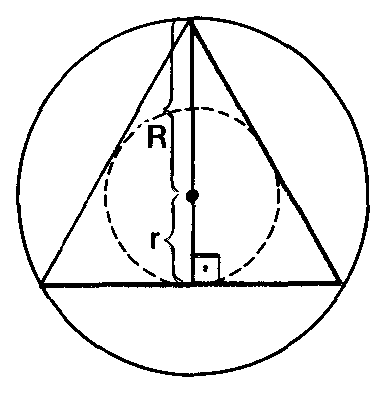
Ver resposta
a) $3\sqrt{3}$ m · b) $2\sqrt{3}$ m · c) $\sqrt{3}$ m · d) $\sqrt{3}$ m
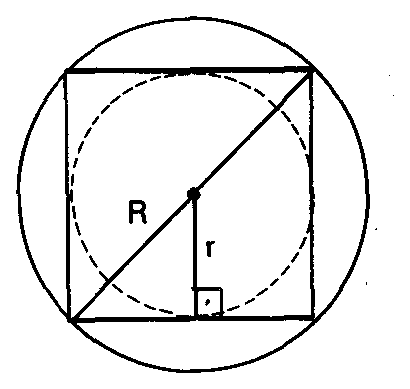
Remembering that in a square the diagonal passes through the center, with 8 m being the side of the square, determine: a) the diagonal; b) the radius $R$ of the circumscription; c) the radius $r$ of the inscription; d) the apothem of the square.
Ver resposta
a) $8\sqrt{2}$ m · b) $4\sqrt{2}$ m · c) 4 m · d) 4 m
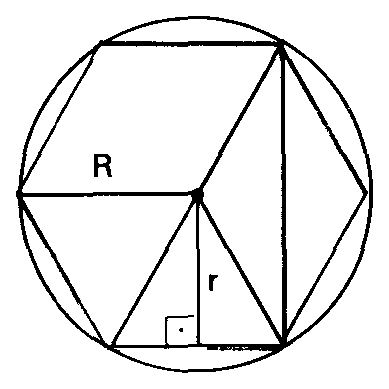
Remembering that in a regular hexagon the largest diagonals pass through the center and determine 6 equilateral triangles in it, with 6 m being the side of the hexagon, determine: a) the largest diagonal; b) the radius $R$ of the circumscription; c) the radius $r$ of the inscription; d) the smaller diagonal; e) the apothem of the hexagon.
Ver resposta
a) 12 m · b) 6 m · c) $3\sqrt{3}$ m · d) $6\sqrt{3}$ m · e) $3\sqrt{3}$ m
Side and apothem
In the following exercises, it is generally not necessary to use the deduced formulas: just calculate the required elements in a figure sketch, with the diagonal of the square and the height of equilateral triangle.
Determine the radius of the circle circumscribed by the regular polygon with 12 m sides in the cases: a) square; b) hexagon; c) triangle.
Ver resposta
a) $6\sqrt{2}$ m · b) 12 m · c) $4\sqrt{3}$ m
Determine the side of the regular polygon inscribed in a circle of radius 6 m, in the cases: a) square; b) hexagon; c) triangle.
Ver resposta
a) $6\sqrt{2}$ m · b) 6 m · c) $6\sqrt{3}$ m
Determine the apothem (or radius of the inscribed circle) of the regular polygon with side 6 m, in the cases: a) square; b) hexagon; c) triangle.
Ver resposta
a) 3 m · b) $3\sqrt{3}$ m · c) $\sqrt{3}$ m
Determine the side of the regular polygon of 6 m of apothem in the cases: a) square; b) hexagon; c) triangle.
Ver resposta
a) 12 m · b) $4\sqrt{3}$ m · c) $12\sqrt{3}$ m
Determine the radius of the circle inscribed in the regular polygon, knowing that the circumscribed radius is 12 m, in the cases: a) square; b) hexagon; c) triangle.
Ver resposta
a) $6\sqrt{2}$ m · b) $6\sqrt{3}$ m · c) 6 m
Determine the radius of the circle circumscribed by the regular polygon, knowing that the radius of the inscribed circle is 6 m, in the cases: a) square; b) hexagon; c) triangle.
Ver resposta
a) $6\sqrt{2}$ m · b) $4\sqrt{3}$ m · c) 12 m
Given a equilateral triangle of 6 cm in height, calculate: a) the radius of the inscribed circle; b) the side; c) apothem; d) the radius of the circumscribed circle.
Ver resposta
a) 2 cm · b) $4\sqrt{3}$ cm · c) 2 cm · d) 4 cm
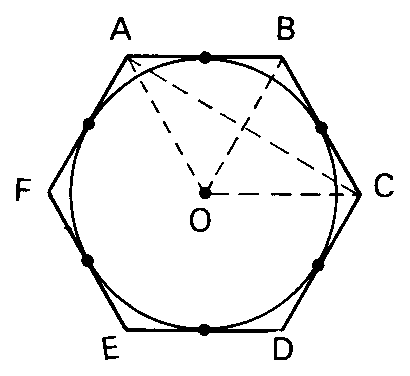
In the regular hexagon $ABCDEF$ in the figure, the side measures 5 cm. Calculate: a) apothem; b) the radius of the inscribed circle; c) the diagonal $\overline{AC}$.
Ver resposta
a) $\dfrac{5\sqrt{3}}{2}$ cm · b) $\dfrac{5\sqrt{3}}{2}$ cm · c) $5\sqrt{3}$ cm
Determine the ratio between the perimeter of the square inscribed in a circle of radius $R$ and the perimeter of the square circumscribed by that same circle.
Ver resposta
$\dfrac{\sqrt{2}}{2}$
Determine the relationship between the radii of two circles, knowing that the first is inscribed with equilateral triangle and the second is inscribed with a square, and that the perimeters of the triangle and the square are equal.
Ver resposta
$\dfrac{4\sqrt{6}}{9}$
Determine the ratio between the apothem of the square and the apothem of a regular hexagon, inscribed in a circle of radius $R$.
Ver resposta
$\dfrac{\sqrt{6}}{3}$
Given the radius $R$ of a circle, calculate the side and apothem of the inscribed regular octagon.
Ver resposta
Side $R\sqrt{2 - \sqrt{2}}$; apothem $\dfrac{R\sqrt{2 + \sqrt{2}}}{2}$
What is the ratio between the perimeter of a equilateral triangle with height equal to the radius of a circle and the perimeter of the equilateral triangle inscribed in that circle?
Ver resposta
$\dfrac{2}{3}$
Calculate the measurement of the segment $\overline{AV}$ of isosceles triangle $BCA$, circumscribed to a circle with unit radius, knowing that the diameter of the circle is equal to the largest segment of the golden section of the height of the triangle $BCA$, with $V$ being the midpoint of the height $\overline{AM}$ relative to the base.
Ver resposta
$\dfrac{1 + \sqrt{5}}{2}$
If the radius of a circle measures 2 m, determine the side $\ell$ of the regular decagon inscribed in it. (Use the isosceles triangles in the figure and the internal angle bisector theorem.)
Ver resposta
$(\sqrt{5} - 1)$ m
Derive the formula that gives the side of the regular decagon inscribed in a circle of radius $R$.
Ver resposta
See the side of the regular decagon, in theory.
Using the result from the previous problem, determine $\operatorname{sen}18°$.
Ver resposta
$\operatorname{sen}18° = \dfrac{\sqrt{5} - 1}{4}$. Note that the apothem of the regular decagon, the radius $R$ of the circumscribed one and half of the side of the decagon form a right-angled triangle with an acute angle of 18°.
Knowing that the side of the regular pentagon inscribed in a circle is the hypotenuse of a right-angled triangle whose legs are the sides of the regular hexagon and the regular decagon inscribed in the same circle, determine the side of the regular pentagon inscribed in a circle of radius $R$.
Ver resposta
See the side of the regular pentagon, in theory.
Using the result from the previous problem, determine $\operatorname{sen}36°$.
Ver resposta
$\operatorname{sen}36° = \dfrac{\sqrt{10 - 2\sqrt{5}}}{4}$. Note that $a_5$, $\dfrac{\ell_5}{2}$ and $R$ form a right triangle with an angle of 36°.
Determine $\cos 36°$.
See the resolution of the book
Consider a regular decagon inscribed in a circle of radius $R$. The central angle opposite $\ell_{10}$ measures 36°. Applying the law of cosines:
$$\ell_{10}^2 = R^2 + R^2 - 2R \cdot R\cos 36° \;\Rightarrow\; \left(\frac{\sqrt{5} - 1}{2}R\right)^2 = 2R^2 - 2R^2\cos 36°$$$$\Rightarrow\; \frac{6 - 2\sqrt{5}}{4} = 2 - 2\cos 36° \;\Rightarrow\; 4\cos 36° = \sqrt{5} + 1 \;\Rightarrow\; \cos 36° = \frac{\sqrt{5} + 1}{4}.$$Ver resposta
$\cos 36° = \dfrac{\sqrt{5} + 1}{4}$
Knowing that $\operatorname{sen}(90° - \alpha) = \cos\alpha$, determine: a) $\cos 72°$; b) $\cos 54°$; c) $\operatorname{sen}54°$.
Ver resposta
a) $\cos 72° = \dfrac{\sqrt{5} - 1}{4}$ · b) $\cos 54° = \dfrac{\sqrt{10 - 2\sqrt{5}}}{4}$ · c) $\operatorname{sen}54° = \dfrac{\sqrt{5} + 1}{4}$
Determine: a) $\operatorname{sen}72°$; b) $\cos 18°$.
Ver resposta
a) $\operatorname{sen}72° = \dfrac{\sqrt{2\sqrt{5} + 10}}{4}$ · b) $\cos 18° = \dfrac{\sqrt{2\sqrt{5} + 10}}{4}$ (use the law of sines, $\ell_5$ and the result of the previous problem)
Using the law of cosines, determine the side of the regular octagon inscribed in a circle of radius $R$.
Ver resposta
$\ell = R\sqrt{2 - \sqrt{2}}$ (central angle opposite $\ell_8$ measures 45°)
Use the answer to the previous problem and determine the radius of the circle circumscribed by a regular octagon with sides $\ell$.
Ver resposta
$R = \dfrac{\ell}{2}\sqrt{4 + 2\sqrt{2}}$
Determine the measurements of the diagonals of a regular octagon with one side $\ell$.
Ver resposta
$\ell\sqrt{4 + 2\sqrt{2}}$; $\ell(\sqrt{2} + 1)$; $\ell\sqrt{2 + \sqrt{2}}$
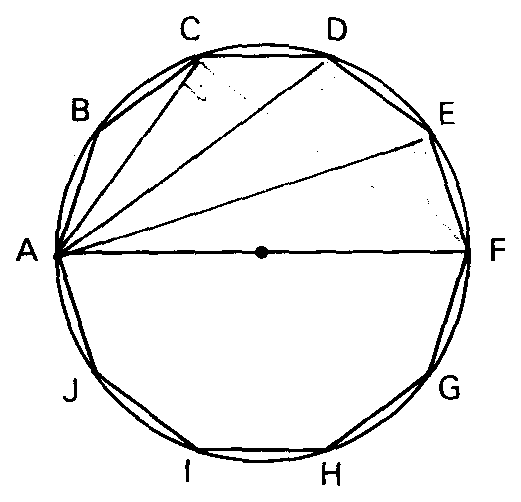
In the figure, we have a regular decagon with one side $\ell$. Determine: a) the radius of the circumscribed circle; b) the diagonal $\overline{AE}$; c) the diagonal $\overline{AC}$; d) the diagonal $\overline{AD}$.
Ver resposta
a) $R = \dfrac{\ell}{2}(\sqrt{5} + 1)$ · b) $AE = \ell\sqrt{5 + 2\sqrt{5}}$ · c) $AC = \ell_5 = \dfrac{\ell}{2}\sqrt{10 + 2\sqrt{5}}$ · d) $AD = \dfrac{\ell}{2}\sqrt{14 + 6\sqrt{5}}$
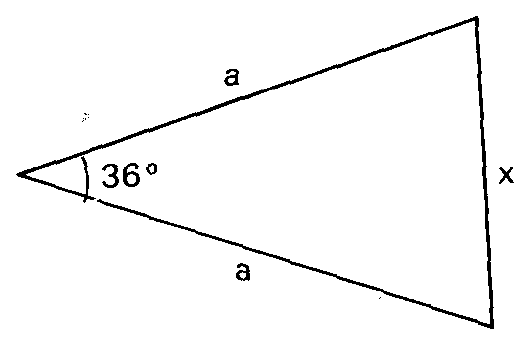
In the triangle in the figure, determine $x$ as a function of $a$.
Ver resposta
$x = \dfrac{a}{2}(\sqrt{5} - 1)$
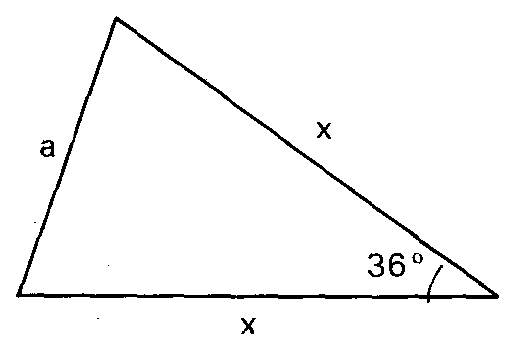
In the triangle in the figure, determine $x$ as a function of $a$.
Ver resposta
$x = \dfrac{a}{2}(\sqrt{5} + 1)$
Determine the diagonal of a regular pentagon with sides $\ell$.
Ver resposta
$d = \dfrac{\ell}{2}(\sqrt{5} + 1)$ (use the previous problem)
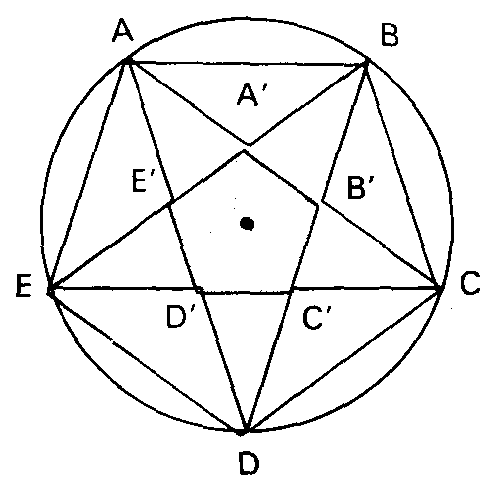
In the figure we have a regular pentagon with sides $\ell$. a) Show that the shaded pentagon is regular. b) Determine the side of the shaded pentagon.
Ver resposta
a) The triangles $A'AB$, $B'BC$, $C'CD$, $D'DE$ and $E'EA$ are congruent and isosceles with bases $\overline{AB}$, …, $\overline{EA}$; therefore $\hat A' = \hat B' = \ldots = \hat E'$ and, by difference, $A'B' = B'C' = \ldots = E'A'$: the pentagon $A'B'C'D'E'$ is regular. · b) $\dfrac{\ell}{2}(3 - \sqrt{5})$ (apply problem 728 twice)