
Euler's Eyes
2024-07-12
Stewart Relationship
In previous posts we talked about ptheorems for any triangles. The Stewart Relation, also known as Stewart’s Theorem, is an important formula in geometry that relates the lengths of the sides of a triangle to the length of a cevian. A cevian is a line segment that starts from a vertex of a triangle and meets the opposite side.
This relationship is useful for solving problems involving determining the lengths of segments within a triangle, such as medians, bisectors, and heights.
History
The Stewart Relation, also known as Stewart’s Theorem, was discovered by Scottish mathematician Matthew Stewart. Born in 1717, Stewart made significant contributions to geometry and mathematics in general. He studied at the University of Glasgow and the University of Edinburgh, where he was influenced by renowned mathematicians such as Robert Simson and Colin Maclaurin.
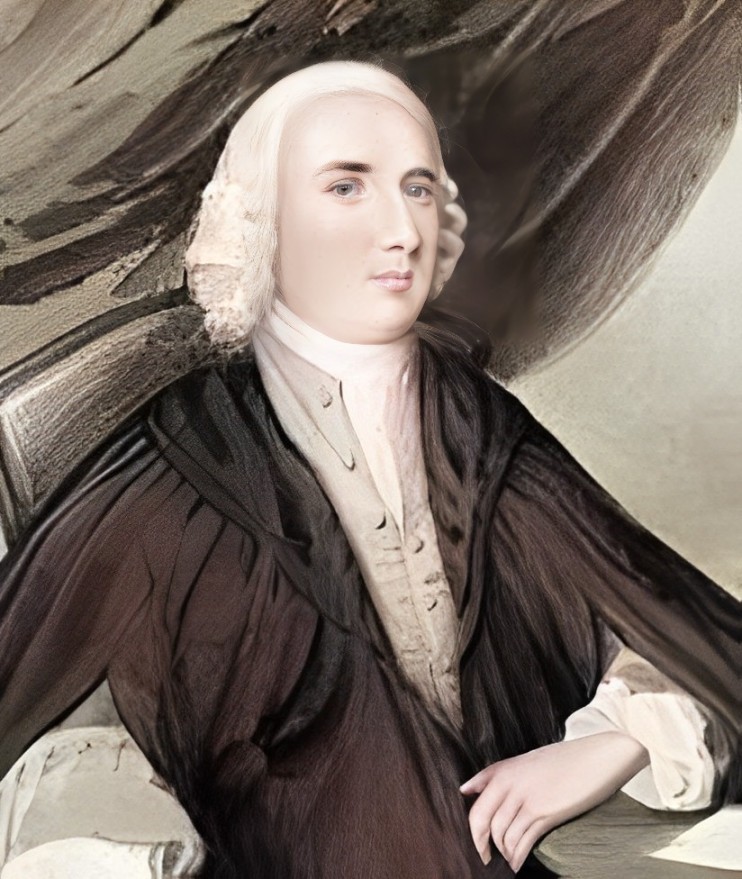
Stewart’s Theorem relates the lengths of the sides of a triangle to the length of a cevian, which is a straight line segment that goes from a vertex of the triangle to any point on the opposite side. The theorem formula is useful for solving problems in plane geometry and can be proved using the law of cosines or the Pythagorean theorem.
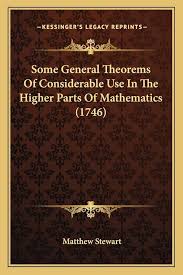
Matthew Stewart published the theorem in 1746 in his work “Some General Theorems of Considerable Use in the Higher Parts of Mathematics”. In addition to Stewart’s Theorem, he also worked on problems related to the motion of planets and the distance between the Sun and Earth.
Applications
The Stewart Relation is a mathematical formula that relates the lengths of the sides of a triangle to the length of a cevian (a straight line segment that goes from a vertex to any point on the opposite side). Although it is a powerful tool in geometry, its applications in everyday life may not be immediately obvious. However, here are some practical ways this relationship can be useful:
-
Architecture and Engineering: When building structures, the Stewart Ratio can help calculate lengths and angles of structural components, ensuring that everything fits together correctly and that the structure is stable.

-
Graphic Design and Animation: In graphic design, especially in animation and 3D modeling, understanding the relationships between different parts of a figure can be crucial to creating accurate and realistic models.

-
Navigation and Cartography: The Stewart Relation can be used in navigation calculations to determine distances and positions on maps, especially when working with triangulation.

-
Robotics: In robotics, precision in movements and construction of components is essential. The Stewart Relation can help calculate the precise movements of robotic arms and other mechanisms.

-
Astronomy: In astronomy, triangulation is often used to measure distances between stars and other celestial bodies. The Stewart Ratio can be a useful tool in these calculations.

These are just some of the many practical applications of the Stewart Relation. It is a versatile tool that can be applied in several areas that require precision and geometric calculations.
Importance
The Stewart Relation is a powerful formula in plane geometry that relates the lengths of the sides of a triangle to the length of a cevian, which is a straight line segment that starts from a vertex of the triangle and intersects the opposite side. Here are some practical applications of this relationship:
-
Calculating the Median: The Stewart Relation can be used to find the length of the median of a triangle, which is the cevian that starts from a vertex and divides the opposite side into two equal segments.
-
Calculation of the Internal Bisector: Another application is to determine the length of the internal bisector of a triangle, which is the angle that divides an angle of the triangle into two equal angles.
-
Advanced Geometry Problems: The relationship is also useful in more complex geometry problems, such as finding the radius of a small circle that is tangent to three other circles within a larger circle.
These applications show how the Stewart Relation is a versatile and essential tool for solving various geometric problems. If you want to see practical and detailed examples, there are several educational videos available that explain step by step how to apply this relationship in different contexts.
Calculation of the medians of a triangle
Let the sides be $a$, $b$ and $c$ and their respective medians $m_a$, $m_b$ and $m_c$. We consider two triangles, one with an obtuse angle $\hat{D}$ $ADC$ and another triangle $ADB$ with an acute angle $\hat{D}$, as shown in the figure:
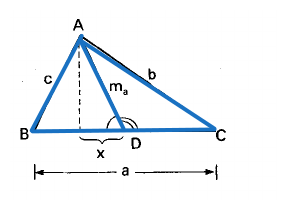
When using the metric relationships from the previous post we have:
As a consequence:
Median of a triangle
$$m_a = \frac{1}{2}\sqrt{2(b^2+c^2) - a^2}$$Similarly
$$m_b = \frac{1}{2}\sqrt{2(a^2+c^2) - b^2}$$$$m_c = \frac{1}{2}\sqrt{2(a^2+b^2) - c^2}$$
Calculation of the heights of a triangle
Let the sides be $a$, $b$ r $c$ of the triangle $ABC$, we define the heights $h_a$, $h_b$ and $h_c$.
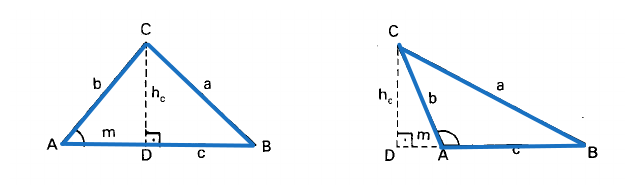
From the triangle $ADC$ we have that $h^2_c = b^2 - m^2$ (1).
From the metric relation in the previous post we have that $a^2=b^2 + c^2 \pm 2mc$, which rearranging and isolating $m$ we have:
$$m=\frac{b^2 + c^2 - a^2}{\pm 2c}\quad (2)$$From (2) to (1) we have:
$$h^2_c = b^2 - \left(\frac{b^2 + c^2 - a^2}{\pm 2c}\right)^2 = \frac{4b^2c^2 - (b ^2+c^2-a^2)^2}{4c^2}$$$$4c^2h^2_c = 4b^2c^2 - (b^2+c^2-a^2)^2$$To make things easier, let’s break down equation (3). Initially $2p$ is the perimeter and will be used to add the sides of the triangle:
$$2p = a+b+c$$For other terms:
With this, we have (3):
$$h_c = \frac{2}{c} \sqrt{p(p-a) (p-b) (p-c)}$$Similarly
$$h_a = \frac{2}{a} \sqrt{p(p-a) (p-b) (p-c)}$$$$h_b = \frac{2}{b} \sqrt{p(p-a) (p-b) (p-c)}$$
Stewart Ratio
Let the triangle $ABC$ and $D$ be a point on the side $\overline{AB}$, as in the following figure:
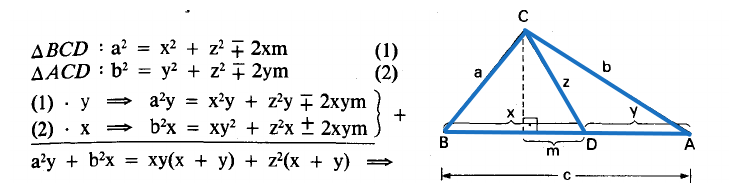
The formula for Stewart’s Theorem is given by:
$$a^2y + b^2x = c(z^2 + xy)$$on what:
- $a$, $b$ and $c$ are the lengths of the sides of the triangle,
- $z$ is the length of the cevian,
- $x$ and $y$ are the segments into which the cevian divides the opposite side.
Calculating the internal bisectors of a triangle
In a triangle $ABC$, let the sides be $a$, $b$ and $c$ and their respective internal bisectors $s_a$, $s_b$ and $s_c$.
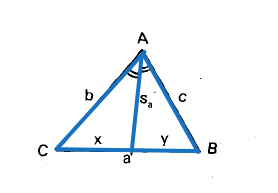
Note that $x+y=a$. Let us take the bisector $s_a$ and use the similarity of triangles to obtain:
$$\frac{x}{b} = \frac{y}{c}$$$$\frac{\overbrace{x+y}^{a}}{b+c} = \frac{x}{b} = \frac{y}{c}$$
With this, we obtain:
$$x = \frac{ab}{b+c}$$$$y = \frac{ac}{b+c}$$
When using Stewart’s theorem in triangle $ABC$.
$$b^2y + c^2x - s^2_a ~.~a = x~.~y~.~a$$When using $x$ and $y$ in the equation above, we obtain:
$$b^2\frac{\cancel{a}c}{b+c} + c^2\frac{\cancel{a}b}{b+c} - s^2_a ~.~\cancel{a } = \frac{ab}{b+c}~.~\frac{ac}{b+c}~.~\cancel{a}$$We multiply both sides of the equation by $(b+c)^2$:
Therefore
Internal bisector of a triangle
$$s_a = \frac{2}{b+c}\sqrt{bcp (p-a)}$$Similarly
$$s_b = \frac{2}{a+c}\sqrt{acp (p-b)}$$$$s_c = \frac{2}{a+b}\sqrt{abp (p-c)}$$
Solved exercises
- For circles $\lambda(O, 3 )$, and internal circles $\lambda_1(O_1, 2 )$, $\lambda_2(O_2, 1 )$ and $\lambda_3(O_3, x )$.
Calculate the radius $x$ in the figure.
Resolution:
In the triangle $O_1 O_2 O_3$ we have:
$$\overline{O_1 O_2} = 3$$$$\overline{O_1 O_3} = 2+x$$
$$\overline{O_2 O_3} = 1+x$$
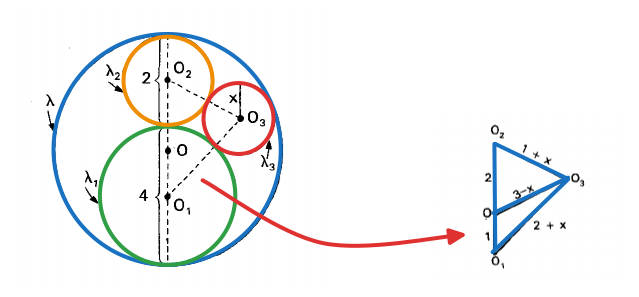 $$\overline{O O_1} = 1$$
$$\overline{O O_2} = 2$$
$$\overline{O O_3} = 3-x$$
When using the Stewart relation we have:
$$(1+x)^2 ~.~1 + (2+x)^2 ~.~2 - (3-x)^2 ~.~3 = 1~.~2~.~3$$$$1+x^2+2x + (4+x^2+4x) ~.~2 - (9+x^2-6x) ~.~3 = 6$$
$$1+x^2+2x + 8+2x^2+8x - 27-3x^2+18x = 6$$
$$28x = 24$$
$$x = \frac{6}{7}$$
Here a small contribution was made to Stewart’s relations, wait for the next posts.