
Euler's Eyes
2024-06-28
Introduction to Circumference
In previous posts we talked about Polygons. Now, let’s talk about Circumference. The circle, one of the most perfect and fundamental shapes in geometry, has fascinated mathematicians throughout history. The quest to understand its nature and properties has led to significant discoveries that have shaped not only the field of mathematics but also the way we view the world.

History
The relationship between the diameter and length of a circle, known as π (pi), is a constant that has intrigued mathematicians for centuries. The search for this constant has led to significant advances in mathematics and understanding of the physical universe.
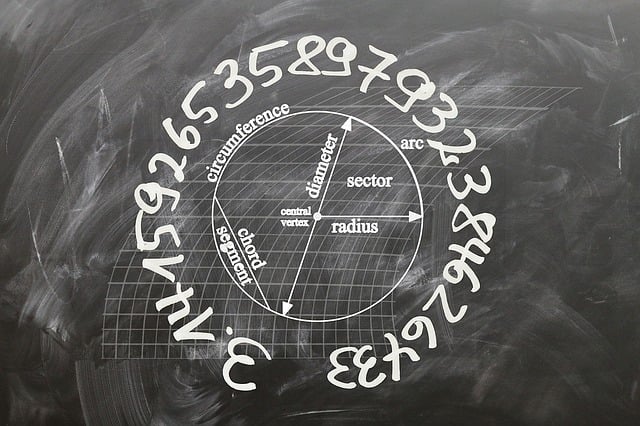
One of the most notable names on this journey is Archimedes of Syracuse. In the 3rd century BC, Archimedes made fundamental contributions to geometry and physics, including calculating π with unprecedented precision for the time. He used geometric methods to approximate the value of π, establishing a legacy that endures to this day.

Another mathematician who played a crucial role in the history of the circle was René Descartes, who in the 17th century developed the Cartesian coordinate system, revolutionizing the way geometric shapes are represented and studied. The Cartesian plane, with its x and y axes, has become an indispensable tool for locating points and representing geometric figures, including the circumference.

The story of the circle is also the story of how mathematics developed as a universal language for describing the natural world. From the ancient Greeks to modern mathematicians, circumference has been a field of study that challenges and inspires. She is a perfect example of how a simple concept can lead to profound discoveries and a greater understanding of the universe in which we live.
Basic Settings
Below we define some fundamental terms for working with circles.
Definition: (Circumference) is a set of points on a plane whose distance to a given point on that plane is equal to a given (non-zero or non-zero) distance. The given point is the center and the given distance is the radius of the circle.
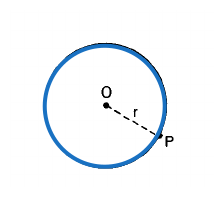
Formal definition: (Circumference) Let there be a plane $\alpha$, a point $O$ of $\alpha$ and a distance $r$. The circumference is given by:
$$\lambda (O,r) = \\{P \in \alpha, ~\text{ such that } d_{P,O}=r\\}$$where $d_{P,O}$ is the distance from point $P$ to point $O$.
Center
Definition (Center): is a point that is the same distance from any point on the circle.

Radius
Definition (Radius): is any straight segment that starts from the center to the circumference.

Rope
Definition (Rope): is any straight segment that has two ends on a circle.

Diameter
Definition (Diameter): is a chord that passes through the center of the circle. It is worth remembering that it is the largest chord in the circle. This chord is equal to twice the radius.
$$D = 2R$$

Circumference Arc and semicircle
Let $\lambda$ be a circle with center $O$ and $A$ and $B$ be two points of $\lambda$ that are not ends of a diameter.
Minor arc: $\stackrel{\frown}{AB}\downarrow$ is the union of the sets of points $A$, $B$ and all points of $\lambda$ that are inside the angle $A\hat{O}B$
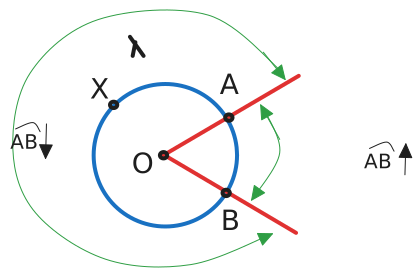
Major arc: $\stackrel{\frown}{AB}\uparrow$ is the union of the sets of points $A$, $B$ and all points of $\lambda$ that are outside the angle $A\hat{O}B$
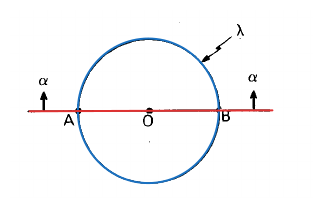
Semicircle: $\stackrel{\frown}{AB}\frac{1}{2}$ is the union of the sets of points $A$, $B$ and all points of $\lambda$ which are not even in the same half-plane as those determined by the straight line $\overleftrightarrow{AB}$
Considerations
The circumference is not just a geometric figure. It is a symbol of the incessant pursuit of human knowledge and our ability to use mathematics to unravel the mysteries of the cosmos. The story of the mathematicians who explored the circle is a source of inspiration for all who value science, innovation and the search for truth. Here a small contribution was made to circumference, wait for the next posts.