
Euler's Eyes
2024-07-03
Arches Properties
In previous posts we talked about circumscribable segments. Now, we talk about properties of circular arcs.
An arc of a circle is a portion of a circle bounded by two points. The circumference, in turn, is the set of all points equidistant from a central point in a plane. One of the properties is the congruence of arcs. Two arcs are congruent (that is, they have the same measure) if they subtend congruent central angles. This is useful, for example, in constructing regular polygons inscribed in a circle, where all sides and angles are equal.
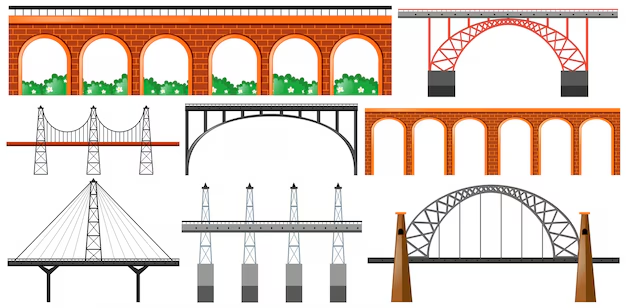
The properties of arcs are applied to geometry problems, such as finding the area of circular sectors (a “slice” of a circle) or the length of an arc. They are also essential for understanding more advanced concepts, such as trigonometry, which studies the relationships between the sides and angles of triangles.

Understanding these properties not only enriches mathematical knowledge, but also opens doors to practical applications that go far beyond the classroom, influencing the way we interact with the world around us.
History
Circumferential arcs, one of the most fundamental figures in geometry, have been studied by mathematicians throughout history, each contributing to our current understanding of this perfect and essential shape.
One of the first mathematicians to study in depth the properties of arcs was Eudoxus of Cnidus, a Greek philosopher, astronomer and mathematician from the 4th century BC. Eudoxus is known for his contributions to the theory of proportions and for his exhaustion method, a precursor to integral calculus. .
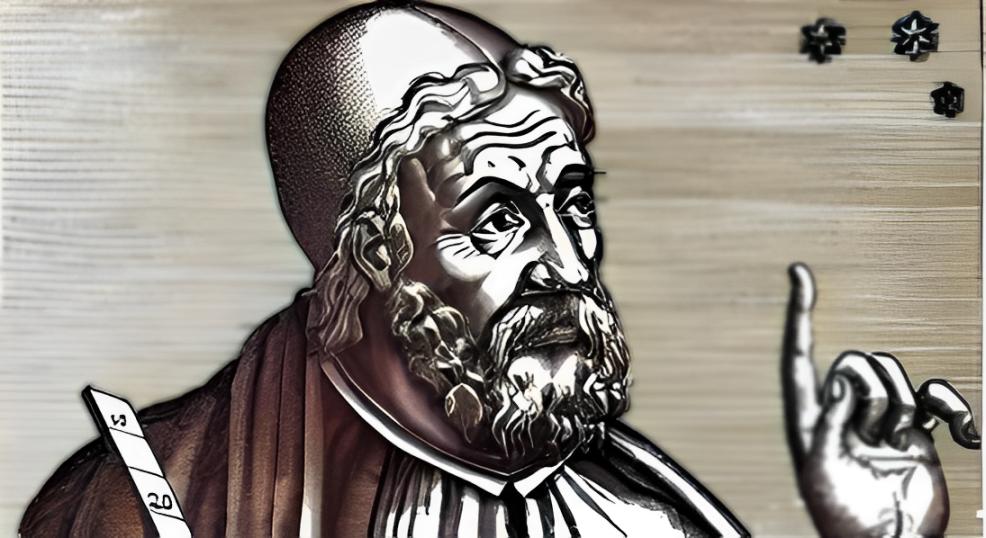
Moving forward in time, we reach the era of great mathematicians such as Euclid and Archimedes. Euclid, often called the “father of geometry,” wrote the “Elements,” a work that served as the primary mathematics textbook for more than 2,000 years. Archimedes, in turn, used circumference arcs to calculate areas and volumes, approaching what we know today as integral calculus.
| Euclides | Archimedes |
|---|---|

|

|
In the Renaissance, mathematicians such as Leonardo da Vinci and Albrecht Dürer explored the properties of arcs in their artistic and scientific works, demonstrating the deep connection between art and mathematics. Later, with the advent of calculus in the 17th century, figures such as Isaac Newton and Gottfried Wilhelm Leibniz further expanded our understanding of arcs, applying them to their formulations of physical laws and planetary motion.
| Leonard da Vinci | Albrecht Dürer |
|---|---|

|

|
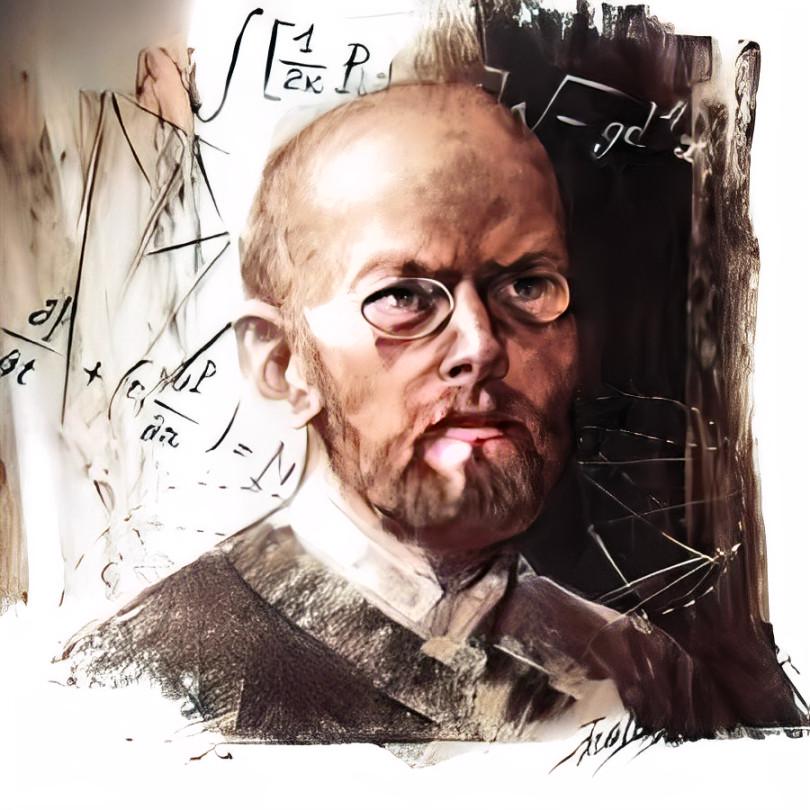
In the 19th century, Bernhard Riemann, a German mathematician, introduced the concept of integration along circular arcs, an advance that proved fundamental to the development of complex analysis. And in the 20th century, mathematicians such as David Hilbert and Henri Poincaré explored the topological properties of arcs, paving the way for the modern theory of metric and topological spaces.
| David Hilbert | Henri Poincaré |
|---|---|
|

|
Congruent arcs
Initially, before talking about congruent arcs, we define congruent circles.
Congruent circles: two circles are congruent when they have equal radii.
With this, we define congruent arcs:
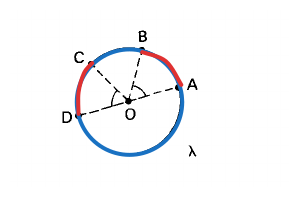
Congruent arcs: two arcs $\stackrel{\frown}{AB}$ and $\stackrel{\frown}{CD}$ of a circle with center $O$ are congruent if, and only if, the angles $A\hat{O}B$ and $C\hat{O}D$ are congruent. In symbols:
$$\stackrel{\frown}{AB} \equiv \stackrel{\frown}{CD}\quad \Leftrightarrow \quad A\hat{O}B \equiv C\hat{O}D$$
Adding arcs
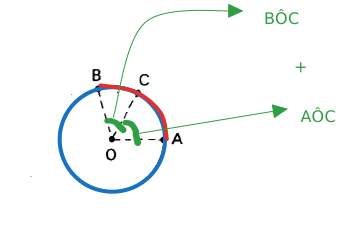
Addition of arcs: in a circle with center $O$, the arc $\stackrel{\frown}{AB}$ is the sum of the arcs $\stackrel{\frown}{AC}$ and $\ stackrel{\frown}{CB}$ if and only if angle $A\hat{O}B$ is the sum of angles $A\hat{O}C$ and $C\hat{O}B$ .
$$\stackrel{\frown}{AB} = \stackrel{\frown}{AC}+\stackrel{\frown}{CB}\quad \Leftrightarrow \quad A\hat{O}B = A\hat{ O}C + C\hat{O}B$$
Arc inequality
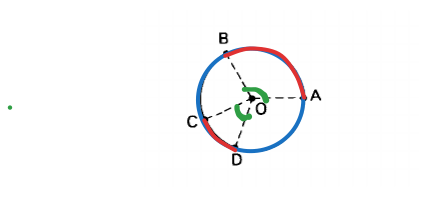
Inequality of arcs: in a circle with center $O$, the arc $\stackrel{\frown}{AB}$ is greater than the arc $\stackrel{\frown}{CD}$ if, and only if, angle $A\hat{O}B$ is greater than angles $C\hat{O}D$.
$$\stackrel{\frown}{AB} > \stackrel{\frown}{CD}\quad \Leftrightarrow \quad A\hat{O}B > C\hat{O}D$$
Central angle
Central angle relative to a circle: is the angle that has the vertex at the center of the circle.
Definition: If in a circle with center $O$ a central angle determines an arc $\stackrel{\frown}{AB}$, we say that:
$\stackrel{\frown}{AB}$ is the arc corresponding to the central angle $A\hat{O}B$, or
$\stackrel{\frown}{AB}$ is the arc subtended by $A\hat{O}B$.
Measurement of the central angle and arcs
The congruence, addition and inequality of arcs were established in correspondence with the congruence, addition and inequality of the corresponding central angles.
Let the arc be defined on the circumference by a unitary central angle. The measure of an arc of a circle is equal to the measure of the corresponding central angle.
Example of measuring central angle and arc
In a circle with center $O$ next to:
- if $m(A\hat{O}B) = 60^\circ$, then $m(\stackrel{\frown}{AB})=60^\circ$ and vice versa $$A\hat{O}B = 60^\circ \quad \Leftrightarrow \quad \stackrel{\frown}{AB}=60^\circ $$
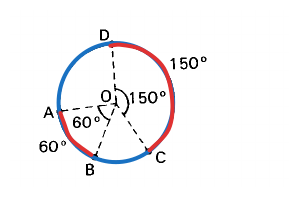
- if $m(C\hat{O}D) = 150^\circ$, then $m(\stackrel{\frown}{AB})=150^\circ$ and vice versa $$C\hat{O}D = 150^\circ \quad \Leftrightarrow \quad \stackrel{\frown}{CD}=150^\circ $$
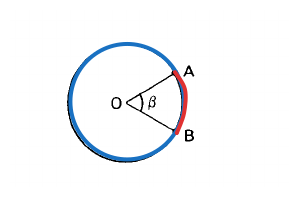
For simplicity, instead of writing the arc measure as $m(\stackrel{\frown}{AB})$, we will write it as simply the arc $\stackrel{\frown}{AB}$.
| Symbology | Geometric figure |
|---|---|
| $$\beta = \stackrel{\frown}{AB}$$ |
|
Solved exercises
- Show that if $\stackrel{\frown}{AB}$ and $\stackrel{\frown}{CD}$ are arcs of equal length on a circle, then the chords $\overline{AB}$ and $ \overline{CD}$ are congruent.
Resolution:
Let $O$ be the center of the circle and let the triangles be $AOB$ and $COD$. The sides of the triangles are equal.
In fact:
$$OA = OB = OC = OD = \text{radius}$$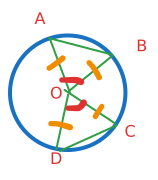
Furthermore, we have that the angles $A\hat{O}B$ and $C\hat{O}D$ are congruent, since from the statement the arcs $stackrel{\frown}{AB}$ and $stackrel{\frown }{CD}$ are congruent.
So, in the $LAL$ case (side angle side), the triangles are congruent.
Therefore
$$\overline{AB} \equiv \overline{CD}$$Mathematics is a universal language, and arcs of a circle are one of its purest expressions. By studying the works of mathematicians who discovered its properties, we not only learn about mathematics; we learn about the history of humanity and its tireless desire to understand the world around us. And so, the journey of the circumferential arcs continues, as infinite as the curve they form. Here a small contribution was made to arch properties, wait for the next posts.