
Euler's Eyes
2024-07-02
Circumscript segments
In previous posts we talked about positions relative to the circumference. Now, we talk about circumscriptive segments.
Geometry is a fascinating area of mathematics that studies the properties and relationships of points, lines, angles, surfaces and solids. Within this vast field lie circumscriptive segments, which play a crucial role in many aspects of geometry and beyond.
Circumscript segments refer to line segments that connect points on the circumference of a circle or other geometric figure. These segments are fundamental for understanding inscribed and circumscribed figures, which are figures drawn inside or outside another figure, respectively.

Circumscript segments also have practical applications, such as in engineering and architecture, where they are used to design structures and systems that require geometric precision. For example, the construction of bridges, the creation of mechanical parts, and the design of buildings often utilize principles of inscribed and circumscribed figures to ensure that structures are stable and aesthetically pleasing.
History
The mathematicians’ journey in discovering circumscribable quadrilaterals is a fascinating journey through the history of geometry. Since ancient times, humanity has explored the properties and relationships between geometric shapes, and circumscribable quadrilaterals are a notable example of this quest for knowledge.
Circumscriptible quadrilaterals, also known as tangential, are those that have an inscribed circle that touches all of their sides. This special property has been studied by many mathematicians over the centuries, and one of the most important theorems related to these figures is Pitot’s Theorem. This theorem states that a quadrilateral can be circumscribable if, and only if, the sum of the lengths of the opposite sides is equal.
The history of mathematicians who have contributed to our understanding of circumscribable quadrilaterals is rich and diverse. For example, Henri Pitot, an 18th-century French engineer, is known for discovering the theorem that bears his name, although the property was known to Chinese mathematicians long before him. Pitot’s contribution helped to establish a solid foundation for the later study of geometric figures and their inscribable and circumscribable properties.
Furthermore, the work of mathematicians such as Euler, who developed the Euler relation for quadrilaterals, and the ongoing efforts of modern mathematicians, show that the story of circumscribable quadrilaterals is one that continues to evolve.
The study of circumscribable quadrilaterals is not just a matter of historical or theoretical interest. For example, in architectural design, mechanical part development, and even the gaming industry, where understanding geometric properties can lead to more efficient and aesthetically pleasing solutions.
Tangent Segments
Tangent segments, straight lines that touch a curve at just one point without cutting it, are fundamental in geometry and have practical applications ranging from engineering to astronomy.
The origin of studies on tangents dates back to ancient civilizations, such as the Greek and Babylonian, which already knew theorems about the ratios of the sides of similar triangles. However, it was with Hellenistic mathematicians that the concept of tangent began to take a more concrete form. Euclid of Alexandria, for example, in his work “The Elements”, presented concepts that would be precursors of modern trigonometry, although represented through geometric shapes.
The title of “Father of Trigonometry” is often attributed to Hipparchus of Nicaea, who in the 2nd century BC, presented a treatise with around 12 volumes dealing with trigonometry. Hipparchus was also responsible for creating the first known trigonometric table, an essential tool for the advancement of mathematics and astronomy.
Moving forward in time, we arrive at Ptolemy, whose work “Syntaxis Mathematica” was one of the most influential of antiquity and included studies on the tangent, which supposedly arose from the need to calculate heights and distances. The tangent, as a trigonometric function, has developed over the centuries, with contributions from different cultures and civilizations.
In the Renaissance, mathematicians such as Regiomontanus treated trigonometry as a distinct mathematical discipline, and it was during this period that the tangent function began to be more clearly defined and used.
Today, tangent segments are studied not only in terms of their practical application, but also as part of the beauty and elegance of pure mathematics.
Theorem: If from a point $P$ we drive the segments $\overline{PA}$ and $\overline{PB}$ both tangent to a circle, with $A$ and $B$ on the circle, then
$$\overline{PA}\equiv \overline{PB}$$
Demonstration:
Let $O$ be the center of $\lambda$ and straight lines $\overline{PA}$ and $\overline{PB}$ tangent to the circumference as shown in the figure:
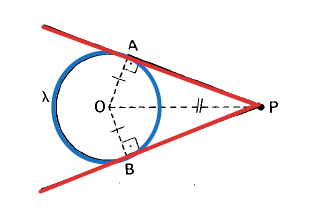
Note that we can use triangle congurency. The legs $\overline{OA}\equiv \overline{OB}$, with $\overline{OP}$ common side (hypotenuse). With this, we have that the triangles $PAO$ is congruent to the triangle $PBO$.
Therefore
$$\overline{PA} \equiv \overline{PB}$$.
$\blacksquare$
Circumscriptible Quadrilaterals
Circumscriptible quadrilaterals, also known as tangential quadrilaterals, are fascinating figures in the field of geometry. They have the unique property of having all their sides tangent to a single circle. This special feature not only makes them an interesting topic of study, but also reveals the beauty inherent in mathematical symmetry and harmony.
A quadrilateral is considered circumscriptible when it is possible to inscribe a circle in such a way that each side of the quadrilateral touches the circle at exactly one point. This property is both a necessary and sufficient condition for a quadrilateral to be classified as circumscribable.
A convex quadrilateral is circumscribed by a circle if, and only if, its four sides are tangent to the circle.
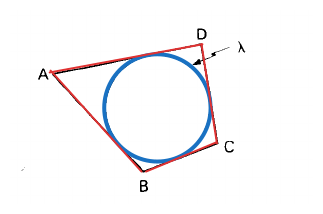
$ABCD$ is circumscribed to $\lambda$ or $\lambda$ is inscribed in $ABCD$.
Proposition 1: If a convex quadrilateral is circumscribed by a circle, the sum of two opposite sides is equal to the sum of the other two.
$ABCD$ circumscribed by $\lambda$, then
$$\overline{AB} + \overline{CD} = \overline{AD} + \overline{BC}$$
Demonstration:
Let $X$, $Y$, $Z$ and $T$ be the points of tangency of $\overline{AB}$, $\overline{BC}$, $\overline{CD}$ and $\overline{DA }$, respectively.
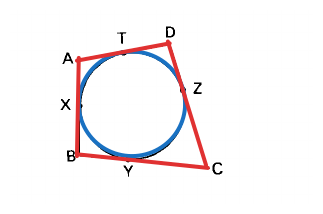
When we apply the tangent segment theorem previously proven:
Therefore,
$$\overline{AB} + \overline{CD} = \overline{AD} + \overline{BC}$$$\blacksquare$
Proposition 2: If in a convex quadrilateral the sum of two opposite sides is equal to the sum of the other two, then the quadrilateral is circumscribed by a circle.
$\overline{AB} + \overline{CD} = \overline{AD} + \overline{BC}$ then $ABCD$ is circumscribable to a circle
Demonstration:
Let $\lambda$ be the circumference tangent to the sides $\overline{AB}$, $\overline{BC}$ and $\overline{CD}$ of the quadrilateral.
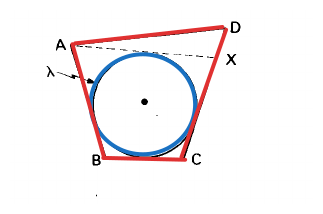
If $ABCD$ is not circumscribed by $\lambda$, there is $ABCX$ with $X$ on the line $\overleftrightarrow{CD}$ that is circumscribed by $\lambda$.
$ABCD$ circumscribed by $\lambda$, then
$$\overline{AB} + \overline{CD} = \overline{AD} + \overline{BC} \quad (1)$$By hypothesis we have
$$\overline{AB} + \overline{CD} = \overline{AD} + \overline{BC}$$which implies
From (1) and (2) we have that $\overline{AX} = \overline{AD} \pm \overline{XD}$, which is absurd in the triangle $ADX$.
Therefore $ABCD$ is circumscribable to a circle.
$\blacksquare$
Theorem: A necessary and sufficient condition for a convex quadrilateral to be circumscribed by a circle is for the sum of two opposite sides to be equal to the sum of the other two.
Demonstration:
Just use propositions 1 and 2.
$\blacksquare$
Solved exercises
- Determine the perimeter of the quadrilateral $ABCD$, circumscribable, as shown in the figure.
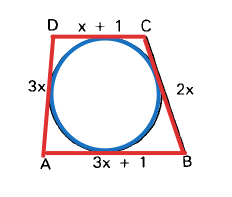
Resolution:
Let $ABCD$ be circumscribed by the theorem, we have that
$$\overline{AB} + \overline{CD} = \overline{AD} + \overline{BC}$$$$(3x+1) + (x+1) = 3x + 2x$$
$$x = 2$$
Now the perimeter is given by:
$$\text{perimeter} = (3x+1) + 2x + (x+1) + 3x$$$$\text{perimeter} = \underbrace{9x}_{9~.~2=18}+2$$
$$\text{perimeter} = 20$$
- Calculate the value of the radius $r$ of the circle inscribed in the rectangular trapezoid.
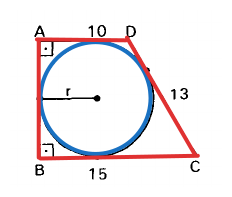
When we draw the line to the center of the circle, we obtain that $AB=2r$.
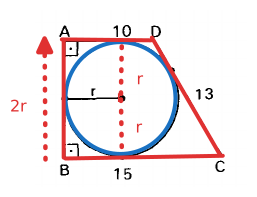
As $ABCD$ is circumscribed, by the theorem, we have
$$\overline{AB} + \overline{CD} = \overline{AD} + \overline{BC}$$$$2r + 13 = 10 + 15$$
$$2r = 12$$
$$r = 6$$
- The circumferences of the figure are externally tangent. If the distance between the centers is 28 cm and the difference between the radii is 8 cm, determine the radii
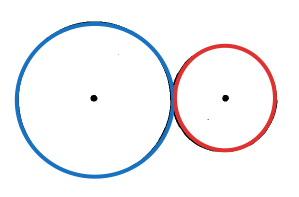
See from the figure that the distance between the centers is 28cm. As they are externally tangent circles, then:
$$d = r_1+r_2 = 28 \quad(1)$$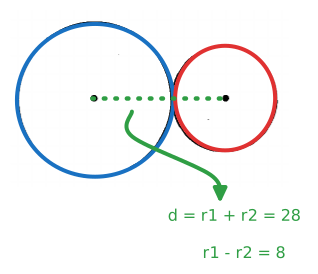
From the statement we have
$$r_1-r_2 = 8$$$$r_1 = 8+r_2\quad (2)$$
From (2) to (1) we have:
$$8 + r_2 + r_2 = 28$$$$2 r_2 = 20$$
$$r_2 = 10$$
Replacing in (2)
$$r_1 = 8+r_2 = 8 + 10$$$$r_1 = 18$$
Here a small contribution was made to positions relative to the circumference, wait for the next posts.